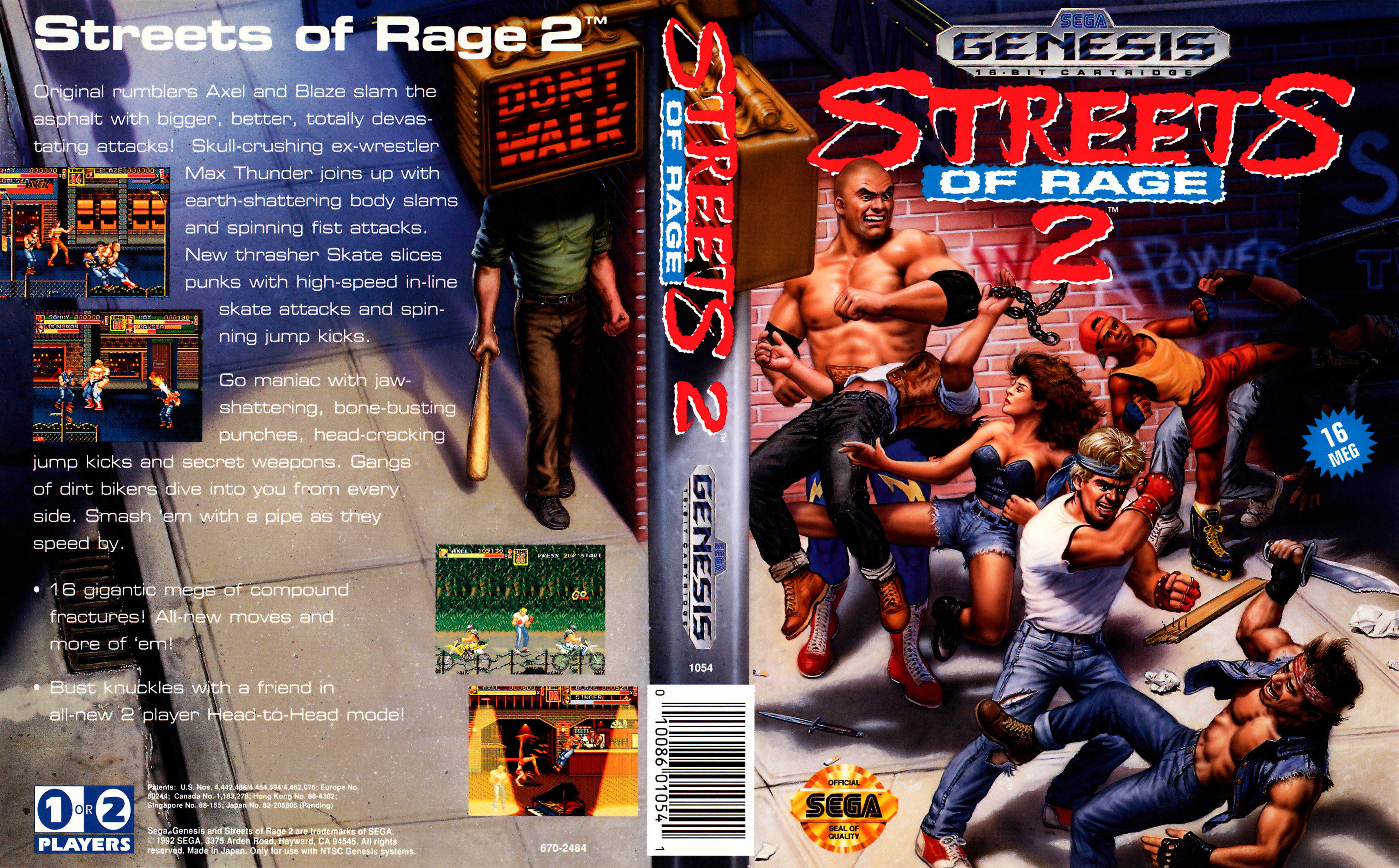
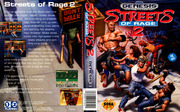
Streets of Rage 2 (Bare Knuckle II), Mega Drive cover - Sega, 1992
Streets of Rage 2 arrived in Japan in December 1992 carrying a soundtrack unlike
anything else in the 16-bit library. Where most Mega Drive composers treated the YM2612
FM synthesis chip as a tool for approximating rock or orchestral music, Koshiro treated
it as a club instrument - writing techno, house, and industrial tracks that did not
merely suggest those genres but genuinely inhabited them. The result is a score that
sounds as though it belongs in a 1992 European rave, not in a cartridge.
It matters because no one else was doing it. Game music in 1992 was broadly
functional - it accompanied and supported. Koshiro's SoR2 soundtrack was compositionally
autonomous: it worked whether or not anyone was playing the game. That distinction
is why the score has outlasted the hardware by thirty years.
A Composer Who Wrote His Own Tools
The standard Mega Drive sound drivers available to developers in the early 1990s
imposed an abstraction layer between composer and chip - convenient but limiting.
Koshiro rejected that abstraction. He built a custom composition sequencer in assembly
language, giving himself direct access to the YM2612's operator-level parameters:
ADSR envelopes, feedback routing, algorithm selection, and sub-frame timing precision.
"I was listening to techno and house music at clubs while making Streets of Rage 2.
I used to go out at night to study the music - the way it moved, the energy. I wanted
to bring exactly that into the game."
Yuzo Koshiro, GDC 2011 - "Memories of a Composer: Creating the Streets of Rage Soundtrack" (GDC Vault)
The custom sequencer also allowed Koshiro to compose at a granularity impossible through
standard tools. He could specify per-operator envelope timing in ways that produced the
characteristic punchy percussion and warm bass lines that separate SoR2 from every other
Mega Drive soundtrack of its era. The chip was not more capable - it was more precisely driven.
His sister Ayano Koshiro handled art direction and pixel art for the
game, making SoR2 an Ancient Corp family production at its core. The combination of Ayano's
visual sensibility and Yuzo's sonic one produced a coherence that later sequels struggled
to replicate. Full career context is in the People section.
The Groove That Drives You Forward
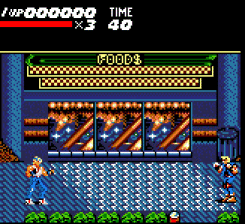
Stage 1 - the urban brawler setting that "Go Straight" was written to accompany
Streets of Rage 2 is a side-scrolling beat-em-up: the player moves left-to-right
clearing enemies across eight stages, each with a distinct setting and theme. The music
tracks are not background wallpaper. They are primary sensory input - often the loudest
and most insistent thing in the experience. Koshiro composed to the stage setting and
emotional tone rather than merely to the genre convention.
"Go Straight" (Stage 1) is a straight techno track with a driving 4/4 pulse, industrial
percussion, and an FM bass that loops and builds without ever resolving into sentimentality.
"Under Logic" (Stage 3 - the factory) sits closer to house: the chord progressions breathe,
there is harmonic warmth underneath the rhythmic grid. "Moon Beach" (Stage 4) is the
warmest track in the set - a late-night outdoor rave quality, something loose and euphoric
that contrasts with the precision of the earlier stages.
The boss tracks push toward industrial: harsher timbres, darker harmonic content, tempos
calibrated to increase tension. This mapping of genre to narrative moment is not accidental.
Koshiro structured the album like a DJ set - building, releasing, and escalating.
Stage 4 - the beach setting that "Moon Beach" scores with warm, late-night rave energy
Six Channels Against a Dance Floor
The Yamaha YM2612 provides six FM channels, each using four operators arranged in one of
eight possible algorithms that determine how modulators route into carriers. FM synthesis
creates sound through frequency modulation - a modulator operator shapes the timbre of a
carrier, and the ratio between their frequencies determines the harmonic content. At high
feedback settings this produces noise-adjacent timbres; at low settings, near-pure tones.
Koshiro's specific techniques in SoR2 include rapid ADSR cycling to simulate hi-hat
patterns and rhythmic gates, detuned operators producing chorus-like warmth on melodic
lines, high-feedback FM configurations for noise-adjacent percussion hits, and
triangle-approximation algorithms for sub-bass warmth. Multi-channel unison on lead
synthesizer lines creates impact out of proportion to channel count.
"With FM synthesis you can create almost any sound if you understand how the operators
interact. The YM2612 is actually very capable - most people just didn't know how to
push it."
Yuzo Koshiro, Red Bull Music Academy lecture (video ID: TAuAM75Pf5w)
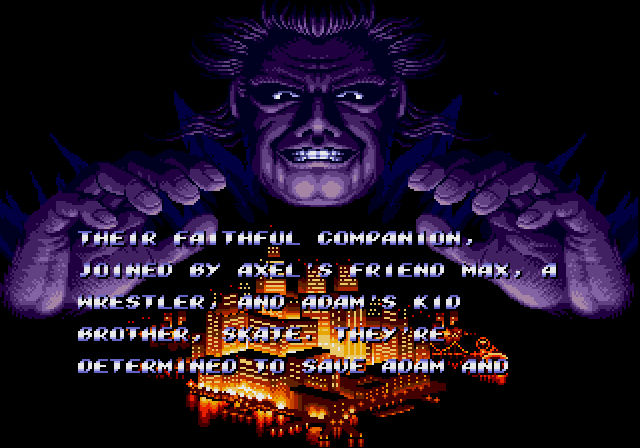
The title screen - the opening notes of the menu theme signal what the soundtrack is going to do
Critics Heard Something They Couldn't Quite Name
Contemporary reviews of SoR2 consistently cited the soundtrack as exceptional without
always having the vocabulary to explain why. Reviewers from publications including
Mean Machines Sega and Electronic Gaming Monthly noted that the music
felt adult and club-influenced - a description accurate enough but incomplete, because
the achievement was not just stylistic: it was technical and compositional.
The game's score contributed materially to its commercial and critical success.
SoR2 moved over two million units worldwide - strong numbers for a Mega Drive title
in 1993 - and its reputation improved steadily in the years after release as the
club music influences became more widely understood by an older audience.
The elevator stage - "Max Man" scores it with heavier percussion and darker harmonic content
The Benchmark That Won't Age
Streets of Rage 2's soundtrack accumulated a secondary life that most game music
never achieves. It is not merely remembered fondly - it is referenced by working musicians,
producers, and composers as a specific example of FM synthesis technique applied at the
highest level. The contemporary chiptune and demoscene communities treat it as an
aspirational benchmark: this is what the YM2612 can do.
The OST has been reissued and officially remixed. Digital Foundry's DF Retro series
documented the technical production in dedicated episodes. Streets of Rage 4
(2020, Dotemu/Lizardcube) was built partly as a tribute to the trilogy, and Koshiro's
return as a contributing composer was treated as a significant event by the developers
and the games press alike. A full career chronology including the SoR4 contribution
is in History; the full soundtrack catalogue is in
Catalogue; music samples are in Music.
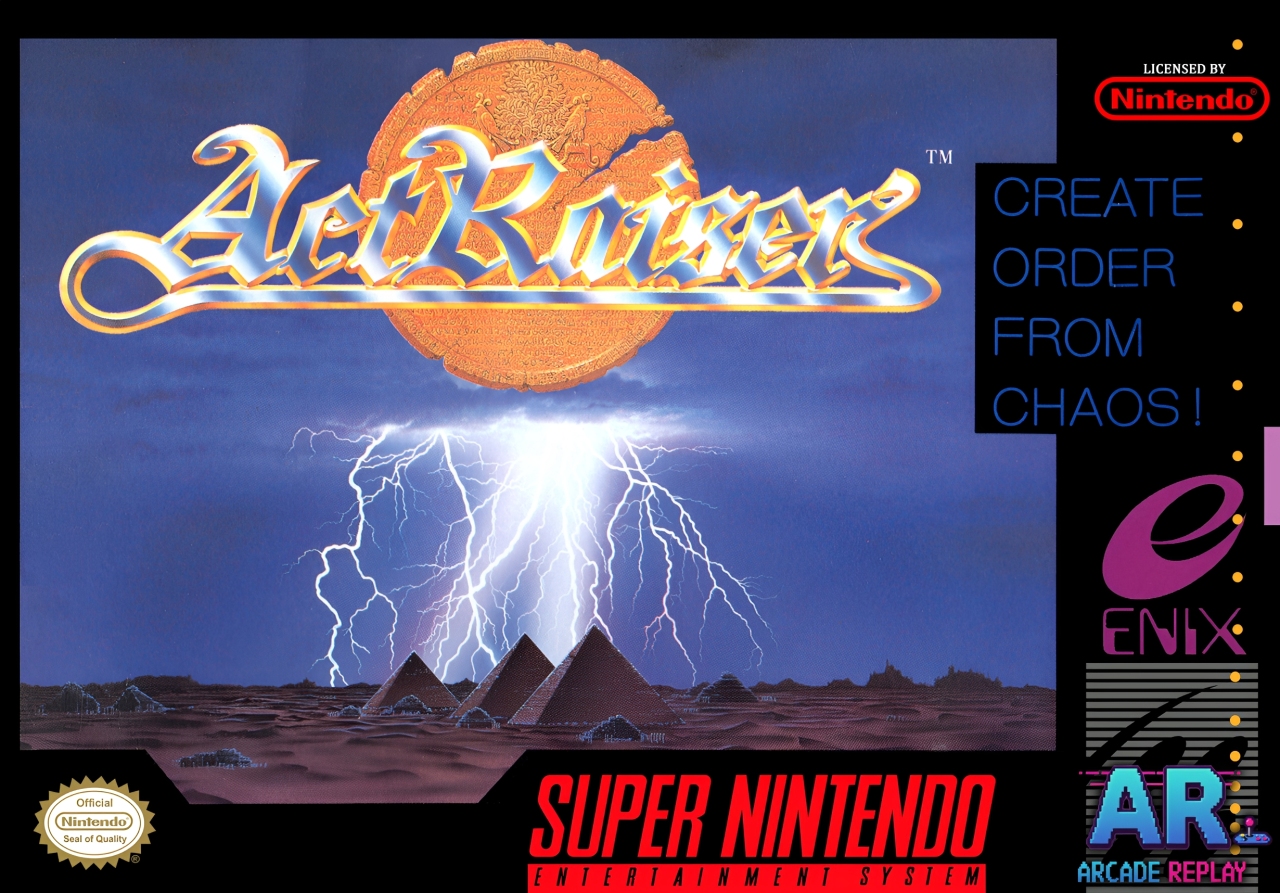
1990 · Super Nintendo Entertainment System · Quintet / Enix
ActRaiser
ActRaiser title screen, SNES - Quintet / Enix, 1990
ActRaiser arrived on the Super Nintendo in 1990 - one year before the console
reached North America - and immediately set an expectation for what the platform's
audio hardware could achieve. Developed by Quintet and published by Enix, the game
brought Yuzo Koshiro in as an external composer, giving him access to Nintendo's
SPC700 audio processor: a custom chip with eight independent channels and a small
amount of on-cartridge sample RAM.
What he wrote for it was not what anyone expected from a game composer whose previous
major work had been techno-inflected Mega Drive electronica. ActRaiser's score
is orchestral, cinematic, and sweeping - the music of gods and mythology rather than
neon-lit city streets. It proved, immediately and conclusively, that Koshiro's range
was not defined by a single platform or style.
Hired to Write God's Theme Music
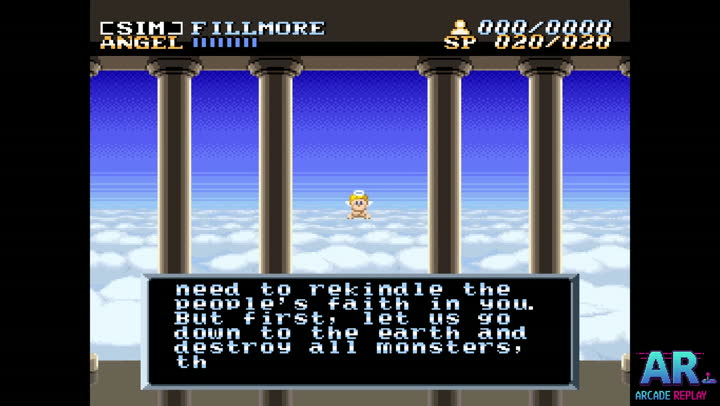
ActRaiser opening cinematic - the score opens with the grandeur befitting the game's god-game premise
The ActRaiser commission arrived at a pivotal moment. Koshiro had just co-founded
Ancient Corp with his sister Ayano in 1990 and was establishing
himself as an independent composer rather than a Falcom staff member. Quintet's concept -
a game in which the player acts as a deity rebuilding civilization - called for something
beyond functional game music. The premise demanded grandeur.
Working for the first time on the SPC700, Koshiro faced hardware he had not previously
used. The SPC700 is sample-based rather than FM-synthesis-based - its sound comes from
digitized audio played back through eight voice channels with hardware pitch-shifting and
envelope control. The challenge was composing music that sounded orchestrally full with
a limited set of samples and limited ROM to store them in.
"For ActRaiser I wanted to write music that felt like it belonged in a movie. The SNES
could do things the Mega Drive couldn't - the sample-based sound was closer to real
instruments. I tried to use that quality as fully as possible."
Yuzo Koshiro, Waypoint / Vice Games feature on Koshiro's career (2020)
Two Games Sharing One Score
ActRaiser's structural distinction is that it contains two completely different
game modes: action platformer stages where the player controls a warrior directly, and
god-game simulation sections where the player guides human civilization from above.
The music had to serve both modes - action and contemplation - without the score feeling
inconsistent.
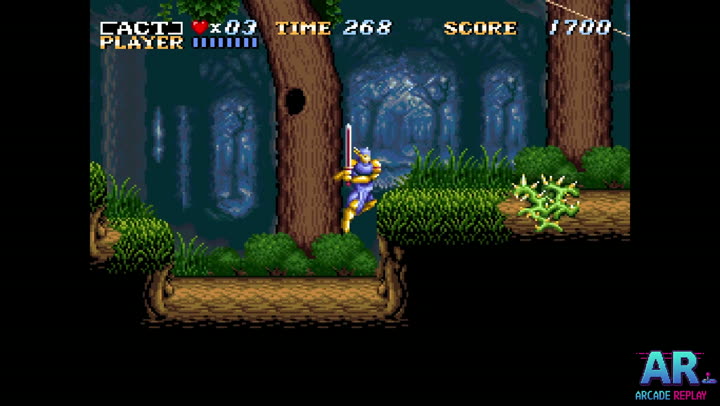
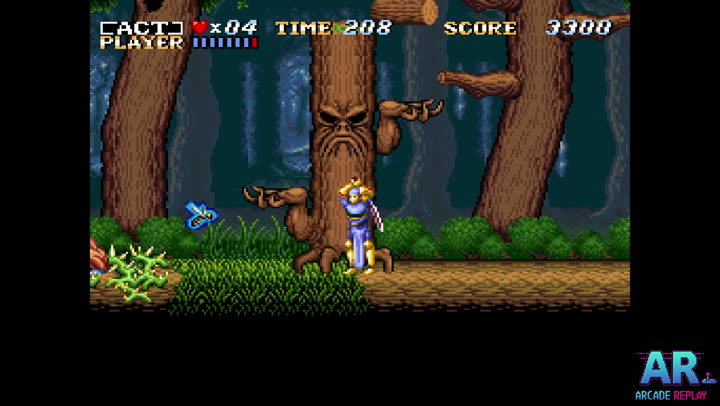
ActRaiser action stage - the score shifts from contemplative to driving for the platformer sections
Koshiro achieved this by writing from a unified thematic vocabulary while changing tempo
and density between modes. The simulation sections use slow, open themes with harmonic
breathing room - music that conveys timescale and grandeur. The action sections use
faster tempos and tighter rhythmic patterns, but the melodic material shares DNA with
the simulation themes.
The result is a score that feels cohesive across its full runtime despite serving
radically different gameplay contexts - a compositional problem that later games in
the god-game genre would continue to grapple with.
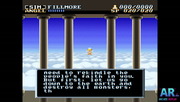
ActRaiser simulation mode - the contemplative score sections match the slow strategic pace
SPC700 at Its Fullest Reach
The SPC700's strength over FM synthesis chips is its proximity to acoustic instruments:
because it plays back digitized samples, it can reproduce strings, brass, and choir
that FM synthesis can only approximate. Its weakness is memory - 64 kilobytes of audio
RAM is extremely limited, requiring composers to make hard choices about which samples
to include at what quality.
Koshiro's solution was to use short, looped samples for sustained instruments and to
layer voices carefully to fill harmonic space without duplicating sample data. The string
arrangements in particular achieve a fullness that belies the hardware's constraints -
the impression of an orchestra with a handful of voices and minimal RAM.
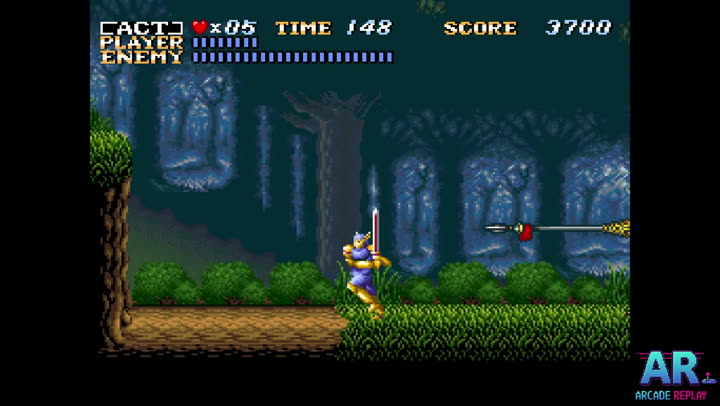
ActRaiser boss encounter - the score escalates with brass and percussion to match the confrontation
The Score That Raised the Bar for an Entire Platform
Contemporary reaction to ActRaiser's music was uniformly strong. Critics reviewing the
game consistently isolated the soundtrack as exceptional - unusual at a time when game
audio was rarely the focus of reviews. Publications including Nintendo Power
and Electronic Gaming Monthly specifically praised the orchestral quality.
More significant was the effect on developer expectations. Other SNES composers pointed
to ActRaiser as a demonstration of what was possible on the hardware. The game arrived
early enough in the console's lifecycle to shape subsequent SNES audio production -
it established a ceiling that others spent the rest of the platform's commercial life
trying to reach.
ActRaiser civilization scene - the game's narrative arc from desolation to settlement is scored throughout
What SNES Players Still Reach For
ActRaiser's score has remained a reference point for SNES audio documentation.
VGMdb lists the official OST album, and the music appears consistently in retrospectives
on the platform's hardware capabilities. When Square Enix released ActRaiser Renaissance
in 2021 - a remaster/sequel - the announcement generated immediate discussion about how
the original score would be treated. The updated arrangements were handled with care
for the source material, acknowledging the originals' standing.
For Koshiro personally, ActRaiser confirmed a compositional range that the Mega Drive
work alone would not have revealed. The simultaneous existence of the SoR2 soundtrack
and the ActRaiser soundtrack - electronic and orchestral, club and cinematic - made
clear that he was not a specialist but a composer. A complete picture of his career
is in History; the full catalogue including ActRaiser is
in Catalogue.
ActRaiser ending - the score concludes the narrative arc it scored throughout the game
1989 · Mega Drive / Genesis · Ancient Corp / Sega
Revenge of Shinobi
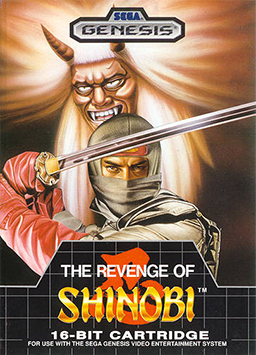
The Super Shinobi / Revenge of Shinobi, Mega Drive cover - Sega, 1989
Revenge of Shinobi (known as The Super Shinobi in Japan) was released
in 1989, the same year the Mega Drive launched in the West. It was Koshiro's first
significant Mega Drive commission and the project through which he established the
techniques - and the reputation - that made the Streets of Rage trilogy possible.
The game is a side-scrolling action title in Sega's Shinobi franchise, following ninja
protagonist Joe Musashi through eight acts of enemies and bosses. Its score had to
serve a fast, demanding action game with a strong aesthetic identity: Japanese martial
tradition filtered through a Western action-thriller visual style. Koshiro answered
with music that was harder and more percussive than his Falcom work while retaining
the melodic clarity that had defined the Ys scores.
Ancient Corp's First Commission, Koshiro's Mega Drive Debut
Koshiro composed Revenge of Shinobi in 1989, the same year he was establishing
the studio that would become Ancient Corp. It was his first
major work on the YM2612 FM synthesis chip, and the learning process is audible in the
score in the best possible sense: the music has an exploratory quality, pushing harder
at the chip's parameters than most of its contemporaries.
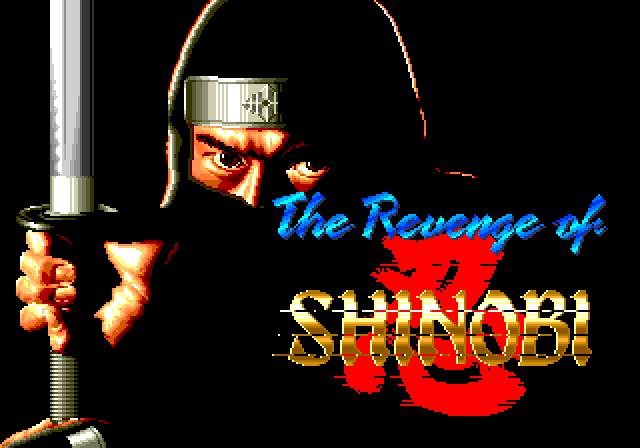
Revenge of Shinobi title screen - the opening music signals an FM synthesis approach more aggressive than typical 1989 Mega Drive output
"With Revenge of Shinobi I was working on the Mega Drive for the first time in a
major way. I was figuring out how to make the FM chip do exactly what I wanted -
learning by doing on a real project."
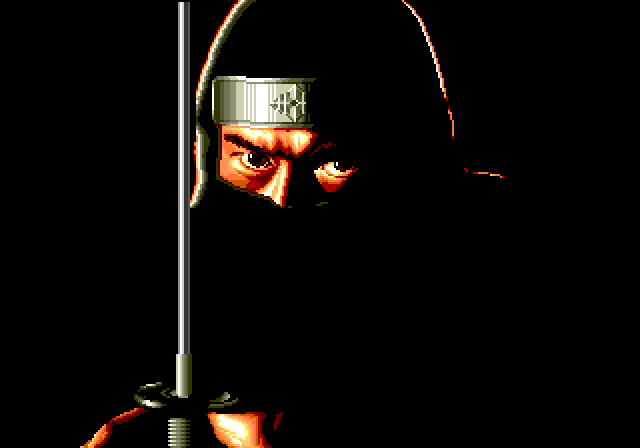
Revenge of Shinobi gameplay - the music's hard rhythmic attacks match the precision of the ninja combat
The gameplay loop of Revenge of Shinobi is deliberate and punishing by
later action standards - the player has limited lives, enemies hit hard, and boss
encounters require patience. The music reflects this: tracks are tense, rhythmically
tight, and do not offer the euphoric release of the later SoR2 compositions. This
is music for concentration, not for dancing.
Koshiro layered FM channels to produce attack transients sharper than most YM2612
compositions of the era - the percussion has a snap that sounds almost sampled despite
being pure FM synthesis. Bass lines are deeper and more prominent than typical Mega Drive
games of 1989. The melodic lines cut through cleanly without muddying the low end.
Revenge of Shinobi stage - the city setting scored with tense, hard-edged FM synthesis
A Chip Finding Its Voice
In 1989 the Mega Drive was a new platform and its audio capabilities were still being
explored by developers. Most launch-era and early Mega Drive games used the YM2612 in
conservative ways: approximating rock band sounds, replicating arcade audio aesthetics,
or writing orchestral emulations. Koshiro treated it differently.
His approach to the YM2612 on Revenge of Shinobi was to push the FM operator
feedback settings further than most composers - producing harsher, more industrial
timbres that suited the game's action tone. He was also developing the programming
discipline that would later produce the custom sequencer used for SoR2: understanding
how to author FM parameters directly rather than through preset patches.
Year One, Best in Class
Revenge of Shinobi was received as one of the best Mega Drive games at launch
and its music was specifically noted. It became the audio benchmark for the platform
in its first year - the thing journalists pointed to when arguing that the Mega Drive's
FM synthesis chip was capable of serious composition rather than arcade bleeps.
The game shipped with the hardware in some markets and was a showcase title: exactly
the context in which its score's quality had maximum impact. Players encountering
the Mega Drive for the first time in late 1989 and 1990 were often encountering
Koshiro's music for the first time.
The Ground Floor for Everything That Followed
Understood retrospectively, Revenge of Shinobi's score is the foundation
beneath the Streets of Rage trilogy. The YM2612 techniques Koshiro developed for it -
sharp percussion, deep bass, clean melodic layering - were refined across Streets of Rage
(1991), Streets of Rage 2 (1992), and Streets of Rage 3 (1994). The
custom sequencer came later; the compositional approach was established here.
The full Mega Drive catalogue including Revenge of Shinobi, the SoR trilogy, and
Beyond Oasis is in Catalogue. Music from the Mega Drive
era is in Music.
Revenge of Shinobi late-game scene - the score maintains tension and drive across all eight acts
1987-1988 · PC-88 / TurboGrafx-16 · Nihon Falcom
Ys I & II
Before the Mega Drive, before Ancient Corp, before Streets of Rage - Yuzo Koshiro was
a teenager writing FM synthesis compositions for Nihon Falcom on the NEC PC-88 home
computer. He joined the company in 1984 at age 16 or 17, contributed to
Dragon Slayer II: Xanadu (1985), and then composed the scores for
Ys I: Ancient Ys Vanished (1987) and Ys II: Ancient Ys Vanished - The Final Chapter
(1988) alongside the Falcom Sound Team JDK.
The PC-88 uses an OPN FM synthesis chip (Yamaha YM2203) - a predecessor and sibling
of the YM2612 that Koshiro would later master on the Mega Drive. It is less capable than
the YM2612 - fewer FM channels, different operator configuration - but it is the chip on
which Koshiro learned FM synthesis composition, and the Ys scores are the demonstration
of that learning at its most advanced.
Sixteen and Writing FM Synthesis for Falcom
The Ys I & II scores are melodically sophisticated beyond what most composers were
producing for the PC-88's FM chip in 1987-1988. The themes are memorable, harmonically
interesting, and emotionally specific to their narrative contexts - the track "First Step
Towards Wars" (Ys I) communicates urgency and adventure in a way that does not require
the action it accompanies.
"The PC-88 FM chip had real character. You had to understand it deeply to get
something musical out of it rather than just technical. The Ys scores were me figuring
out what that chip could actually do."
Yuzo Koshiro, Red Bull Music Academy lecture (video ID: TAuAM75Pf5w)
The Port That Reached the West and Set a Standard
Ys I & II is an action RPG using a distinctive "bump" combat system:
the player character attacks enemies by running into them at the right angle and speed.
There are no separate attack animations - combat and movement are unified. The music
supports this by maintaining consistent energy across areas rather than cutting to
combat themes: the score flows as the game flows.
On the PC-88, the Ys scores were known within the Japanese PC market. The TurboGrafx-16
CD port changed that. When Ys Book I & II reached North American TurboGrafx-16
owners in 1990, it introduced Koshiro's melodies - in arranged form, with richer
instrumentation - to audiences who had never heard Japanese computer game music.
The impact on JRPG music expectations was significant. Koshiro's melodic approach -
emotionally direct, rhythmically purposeful, harmonically varied - became a reference
point for composers working on the action-RPG genre across both the Mega Drive and
SNES platforms in the early 1990s.
Music samples from the Ys era and the full Falcom-period catalogue are in
Music and Catalogue.
Career context for the Falcom years is in History.