Listen In-Browser — SNES SPC
Loading audio engine…
Played via Game_Music_Emu WASM — SNES SPC700 emulation in-browser.
Guile’s Theme
Why the most viral piece of game music ever written actually works perfectly - a compositional analysis.
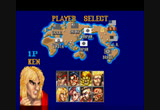
Guile’s Theme from Street Fighter II is one of the most analysed pieces of game music in existence, in part because of the internet meme (“Guile’s Theme Goes With Everything”) and in part because the meme exposes something genuinely true about the composition: it is structurally engineered to accompany continuous action.
The key to why it “goes with everything” lies in its rhythmic and harmonic design. Shimomura wrote the theme in a minor key — specifically, what functions as a Dorian mode inflection over a persistent tonic pedal. The bass line is almost hypnotic in its regularity, providing a rhythmic anchor that the ear can lock onto regardless of what is happening on screen.
The melody sits above this bass line in a mid-register that does not compete with either high treble (where spoken dialogue or sound effects live) or deep bass (where impact sounds register). This means in any audio mix, Guile’s Theme can coexist comfortably with other sound sources. It was not designed for this purpose - the SFX were simply stripped for the meme - but the compositional choices make it unusually adaptable.
There is also the matter of phrasing. The melody moves in regular four-bar phrases that resolve predictably. Listeners can track where they are in the theme without effort. This resolution pattern creates a sense of narrative arc - tension and release - that maps onto whatever action is happening visually, creating the illusion that the music was written specifically for that moment.
The internet meme emerged around 2008 when YouTube users began dubbing the track over unrelated clips and finding that it consistently improved or contextualised the footage. The meme accurately identifies something real: Guile’s Theme is compositionally robust, with sufficient momentum and enough tonal ambiguity to impose a mood of focused determination on almost any subject matter.
Shimomura has spoken about designing themes to match fighter personalities. For Guile — an American Air Force officer fighting in memory of a dead comrade — she wanted something that conveyed discipline and restrained grief. The minor key choice, the driving bass, and the controlled melodic phrasing all serve that character brief. That it also happens to “go with everything” is a consequence of how precisely it was constructed, not an accident.
Street Fighter II SNES complete soundtrack. Guile’s Theme is among the most celebrated tracks.
Final Fight Stage Themes
Metro City at night - Shimomura’s early SNES work before SF2 changed everything.
Final Fight on SNES is a reduced port of the arcade original, missing the two-player mode and one of the three playable characters (Guy). Capcom’s sound team, including Shimomura, adapted the score for the SNES SPC700 chip rather than directly porting the arcade YM2151+MSM5205 audio.
The Industrial Area stage theme and elements of the Metro City character selection screen have been attributed to Shimomura by sound credit researchers. These tracks show the same rhythmic drive and clear harmonic language that would define her SF2 work a year later — a bass-driven pattern beneath a melodic line that captures the energy of the streets-of-Metro-City scenario.
What distinguishes Shimomura’s early SNES work from her later compositions is density. The Final Fight contributions are lean, direct, action-serving. By the time she reached Live A Live in 1994, she was comfortable with much wider orchestral textures and emotional range. The Final Fight period is compositionally interesting as a baseline — raw functional music for raw functional game design.
Live A Live - Eight Periods, Eight Worlds
The most compositionally ambitious SNES soundtrack - eight distinct styles in one game.
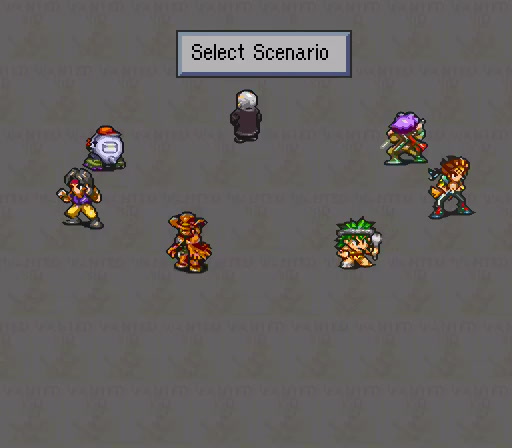
Live A Live is structured as an anthology: players choose from eight distinct scenarios set in different historical periods, each playable independently before converging in a final chapter. This structure gave Shimomura an extraordinary compositional brief: write eight completely different soundtracks, each authentic to its era and genre, all within the technical constraints of a single SNES cartridge.
The Prehistoric chapter (“In the Beginning”) uses percussive, rhythmic themes with minimal harmonic development — music as ritual rather than narrative. The Feudal Japan chapter deploys traditional Japanese scales and sparse koto textures. The Imperial China chapter is martial and structured, with pentatonic melodies over driving bass.
The Wild West chapter (“The Wanderer”) is perhaps the most surprising departure: it features minimal dialogue and almost no text, communicating its story almost entirely through visual storytelling and music. Shimomura’s score for this chapter is atmospheric and melancholy — sparse guitar textures evoking the isolation of frontier existence.
The Sci-Fi chapter (“The Mechanical Heart”) embraces industrial electronic textures, building tension through mechanical repetition and synthesiser drones that reference the claustrophobic horror of being alone on a spaceship with an unknown threat.
The Near-Future chapter features sports tournament themes, and the Present Day chapter is the most conventional RPG of the eight — a traditional hero’s journey with appropriately grand orchestral themes. The Middle Ages chapter, which serves as the final convergence point for all stories, deploys the most conventionally epic fantasy music of the entire soundtrack.
Taken as a whole, Live A Live demonstrates a compositional range that no other single SNES game required of its composer. Shimomura later said that the project was one of the most technically and creatively challenging of her career precisely because each chapter demanded a different approach, with no established sonic identity to build from.
Live A Live (SNES, 1994) — Original Soundtrack. Eight periods, one extraordinary composer.
Super Mario RPG Composition
Orchestral ambition in the Mushroom Kingdom - working alongside Koji Kondo.
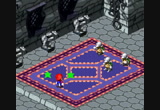
Super Mario RPG presented Shimomura with an unusual constraint: compose an RPG score for one of Nintendo’s most iconographically established franchises, in collaboration with the composer who created and owns the sonic DNA of that franchise.
Koji Kondo’s Mario themes — the ground theme, the castle theme, the star power theme — are among the most immediately recognisable melodic signatures in popular culture. Any new music for a Mario game must coexist with those themes without either ignoring them or simply imitating them.
Shimomura’s solution was to write new music that referenced the harmonic and rhythmic language of Mario without directly quoting it. Her themes for Smithy’s Factory, the Forest Maze, and the star-shaped world of Star Road have the same bouncing rhythmic energy as classic Mario music, but they are harmonically richer — more orchestral in their voicing and more willing to explore minor keys and chromatic movement.
The Forest Maze theme is particularly notable. It builds on a three-note repeating figure that creates a sense of circular confusion — perfectly capturing the feeling of being lost in a labyrinthine forest — while layering increasingly complex harmonies above it. It is one of the most musically sophisticated pieces in the entire SNES library.
The collaboration between Shimomura and Kondo is most visible in the seamless transitions between existing Mario themes and new RPG content. When the player enters Mushroom Kingdom castle and hears Kondo’s classic castle theme reimagined with RPG orchestration, and then moves into a dungeon sequence scored entirely by Shimomura, the tonal consistency is striking. The two composers clearly discussed a shared harmonic language before writing.
Super Mario RPG: Legend of the Seven Stars (SNES, 1996) — Complete Soundtrack.