Flagship Titles
An in-depth look at the two Wing Commander games that most decisively shaped the series and the PC gaming industry: the 1990 original that started it all, and the 1994 blockbuster that redefined what a game could be.
Wing Commander (1990)
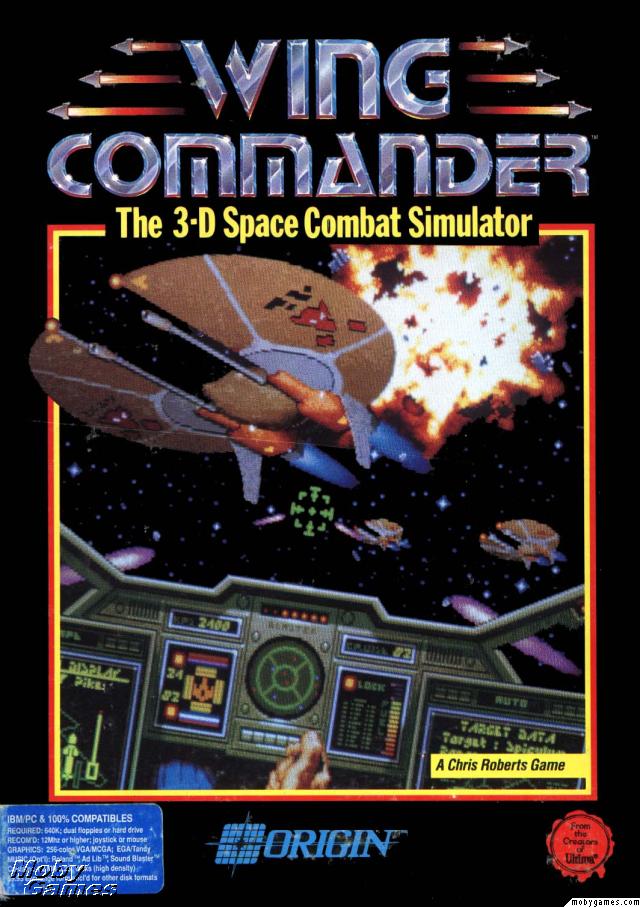
The Game That Changed Everything
Wing Commander was released on 26 September 1990 for DOS, designed by Chris Roberts and developed at Origin Systems. It arrived in an era when PC space games were largely abstract affairs - wireframe vectors, flat sprites, and mechanics inherited from the arcade. Wing Commander discarded every one of those conventions and replaced them with something no one had seen before: real-time 3D spacecraft, cinematic camera cuts, pilot dialogue, and a story that unfolded across a branching mission tree that responded to the player's success and failure.
The game shipped with 34 missions across five star systems, each framed by briefing sequences aboard the carrier Tiger's Claw. Between missions, pilots gathered in the briefing room and bar, where character interactions played out through text dialogue and animated portrait sequences. Death was permanent for wingmen: if a comrade was shot down, they were gone for the rest of the campaign. The emotional stakes were unusual for 1990 PC gaming.
A Small Team with an Unreasonable Ambition
Chris Roberts joined Origin Systems from the UK games industry in the late 1980s. The game he pitched to Origin founder Richard Garriott was ambitious beyond what contemporary PC hardware was thought capable of. The core team was small - Roberts as director, Geof Kiefer as lead programmer, and writer Ellen Guon Beeman among a tight group of Origin staff. Development ran through 1989 and into 1990 with the goal of shipping before the 1990 holiday season.
Roberts drew directly on George Lucas's Star Wars as a reference for tone, pacing, and visual style. He has described Wing Commander as a direct attempt to recreate the experience of a Star Wars aerial combat sequence - the kind of film moment where scale, danger, and momentum converge - and put the player inside it. The Kilrathi were designed as a credible science-fiction adversary with a distinct warrior culture, not generic alien antagonists. Beeman wrote the in-world "Claw Marks" pilot manual and contributed to the mission briefing dialogue that gave the game's universe tangible depth from the first hour of play.
The game's branching mission structure was a deliberate design choice, not a technical afterthought. Roberts wanted players to experience different sorties, different dramatic beats, different outcomes depending on their combat performance. Both the winning and losing paths reach a finale, but the journey through them differs substantially - a commitment to player agency that cost development time but defined the series' narrative identity.
"Wing Commander was my attempt to make a Star Wars movie you could play."
— Chris Roberts, creator of Wing Commander (Wing Commander CIC developer interviews)
In the Cockpit of the Tiger's Claw
Each mission begins with a briefing aboard the carrier, where the player receives objectives and wingman assignments before launching into space. Once out, the player controls one of several fighter types - the light Hornet, the balanced Scimitar, or the heavy Rapier - using a joystick or keyboard, managing afterburner fuel, guns, and a limited supply of missiles. Combat is immediate and close-range: the effective range for gunfire is short, forcing real manoeuvring and positioning rather than long-distance sniping.
Wingmen follow commands and engage targets independently. Pilots who survive multiple missions become familiar presences in the Tiger's Claw bar sequences between sorties - and their deaths, when they happen, register. The game was designed to make the player care about specific named characters: Paladin, Angel, Knight, Bossman. Losing them is not just a tactical setback. This personal investment, built through brief but repeated character moments, was what made Wing Commander's branching narrative feel meaningful rather than mechanical.
What a 286 Was Not Supposed to Do
The technical foundation was Geof Kiefer's 3D engine, built to run on 286 and 386-class personal computers without any hardware graphics acceleration. Enemy fighters were rendered as 3D polygon objects that grew and shrank with distance, banked and rolled convincingly, and were drawn with enough detail to read clearly as recognisable craft in combat. This was not considered achievable on 1990 consumer PC hardware. Kiefer used fixed-point mathematics rather than floating-point operations, avoided processor-intensive division wherever possible, and structured the renderer to minimise CPU overhead per frame.
The engine supported both EGA and VGA display modes. VGA - which the game was optimised for - rendered in 256 colours at 320x200 resolution, giving the space combat a visual richness that matched the game's cinematic ambitions. The MT-32 MIDI soundtrack, composed specifically to showcase Roland's hardware synthesiser, gave Wing Commander an audio identity to match the visual achievement. Origin designed the game as a showcase for the MT-32's capabilities, and the resulting compositions elevated the hardware to something approaching a film score.
Game of the Year, First Time Out
Computer Gaming World named Wing Commander its 1990 Game of the Year - the most significant recognition a PC title could receive from the era's most authoritative publication. The game's MobyGames critic aggregation score of 91/100 reflects consistent critical esteem across decades of review. Period coverage highlighted the combination of technical achievement and cinematic presentation as unprecedented: no PC game had previously offered real-time 3D action alongside cutscenes, voice callsigns, and a branching narrative campaign.
Wing Commander sold over 500,000 copies in its first year, a remarkable figure for premium PC software in the early 1990s marketplace. Its commercial success immediately justified sequels and created a franchise that would extend through fourteen titles, novelisations, a tabletop roleplaying game, a comic book series, and a 1999 theatrical film. For period review coverage of Wing Commander and its successors, see the Reviews page.
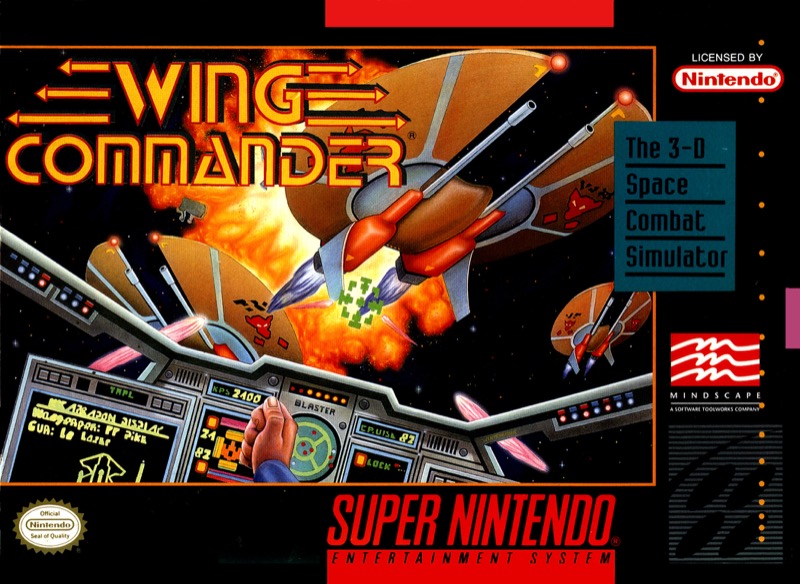
The Template All Space Sims Followed
Wing Commander's influence on the decade of PC gaming that followed is direct and traceable. LucasArts's X-Wing (1993) applied the cinematic space combat template to the Star Wars licence, explicitly acknowledging Wing Commander as its reference point. Freespace (1998) and Independence War (1997) refined the genre further, both built on assumptions about what a space combat game should do that Wing Commander had established eight years earlier. The game was ported to the SNES, Amiga, and Macintosh - unusual platform breadth for a DOS title.
The full Wing Commander I catalogue, including both Secret Missions expansion discs, is available on GOG.com. The fan community at Wing Commander CIC (wcnews.com) has maintained active archive resources since 1998, including developer interviews, mission walkthroughs, and documented histories of the original development team. For detailed profiles of the people behind Wing Commander's creation - Chris Roberts, Geof Kiefer, Ellen Guon Beeman - see the People page. For a complete listing of every game in the series, visit the Games page.
Wing Commander (1990) longplay - the full campaign from the Tiger's Claw, showcasing the 3D engine and branching mission structure.
Wing Commander III: Heart of the Tiger (1994)
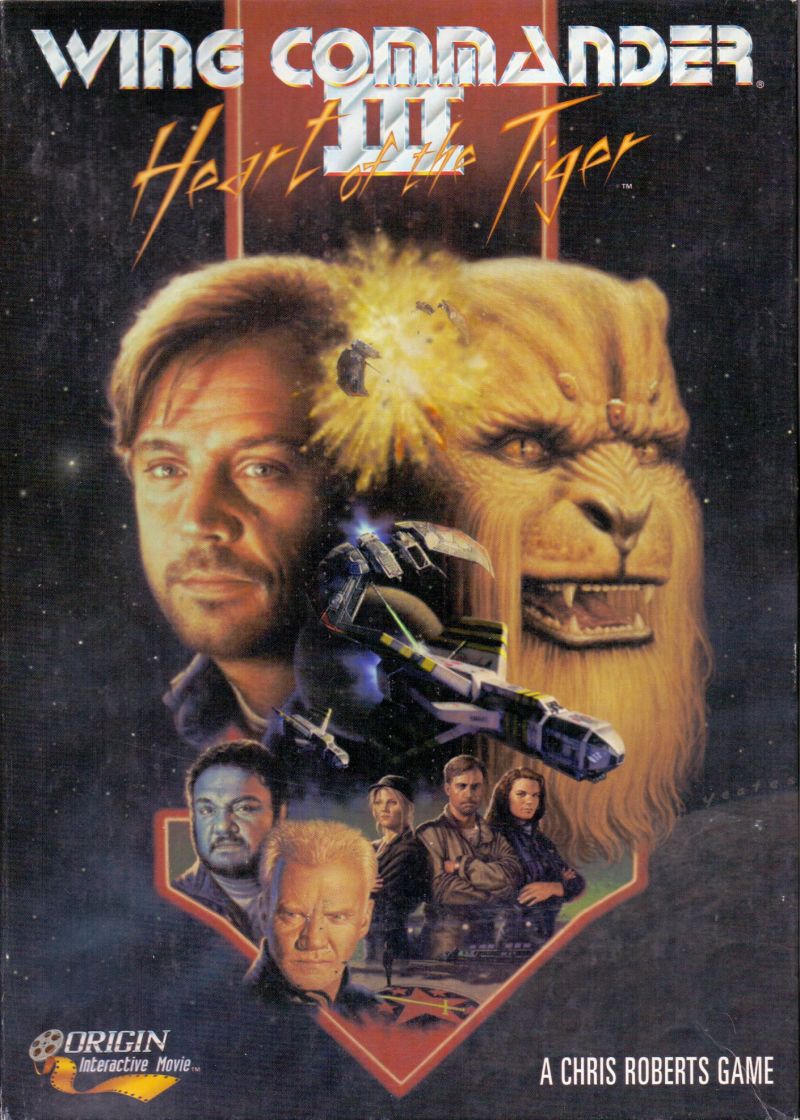
Hollywood Comes to PC Gaming
Wing Commander III: Heart of the Tiger was released in December 1994 for DOS, later ported to the 3DO, PlayStation, and Sega Saturn. It shipped on four CD-ROM discs and carried a production budget of approximately $4 million - making it one of the most expensive PC games ever made at the time of release. The budget went into something Origin Systems had never attempted before: feature-film-quality live-action FMV sequences filmed on professional studio sets in Austin, Texas, with a Hollywood cast assembled by Chris Roberts.
Mark Hamill was cast as Colonel Christopher Blair, the player's in-game avatar. Malcolm McDowell played Admiral Geoffrey Tolwyn, the series' increasingly ambiguous authority figure. John Rhys-Davies appeared as James "Paladin" Taggart, reprising a role established in animated form in the earlier games. Tom Wilson played Major "Maniac" Marshall, Blair's most consistently unreliable wingman. The casting of recognisable Hollywood actors gave Wing Commander III a media profile no previous PC game had achieved.
Sets Built to Film, a Game Built Around Them
The FMV sequences for Wing Commander III were filmed using techniques borrowed directly from Hollywood production - director's slates, multiple camera angles, professional lighting rigs, and dedicated costume and makeup departments. The sets built for Wing Commander III, including the bridge and crew quarters of the carrier TCS Victory, were physical constructions designed to hold up to close-up camera work. This was not the blue-screen-and-compression-artefact FMV of most contemporaries - Origin spent the budget to build something that would read as professional filmed entertainment.
Chris Roberts directed the FMV sequences himself, handling both the game's design and its film production. The scale of the operation required Origin to essentially run two projects simultaneously: a game studio and a film production unit. The resulting hybrid was something the industry had never seen. Entertainment journalists who did not ordinarily cover PC games took notice, and Wing Commander III generated mainstream press coverage that no pure game release had previously attracted.
"We spent more money making Wing Commander III than the average Hollywood B-movie. And the game was better."
— Chris Roberts, director of Wing Commander III
The Cockpit Still Delivers
Beneath all the production spectacle, Wing Commander III's space combat was the mechanical core, and it held up. Origin had refined and expanded the flight model through two previous mainline entries and Privateer, and Wing Commander III's combat retained the satisfying close-quarters dogfighting that had defined the series from the beginning. The player still pilots from a carrier, still manages fuel and missiles, still relies on wingmen whose personalities shape how they fight.
Wing Commander III's story placed Colonel Blair aboard the ageing carrier TCS Victory as the Terran Confederation faced what appeared to be its final war against the Kilrathi Empire. The narrative was darker than its predecessors, structured around Blair's relationships with his crewmates and the tactical choices of a war the Confederation appeared to be losing. Player choices in dialogue sequences shaped the narrative path through the campaign - whom Blair trusted, which characters survived, which ending the player reached. The FMV format meant those choices played out with genuine performances rather than animated sprites, giving the branching narrative a dramatic weight the earlier games could only gesture toward.

The Score That Listened
George Oldziey's adaptive musical score was among the most sophisticated audio implementations in 1994 games. Tracks transitioned dynamically between tense combat themes, dramatic orchestral passages, and quieter character-driven cues based on what was happening in a mission at any given moment. The system made Wing Commander III's audio feel responsive rather than repetitively looped, and it set a standard for game music integration the industry was still working toward years later.
Oldziey later conducted a live orchestral recording of selected Wing Commander music, released commercially - a rare example of a PC game's score receiving a full orchestral treatment. The adaptive music system in Wing Commander III anticipated techniques that modern AAA games treat as standard: horizontal re-sequencing, layer switching based on gameplay state, and thematic development across a campaign's arc. In 1994, it was an outlier.

95 Percent and a Cultural Watershed
PC Gamer US awarded Wing Commander III approximately 95%, describing it as "the most cinematic game ever made" - a verdict that reflected both the technical achievement and the cultural ambition. Computer Gaming World named it a Game of the Year finalist. MobyGames retrospective critic aggregation places the game at 90/100, reflecting sustained critical esteem across decades of reassessment.
Wing Commander III became the best-selling entry in the franchise. It demonstrated conclusively that PC games could sustain Hollywood production values, that players would respond to genuine dramatic performances in interactive contexts, and that the PC was not simply a platform for abstract gameplay. Critical reviews from the era, including period scores from PC Gamer and Computer Gaming World, are collected on the Reviews page. For profiles of the people who made Wing Commander III - including Mark Hamill, George Oldziey, and Chris Roberts - see the People page.
The Blueprint for Every Cinematic Game That Followed
Wing Commander III's commercial success validated a model of game development that had been considered reckless: spending B-movie production budgets on interactive entertainment and expecting an audience. The PlayStation era that followed WC III saw cinematic production values become standard rather than exceptional. Games from Metal Gear Solid to Final Fantasy VII drew on a vocabulary of cutscenes, character-driven narrative, and performance-led storytelling that Wing Commander III had proved audiences would pay for and critics would reward.
Wing Commander IV (1996) escalated the approach with a $12 million budget, the largest in series history. The series ended with Prophecy (1997) and the free-download Secret Ops (1998), before Origin Systems was wound down by EA. Chris Roberts left the industry after Wing Commander IV to found Digital Anvil; he returned in 2012 with Star Citizen, announced from the start as a spiritual successor to Wing Commander. Wing Commander III is available on GOG.com, alongside the full series from WC I through Secret Ops. For the complete series catalogue, see the Games page.
Wing Commander III: Heart of the Tiger (1994) - the complete FMV cut, with the full Hollywood-cast performances by Mark Hamill, Malcolm McDowell, and John Rhys-Davies.