Founding — 1985
Westwood Studios was founded in 1985 in Las Vegas, Nevada, by Brett Sperry and Louis Castle. Sperry, with a background in business and creative direction, and Castle, a programmer of exceptional technical facility, had complementary skills that proved potent. Their earliest projects were game adaptations and text-adventure titles produced for other publishers.
The studio's early output demonstrated competence rather than ambition - ports, licensed titles, work-for-hire. But the commercial success of these projects funded the hardware and team that would later produce something genuinely original.
Eye of the Beholder — 1991
In 1991, Westwood produced Eye of the Beholder for Strategic Simulations Inc., an Advanced Dungeons & Dragons first-person dungeon crawler that established Westwood's reputation for technical polish and atmospheric world-building. The game combined real-time movement through tile-based dungeons with turn-based combat in a way that felt immediate and tactile, earning strong reviews across Amiga, DOS, and later SNES releases.
Two sequels followed. Eye of the Beholder II: The Legend of Darkmoon (1991) expanded the scope considerably; Eye of the Beholder III: Assault on Myth Drannor (1993), produced after the core team had moved on to other projects, was regarded as a lesser entry. But the original remains a landmark of the dungeon RPG genre.
The Legend of Kyrandia — 1992
Released in 1992, The Legend of Kyrandia was Westwood's own point-and-click adventure - a puzzle game with a lush hand-painted aesthetic, memorable characters, and a darker tone than its genre contemporaries. Kyrandia sold well enough to support two sequels: Hand of Fate (1993) and Malcolm's Revenge (1994).
The Kyrandia trilogy demonstrated that Westwood could hold its own against LucasArts in the adventure game market while simultaneously developing entirely different genres. The ability to sustain multiple serious projects across different categories was rare for a studio of Westwood's size.
Dune II - The Invention of Real-Time Strategy — 1992
Dune II: The Building of a Dynasty, released in 1992, is among the most consequential games ever made. Working from Frank Herbert's Dune license (which Westwood acquired from Cryo Interactive's earlier adventure adaptation), Brett Sperry and lead programmer Joseph Bostic designed a game that established the foundational grammar of real-time strategy: resource harvesting, base construction, unit production queues, technology trees, and map fog-of-war.
These were not merely refinements of existing ideas. In 1992, no game had combined these elements in real time. Sperry's design insight - that the pleasure of a board war game could be preserved while adding the dynamism of real-time decision-making - created an entirely new form of play.
"We were trying to create something that felt like you were commanding troops in real time. We didn't know we were inventing a genre - we were just trying to make something exciting."
- Brett Sperry
Dune II sold strongly and was enormously influential. Blizzard's Warcraft (1994) openly acknowledged its debt. Command & Conquer was Westwood's own evolution of the concept.
Command & Conquer — 1995
Command & Conquer (1995) took the mechanics of Dune II and wrapped them in a contemporary geopolitical thriller: GDI versus NOD, a shadow war for a mysterious resource called Tiberium, told through live-action FMV cutscenes of surprising quality and - most memorably - Frank Klepacki's thunderous industrial soundtrack.
C&C sold over three million copies. It shipped on two CDs - one for each faction - and came with a free copy for a friend, an early experiment in what we would now call viral marketing. The game established Westwood at the forefront of PC game development and triggered a franchise that would define the studio's final decade.
Command & Conquer: Red Alert (1996) followed, shifting the setting to an alternate Cold War in which Einstein's time machine removed Hitler from history - producing a Soviet Union unchecked by the Nazi threat. Red Alert's tone, its two-sided storytelling, and its multiplayer balance made it perhaps the most beloved game in the entire series.
Lands of Lore — 1993
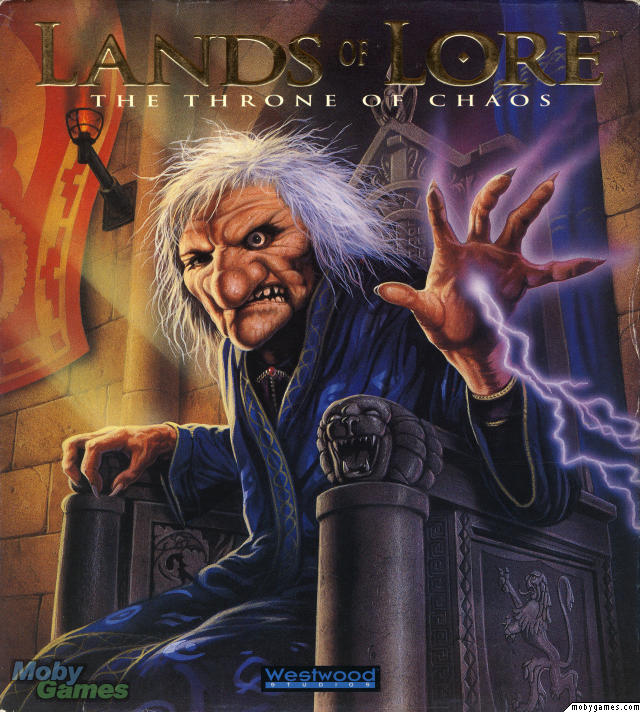
Lands of Lore: The Throne of Chaos (1993), narrated by Patrick Stewart in the CD-ROM version, demonstrated Westwood's facility with atmospheric RPG design. A polished first-person dungeon crawler with more accessible mechanics than the Eye of the Beholder series, it found a wide audience and spawned two sequels developed by the studio in the late 1990s.
Blade Runner — 1997
Blade Runner (1997) is one of the most technically remarkable games ever made. Westwood recreated the world of Ridley Scott's 1982 film through a proprietary voxel engine - a technology that allowed fully three-dimensional environments without the polygon rendering that dominated PC games of the era. The result was photorealistic rain-slicked streets, neon-lit interiors, and a Los Angeles that felt inhabited.
The game runs parallel to the film's narrative rather than adapting it directly, following a different Blade Runner whose investigation intersects with Deckard's. Its non-linear structure - NPCs remembered their interactions with the player across sessions, replicants were randomised - meant no two playthroughs were identical. Its preservation was long a concern; for decades no legitimate copies remained. The game was eventually re-released in 2019 through a community restoration effort.
Electronic Arts Acquisition — 1998
Electronic Arts acquired Westwood Studios in August 1998. The deal was primarily motivated by the Command & Conquer franchise, which had become one of the most commercially successful strategy game series in history. Under EA, Westwood continued development on Tiberian Sun (1999), Nox (2000), Red Alert 2 (2000), and Renegade (2002).
Tiberian Sun was ambitious and technically impressive - full dynamic lighting, destructible terrain, an isometric engine that pushed late-1990s hardware - but suffered from performance issues on typical machines of the time. Reception was mixed despite its design achievements.
Red Alert 2 (2000) was the creative high point of the EA era: a characteristically campy, well-balanced, and deeply enjoyable strategy game that many fans consider the finest entry in the franchise. Nox, an action-RPG released the same year, was a critical favourite that found a smaller audience.
Closure — 2003
Electronic Arts closed Westwood Studios in March 2003. Some staff were absorbed into EA Los Angeles; others dispersed to form new studios or join existing ones. The Command & Conquer franchise continued under EA Los Angeles until 2013, when EA shut that studio too. A partial C&C revival through the Remastered Collection (2020) acknowledged both the franchise's importance and the failings of its EA-era handling.
Westwood's closure marked the end of an era for strategy gaming. The studio that had invented the genre, dominated it through the 1990s, and produced works as varied as Blade Runner, Kyrandia, and Eye of the Beholder was gone. The community projects - OpenRA, CNCNet, the Blade Runner restoration - carry the work forward in the absence of official support. See Modern for what survives.