The creators who built Britannia, and the characters who inhabit it.
Richard Garriott - Lord British
Richard Allen Garriott (born 4 July 1961) is the creator of the Ultima series and co-founder of Origin Systems. The son of NASA astronaut Owen Garriott, he grew up surrounded by science and technology, developing his first games on a teletype machine at his high school's computer terminal.
Garriott is inseparable from his alter ego Lord British - the benevolent ruler of Britannia who appears in every Ultima game, always in need of rescue or guidance. Lord British is not simply a self-insert; he represents Garriott's evolving philosophy about leadership, responsibility, and the nature of virtue.
After Origin Systems was acquired by EA and eventually closed in 2004, Garriott pursued space travel (he flew to the International Space Station in 2008 aboard a Soyuz spacecraft), before returning to games. His studio Portalarium developed Shroud of the Avatar, a spiritual successor to Ultima Online.
Garriott is renowned for his elaborate Halloween parties at his Austin mansion Britannia Manor, designed with detailed fantasy theming. He has stated that the real Britannia was always the community of players, not the software.
Lord British exists in every Ultima because I wanted players to feel they were adventuring in my world, alongside someone who understood it. He was always me - curious, ambitious, and occasionally in need of rescue.
Richard Garriott, various interviews
Ultima Online Postmortem
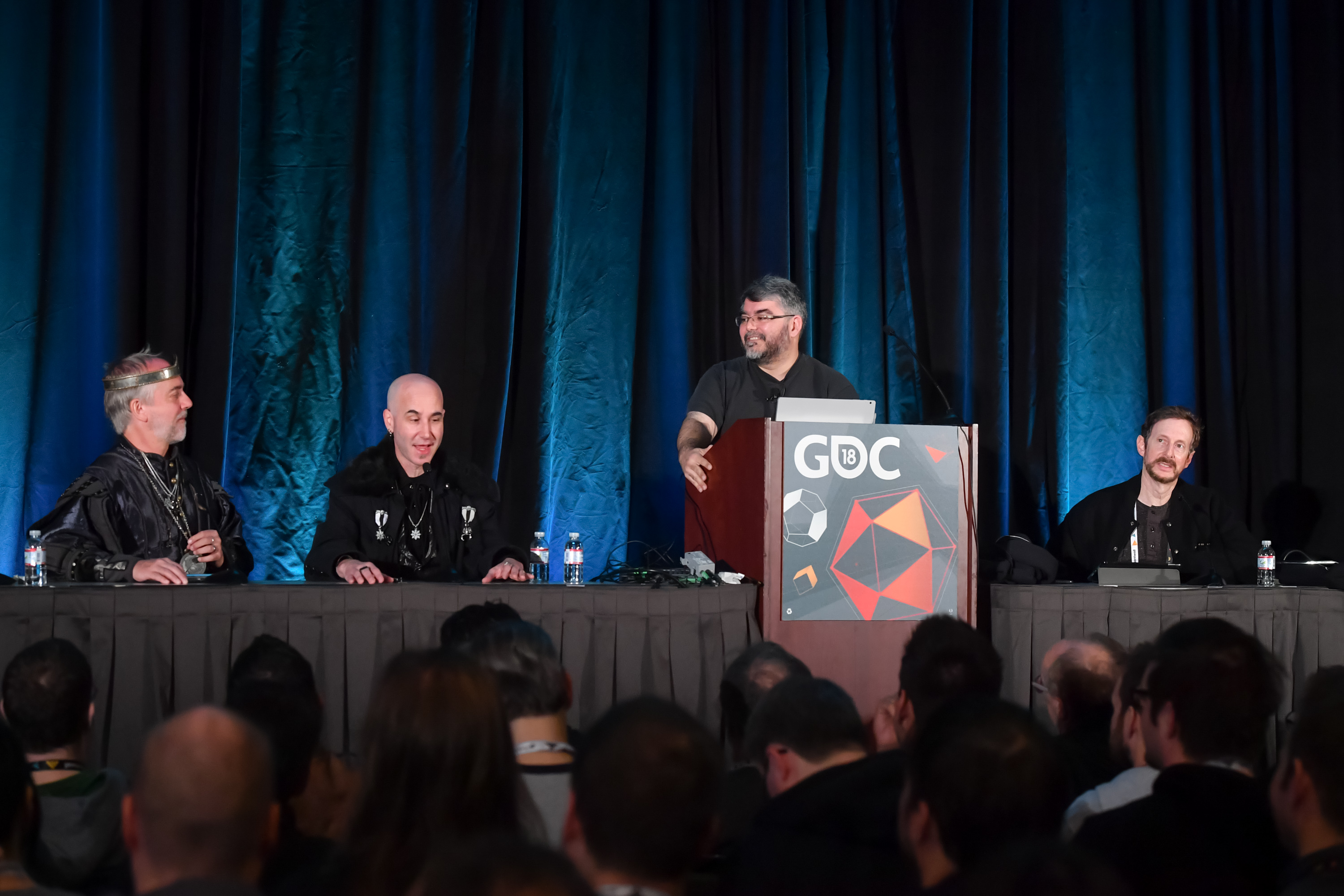
GDC · Garriott, Koster, Long, Vogel
Garriott on Ultima's Legacy
Retro Tea Break · Career interview
Denis Loubet - The Artist of Britannia
Ultima IV - one of Loubet's finest paintings
Denis Loubet is the artist responsible for the cover paintings of Ultima I through Ultima VIII, creating the visual identity of the series for nearly two decades. His oil paintings - featuring the Avatar, Lord British, gargoyles, and the landscapes of Britannia - defined how players imagined the world before they ever booted the game.
Loubet joined Origin Systems in the early 1980s and became the studio's primary visual voice. His palette - rich golds, deep blues, dramatic lighting - became synonymous with the Ultima aesthetic. The Ultima IV cover, depicting the Avatar in meditative contemplation beneath an ankh, is widely considered one of the finest pieces of game art from the era.
After Origin, Loubet continued working as an artist and illustrator. He has remained connected to the Ultima fan community and has contributed artwork to fan projects including Shroud of the Avatar.
Warren Spector
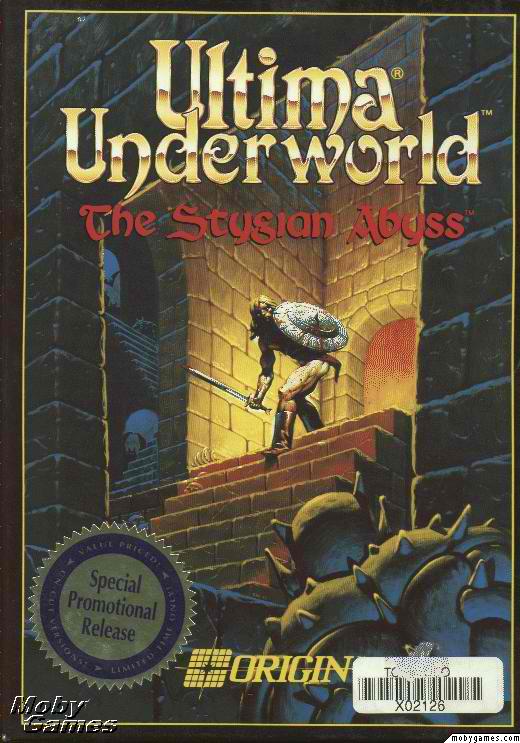
Warren Spector joined Origin Systems in the late 1980s and produced several Ultima titles, including Ultima VI and Ultima Underworld. He is one of the principal architects of the "immersive sim" genre - games that give players deep systemic freedom to approach problems in multiple ways.
After Origin, Spector founded Looking Glass Studios alumni project Ion Storm Austin, where he created Deus Ex (2000) - widely considered a direct spiritual descendant of the Ultima Underworld design philosophy. His career trajectory from Britannia to Deus Ex illustrates the direct line between Origin's ambitions and modern game design.
Spector has spoken extensively about Ultima's influence on his approach to game design - particularly the belief that player agency and systemic simulation are more important than scripted spectacle.
Ultima Underworld set out to prove that you could have a fully interactive, three-dimensional world that responded to the player's choices. That was the entire goal - not graphics, not story, but systemic depth.
Warren Spector, GDC developer retrospective
Paul Neurath
Paul Neurath is the founder of Blue Sky Productions (later renamed Looking Glass Studios), the team that created Ultima Underworld: The Stygian Abyss. Though not an Origin Systems employee, Neurath's collaboration with Origin produced one of the most technically and conceptually ambitious games of the early 1990s.
Ultima Underworld pioneered true 3D first-person environments with texture mapping, light sourcing, and physics simulation - technologies that informed the development of Doom and Quake. The game's design philosophy - rich simulation, player agency, emergent gameplay - became the foundation of the immersive sim genre.
Neurath went on to found OtherSide Entertainment, which began development on System Shock 3 and Underworld Ascendant, a spiritual successor to Ultima Underworld.
The question we asked ourselves every day on Underworld was: if this were a real place, how would it work? Not how would it look, how would it work. That distinction is everything.
Paul Neurath, Gamasutra retrospective
Companions of the Avatar
The recurring companions who journeyed through Britannia across multiple games.
Iolo
Bard · Virtue: Justice
Iolo FitzOwen, bard and archer. Appears in Ultima III through IX. Known for his crossbow, his wit, and his unwavering loyalty to the Avatar.
Shamino
Ranger · Virtue: Honour
A ranger of Britannia, veteran of many campaigns. Appears from Ultima I onwards, always at the Avatar's side. His backstory deepens considerably in Serpent Isle.
Dupre
Paladin · Virtue: Valour
Paladin and knight. Dupre's sacrifice in Ultima VII Part 2 is one of the most memorable moments in the series - giving his life to destroy the Bane of Chaos.
Katrina
Shepherd · Virtue: Humility
The companion of Humility - the most overlooked of the Eight Virtues. Katrina appears in Ultima IV and later entries, representing the virtue that requires no class or skill to embody.
Julia
Tinker · Virtue: Sacrifice
A tinker who embodies Sacrifice. Her mechanical skills serve the party well, and her self-giving nature defines her arc across several entries.
Jaana
Druid · Virtue: Spirituality
Druid of Yew, companion of Spirituality. Jaana's arc explores the meditative and contemplative aspects of the Avatar's quest.
Geoffrey
Fighter · Virtue: Valour
A straightforward warrior whose courage is as uncomplicated as it is reliable. Geoffrey represents the martial arm of the fellowship.
Mariah
Mage · Virtue: Honesty
A mage of Moonglow, the city of Honesty. Mariah's quest for arcane knowledge parallels the Avatar's own search for truth.
Antagonists
The villains - from simple sorcerers to systems of evil.
Mondain
Ultima I antagonist
A sorcerer who created the Gem of Immortality, making himself unkillable. The Avatar must travel back in time to destroy the gem before it is created.
Minax
Ultima II antagonist
Mondain's apprentice and lover, wielding time manipulation to reshape history in her favour. One of gaming's first female antagonists.
Exodus
Ultima III antagonist
The demonic offspring of Mondain and Minax - not a person, but a machine. Exodus must be destroyed using the cards of virtue, not combat, in a remarkably early example of a non-combat resolution.
Blackthorn
Ultima V antagonist
A corrupted regent who enforces warped versions of the Eight Virtues as totalitarian law. Blackthorn is a deeply sympathetic villain - a good man destroyed by the Shadowlords.
The Guardian
Ultima VII–IX antagonist
The great antagonist of the final trilogy - a vast, malevolent entity who claims to be the Avatar's shadow self, the embodiment of every vice the Avatar refused. His true nature is the subject of one of gaming's most debated narrative mysteries.