Editorial Deep-Dive

Flagship Titles

Five games that defined Thalamus Ltd - and raised the standard for every Commodore 64 publisher that followed.

1986 Commodore 64 Stavros Fasoulas

Sanxion

The debut that announced Thalamus to the world

Development Story

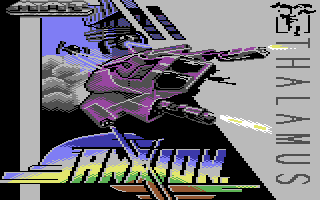
When Thalamus Ltd launched in 1986 as the in-house publishing arm of Newsfield Publications, it needed an immediate statement of intent. The game it chose to lead with - Sanxion, developed by Finnish programmer Stavros Fasoulas - delivered something far beyond what anyone anticipated from a debut release.

Fasoulas was twenty-one years old when he wrote Sanxion, and the game he produced was technically extraordinary for a developer of any age. Born in Helsinki and working in relative isolation from the British C64 development scene, he had taught himself machine-code programming with an intensity that is reflected in every line of Sanxion's code. The game demonstrated not merely competence but mastery - mastery of the C64's VIC-II graphics chip, its raster interrupt system, and the tight timing constraints that C64 developers exploited to produce effects the chip was not officially capable of generating.

The development of Sanxion was funded directly by Newsfield, giving Thalamus an unusually clean path from concept to release without the commercial compromises that constrained independent developers. Gary Liddon, Thalamus's technical executive and a former Zzap!64 staff writer, provided the crucial link between Fasoulas's programming talent and Thalamus's publishing infrastructure. The result was a game released in finished, polished form - no rough edges, no features abandoned under deadline pressure.

Technical Innovation: The Split-Screen Radar Display

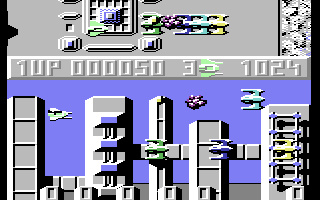
Sanxion's defining technical achievement is its split-screen display, a feature with no direct precedent in C64 shoot-em-ups at the time of its release. The screen is divided into two regions: the upper portion, occupying roughly two-thirds of the display, presents the standard scrolling gameplay view; the lower portion shows a compressed radar-style overview of the entire level ahead, condensing the full playfield into a miniature tactical readout updated in real time.

Achieving this on the C64 required precise raster interrupt programming. The VIC-II chip generates a single continuous display signal, and splitting it into two independently managed regions requires inserting interrupt routines at exact horizontal scan lines to reconfigure the chip's parameters mid-frame. Fasoulas used this technique to repurpose the lower portion of the screen entirely - different scroll registers, different sprite configurations, different colour settings - all within a single video frame.

The radar's value extended beyond the technical. It gave Sanxion a distinctive gameplay dimension: players who watched the radar could anticipate threats before they entered the main view, turning a pure reflex exercise into something with a genuine tactical layer. C64 players had never seen this integration of tactical information display with real-time action gameplay, and it immediately distinguished Sanxion from the horizontal shooters it superficially resembled.

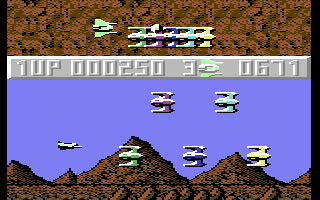
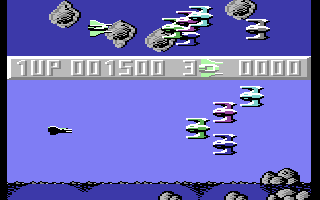
The sprite handling in Sanxion's main display was equally impressive. The C64's VIC-II chip provides eight hardware sprites, but Sanxion routinely displayed more than eight distinct moving objects simultaneously - achieved through sprite multiplexing, a technique in which the same sprite registers are reused multiple times per frame to create the visual impression of more sprites than the hardware supports. This requires the interrupt routine to reposition and reprogramme sprite registers with frame-precise timing, and Fasoulas executed it with exceptional fluency.

Rob Hubbard and "Thalamusic"

Rob Hubbard's title music for Sanxion is one of the most celebrated SID chip compositions ever produced, and its cultural significance within the C64 community extends well beyond the game it accompanies. Hubbard was already recognised as the pre-eminent SID composer of the era when he wrote the Sanxion soundtrack, but the piece he created for Thalamus's debut represented a new height even by his own extraordinary standards.

The composition is relentlessly energetic - a driving, melodically dense piece that matches the kinetic pace of the game's horizontal scrolling action. Hubbard exploited all three voices of the SID chip simultaneously, layering a throbbing bass line under interweaving melodic lines of considerable complexity. The chip's ring modulation and filter parameters were deployed as expressive tools rather than simple tone generators, producing a harmonic richness that many contemporary listeners failed to identify as 8-bit synthesis.

The piece became famous enough to receive its own release: Zzap!64 magazine distributed it on a cover cassette titled "Thalamusic" - a conflation of the Thalamus name and music that served simultaneously as product promotion and genuine cultural event. The fact that a game soundtrack was considered worthy of a dedicated commercial distribution was unprecedented in British gaming at the time, and it established Hubbard's SID music as a cultural artefact rather than merely functional game audio.

The Zzap!64 connection was not without controversy: the magazine was owned by Newsfield, the same parent company that owned Thalamus, making the promotional relationship transparently conflicted. Critics questioned whether Sanxion's enthusiastic reviews reflected genuine editorial independence or publisher pressure. The controversy generated more publicity than any standard review could have achieved, and in retrospect, the sceptics' structural objection has been vindicated by time - Sanxion's quality required no friendly press. It remains outstanding on its own terms, forty years later.

Legacy

Sanxion established the template for Thalamus's entire publishing identity: technically ambitious, visually distinctive, musically sophisticated, and designed by programmers operating at the outer limit of what C64 hardware could achieve. The games that followed - Delta, Armalyte, Creatures - all share this DNA. Sanxion created the expectation of excellence that Thalamus was obligated to sustain. The remarkable thing is that it did.

Fasoulas returned for two more Thalamus titles - Delta and Quedex - before departing for Finland to complete his compulsory military service. His three-game Thalamus run remains one of the most concentrated bursts of C64 development excellence on record, and Sanxion is where it began.

1987 Commodore 64 Stavros Fasoulas

Delta

Mix-E-Load and the reinvention of the loading screen

Development Story

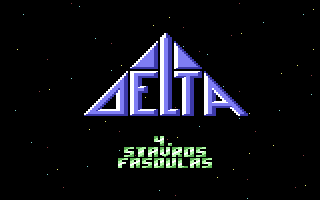
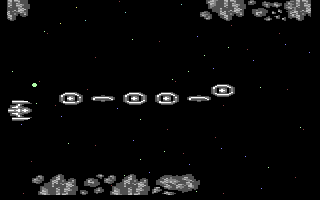
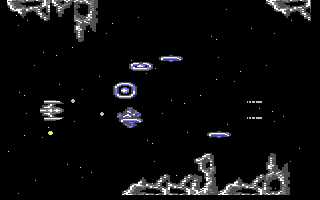
Delta arrived in 1987 as Stavros Fasoulas's second Thalamus title and demonstrated that Sanxion had not exhausted his ambition. The game is a vertically scrolling shoot-em-up of genuine quality - but the mode of the game's cultural impact had little to do with the scrolling or the shooting. It had to do with what happened while the game loaded from cassette.

Gary Liddon, Thalamus's technical executive, had been developing an idea for an interactive loading system rooted in the work of Nick Pelling, a British programmer whose experiments on the BBC Micro had suggested ways of making the loading period productively experiential rather than merely endured. Liddon recognised that the C64's tape loading architecture - which occupied the processor almost entirely during a load, leaving only marginal CPU cycles available - could nonetheless sustain a limited interactive application if designed with sufficient care. He brought Rob Hubbard into the project to provide the musical component, and the result was Mix-E-Load.

The collaboration between Liddon, Hubbard, and Fasoulas - programmer, system architect, and composer - produced something that was simultaneously a technical achievement, a creative achievement, and a marketing achievement. No other publisher had considered the loading screen as a canvas. Thalamus turned it into the most talked-about feature in the British gaming press that year.

Technical Innovation: Mix-E-Load

Mix-E-Load is the most imaginative use of enforced downtime in video game history. While Delta's game data transferred from cassette in the background - a process occupying several minutes - the C64 presented players with a fully functional music remixer built around Rob Hubbard's Delta soundtrack.

The technical challenge was formidable. C64 tape loading monopolises the 6510 processor almost entirely: the timing-sensitive serial protocol that reads data from the cassette motor requires interrupt-driven routines that leave only a handful of CPU cycles per raster line for any other activity. Implementing a real-time interactive application within those constraints required careful partitioning of the available processor time - identifying the gaps between loading interrupt pulses and exploiting them for interface rendering and user input processing.

The SID chip's three-voice architecture was used in full. Players could manipulate individual voice parameters - adjusting envelope settings, switching between musical phrases, altering the relative volumes of the bass, lead, and harmony voices. The temporal structure of Hubbard's music was exposed as a modular system, and the player became its remix engineer for the duration of the load.

The experience was fundamentally different from any passive loading screen. The loading wait - typically experienced as dead time to be tolerated - became a creative engagement in its own right. Players who bought Delta would describe their Mix-E-Load sessions to friends, sharing the specific combinations they had found. The loading screen had become content.

Rob Hubbard's Delta Soundtrack

The Delta soundtrack is Rob Hubbard's most ambitious SID composition and one of the most discussed pieces of music in the entire C64 repertoire. The score represents a deliberate departure from the conventions of game music in 1987 - music conceived not as accompaniment to action but as an autonomous artistic statement capable of sustaining attention in its own right.

Hubbard's acknowledged influences for the Delta score were Pink Floyd and Philip Glass. The Pink Floyd influence is audible in the score's atmospheric density - the way textural layers accumulate and recede, the preference for sustained timbres over staccato melodic lines, the sense of space and weight in the arrangement. The Philip Glass influence is apparent in the music's minimalist procedural logic - phrases that repeat with incremental variation, structures that evolve slowly through additive and subtractive processes rather than conventional harmonic development.

On the SID chip's three voices, Hubbard achieved a timbral palette of unusual warmth and complexity. The chip's voltage-controlled filter - a feature that distinguishes the SID from contemporary synthesiser chips - was used to sculpt the frequency content of each voice dynamically, producing a sense of tonal motion that transcended simple melodic variation. The resulting sound was genuinely original: neither conventionally "electronic" nor conventionally "game music", but something occupying its own category that listeners of the period had no prior framework to classify.

The fact that Mix-E-Load made this music interactive - allowing players to remix it in real time - was the definitive act of the Thalamus artistic project. It insisted that game music could be more than background. It insisted that players could engage with it as participants. Four decades later, the Delta SID recordings remain among the most studied and celebrated artefacts in 8-bit audio history.

Legacy

Delta's game itself - the shooting, the vertically scrolling levels, the power-up system designated by Greek letters - is very good. It would be an admirable Thalamus title if the loading screen had been merely a static image. But the Mix-E-Load innovation transformed Delta from a game into an event, and its influence on how developers and publishers thought about the full user experience of a software product was tangible in the years that followed.

No subsequent C64 publisher replicated Mix-E-Load with equivalent ambition. The idea of using enforced wait time as creative space has persisted in games development thinking ever since, surfacing in loading screen mini-games from the PlayStation era onward. Delta did it first, and still did it best.

1988 Commodore 64 Cyberdyne Systems

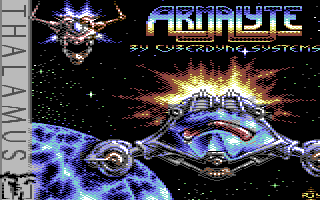
Armalyte

The C64's finest shoot-em-up and Thalamus's commercial zenith

Development Story

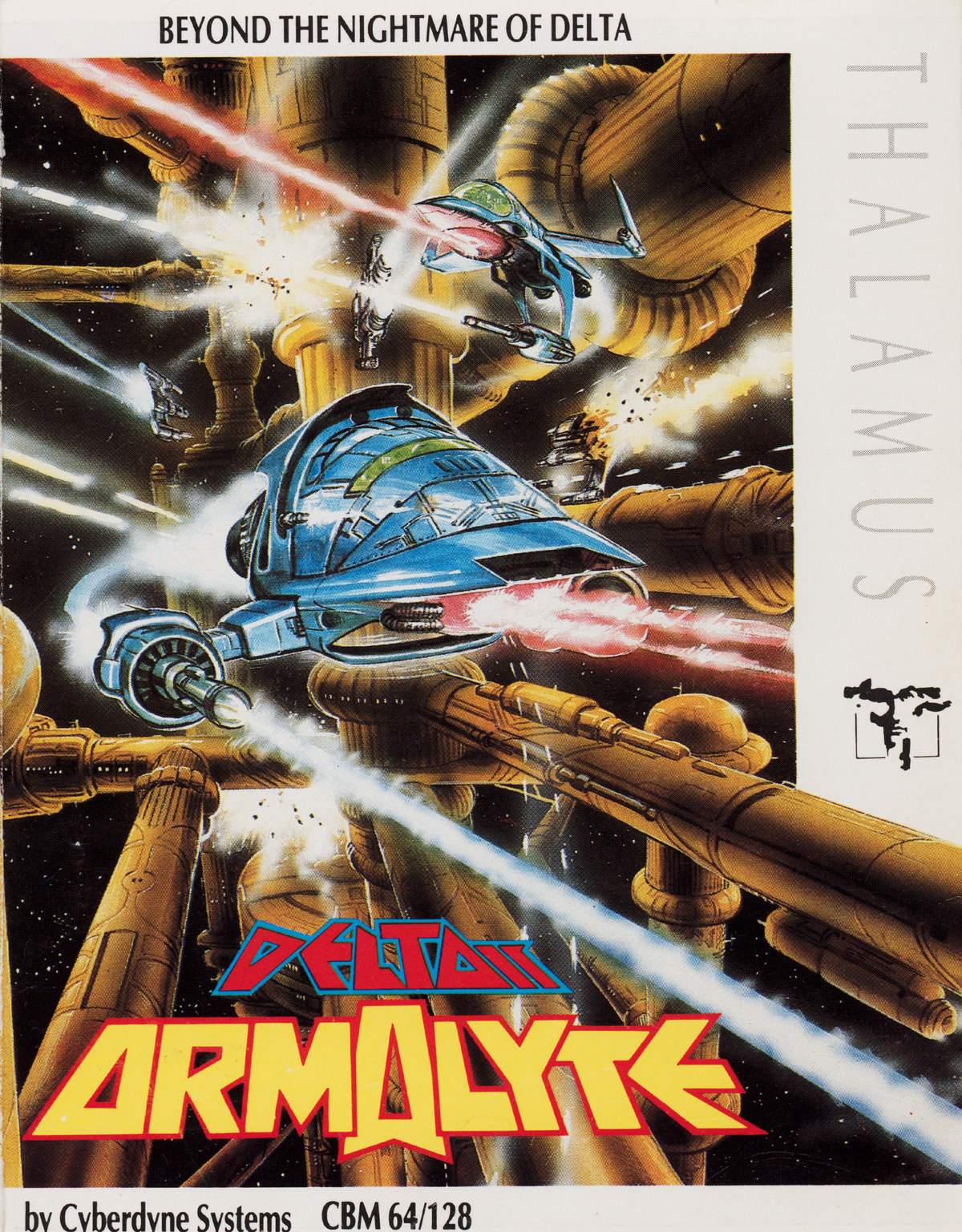
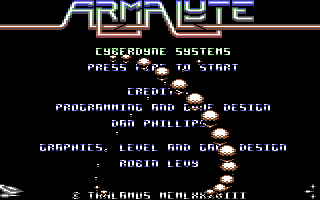
Armalyte was developed by Cyberdyne Systems - the trading name of Colin Dooley and Daniel Emmerson - with additional programming by Martin Walker, who also composed the entire musical score. The game's development history is less well documented than its reception, but the quality of the final product makes it clear that the team worked with exceptional rigour and ambition.

Thalamus signed Cyberdyne Systems based on the quality of demo work Dooley and Emmerson had produced - both were known within the C64 development community as technically exceptional programmers capable of effects that other developers would not attempt. Martin Walker joined the project as a contributor whose own Thalamus track record - Hunter's Moon - demonstrated both programming capability and compositional skill. The resulting team was arguably the most technically concentrated collaboration in C64 game development history.

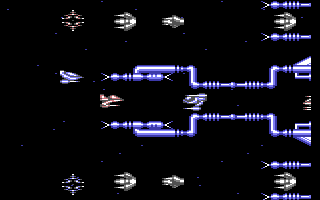
The game took clear creative inspiration from Konami's R-Type arcade system - the horizontal scrolling format, the droid companion mechanic, the measured pacing that rewarded pattern learning over reflexes - but executed these concepts with a level of technical polish and design refinement that matched and frequently exceeded the arcade original. That a home computer game could credibly be compared to an arcade machine was itself significant; that it could exceed that machine in certain respects was a remarkable achievement.

Technical Innovation: The Droid Companion System

Armalyte's most distinctive design feature - the droid companion - is also its most strategically significant. The droid is a secondary weapon pod that follows the player's ship, absorbs some incoming fire, and provides supplementary firepower oriented in a direction determined by its position relative to the player's ship. Players who learn to position the droid deliberately - ahead of the ship, behind it, above or below - can adapt their combined attack and defensive profile to the specific threat topology of each screen.

The droid mechanic transforms Armalyte from a straight reflex exercise into a spatial tactics problem. Advanced players learn to read approaching formations and reposition the droid before the threat arrives, thinking several seconds ahead of the action. The droid also provides a forgiving layer of defensive cover for players still developing their skills: a hit absorbed by the droid is not fatal, where an equivalent hit on the main ship would be. This tiered survival system makes Armalyte accessible to beginners while rewarding mastery with substantially enhanced offensive capability.

The implementation of the droid within Armalyte's sprite system is technically impressive. Tracking the relative position of two ships under fire, calculating droid orientation, and rendering both entities alongside the multiple enemy sprites that Armalyte routinely displays demanded tight, optimised code. The frame rate never dropped. The scrolling never tore. Under conditions of maximum on-screen activity that would have caused other C64 games to stutter and slow, Armalyte maintained absolute composure. This smoothness was not accidental - it was the product of machine-code discipline of the highest order.

Martin Walker's Score

Martin Walker's musical contribution to Armalyte is frequently overshadowed by the game's visual and programming achievements, but it represents some of the finest SID composition in the C64 catalogue. Walker composed and implemented the entire score while simultaneously contributing code to the game's engine - a dual contribution that would be remarkable for any developer.

The Armalyte soundtrack maintains a consistent tonal character across its multiple pieces: urgent but controlled, technically accomplished, with a harmonic sensibility that complements the game's visual density without competing with it. Walker deployed the SID's arpeggio and filter capabilities with particular skill, creating melodic lines of clarity and drive that sit naturally under the gameplay action. The music escalates in intensity in parallel with the game's difficulty, providing effective emotional calibration to the player's experience.

Commercial Peak: Number One in Europe

Armalyte reached number one in the European software charts in 1988 - a commercial validation without precedent for a Thalamus title and one of the most significant achievements in the history of C64 software.

The context makes the achievement more remarkable. By 1988, the Commodore Amiga and Atari ST were established commercial realities. Both were substantially more powerful than the C64, with superior colour depth, sampling-capable sound hardware, and processing headroom that made certain visual effects categorically easier. The majority of the European software market's most prominent new releases were on 16-bit platforms. That a C64 game - on a machine launched in 1982, now six years into its commercial life - could reach the top of the European charts against 16-bit competition was a definitive statement about both Armalyte's quality and the continuing vitality of the C64 audience.

Armalyte was reviewed by Zzap!64 with an overall score of 96% - one of the highest scores the magazine ever awarded to any game on any platform. Subsequent community assessment has been uniformly consistent with that verdict. Armalyte appears at or near the top of virtually every authoritative "best C64 games" list, and its position in the community's esteem has never been seriously challenged. Forty years of retrospective assessment have not dimmed the consensus: Armalyte is the finest horizontal shoot-em-up ever released on the Commodore 64.

1990 Commodore 64 Rowlands Brothers

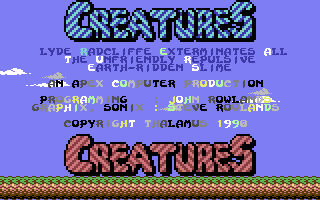
Creatures

The graphical peak of 8-bit platform gaming

Development Story

By 1990, the C64 was eight years old. The games press had largely migrated its attention to the Amiga and the Atari ST. The mainstream gaming conversation treated the C64 as a legacy platform - admirable in its history, but effectively exhausted as a creative medium. Creatures, developed by Steve and John Rowlands, demonstrated with categorical force that this assessment was wrong.

The Rowlands Brothers had joined the Thalamus stable with Retrograde (1989) - a strong horizontal shooter that established their reputation as programmers of exceptional graphic skill. Creatures was their full statement. Where Retrograde had demonstrated what the Rowlands Brothers could do in a familiar genre, Creatures demonstrated what they could do when given the freedom to develop a game on their own terms.

The game was a platform game in the tradition of Jet Set Willy and Manic Miner, but executing in that tradition at a level of visual sophistication that its predecessors would not have recognised as belonging to the same technical category. Steve Rowlands handled the primary programming; John Rowlands contributed graphics and design; Steve Turner (performing under the scene name Steve Rowlands) provided the musical score. The collaborative dynamic produced results that could not have been achieved by any one of them working alone.

Technical Innovation: Sprite Multiplexing and Colour Cycling

Creatures' visual achievement rests on two techniques applied with extraordinary precision: sprite multiplexing and colour register cycling.

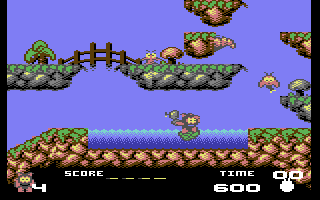
Sprite multiplexing is the same technique Fasoulas used in Sanxion, but applied to a much richer visual context. The VIC-II chip supports eight hardware sprites simultaneously; multiplexing creates the impression of more by reusing the same sprite registers multiple times within a single video frame. Each time the raster beam passes a point on the screen, interrupt-driven code can reposition and reconfigure the sprite hardware to display a different sprite in a different location lower on the screen. The technique requires cycle-precise interrupt timing - any deviation by a single CPU cycle causes visible glitching. The Rowlands Brothers' implementation was flawless: Creatures displays character sprites of exceptional detail and animation smoothness that would be impossible on unhacked VIC-II hardware.

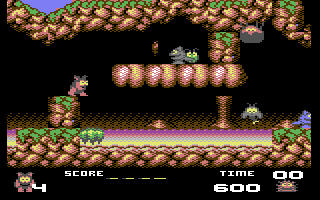
Colour register cycling exploits the C64's character mode colour system. The VIC-II assigns colours to 8×8 pixel character cells; by modifying the colour registers on a per-raster-line basis using interrupts, programmers can create backgrounds with apparent colour depth that far exceeds the hardware's nominal sixteen-colour capability. The Rowlands Brothers used colour cycling to produce background environments of startling richness - gradients, atmospheric effects, and spatial depth that many players simply refused to believe were possible on a C64.

The combination produced visuals that contemporary reviewers compared to the Amiga - not as hyperbole but as a genuine technical assessment. Players upgrading from the C64 to 16-bit machines would discover that the visual gap was smaller than expected, partly because Creatures had already pushed the C64 to within touching distance of 16-bit capability in certain rendering categories.

Gameplay and the Torture Chamber

Creatures' platform game design is characterful, inventive, and laced with a distinctive British humour that was unusual in commercial game design of the period. The protagonist - Clyde Radcliffe, a furry creature of cheerful disposition - navigates elaborately designed levels populated by enemies of considerable visual variety and personality. The level design escalates in complexity at a considered pace, introducing new hazards and mechanics progressively without overwhelming the player.

The game's most notable gameplay innovation is its bonus torture chamber sequence. At the end of each level, captured enemies could be subjected to elaborately comic methods of despatch - methods that were gently grotesque rather than genuinely violent, presented with a theatrical irreverence that was entirely in keeping with the game's overall tone. Players who completed a level with enemies captured (rather than simply destroyed) were rewarded with these sequences, providing an incentive to play more strategically and offering entertainment considerably beyond the expected arcade bonus screen.

The torture chamber sequences were technically accomplished in their own right, featuring animations of considerable detail and humour. They became one of the most discussed features of the game and contributed significantly to its cultural impact - players who had not experienced them sought them out; players who had experienced them described them to friends. The sequences were, in their way, the Mix-E-Load of Creatures: a feature that made the game an event rather than merely a product.

Legacy

Creatures received outstanding reviews across all remaining C64 publications and is consistently ranked among the five greatest C64 games ever released. Its position in the C64 community's esteem is not merely a function of technical achievement - though that achievement is remarkable - but of the completeness of its execution as a game. The graphics serve the gameplay; the gameplay serves the game's tonal identity; the tonal identity is coherent throughout. Creatures is a finished work, and finished works of this quality are rare at any point in gaming history.

The game was proof that the C64 was not exhausted. It was proof that the C64 development community still contained individuals with the skill and vision to extract performance from the hardware that its designers had not anticipated. Creatures made that proof undeniable, and the Rowlands Brothers' sequel - released two years later - made it even more emphatic.

1992 Commodore 64 Rowlands Brothers

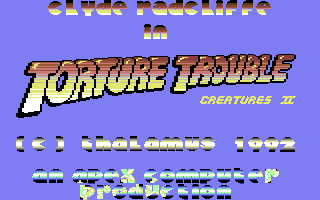
Creatures II: Torture Trouble

The impossible sequel - more from a machine that had nothing left to give

Development Story

Creatures II: Torture Trouble was released in 1992 - the same year that Wolfenstein 3D was redefining PC gaming, two years after the Amiga had fully established itself as the dominant European home computer platform, and substantially past the point at which any commercial rationale for C64 software development could be defended to a disinterested observer. Steve and John Rowlands made it anyway.

The decision to return to the C64 with a sequel - rather than port Creatures to the Amiga or develop a 16-bit original - says something fundamental about the Rowlands Brothers' relationship to the C64 as a creative medium. The machine was not merely a delivery platform for them. It was the specific constraint system within which they had developed their craft, and the challenge of extracting more from it than they had extracted from it before was a sufficient creative motivation in itself.

By 1992, the C64 software market was a fraction of its mid-1980s scale. Thalamus itself was in its final period of operation, and the commercial case for any C64 title was marginal at best. That Thalamus continued to publish C64 software of this quality in these market conditions speaks to the publisher's continued creative commitment even as financial pressures mounted. Creatures II was one of Thalamus's last C64 releases, and it is among its finest.

Technical Achievement: Beyond the Original's Limits

The defining question posed by Creatures II is whether the Rowlands Brothers, having produced what was by consensus the most visually impressive C64 game in existence, could improve upon it. The answer was yes. By a significant margin.

The technical techniques deployed in Creatures II - sprite multiplexing, raster interrupt colour cycling, character mode background rendering - are the same techniques used in the original. What differs is the precision and density of their application. The character animations in Creatures II are more detailed and more smoothly interpolated. The background environments are more elaborately decorated, with more colour information per screen than the original's already remarkable backgrounds. The sprite multiplexer handles more active sprites per frame, with tighter interrupt timing that produces less visual artefacting under conditions of maximum screen activity.

The net result is a game that looks, by any reasonable measure, better than its 1990 predecessor - which itself already looked better than any other C64 game produced up to that point. This iterative improvement within a fixed hardware constraint represents one of the most impressive technical progressions in 8-bit game development: not the result of new hardware capabilities but of refined understanding of the hardware that existed, applied with greater skill and confidence than before.

The colour cycling in Creatures II achieves effects in background rendering that, to an uninformed observer, suggest hardware capabilities beyond the C64's actual specification. Smooth colour transitions, apparent anti-aliasing, and atmospheric lighting effects were all produced on a machine with a fixed sixteen-colour palette and no hardware blending. The effect was achieved purely through careful timing of palette register modifications at specific raster positions - a technique that requires complete command of the VIC-II's interrupt system and the discipline to exploit that command without introducing instability into the game's frame rate.

Design Evolution: Torture Trouble

The game's subtitle - Torture Trouble - signals from the outset that the bonus torture chamber sequences, a highlight of the original game, would receive expanded treatment in the sequel. This promise is delivered thoroughly. Creatures II's torture sequences are more elaborate, more varied, and more extreme in their comic grotesquerie than those of the first game. The enemy roster is more diverse, providing more varied subjects for the torture interactions; the torture methods themselves are more inventive, with improved animation fidelity that makes the comedy more effective.

The platform gameplay itself is more demanding than the original, with level design that exploits the player's familiarity with Creatures' mechanics and introduces complications accordingly. The game is not merely harder; it is more precisely calibrated to the experienced Creatures player. This calibration is a form of respect for the audience - the expectation that players who have completed the first game will arrive with formed skills that the sequel can challenge at a higher level.

Historical Context and Significance

Creatures II was not a game produced in response to market demand. The C64 market of 1992 could not have generated a meaningful commercial justification for a C64 platform game of any quality, let alone one requiring the development investment the Rowlands Brothers clearly made. The game was produced because its creators believed the C64 had more to give, and they were correct.

Its historical significance is twofold. First, as a technical artefact: it represents the practical ceiling of what sprite multiplexing, raster interrupt colour manipulation, and character-mode rendering could achieve on the 6510-based C64 hardware. No subsequent C64 game produced comparable visual results in the platform genre. Second, as a cultural statement: Creatures II asserted, in 1992, that the quality of creative work is independent of the age or power of the hardware on which it is produced. Genius matters more than specification.

That assertion remains as true in 2026 as it was in 1992. Creatures II is a game that stands entirely on its merits, without apology or qualification for the hardware on which it runs. In this respect, it is the purest expression of the Thalamus philosophy - a philosophy that the best games are made not by the best hardware but by the best programmers.