Three deep dives into the games that built the System 3 reputation. Full catalogue in Games. Composer profiles in People. SID music in Music.
The Last Ninja (1987)
Programmer: John Twiddy - Artist: Hugh Riley - Composers: Ben Daglish, Anthony Lees - full entry in Games - composer profiles in People
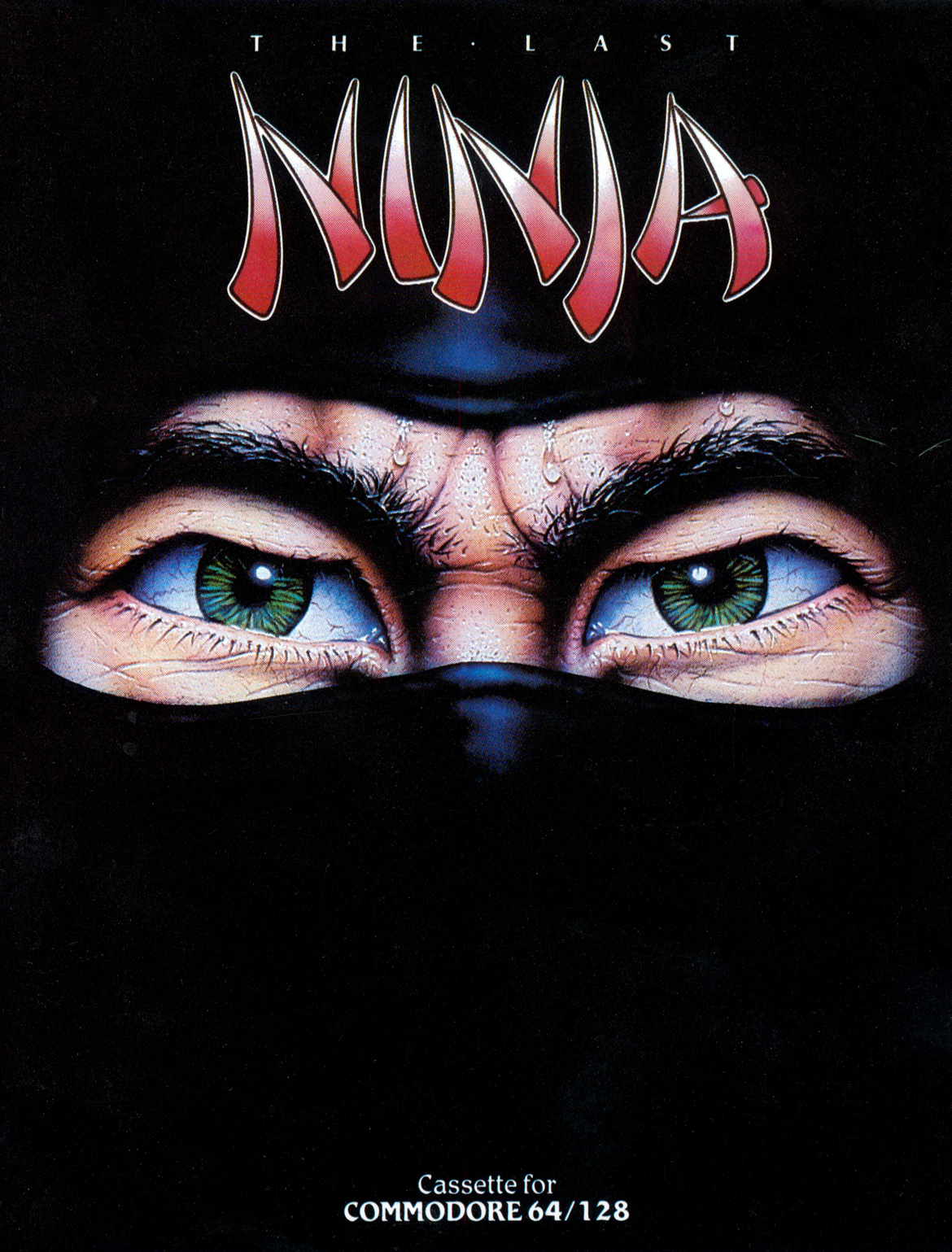
The Last Ninja C64 box art. The game shipped in 1987 and became the best-selling C64 title of that year.
Six Stages Between Garden and Palace
The Last Ninja arrived in 1987 as an isometric action-adventure with a premise as stark as its cover art: Armakuni, the last surviving member of the Koga ninja clan, must cross six stages of feudal Japan to confront the shogun Kunitoki. The game begins in the manicured gardens of Lin Fen and ends inside the shogun's palace, passing through caves, a wilderness, a village, and a mountain shrine along the way. Each stage is a self-contained environment requiring the player to collect weapons, items, and equipment before moving on - progress accumulates, and there is no returning to pick up what was missed.
Nothing else on the C64 looked like it. John Twiddy's isometric engine placed the player inside a pre-rendered three-dimensional world, and Hugh Riley's pixel artwork gave each stage a visual identity distinct from anything else in the machine's catalogue. The combination attracted immediate critical attention and drove the game to number one on the UK charts within weeks of launch, where it held a position for months.
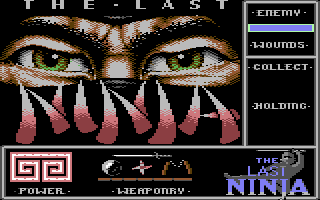
The opening stage of The Last Ninja: Lin Fen gardens, rendered in isometric perspective on C64 hardware. The pre-rendered sprites required a purpose-built depth-sorting engine.
John Twiddy's Isometric World
Twiddy had to solve a problem no C64 programmer had tackled at commercial scale before: how to render a convincing isometric environment on hardware with no dedicated 3D capability, a single-chip processor running at approximately 1 MHz, and 64 kilobytes of RAM. The approach he settled on was to pre-render every sprite at every required isometric angle, store those images in ROM, and write a depth-sorting algorithm that would place them in the correct layering order as the player moved through the space.
The depth-sorting was the critical engineering challenge. In a flat 2D game, the order in which sprites are drawn rarely matters. In an isometric environment, the player must appear behind a wall when walking behind it and in front of a bush when walking in front of it - and these relationships change as the player moves. Twiddy's solution handled this in real time on hardware that contemporary developers widely considered incapable of supporting it.
The game was divided across multiple load stages, with different sections of the world stored on separate portions of the disk or cassette. Players had to reload between areas. On cassette, this meant minutes of waiting. The wait did not reduce the game's commercial appeal - most players simply accepted it as the cost of the experience the game delivered.
Weapons, Puzzles, and the Weight of a Single Life
Each stage of The Last Ninja follows the same structure: explore the environment, collect the weapons and items scattered across the map, and reach the exit. The player starts each stage unarmed and vulnerable. Weapons - shurikens, nunchaku, swords, staffs - are found in the environment and must be equipped before combat. Enemies patrol fixed routes and attack on contact. Health is a finite resource that does not regenerate between encounters, creating a cumulative pressure that builds across the game's six stages.
The combat system is simple by later standards - a handful of kicks, punches, and weapon strikes - but it is enough to require considered play. Running into an enemy without a weapon equipped is usually fatal. The game's level design channels the player toward confrontation while providing enough space to plan each encounter. Puzzle elements are present but secondary: the real challenge is resource management and spatial orientation inside the isometric grid, which early players found genuinely disorientating until they learned its rules.
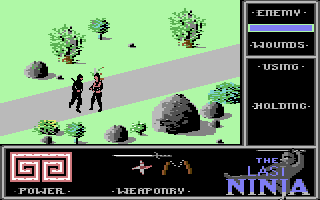
Combat in The Last Ninja: Armakuni engages a guard on a bridge. The isometric perspective required the player to adjust to a 45-degree view of all movement and attacks.
Depth-Sorting Feudal Japan on a 1-MHz CPU
The technical achievement of The Last Ninja was recognised immediately by the press and by other programmers. The C64's hardware architecture had not been designed with isometric rendering in mind. The machine's sprite system - eight hardware sprites, each eight pixels wide and 21 pixels tall - was useful for simple moving characters, but the layered, overlapping environments of an isometric world required software sprites drawn into the character memory instead. Twiddy built an engine that could draw, position, and depth-sort software sprites fast enough to maintain playable frame rates while the CPU was simultaneously handling game logic, input, and audio calls.
Hugh Riley's contribution to the technical presentation was equally significant. Each sprite in The Last Ninja had to be drawn at multiple angles and in multiple animation frames, all within the C64's tightly constrained colour palette. Riley produced pixel art that communicated three-dimensional space convincingly within those limitations, giving each environment a cohesive aesthetic that held up across the game's six stages.
Ben Daglish and Anthony Lees composed five distinct musical themes across the stages, each using the SID chip's three voice channels and its ring modulation and filter capabilities to produce music of an atmospheric density that few contemporary C64 soundtracks matched. The Lin Fen garden theme has been cited by SID composers and fans as one of the finest pieces ever written for the platform. The full soundtrack is available to listen to on the Music page.
I personally think that Ben's tunes are probably some of the best tunes ever.
Mark Cale, System 3 founder, on Ben Daglish's Last Ninja compositions - Time Extension, "We Were World Leaders: The History of System 3 and the Last Ninja", 2023
The Last Ninja series went on to sell over 23 million copies which is incredible.
Mark Cale, System 3 founder, Time Extension - "We Were World Leaders: The History of System 3 and the Last Ninja", 2023
Charts and Critical Acclaim in the Same Week
Zzap!64 scored The Last Ninja in its upper tier, awarding it marks that placed it among the highest-rated C64 games of the decade. The review singled out the isometric engine, the sprite work, and the soundtrack as each being individually exceptional, and noted that the combination produced an experience with no precedent on the platform. Crash magazine, Commodore User, and other UK publications followed with comparably enthusiastic coverage.
The commercial performance matched the critical reception. The Last Ninja sold strongly throughout 1987 and into 1988, reaching sales figures that Mark Cale, System 3's founder, has described as making the series one of the best-selling franchises in 8-bit gaming history. Independent verification of the specific numbers Cale has cited is not available, but the game's chart position and longevity in retail catalogues are documented. See Reviews for period press coverage of the game.
A stage overview from The Last Ninja. The game's level design was considered complex by 1987 standards, with multiple paths and item locations that rewarded exploration.
The Series That Refused to End
The Last Ninja's commercial success made sequels inevitable. Last Ninja 2: Back with a Vengeance arrived in 1988, transplanting Armakuni to modern New York City with the same isometric engine and a new Matt Gray soundtrack. Last Ninja 3 followed in 1991, returning to a Japanese setting with a Reyn Ouwehand score, completing the C64 trilogy. Last Ninja Remix appeared in 1990 as a C64 re-release of the original with revised graphics, and a NES conversion reached North American markets in the same year.
Beyond the C64, The Last Ninja was ported to the Amiga, Atari ST, DOS, and Apple II, with each version adapting the engine to different hardware. Mark Cale stated in a 2023 Time Extension interview that the combined Last Ninja series across all titles and all platforms sold over 23 million copies worldwide. This figure has not been independently corroborated, but the franchise's sustained commercial performance across platforms and its longevity in retail catalogues point to genuine scale. The in-depth article on Last Ninja 2 follows below.
International Karate+ (1987)
Programmer: Archer Maclean - Composer: Rob Hubbard - full entry in Games - Maclean and Hubbard profiles in People - Hubbard's score in Music
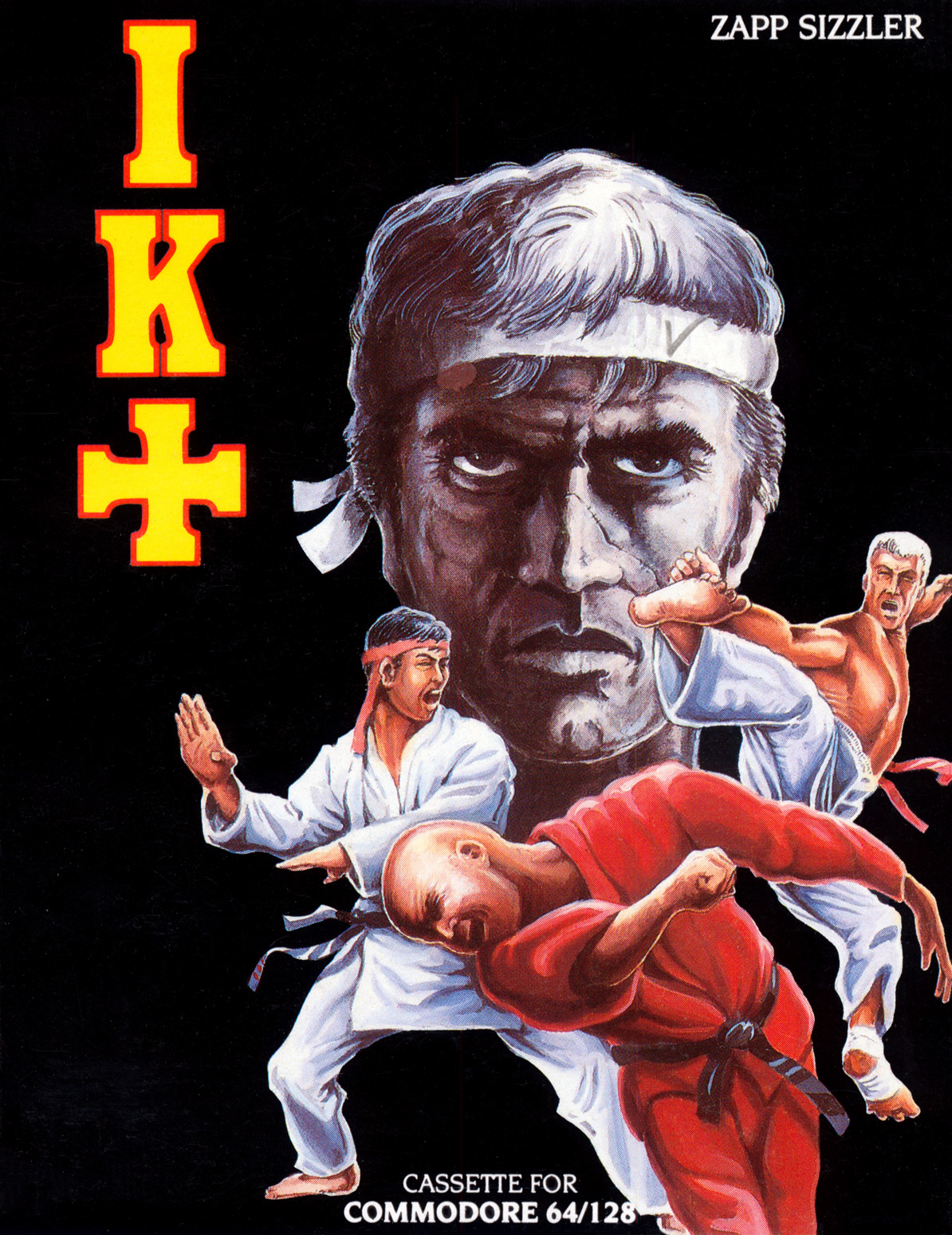
International Karate+ C64 box art. The game was published by System 3 in 1987, the same year as The Last Ninja.
Three Fighters, One Rotating Globe
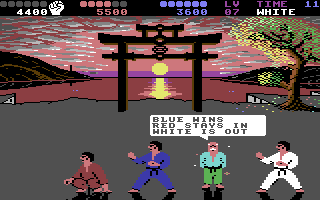
International Karate+ arrived in 1987 with a central mechanic that no other C64 fighting game had attempted: three simultaneous combatants on screen at once. Where every other 1987 fighting game placed one player against one opponent, IK+ placed one player against two AI fighters - or, in two-player mode, two human players against one AI - and ran all three at full animation speed on a single C64. The backdrop was a slowly rotating globe. Balloons drifted across the screen during fights. There were bonus stages between rounds. The game was technically outrageous, and it worked.
Programmer Archer Maclean had already built International Karate (1985/1986) for System 3 - itself a critically acclaimed one-on-one fighter that Rob Hubbard's soundtrack had helped propel to strong sales. IK+ was not a sequel in the conventional sense. It was a complete redesign built around the three-fighter concept, sharing the same martial arts theme but rebuilt from scratch to accommodate the additional combatant.
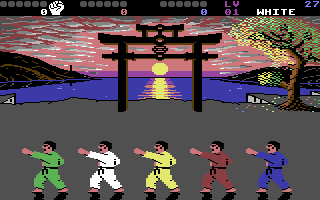
Three simultaneous fighters on the globe backdrop. The C64's hardware sprite system supported only eight sprites; three full-body fighters required extensive use of software-drawn sprites and hardware multiplexing.
Maclean Built It Himself
Archer Maclean developed IK+ largely independently. His approach to C64 programming had always been characterised by close attention to hardware constraints and a willingness to find solutions that other developers considered impossible. IK+ extended this approach to its limit: the animation system that made the three fighters move smoothly required hand-optimised assembly code running close to the processor's maximum throughput, and the collision detection system had to evaluate three fighter positions simultaneously rather than two.
Maclean's animation philosophy centred on weight and momentum. Each fighter in IK+ decelerates realistically before reversing direction, attacks have distinct wind-up and recovery frames, and falls and throws play out with genuine physical consequence. This commitment to realistic movement was unusual in 1987, when most fighting games prioritised responsiveness over simulation. The result was a game that felt different to control - more considered, more physical - than its contemporaries.
The balloon bonus stage between rounds, a comedic interlude in which fighters punch floating balloons for points. The stage was unusual for a fighting game of the period and contributed to the game's distinctive personality.
The Third Fighter Changes Everything
In a two-fighter game, the player has one variable to manage: the opponent's position and actions. In IK+, the player must account for two opponents simultaneously while avoiding being caught in a pincer. The dynamic changes the fundamental character of every engagement. Retreating from one fighter often places the player in range of the second. Attacking one opponent opens the player's back to the other. The balloon bonus stage - a brief interlude between rounds in which all three fighters punch floating balloons - provided comic relief that balanced the intensity of the main bouts.
The game offered a scoring system that rewarded throws, sweeps, and combination attacks, and a configurable difficulty setting that adjusted both the AI's aggression and the point requirements between rounds. Players who wanted a quick bout could configure the game for short matches; those who wanted a serious test could increase the requirements until only perfectly executed combinations would satisfy the scoring threshold.
IK+ in mid-bout. The game's animation system gave each strike and throw a physical weight that was unusual in 1987 fighting games.
Smooth at 50fps with Three Combatants
The C64's hardware sprite system provided eight sprites of fixed dimensions. A single full-body fighter required multiple sprites for its constituent body parts; three simultaneous fighters required a sprite count that the hardware could not supply without multiplexing - cycling the same sprite positions across multiple uses within a single frame, relying on the display beam's movement to prevent flicker. Maclean's multiplexing implementation ran cleanly enough that the three fighters appeared solid and stable. The global backdrop rotation added a further real-time calculation burden that ran without compromising the fighter animation.
Rob Hubbard's soundtrack matched the game's technical ambition. His score for IK+ used all three of the SID chip's voice channels continuously, with a driving bass line, a melodic theme, and percussion cycling through arpeggiated chords at a tempo that suited the game's rhythm. The IK+ title music became one of the most recognised pieces of C64 music in the UK. Full coverage of Hubbard's SID work is on the Music page.
As soon as he passed we just pulled the plug on it because it wasn't the same.
Mark Cale, System 3 founder, on the IK++ project following Archer Maclean's death - Time Extension, "We Were World Leaders: The History of System 3 and the Last Ninja", 2023
An Epyx Lawsuit and a String of Near-Perfect Scores
IK+ received exceptional reviews across the UK specialist press. Zzap!64 placed it among the highest-rated games of 1987. Commodore User and Crash ran similarly strong coverage, with reviewers singling out the three-fighter mechanic, the animation quality, and the Rob Hubbard soundtrack as individually worthy of the highest scores. The game sold strongly through 1987 and was ported to the Amiga, Atari ST, and DOS - platforms where the greater hardware resources allowed full graphical fidelity without the sprite-multiplexing demands of the C64 version.
The Epyx legal situation was resolved through territorial product naming rather than litigation - IK+ launched in the UK and Europe under its original name while the US received the Chop N' Drop release. The resolution allowed the game to reach its full commercial potential without protracted legal delay. See Reviews for period critical coverage.
The C64 Fighting Game Nobody Has Superseded
No subsequent C64 fighting game produced the three-simultaneous-fighter mechanic with IK+'s animation quality. The game was ported and re-released across multiple generations - the Amiga CD32 received a version in the early 1990s, and the game has appeared on modern digital distribution platforms through System 3's ongoing re-release programme. Archer Maclean went on to further acclaimed work: Dropzone, Jimmy White's Whirlwind Snooker, and Mercury. IK+ is consistently cited in C64 retrospectives as among the ten greatest games the machine produced. Maclean died on 17 December 2022; his contribution to C64 gaming is documented in his People profile.
Last Ninja 2: Back with a Vengeance (1988)
Programmer: John Twiddy - Artist: Hugh Riley - Composer: Matt Gray - full entry in Games - composer profile in People - Matt Gray's score in Music
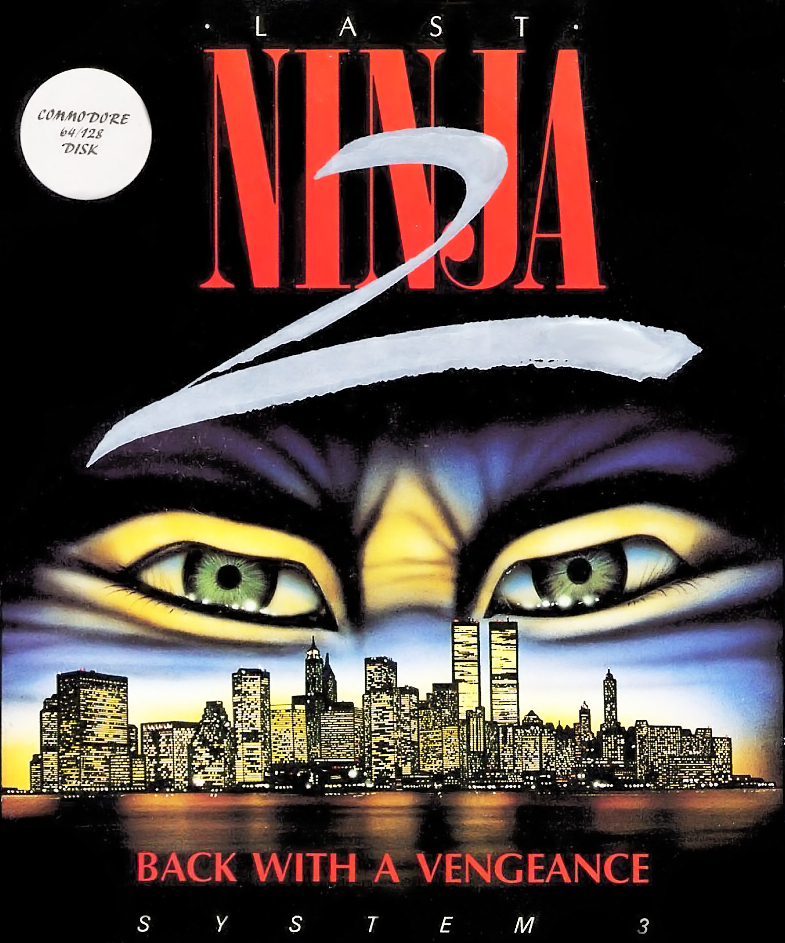
Last Ninja 2 box art. The sequel shipped in 1988, one year after the original, with a new New York City setting and a Matt Gray soundtrack.
From Feudal Japan to Manhattan
Last Ninja 2: Back with a Vengeance arrived in 1988 with one of the more audacious conceptual shifts in 8-bit gaming. Where The Last Ninja had placed its ninja protagonist in a convincingly realised feudal Japan, the sequel dropped Armakuni into modern-day New York City. The shogun Kunitoki had been transported forward in time by dark sorcery; Armakuni followed. The result was a game in which a C64 ninja navigated Central Park, a Manhattan apartment block, a sewer system, and the roof of a skyscraper - environments with no precedent in the isometric genre.
The creative risk paid off. The New York setting gave Hugh Riley a completely new visual vocabulary to work with, and his pixel art captured the urban environment with the same quality he had brought to the gardens and palaces of the first game. John Twiddy's isometric engine ran the new environments without modification - the depth-sorting and sprite systems transferred cleanly from feudal Japan to twentieth-century Manhattan, demonstrating the robustness of the original architecture.
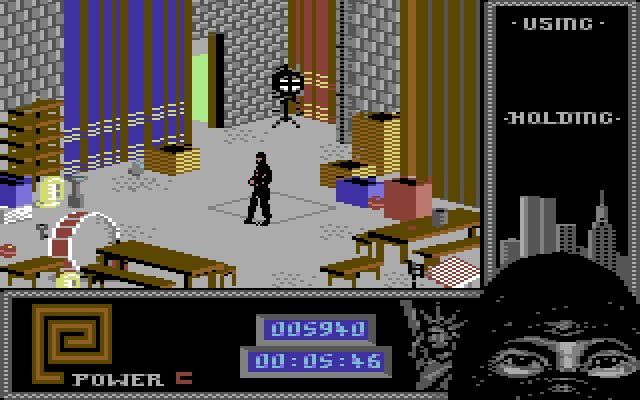
Last Ninja 2 in play: Armakuni navigating a New York stage. The urban environments required Riley to design entirely new sprite sets while maintaining visual coherence with the first game's isometric style.
New York on Eight Bits
The decision to set the sequel in New York originated with System 3. Mark Cale has described the reasoning in interviews as wanting to take the series somewhere genuinely unexpected - a feudal sequel would have been commercially safe but creatively inert. The New York setting forced the development team to solve visual problems the first game had never encountered: modern buildings, urban infrastructure, twentieth-century props, and enemies dressed in contemporary clothing rather than historical costume.
Riley approached these challenges by designing new sprite sets from scratch while keeping the isometric projection and the colour discipline consistent with the original. The Central Park stage reuses elements of garden-level design from The Last Ninja but populates them with contemporary props - park benches, hot dog carts, water fountains. The apartment and rooftop stages required Riley to render interiors and exteriors with furniture, fire escapes, and city skylines. The overall visual quality matched and in some areas exceeded the first game.
Six Stages Across the City That Never Sleeps
Last Ninja 2 followed the structure of the original: six stages, each requiring the player to explore the environment, collect weapons and items, and find the exit. The New York stages - Central Park, the city streets, a basement, a sewage system, an apartment, and a rooftop - provided a variety of visual environments while maintaining the gameplay loop that players of the first game would recognise immediately. New enemy types in contemporary clothing replaced the samurai and guards of the original, and the weapon set was updated to reflect the modern setting while retaining the martial arts character of the series.
The combat system received refinements from the original, with smoother animation transitions and more responsive controls. The difficulty was calibrated to challenge players who had completed the first game without being impenetrable to newcomers. Players who completed Last Ninja 2 were well-prepared for Last Ninja 3 (1991), which returned to a Japanese setting with a Reyn Ouwehand soundtrack.
Commissioned artwork for Last Ninja 2. The New York setting gave artists the opportunity to depict Armakuni against an urban backdrop - a visual contrast that became central to the game's identity.
Urban Isometrics and a SID Masterclass
Twiddy's engine had been built with enough architectural headroom to handle the different visual requirements of the New York setting without fundamental revision. The depth-sorting algorithm worked as well on modern urban geometry as it had on Japanese garden design. The larger sprite counts required by some urban environments - pedestrians, vehicles, urban furniture - required careful memory management, but the performance remained playable throughout.
Matt Gray's contribution to Last Ninja 2 is the element most frequently singled out in retrospectives. Where Ben Daglish and Anthony Lees had scored the original with five atmospheric themes keyed to the Japanese setting, Gray composed a suite of tracks for the sequel that used the SID chip's capabilities with technical precision and musical ambition in equal measure. The Central Park theme, the sewers theme, and the game's main title music are cited repeatedly in C64 music discussions as among the finest pieces written for the platform. Gray used the SID's filter sweep capabilities to produce bass lines that moved in ways conventional digital audio of the period could not replicate, and his chord voicings gave the urban setting a cinematic quality that suited the game's larger-than-life premise. Full coverage of Gray's SID work, with audio player, is on the Music page.
Better Than the Original, Some Said
The critical reception for Last Ninja 2 was strong across the UK press. Zzap!64 awarded it scores comparable to the original, with reviewers noting the improved controls and the strength of Matt Gray's soundtrack alongside the visual ambition of the New York setting. Commodore User and Crash were similarly enthusiastic. The novel setting attracted coverage in outlets that had not reviewed the first game, giving the sequel a wider profile than a straightforward feudal sequel would have reached.
The game sold well enough to warrant a third instalment. Last Ninja 3 arrived in 1991 with Reyn Ouwehand on composition duties, completing the C64 trilogy. The series also expanded to the Amiga, Atari ST, and DOS, with each platform port handled to varying degrees of fidelity. Period reviews are collected in Reviews.
If you look back into the history of retro gaming...we were world leaders at that time.
Mark Cale, System 3 founder, Time Extension - "We Were World Leaders: The History of System 3 and the Last Ninja", 2023
Matt Gray's Score and the Bar It Set
Last Ninja 2's soundtrack has had a longer afterlife than most C64 game music. Matt Gray has performed the music live at C64 and retro gaming events in the UK and Europe, and fan-arranged versions of the Central Park and title themes have accumulated substantial listening figures on YouTube. The High Voltage SID Collection (HVSC) includes Gray's original SID files, and they have been remixed and covered more frequently than most other C64 compositions.
The game's combination of setting innovation, visual quality, and musical ambition gives it a reputation that has grown rather than faded in the decades since its release. Players who came to it through Last Ninja 3 or later retrospectives frequently rate it above the original. System 3's decision to take the sequel to New York - a choice that could easily have read as gimmick - turned out to be the creative decision that gave the series its most distinctive single entry. The full Last Ninja series is catalogued in Games.