Super Mario Bros. 3 Longplay
A complete run through all eight worlds of Super Mario Bros. 3 — from World 1’s grasslands through the airships, giant enemies, and the ice world, to the final confrontation with Bowser in Dark Land.
1981 — 1996
From Jumpman in a Tokyo arcade to a plumber saving princesses in three dimensions — fifteen years that changed what video games could be.
1981
Donkey Kong
Jumpman debuts in arcades. The character who will become Mario is born under technical constraint.
1983
Mario Bros.
Jumpman is renamed Mario and joined by Luigi. The brothers work the sewers of New York.
1985
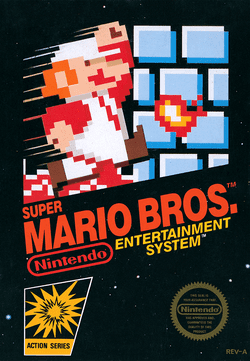
Super Mario Bros.
The NES launch title that redefined gaming globally. 40 million copies sold.
1988
SMB 2 & 3
Two sequels in one year: a reimagined western edition and the greatest NES game ever made.
1989
Mario Goes Portable
Super Mario Land launches with the Game Boy - a new team, new kingdoms, Princess Daisy’s debut.
1990
Super Mario World
SNES launch title. Yoshi’s debut. 96 exits. The pinnacle of 2D Mario.
1992
SML 2 & Wario
Super Mario Land 2 introduces Wario — anti-Mario, future franchise star.
1995
Yoshi’s Island
The Super FX2 chip powers a bold visual reinvention. Baby Mario, eggs, and a crying mechanic.
1996
Super Mario 64
The leap to 3D. An N64 launch title that defined third-person platforming for two decades.
Jumpman, Donkey Kong, and the birth of a character.
Mario was not designed — he was invented by necessity. In 1981, Shigeru Miyamoto was tasked with producing a game for Nintendo’s struggling arcade division using a Radar Scope cabinet. The result was Donkey Kong: a carpenter called Jumpman must rescue his girlfriend Pauline from a giant gorilla.
Jumpman’s design was driven entirely by hardware limitation. At the resolution available — roughly 16 × 16 pixels for a character sprite — hair was impossible to animate convincingly, so a cap was substituted. A mouth was too small to render, so a moustache defined the face. Overalls distinguished arms from the body in motion. The character was defined by what the hardware could not do.
In 1983, Mario Bros. gave the carpenter a profession (plumber), a surname (Mario), and a brother (Luigi). Designed for simultaneous two-player cooperation, the game was set in the sewers of New York, with Mario and Luigi battling turtles, crabs, and fighter flies by bumping platforms from beneath to flip enemies, then kicking them away.
Mario Bros. established the cooperative dynamic that would define the series’ two-player modes and introduced Luigi — a character who would eventually earn his own franchise, his own mansion, and an entire Year (2013) dedicated to him by Nintendo.
World 1-1. Eight worlds. The most important games in platform history.
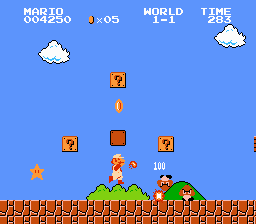
Super Mario Bros. launched alongside the Nintendo Entertainment System in North America in October 1985. The American video game market had collapsed in 1983 under a flood of low-quality Atari 2600 software. Nintendo repackaged the NES as a toy — complete with R.O.B. the robot — to get past skeptical retailers and created Super Mario Bros. as the system’s killer application.
The game’s design was revolutionary in its pedagogy. World 1-1 begins with a gap and a Goomba: the player must jump. A ? Block releases a mushroom that grows Mario larger. The player learns, without instruction, that blocks reward and that growing is good. By the time the player reaches the first castle, they understand physics, power-ups, enemies, and flagpoles — all taught through play. Miyamoto called this “obstacles that teach.”
Released in Japan in October 1988 and North America in February 1990, Super Mario Bros. 3 is widely considered the greatest NES game ever made. Eight themed worlds — each with an overworld map, distinctive aesthetic, and unique enemy roster — gave the game a sense of geography unprecedented in platform games. The Tanooki Suit, Frog Suit, and Hammer Suit expanded Mario’s power-up vocabulary dramatically.
SMB3 previewed in the 1989 American film The Wizard, starring Fred Savage, making it the first game in history to be genuinely famous in America before it was available to purchase. Queues formed outside stores on its February 1990 US release — a cultural moment unprecedented for a video game.
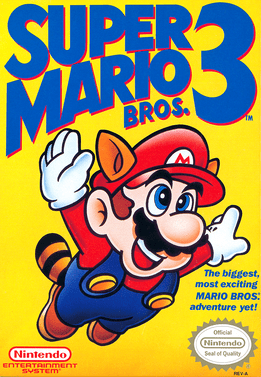
A complete run through all eight worlds of Super Mario Bros. 3 — from World 1’s grasslands through the airships, giant enemies, and the ice world, to the final confrontation with Bowser in Dark Land.
Yoshi’s debut. 16-bit masterpieces. The peak of 2D platform design.
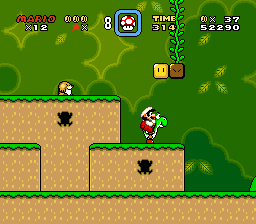
Yoshi — a rideable dinosaur Miyamoto had sketched for the original Super Mario Bros. but the NES hardware could not support — finally arrived with the SNES. Super Mario World launched with the Super Famicom in Japan (November 1990) and the SNES in North America (August 1991). The game showcased everything the SNES could do: a 512-colour palette, hardware-accelerated scrolling, sampled audio via the Sony SPC700 chip, and Mode 7 effects in the ghost house and Bowser stages.
Super Mario World features 96 exits across 72 stages — the largest Mario game yet. Many stages contain two exits, requiring players to find alternate paths. The hidden Star Road connects across the map to Bowser’s castle in a secret warp network; the Special Zone beyond it contains the game’s eight hardest stages, accessible only after clearing Star Road entirely.
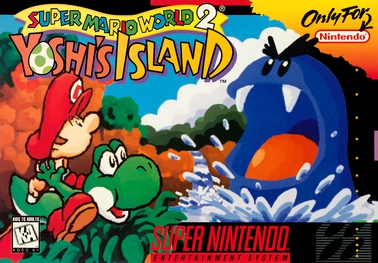
Super Mario World 2: Yoshi’s Island (1995) used the Super FX2 chip — an enhanced version of the co-processor used in Star Fox — to achieve its distinctive hand-drawn crayon-and-watercolour visual style. The game cast Yoshi and Baby Mario as protagonists, set in the past before Mario’s adventures in the Mushroom Kingdom.
The egg-throwing mechanic — swallow enemies, turn them into eggs, aim with a reticle and fire — replaced the simple jumping of previous games as the central skill expression. Flutter jumping, Yoshi vehicle transformations, and the 100-point completion system made it one of the most replayable entries in the series. Baby Mario’s crying when knocked from Yoshi’s back remains one of the most deliberately irritating sounds in platform game history.
I designed the underwater levels in Super Mario Bros. partly because I was afraid of the ocean. I wanted to put that feeling of unease into the game — the sensation of something coming from behind you in dark water. — Takashi Tezuka
Super Mario 64 and the invention of third-person gaming.
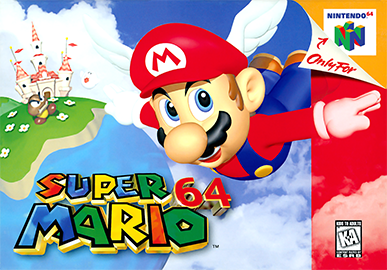
Super Mario 64 shipped as a Nintendo 64 launch title in June 1996 in Japan and September 1996 in North America. The game placed Mario inside Peach’s castle as a hub world, with 15 paintings serving as portals to self-contained 3D environments. The analogue stick of the N64 controller mapped directly to Mario’s movement speed: a gentle push walked, a full push ran. Backflips, triple jumps, wall kicks, and long jumps gave Mario a movement vocabulary that no 3D game had explored.
The camera system — controlled via the C buttons and operated in-world by a Lakitu character — was developed in parallel with the game itself. Miyamoto’s team observed that existing 3D games of the era were difficult to navigate because cameras were fixed. They invented the free-roaming third-person camera to solve the problem — and the entire industry followed. The BLJ (Backwards Long Jump) speedrunning technique that allows clipping through certain walls emerged from the physics system’s momentum accumulation.
What if everything looks perfect but it’s just not fun? That’s the most dangerous trap in game design. — Shigeru Miyamoto