Series History
How a mascot competition, a physics prototype, and a deadline-split cartridge produced the defining platform series of the 16-bit era.
1990–1991 — Creation
The Mascot That Challenged Nintendo
Sega's dominant console in Japan was losing ground to Nintendo in North America. The Game Boy had made handheld gaming mainstream, and the Super Nintendo was on the horizon. Sega's existing mascot, Alex Kidd, lacked the distinctive personality needed to anchor a marketing campaign against Mario. In 1990, Sega issued an internal competition for a new character.
Naoto Ohshima submitted three candidates: a man in pyjamas with a moustache modelled on Theodore Roosevelt, an aggressive bulldog, and a round blue hedgehog with spines and attitude. The hedgehog won the internal vote, partly on design strength and partly because programmer Yuji Naka had independently built a physics prototype featuring a rolling ball moving through looping curves - the two ideas were immediately recognised as a match.
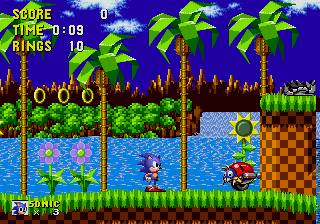
Naka's engine was the technical breakthrough that made Sonic possible. Rather than assigning a fixed speed to a left/right input, the engine modelled momentum across slopes: moving upward slowed the player proportionally, while descending a slope accelerated them naturally. Loops worked through centripetal calculations that kept Sonic attached to the track at speed and threw him off if he was moving too slowly. The result was a game where skilled players felt qualitatively faster than cautious ones.
Level designer Hirokazu Yasuhara joined the project to translate Naka's engine into playable stages. His design language - multiple routes, high paths rewarding speed and low paths rewarding caution, visible exits giving players spatial confidence - was developed from scratch during Sonic 1's production.
I wanted to make a game where speed was the mechanic, not just the theme. The physics of Sonic is not about going fast - it is about feeling the difference between going slow and going fast.
Sonic the Hedgehog launched in North America on 23 June 1991, bundled with the Mega Drive as a replacement for Altered Beast. The game sold 15 million units on the Mega Drive/Genesis, shifting the market balance decisively toward Sega and giving the company a platform identity it had never had before.
1992 — Expansion
Sonic 2 and the Transatlantic Development
After Sonic 1's commercial success, Sega established Sonic Team as a formal division and moved a core of its developers to the Sega Technical Institute (STI) in San Mateo, California. Sonic 2 was built across two offices simultaneously - Sonic Team Japan and STI - and the resulting communication friction would define both the game's strengths and its omissions.
The most significant addition was the spin dash, a mechanic born from a specific usability problem: playtesters hated losing all momentum when they took damage and were knocked backward, especially on slopes. The spin dash gave players a way to accelerate from a standing start by revving in place and releasing. It was added relatively late in development and became permanent in every subsequent Sonic title.
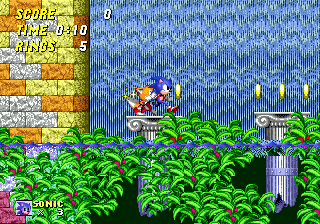
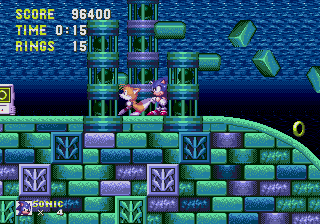
Tails was introduced as a playable second player - CPU-controlled in single-player, human-controlled in co-op - and the game introduced Super Sonic, the golden invincible form unlocked by collecting all seven Chaos Emeralds. The scope was nearly double its predecessor: eleven zones across nineteen acts. Hirokazu Yasuhara designed twelve zones, but Hidden Palace Zone and five others were cut before release under deadline pressure.
Sonic 2 launched on 22 November 1992 - a date Sega of America branded internally as "Sonic Tuesday," an unprecedented marketing event that sold over 400,000 units in North America on launch day alone.
Every level needs a path for the person who plays carefully and a path for the person who trusts their reflexes. Both players should feel that the level was made for them.
1993 — Divergence
Sonic CD and the Sega CD Experiment
Developed simultaneously with Sonic 2 but released as an exclusive for the Sega CD add-on, Sonic CD represented Sonic Team's vision of what the series could achieve with more storage and CD audio. Directed by Naoto Ohshima - his only directorial credit in the series - the game introduced a time travel mechanic that gave each zone four distinct visual states: Past, Present, Good Future, and Bad Future.
The time travel system transformed how the game's narrative was communicated. A good future required destroying Robotnik's machines in the past, transforming polluted mechanical wastelands into lush, wildlife-filled environments. The mechanic required players to think across time rather than simply across space.
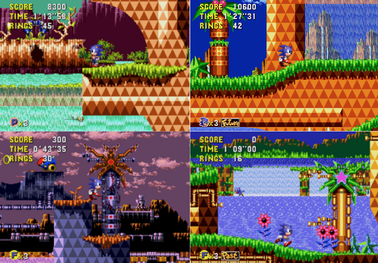
Sonic CD also introduced Amy Rose and Metal Sonic, and featured two completely different soundtracks for Japan/Europe (jazz-influenced, by Naofumi Hataya) and North America (ambient electronic, by Spencer Nilsen). The division between these soundtracks has sustained debate among fans for three decades.
1994 — Completion
Sonic 3 and Knuckles - The Split Vision
The most ambitious project of the classic era was always intended as a single game. Sonic 3 and Sonic & Knuckles were designed together - a twelve-zone epic featuring three playable characters and a narrative culminating in Super Sonic's pursuit of Robotnik across the upper atmosphere. The Christmas 1993 deadline made releasing the full game impossible, so Sega split the project across two cartridges released seven months apart.
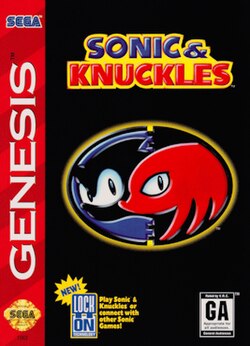
Sonic 3 introduced Knuckles the Echidna as an antagonist (manipulated by Robotnik into blocking Sonic's progress), the elemental shields (Flame, Lightning, and Bubble, each with distinct environmental interactions), and a save feature - the first in the series. Sonic & Knuckles completed the narrative, added the Doomsday Zone as a Super Sonic-only final chapter, and introduced the lock-on cartridge technology that merged both games into one.
The lock-on technology was a patented Sega innovation - a pass-through cartridge slot on top of Sonic & Knuckles that could merge the ROM data of an inserted Sonic 3 cartridge with its own, creating Sonic 3 & Knuckles: a 26-act game widely considered the pinnacle of classic 2D Sonic design. The same slot made Knuckles playable in Sonic 2 and unlocked the Blue Sphere collection game from Sonic 1.
Speed is a reward, not a right. In Sonic, you earn speed by learning the level. That was the whole design.