Speed as a Design Philosophy
Before Sonic, platform games rewarded caution. Sonic the Hedgehog rewarded mastery - and made velocity itself the point.
In 1991, Sega needed a mascot to challenge Nintendo's stranglehold on the console market. What they got from a small internal team led by programmer Yuji Naka, character designer Naoto Ohshima, and level designer Hirokazu Yasuhara was something more radical: a character whose entire identity was an argument about how games should feel.
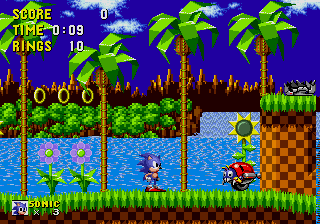
The physics engine Naka built was the first of its kind - a momentum-based system where speed was accumulated through skilled navigation of slopes, loops, and springs rather than simply holding a button. Green Hill Zone's chequered earth and loop-de-loops were a tutorial in motion disguised as a level. By the time players reached Spring Yard, they understood Sonic's language.
Between 1991 and 1994, the series produced five Mega Drive classics plus a suite of spin-offs, each iterating on the core formula. Sonic 2 added the spin dash, Sonic CD added time travel, Sonic 3 added elemental shields, and Sonic & Knuckles completed the vision via its famous lock-on cartridge. Together they form the canonical classic era.
Worlds at Speed
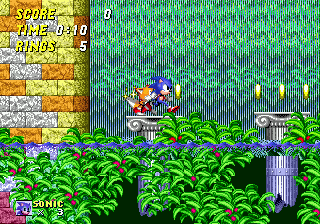
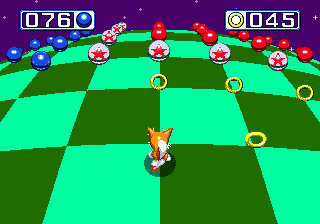
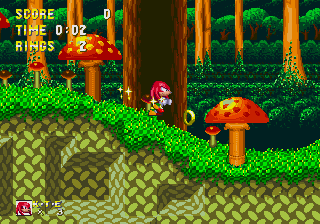
From Green Hill to The Doomsday Zone - four years of zone design built around a single question: what makes movement feel good?
Five Characters, One Era
From a blue hedgehog to a red echidna guardian, the classic-era cast were designed around gameplay mechanics first and personality second - each one unlocking routes and abilities the others could not reach.
Sonic himself was designed to be impatient: too fast to stand still, too self-assured to look worried. Miles "Tails" Prower followed in Sonic 2 as the cooperative second player, flying by spinning his twin tails and absorbing damage so Sonic could press forward. His name is a pun on miles per hour. Amy Rose debuted in Sonic CD (1993) as the first female character in the series, kidnapped by Metal Sonic in Collision Chaos Zone. Knuckles arrived in Sonic 3 as an antagonist - tricked by Robotnik into opposing Sonic - before becoming the third fully playable character in Sonic & Knuckles with unique glide and wall-climb abilities.
These distinctions are not cosmetic. Each character produces entirely different routes through identical zones: Knuckles' glide and climb open upper paths invisible to Sonic, while Sonic's accumulated speed unlocks lower momentum paths inaccessible to Knuckles. The zone designers at Sonic Team built three games' worth of routing into the same twelve-zone structure.
Metal Sonic appeared only in Sonic CD but left a deeper impression than most of the organic cast. The race at Stardust Speedway is the most cinematically staged boss encounter of the classic era: a projector-lit track, a vertical thunderstorm, and an opponent who could cheat the finish line. Robotnik's robotic duplicate was never returned to in the classic 2D era - which may be why it has retained its menace.
The people behind the characters - Yuji Naka, Naoto Ohshima, and Hirokazu Yasuhara - are covered in depth on the People page, including Ohshima's original character sketches and the internal Sega mascot competition that produced Sonic from a shortlist of three.
The Sound of Speed
Masato Nakamura composed Sonic 1 and 2 while on tour with Dreams Come True. The results are among the most beloved soundtracks in platform gaming history.
Sonic the Hedgehog - Complete OST
Nakamura's full score for the original game - Green Hill, Labyrinth, Star Light, and the Scrap Brain tension. Composed in weeks, remembered for decades.
Sonic the Hedgehog 2 - Complete OST
Nakamura's return engagement - Chemical Plant's urgent loops, Casino Night's slot-machine shuffle, and the haunting Oil Ocean at dusk. Written in three weeks while touring.