1978 – Present

History

From Osaka pachinko halls to the gold standard of 2D gaming.

SNK Founded - 1978

SNK (Shin Nihon Kikaku, “New Japan Project”) was founded in 1978 in Osaka, Japan, by Eikichi Kawasaki. The company began by distributing American arcade games in Japan before pivoting to developing its own titles. Early SNK coin-op games including Vanguard (1981) and Ikari Warriors (1986) established the studio’s capacity for technically ambitious action games.

By the mid-1980s, SNK had built an international profile through licensing deals with Data East and Tradewest for North American distribution. Ikari Warriors - a top-down military shooter - became a significant hit in American arcades, laying the groundwork for SNK’s later success in the home market.
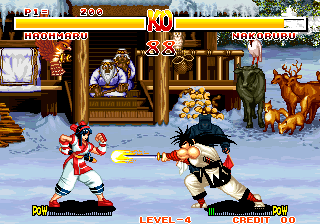
Samurai Shodown (1993) - SNK - arcade screenshot showing sword combat
Samurai Shodown (1993) on the MVS arcade board - defining the platform’s early style.

Neo Geo AES — 1990

The Neo Geo MVS (Multi Video System) launched in arcades in 1990 as a multi-game cabinet platform - operators could swap cartridges rather than replacing entire boards. The same year, SNK commercialised the home version: the Neo Geo AES (Advanced Entertainment System), priced at $649 in North America.

The AES ran the same Motorola 68000 processor (running at 12 MHz) and Zilog Z80 sound co-processor as the MVS arcade board. Game cartridges were interchangeable between the home and arcade systems, meaning the AES delivered a true arcade experience - not an approximation. This was the hardware’s core selling proposition and its enduring legacy.

“The concept was simple: give the hardcore player the exact arcade experience at home. No compromises.”

— SNK promotional material, 1990
Fatal Fury Special (1993) - SNK - gameplay screenshot showing fighter match
Fatal Fury Special (1993) - one of the platform’s landmark fighting games.

Fighting Games & Run-and-Guns - 1991–2000

Through the 1990s, the Neo Geo accumulated a library defined by two dominant genres: fighting games and run-and-gun shooters. The fighting game roster included Art of Fighting (1992), Samurai Shodown (1993), Fatal Fury Special (1993), and the annual King of Fighters series from 1994 onwards. Each iteration pushed sprite art and animation further than the competition could follow.

The Metal Slug series - developed initially by Nazca Corporation before SNK’s acquisition - arrived in 1996 and redefined what 2D run-and-gun looked like. The first game deployed hand-drawn sprite animation at a level of detail and density that astonished players and developers alike. By Metal Slug 3 (2000), the series was widely cited as the most densely animated 2D game ever made.

The platform’s peak period ran roughly 1995–2000, producing classics including The King of Fighters ’98, Garou: Mark of the Wolves (1999), The Last Blade 2 (1998), and the Metal Slug series through its third entry. SNK employed some of the most skilled 2D sprite artists in the industry during this period.

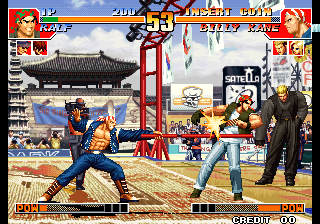
King of Fighters '97 (1997) - SNK - arcade screenshot
King of Fighters ’97 - the annual KOF series defined the Neo Geo calendar.
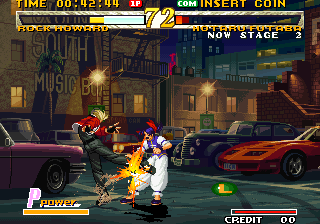
Garou: Mark of the Wolves (1999) - SNK - arcade screenshot
Garou: Mark of the Wolves (1999) - often cited as the finest 2D fighter the platform produced.

2001 Bankruptcy

SNK filed for bankruptcy in October 2001, a casualty of the broader crisis affecting Japanese arcade operators as 3D polygon gaming shifted player attention and spending toward PlayStation and Dreamcast. The company had struggled with debt accrued during its aggressive MVS expansion and the transition to 3D - a genre where the Neo Geo hardware, with its 2D-optimised chipset, could not compete.

The bankruptcy triggered the sale of the SNK brand and intellectual property to Playmore Corporation (later renamed SNK Playmore), which continued to publish fighting games - primarily the King of Fighters series - using the established franchises.

2003 — Present

Following the 2001 bankruptcy, SNK Playmore (later rebranded as SNK Corporation in 2016 after acquisition by a Chinese investment group) continued to publish King of Fighters titles through the 2000s and 2010s. The King of Fighters XIII (2010) was widely praised as a return to the sprite art quality of the Neo Geo era.

The Neo Geo Mini (2018) - a miniaturised arcade cabinet replica with 40 pre-installed games - marked SNK’s re-engagement with the retro collector market. Hamster Corporation’s Arcade Archives Neo Geo series brought accurate emulations of the MVS library to modern platforms from 2015 onwards, providing legal digital access to the catalogue for the first time at scale.

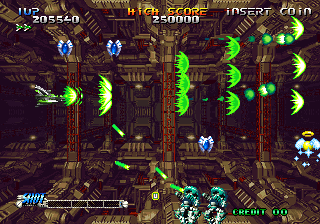
Blazing Star (1998) - Yumekobo / SNK - arcade screenshot
Blazing Star (1998) by Yumekobo - a late-era gem showing the platform at full technical stretch.

“The library SNK built between 1990 and 2001 represents the definitive canon of 2D sprite art. Nothing in the medium approaches the animation density and craft of the Neo Geo at its peak.”

— Digital Foundry retrospective analysis, 2019