Click Play on any entry to hear it in the persistent player bar.
Full catalogue and SID files on the Music page.
Commando: The March That Launched a Career
1985 · Elite Systems · C64 ·
Before Rob Hubbard, C64 game music was functional at best and forgettable at worst.
After Commando, in the summer of 1985, the question of whether
computer game music could be genuinely impressive was answered. His title march -
militaristic, structurally coherent, and startlingly orchestral from a chip with
three oscillators - announced a new standard for what SID music could be.
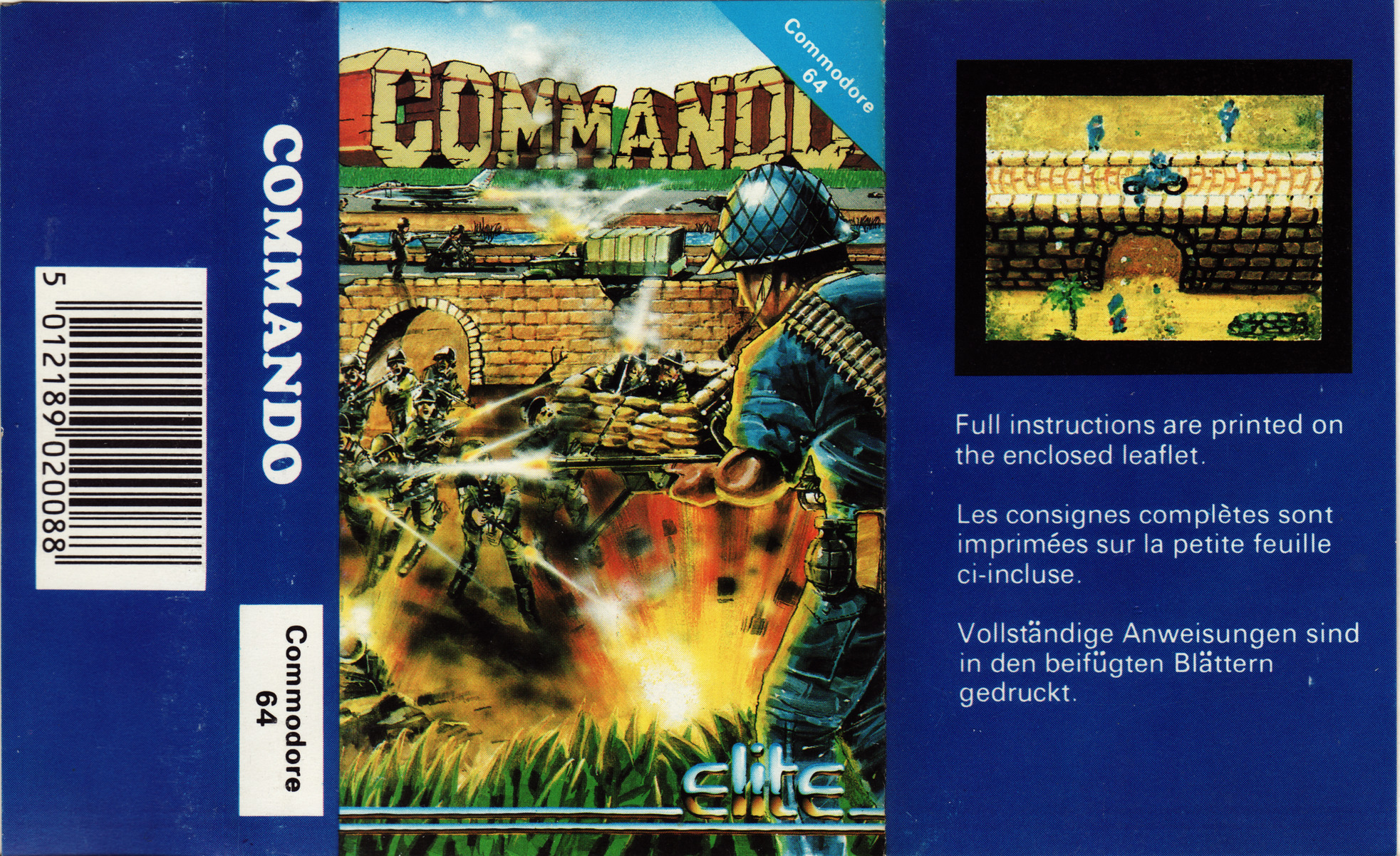
Commando on the Commodore 64 - Elite Systems' 1985 port of the Capcom arcade game, with Hubbard's march driving every moment of play.
A Commission Without a Handbook
Commando arrived as a port commission. Capcom's 1985 arcade original had already
established itself in UK arcades, and Elite Systems needed a C64 conversion that
could hold its own against the coin-op. The game itself - a vertical-scrolling
military shooter where a lone soldier fights through enemy lines - made no particular
demands on the composer. What the game needed was momentum, urgency, and military
character.
Hubbard had been composing for the C64 for barely months when Commando arrived.
His approach was already unconventional: rather than sequencing notes in a tracker
or dedicated composition tool, he wrote directly in 6510 assembly language, placing
note and timing values into memory and triggering the SID chip's registers by hand.
Every filter sweep, every envelope shape, every pulse-width value was a line of
code he had written himself. The process was slow compared to later methods but
gave him complete control over every parameter the SID exposed.
Three Voices, One Military Formation
The Commando title theme is built on a march structure that Hubbard has attributed
to the game's subject matter - a European military feel rather than the funk or
jazz that dominated American-influenced C64 composition at the time. The melody
line opens with a snare-roll figure, achieved by running the noise-waveform channel
through rapid ADSR cycling, before the main theme enters on a pulse voice with
carefully tuned pulse-width modulation.
What the player actually hears is a three-part conversation: a melody voice carrying
the main march theme, a bass voice providing harmonic grounding, and a counter-melody
that weaves between the two. For a chip with three available voices and no polyphony
within a voice, the result creates a convincing illusion of orchestral depth. The
sense of movement - the forward propulsion that makes the march feel relentless - comes
from the rhythmic interplay between all three parts rather than any single voice.
Filters as Architecture
The defining technical achievement in Commando is Hubbard's use of the SID's
shared filter. The filter - which can be applied independently or collectively
to any of the three voices - is used in low-pass mode with the cutoff frequency
swept on the off-beat. The result is a rhythmic pump effect under the brass stabs
in the chorus section: the high-frequency content of the melody drops away briefly
on each downbeat, giving the brass a plunging, weighty character that reinforces
the march's military authority.
The pulse waveform on the melody voice sweeps between approximately 0x800 and 0xC00
(half the available range) across the phrase, giving the sound a characteristic
choir-like brightness that no single fixed pulse width could produce. Combined with
the filter automation, the piece never sits static - the timbre is in constant subtle
motion even when the pitch sequence repeats.
"I approached the SID voices the way I'd approach an ensemble - each one needed
a clear role. The filter was the secret weapon. Once you understood how to move
the cutoff in time with the music, you could create the illusion of instruments
that didn't exist on the chip at all."
Rob Hubbard, Retro Tea Break interview (2019)
What the Critics Made of It in 1985
Zzap!64, the UK's leading C64 magazine, reviewed Commando in issue 6 (October 1985)
and awarded perfect marks for sound. The reviewers noted that Hubbard's score
operated in a different category from what they had previously heard on the machine,
singling out the march as evidence that C64 music had crossed a threshold. The game
sold strongly - Elite Systems was one of the few publishers still charging full price
in an era of £1.99 Mastertronic budget releases - and the music was widely
cited as a reason buyers didn't feel short-changed.
The in-game music uses the same voice configuration as the title theme but at a
faster tempo with shorter ADSR release times, creating the urgency the play
session demands. The switch between title and in-game themes demonstrated something
that other composers quickly adopted: SID music could shift register to match
context while remaining recognisably one composer's work.
The Score That Started a Standard
Commando is the composition that established Hubbard as the leading C64 composer -
not just because of its quality but because of how quickly that quality was
recognised and how widely it spread. Within months of the game's release, publishers
and developers were specifically requesting "something like the Commando music."
The compositional approach Hubbard demonstrated here - orchestral thinking applied
to a three-voice constraint, with filter automation as a structural element - became
the template that defined the C64's musical identity for the rest of the decade.
Hear the full score - title theme, in-game music, and all subtunes - in the
Music catalogue.
Sanxion: Thirty Seconds That Changed Loading Screens
1986 · Thalamus · C64 ·
The Sanxion Loader is the piece of SID music that non-C64 owners
have heard most often without knowing what it is. In the time it takes to load
the game from cassette - somewhere between 30 and 90 seconds depending on the
machine - Hubbard delivers a composition of orchestral scope, moving from silence
through a slow, aching string build to a triumphant brass theme and back again.
It sounds like a film score that accidentally arrived on a home computer.
A Brief for the Gap Between Play and Game
Thalamus was a small UK publisher that positioned itself on quality: they released
very few titles but invested heavily in each one. Sanxion was developed
by Stavros Fasoulas, a Finnish programmer whose dual-layer horizontal shooting game
was technically ambitious for 1986 - the scrolling landscape split into two
independently moving layers was a genuine display achievement on C64 hardware.
Hubbard was commissioned to score the whole game, but the loader music - the
piece that plays during the cassette load sequence - became the composition that
overshadowed everything else. In 1986, cassette loading was unavoidable: players
sat with the machine running and nothing to do except listen. Most publishers
left that time blank or filled it with simple holding patterns. Hubbard filled
it with an 86-second concert.
Building an Orchestra From Three Oscillators
The loader opens with silence before a faint, swelling texture begins to emerge
- all three SID voices running in near-unison at slightly different pitch offsets,
a technique called detune stacking. The result is not quite in tune with itself
and not quite out of tune: it sits in that particular phasing zone where the
interference between close frequencies creates a chorus effect, like massed strings
settling into a chord.
The filter is in band-pass mode during this opening section. Band-pass carves out
the midrange while attenuating both the lowest and highest frequencies - the effect
is that the sound feels distant, as though arriving from another room. As the
music builds toward the brass theme, Hubbard gradually sweeps the filter from
band-pass toward low-pass, allowing the full harmonic content of the voices to
open up. By the time the main theme arrives, the filter is fully open and all
three voices are playing at maximum audible bandwidth. The subjective effect is
of a room that has suddenly expanded.
The Ring-Mod Transition
The SID chip includes a ring modulation capability: one voice's frequency can
be applied as a modulator to another's amplitude, producing sum and difference
tones that exist nowhere in the original signal. Hubbard uses ring modulation
briefly at the dramatic climax of the loader - the point where the string texture
peaks and the brass theme is about to enter. The ring modulation introduces a
clangorous, bell-like overtone that would be impossible to achieve through
waveform selection alone. It lasts perhaps two seconds. In context, it sounds
like a percussion hit that arrives on a note, which is exactly what the music
needs at that moment.
The title music (subtune 2, which plays during gameplay) is a separate composition
entirely - a fast, propulsive melody with Baroque-influenced voice leading. It is
impressive in its own right but has always lived in the shadow of the loader,
which is how it feels to be the second-best piece of music on the same SID file.
"The SID filter was the thing nobody was really using properly. It wasn't just
a tone control - you could automate it, sweep it, synchronise it to the beat.
Once I understood that, I had access to a whole dimension of sound that most
composers weren't touching."
Rob Hubbard, Retro Tea Break interview (2019)
Outsized Reception for Undersized Hardware
Zzap!64 awarded the Sanxion loader a perfect sound rating and dedicated unusual
editorial space to discussing it as a piece of music rather than a game sound
effect. The distinction mattered: prior to Sanxion, even the best C64 music
was evaluated in terms of how well it served the game. Sanxion's loader was
evaluated on its own terms as a composition that happened to accompany a load.
The game itself reviewed well on technical grounds - Fasoulas's dual-layer
scrolling engine drew praise - but it was the loader that circulated on compilation
tapes, appeared in music-only software packages, and generated the reputational
momentum that made Thalamus a label players trusted.
The Loading Screen as Art Form
Sanxion established that the gap between pressing Play and reaching the title
screen was usable space - not dead time to be minimised but a performance
opportunity. After Sanxion, a number of C64 publishers invested specifically in
loader music, commissioning composers to fill what had previously been silence.
None matched the Sanxion loader's impact, but the concept it demonstrated -
that a loading screen could be the most memorable part of a game - is traceable
directly to this piece.
Auf Wiedersehen Monty: The Sound of a Mole's Last European Tour
1987 · Gremlin Graphics · C64 ·
By 1987, Hubbard had established a reputation for dramatic, high-energy scores.
Auf Wiedersehen Monty is something different: bittersweet,
unhurried, and genuinely melancholic. The theme for Gremlin Graphics' third
Monty Mole game doesn't drive the player forward - it accompanies them sideways,
with the kind of resigned warmth you feel at the end of something good.
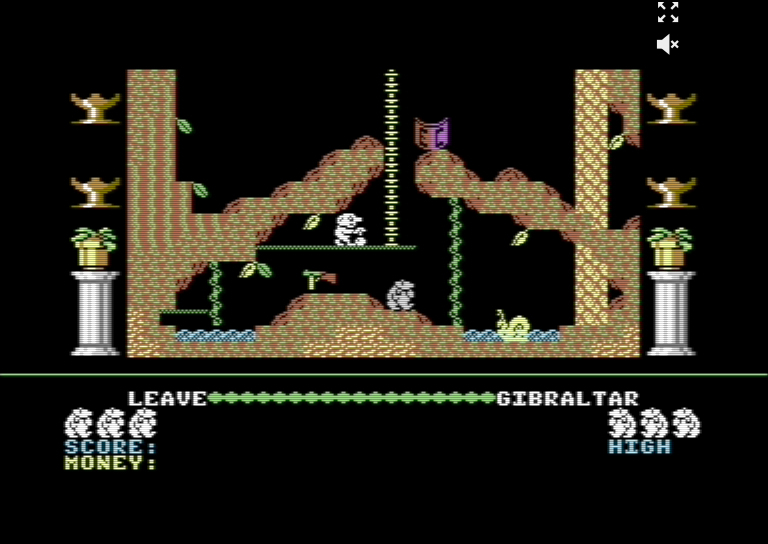
The cover for Auf Wiedersehen Monty - Gremlin Graphics, 1987. Monty's pan-European escape provided the emotional context for Hubbard's most melancholic score.
The Final Chapter of the Monty Mole Series
The Monty Mole series had a peculiar arc. The original Monty Mole (1984)
began as a licensed tie-in to the UK miners' strike. Monty on the Run (1985)
turned Monty into a fugitive. Auf Wiedersehen Monty (German for "Goodbye,
Monty") completed the trilogy: the mole must earn enough money working odd jobs
across European cities to retire to Monte Carlo.
Gremlin Graphics had grown into one of the UK's more substantial independent
publishers by 1987, and the Monty series was their flagship property. Hubbard
had scored Monty on the Run and the sequel retained the same composer.
The brief, essentially, was to write music for a farewell - something that
matched the game's tone of cheerful resignation and forward-looking melancholy.
Gameplay in Auf Wiedersehen Monty - Monty travels across European cities collecting money for his Monaco retirement, with Hubbard's walking-bass score accompanying every step.
A Walking Bass and a Mole's World-Weariness
The emotional character of the AWM theme comes primarily from its bass line.
Hubbard chose a sawtooth waveform for the bass voice - a waveform the SID produces
naturally, with a bright, reedy attack and a slightly nasal sustain. The sawtooth
bass walks in a pattern that suggests jazz and folk simultaneously: not quite a
march, not quite a dance, somewhere between the two. It is the sound of someone
who has been walking for a long time and has made peace with the distance still
to go.
The melody uses vibrato, implemented as rapid pitch LFO cycling within the SID's
interrupt handler. This was a standard technique of the era, but Hubbard's
implementation is unusually restrained: the vibrato depth is narrow enough that
the pitch variation feels like expressiveness rather than a technical artifact.
Listen to it alongside other 1987 SID melodies and the difference is clear -
most implementations produce a mechanical wobble; Hubbard's sounds like someone
singing a little flat on purpose because the note has more feeling that way.
The Full Range of What the SID Could Feel
The SID chip's association with dramatic, high-energy music is partly Hubbard's
own doing - Commando, Sanxion, and Knucklebusters all pull in that direction.
AWM demonstrates the other end of the emotional spectrum available to a skilled
SID composer. The chip's voices are fully capable of warmth, restraint, and
something recognisably close to sadness; it requires compositional choices that
work against the hardware's natural tendency toward brightness and attack.
A later section of Auf Wiedersehen Monty - the game's European geography gave Gremlin Graphics room for varied level design, with Hubbard's score carrying the player through each location.
"Each game had its own personality and that's what you had to find first.
Some games wanted something driving and aggressive. Monty was different -
it needed to feel warm, a bit sad. The SID could do that if you thought
carefully about which waveforms and which registers you were using."
Rob Hubbard, Retro Tea Break interview (2019)
Commercial High Point, Critical Recognition
Auf Wiedersehen Monty was Gremlin Graphics' biggest commercial release of 1987
and one of the strongest-selling C64 platform games of the year. Zzap!64 gave
the game high marks across the board, with the sound score reflecting the
reviewers' view that Hubbard had produced something qualitatively different from
his previous work - not more technically impressive, but more emotionally resonant.
The Hubbard-Gremlin relationship that produced AWM remained productive through
the C64 era, but this score is widely considered their creative peak together.
Proof That Constraint Does Not Mean Coldness
Auf Wiedersehen Monty is the piece that tends to surprise first-time listeners
who come to SID music expecting noise and aggression. It is neither. It is, in
the most direct sense, a piece of music that communicates a feeling through
deliberate compositional choices on a severely limited instrument - and it does
so completely. The hardware is invisible; what you hear is the mole's farewell.
Play the full score - including the in-game music and all subtunes - in the
Music catalogue.
Knucklebusters: When All Three Voices Maxed Out at Once
1987 · Ocean Software · C64 ·
Knucklebusters is not the most celebrated piece in Hubbard's
catalogue, but it may be the most technically demanding. The title theme runs
all three SID voices simultaneously at their maximum functional complexity:
arpeggiated chords in voice one, a moving bass in voice two, a sustained
melody with filter automation in voice three. Nothing is wasted, nothing rests.
Ocean, a Boxing Ring, and a Deadline
Ocean Software was, by 1987, one of the largest and most commercially successful
UK games publishers - a full-price label with a reputation for licensed titles
and technically ambitious originals. Knucklebusters was an action
game built around boxing, with the player character working through a series
of increasingly difficult opponents. The game made limited commercial impact,
but Ocean's commissioning of Hubbard for the score ensured at least one element
would be remembered.
This was one of Hubbard's final C64 freelance commissions before he joined
Electronic Arts in 1988. By 1987 he was working across multiple publishers
simultaneously, typically completing a score in a matter of days. The density
of Knucklebusters - its refusal to give any voice a moment of rest - suggests
a composer who had fully internalised what the SID could do and was working
at the edge of that capability.
Jazz Changes in Three Voices on a Games Chip
The distinguishing feature of the Knucklebusters title theme is its chord
arpeggiation. Arpeggiation - playing the notes of a chord in rapid succession
to imply full harmony - was standard practice in C64 composition: with three
voices, a composer could only play three notes simultaneously, so chords with
four or more notes required arpeggiation or omission. Hubbard's arpeggiation
in Knucklebusters is unusual in two respects.
First, the speed: the arpeggio pattern cycles fast enough that the individual
notes lose distinct identity and fuse into a single perceived timbre with a
particular harmonic colour. Second, the harmonic logic: where most C64 arpeggiation
implied simple major and minor triads, Hubbard's pattern in Knucklebusters implies
chord extensions - ninths, elevenths, and alterations associated with jazz harmony.
The result is a texture that sounds aggressively modern for 1987 home computer music.
The High-Pass Sweep as Architecture
The filter automation in Knucklebusters is some of the most dramatic in Hubbard's
catalogue. A high-pass sweep runs from closed to fully open over four bars,
progressively stripping the mix of its low-frequency content until only the
highest harmonics of the melody remain. The bass disappears first. Then the
lower harmonics of the chords. By the end of the sweep, what was a dense,
full-bandwidth texture has been reduced to a thin thread of high-frequency
sound. Then the filter releases and everything comes back simultaneously.
In a traditional mix, this technique uses dedicated processing and automation
lanes. In Knucklebusters, it runs in the SID's CutFreq register, incremented
on each interrupt tick by a value calculated to land at the target position
at the right moment. Every architectural decision in the piece was an
arithmetic one.
"The SID was an instrument that rewarded people who understood electronics
as well as music. You had to think in registers, not notes. Once you could
visualise what the filter register was doing to the waveform in real time,
you could use it the way a string player uses bow pressure."
Rob Hubbard, X'2023 demoparty interview
The Game Faded, the Music Stayed
Knucklebusters the game was not a notable commercial success. Ocean
had more prominent titles in their 1987 catalogue, and the boxing game did not
generate significant critical attention. What survived was the score, which
circulated on SID compilation disks and appeared on fan-produced music collections
throughout the late 1980s and 1990s, consistently rated among Hubbard's
strongest technical achievements.
Among SID composers working in the decade that followed, Knucklebusters was
cited specifically for its arpeggiation approach - the technique of implying
jazz harmony through fast cycling was adopted and expanded by several composers
who identified it as one of the things that distinguished Hubbard's work from
his contemporaries.
Complexity as Argument
Knucklebusters is the piece that most directly demonstrates Hubbard's claim on
the SID chip's outer limits. Where Sanxion proves what SID music could feel like
and AWM proves what it could communicate, Knucklebusters proves what it could
technically do when a composer gave it no quarter. All three voices, all the way
up, for the full duration. Nothing rests.
Delta: A Prog-Rock Statement From a Chip the Size of a Coin
1987 · Thalamus · C64 ·
Delta closes Hubbard's most productive period - the three
freelance years from 1985 to 1987 that produced more landmark SID compositions
than any other stretch in the medium's history. The title theme is built on a
repeating harmonic cycle with a formal structure that suggests large-scale
planning: a theme, a development section that introduces new voice combinations,
a climax, and a resolution. This is not typical game music architecture. It is
closer to prog-rock in miniature.
Fasoulas Again, and the Last Thalamus Commission
Delta was the second game Hubbard scored for Stavros Fasoulas and
Thalamus, following Sanxion from the previous year. Where Sanxion
was a horizontal dual-layer shooter, Delta was vertical: a shoot-em-up in
which the player pilot controls a fighter that can fire in a triangular
formation pattern - the "delta formation" that gave the game its name.
Thalamus's model of releasing very few titles but investing heavily in each
one extended to the music commission. Hubbard was given time to develop
something that could stand as the sonic identity of a prestige release.
What he produced was not one composition but several: the title theme,
a separate and complete in-game score (subtune 2), and additional pieces
for other game states. The SID file for Delta contains more compositional
material than most complete game soundtracks of the period.
Sync Modulation and the Lead That Shouldn't Exist
The Delta title theme's lead voice uses sync modulation - a technique in which
one SID oscillator is synchronised to another, forcing its waveform to restart
at the synchronising oscillator's frequency rather than running free. The effect
on a sawtooth wave (the natural choice for a lead voice) is a distinctive
distorted timbre: buzzy, aggressive, slightly abrasive. It sounds like a
synthesiser doing something it wasn't entirely designed to do, which is exactly
what it is.
Hubbard uses sync modulation here as a counterpoint to his earlier work. The
Commando melody was clean, choral, smooth - pulse with PWM and a restrained
filter. The Delta lead is the opposite: it pushes against its own waveform,
produces a controlled distortion, and sits in the mix as something that demands
attention. For a piece with contemplative formal ambitions, the choice of an
aggressive lead timbre creates productive tension.
The Bass That Changed the Texture
Delta's bass voice uses a triangle waveform. This is a deliberate departure
from Hubbard's earlier practice - the bass in Commando used triangle too, but
Auf Wiedersehen Monty's walking bass was sawtooth, and the arpeggio bass in
Knucklebusters was pulse. Triangle is the SID's softest waveform: sine-like,
low in harmonics, warm in character. In Delta, the triangle bass gives the piece
a rounded, cushioned low end that absorbs the aggression of the sync-modulated
lead rather than competing with it.
The harmonic language across all three voices goes further into ambiguity than
any of Hubbard's earlier work. The phrasing in the title theme is irregular -
not quite four-bar, not quite eight-bar, with phrase endings that resolve later
than expected. This is the prog-rock influence that most SID music avoids: a
willingness to let the music breathe and expand rather than cycling on a fixed
loop.
"Delta was something I wanted to be a proper piece of music, not just a
game score. I'd been doing this for three years by then and I felt I could
push the formal structure further than usual - give it more of a beginning,
middle and end rather than just a good loop."
Rob Hubbard, From Bedrooms to Billions documentary (2014)
What the Contemporary Critics Heard
Zzap!64 reviewed Delta and awarded it high marks across graphics and sound.
The reviewers noted that Hubbard's score operated at a different level of
compositional ambition from even his own recent work - the title theme was
described as the most formally complete piece of C64 music the magazine had
reviewed. The game's technical achievement (Fasoulas's engine generating
smooth multi-object scrolling without flicker on C64 hardware) received equal
praise, giving Delta the rare status of a game where two separate craft
achievements were both considered best-of-year.
The Composition That Still Defines the Ceiling
Delta occupies a specific position in SID music history: it is the piece that
established the formal upper limit of what Rob Hubbard would achieve on the
C64. Not because his subsequent work was weaker - several of his 1987 and
1988 pieces are technically extraordinary - but because Delta is the one where
every dimension of SID composition reaches its fullest expression simultaneously.
The timbre is the most sophisticated. The harmonic language is the most ambitious.
The formal structure is the most complete.
In the decades since its release, Delta has remained the benchmark that SID
composers and enthusiasts return to when trying to explain what the C64 could
do in the hands of its greatest practitioner. It is the piece that answers the
question "but is it really music?" most definitively and most quietly.
Explore the full Delta score - title theme, in-game music, and all subtunes -
in the Music catalogue.