Four games that made Psygnosis: the technical spectacle that sold the Amiga,
the puzzle game that conquered every platform, the racing title that defined
a console, and the shooter that proved games could be fine art.
1989Amiga / Atari ST / Mega Drive / TurboGrafx-16
Shadow of the Beast
The game that made the Amiga impossible to ignore.
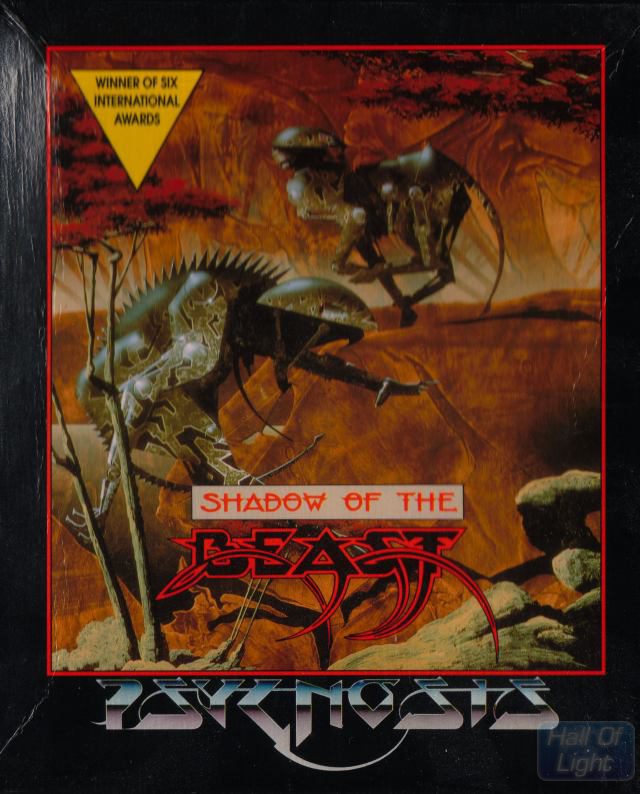
The Roger Dean box art that sold thousands of Amigas.
Shadow of the Beast is a side-scrolling platform action game released by Psygnosis
in 1989 for the Amiga. The player controls Aarbron, a man transformed into a beast-servant
of the dark lord Maletoth, who fights his way across a hostile fantasy landscape to reclaim
his humanity. The game spans three distinct zones - an overworld, underground caverns, and
a final tower - each with its own visual character and enemy complement.
That description, however, misses the point entirely. Shadow of the Beast was
not primarily a game about its mechanics. It was a demonstration - a deliberate, carefully
engineered proof that the Amiga could produce something that looked, and sounded, like
nothing else available on home hardware. In 1989, that demonstration worked. The game
sold Amigas. It earned Psygnosis a reputation that endured for a decade.
See the full entry in the catalogue.
Fourteen Months of Parallax
Shadow of the Beast was developed internally at Psygnosis over approximately fourteen months
by a small team. The driving ambition was singular: produce the most visually impressive
software ever released for a home computer. Commercial viability was secondary. The
technical specification came first, and the game design was built around what the
technology could produce rather than the reverse.
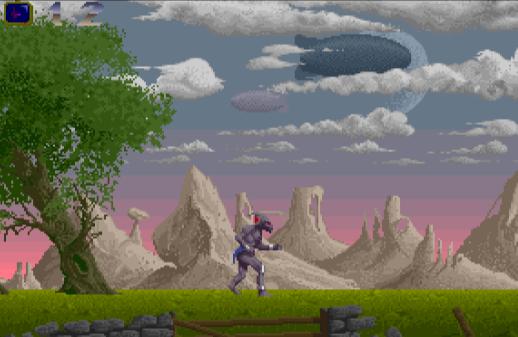
The central challenge was the parallax scrolling engine. The team implemented
thirteen distinct scrolling layers, each advancing at a different rate
to create a convincing illusion of depth across the fantasy landscape. Layers at the
extreme rear moved almost imperceptibly; foreground elements swept past rapidly.
The result, playing on Amiga hardware in 1989, looked physically impossible.
Visitors to computer fairs would stop and stare. Shop assistants would demonstrate it
to customers who were sceptical that it was running in real time.
Roger Dean provided the box art - a vast fantasy
landscape rendered in his signature organic style, with structures that seemed grown
rather than built and a colour palette drawn from twilight and deep space. The
packaging for Shadow of the Beast was a deliberate artistic statement: before anyone
loaded the disk, the box alone told a buyer what kind of company Psygnosis was.
Dean's involvement extended the visual identity of the game into the physical world.
The thirteen-layer parallax scroll in motion - each band moving at its own rate across the Amiga's display.
Spectacle as Gameplay
Playing Shadow of the Beast in 1989 was an unusual experience. The action - punching
enemies, timing jumps, using a limited inventory of items - was not especially deep
by the standards of contemporary platform games. The difficulty curve was steep and
unforgiving. There were no continues and no save states; death meant starting the
entire game from the beginning.
Critics at the time were divided. Some celebrated the technical achievement without
reservation. Others pointed out, not unfairly, that the gameplay did not match the
production values. The game's response to this criticism was largely to ignore it.
Psygnosis had built something beautiful and technically audacious, and it knew that
was what the market wanted. The reviews came second.
The audio reinforced the visual ambition. David Whittaker
composed the original C64 version's soundtrack, which Psygnosis then adapted for the
Amiga using the Paula chip's four-channel capability. The result was atmospheric,
unsettling, and genuinely cinematic - a tension-sustaining score that made the
landscape feel inhabited by something malevolent even when the screen was still.
The SID versions are available via the music player.
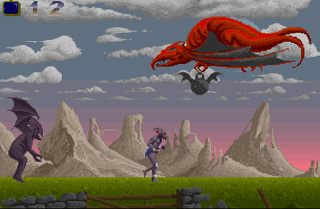
The underground sections featured larger, more detailed sprites - demonstrating the Amiga's capacity for complex animated characters.
What Nobody Else Had Done
The specific technical achievements of Shadow of the Beast were not incremental improvements
on prior Amiga titles. They were a categorical advance. Thirteen parallax layers was not
just "more than usual" - it was three to four times what any comparable release had
attempted. 128 simultaneous colours exceeded what most developers
considered achievable without major visual compromises. The sprite detail and animation
quality set a standard that most Amiga titles from the following two years did not reach.
The game demonstrated something important about the Amiga hardware that was not widely
appreciated at the time: its custom chips (Copper, Blitter, Denise) could be orchestrated
to produce results far beyond what the specification suggested, if the programmer understood
them at a sufficiently low level. Psygnosis had programmers who did. That technical
culture - of mastering hardware to its limits rather than working within comfortable
abstractions - defined the company's output for the next several years.
"Psygnosis titles were always about raising the bar visually. We wanted people to
see the game and immediately know it was something different - something that wasn't
available anywhere else."
Ian Hetherington, Psygnosis co-founder, Game Developer magazine retrospective
The Reviews That Couldn't Agree
Period reviews of Shadow of the Beast reflected genuine critical disagreement. The Amiga
press universally acknowledged the technical achievement; opinion diverged sharply on
whether the game justified purchase on its own terms or existed primarily as a showpiece.
CU Amiga awarded it a strong score with heavy emphasis on the visual presentation.
Zzap!64, reviewing the C64 port, praised Whittaker's music adaptation while
noting the platform gap in visual capability.
In consumer terms, Shadow of the Beast was a significant success. It sold well on Amiga
and was subsequently ported to Atari ST, Mega Drive, TurboGrafx-16, Lynx, and Master
System - each port a measure of the original's commercial momentum, even if none
could replicate the Amiga version's graphical precision.
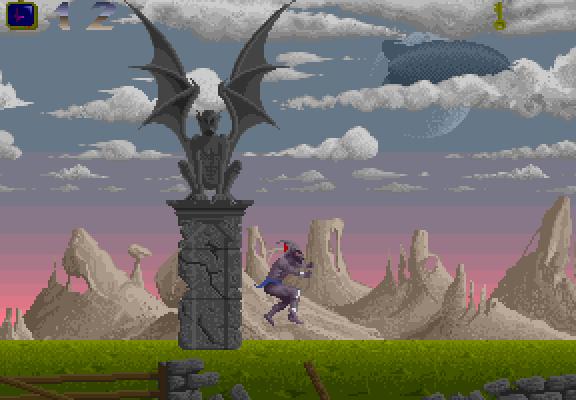
The colour depth that distinguished the Amiga version from every subsequent port.
What It Started
Shadow of the Beast was not the last of its kind; it was the first. The approach it
pioneered - treating a game as primarily a technical and aesthetic statement, building
commercial expectations around production value - became the defining Psygnosis method.
Every major title the company released over the following six years shared this DNA.
The 2016 PlayStation 4 remake by HexaDrive preserved and reinterpreted the original's
commitment to visual ambition, adding roguelike elements and a lore layer while keeping
the brutal difficulty that critics originally divided on. That remake is covered in the
Modern Legacy section.
In the broader history of British games development, Shadow of the Beast occupies a
specific and irreplaceable position: the moment when a Liverpool studio told the world
what the Amiga could do, and the world listened.
Thirteen layers of scrolling. One studio. Zero apologies.
1991Amiga / DOS / Atari ST / SNES / Mega Drive / Game Boy + 25 more
Lemmings
The puzzle game that convinced fifteen million people to play.
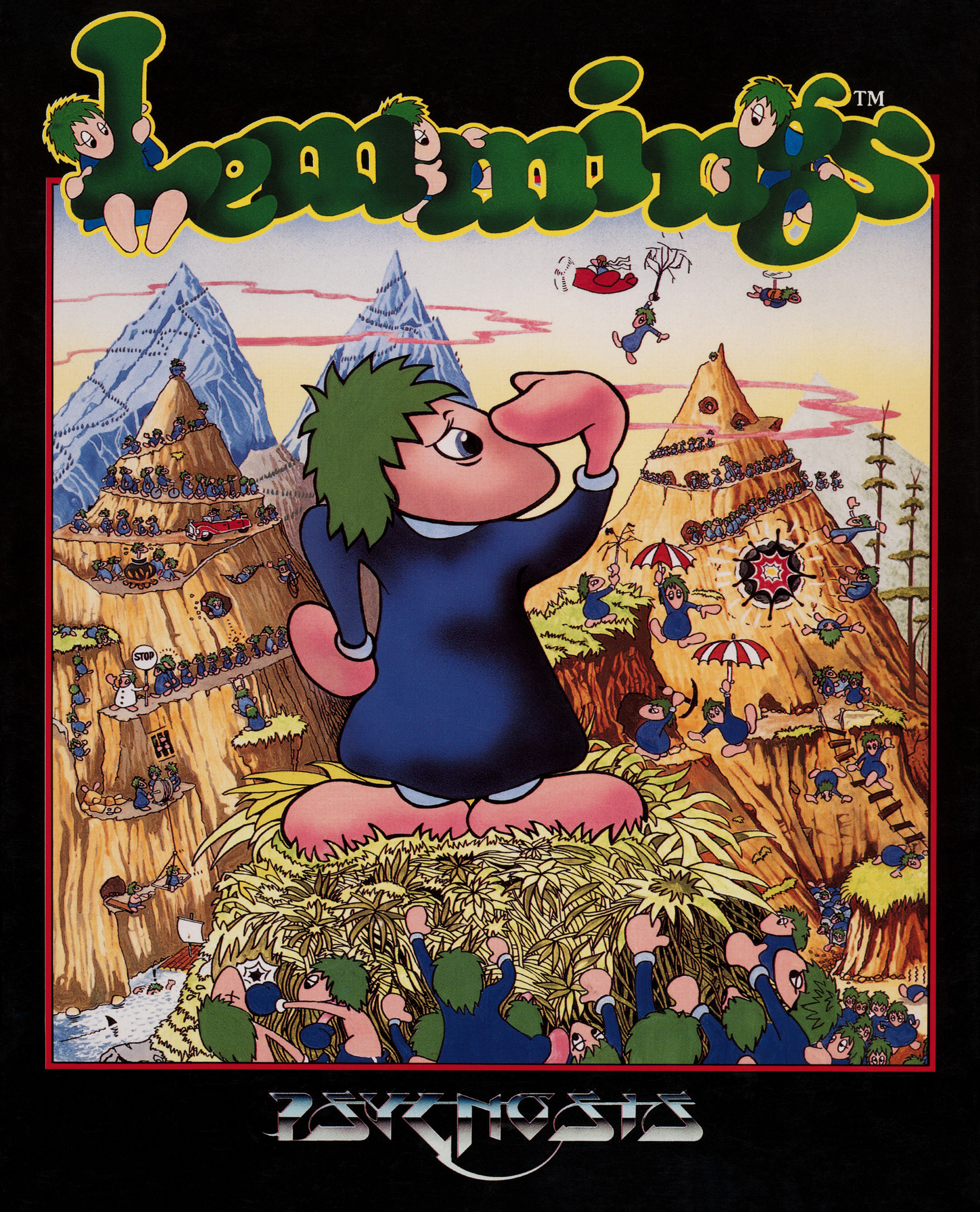
The Amiga box art for Lemmings - published by Psygnosis, designed by DMA Design.
Lemmings is, without qualification, the most commercially successful game
Psygnosis ever published - and one of the most significant video games of the early
1990s. A puzzle game about guiding small, suicidal rodent-like creatures to safety,
it sold over fifteen million copies across more than thirty platforms
and introduced an entire generation to gaming who might not otherwise have engaged
with the medium.
It was designed and developed by DMA Design - the Dundee studio that
would later become Rockstar North, creators of Grand Theft Auto - and published by
Psygnosis. The Psygnosis-DMA Design relationship had already produced
Menace (1988) and
Blood Money (1989);
Lemmings was the collaboration that made both companies' reputations permanent.
See the full entry in the catalogue.
Born from a Two-Pixel Walking Man
The origin of Lemmings is one of the most documented and retold stories in British
games development. In late 1990, DMA Design programmer Mike Dailly
was experimenting with animation - specifically trying to see how small he could make
a convincingly walking human figure on screen. The result was a 16x8 pixel character,
green-haired, marching steadily in one direction. It was, in essence, a technical
exercise with no game attached to it.
DMA Design's David Jones saw the animation and recognised something in it: the figure's
mindless forward motion, its apparent obliviousness to what lay ahead, suggested an
entirely new puzzle structure. What if there were hundreds of these figures, walking
inexorably toward their doom? What if the player's job was to save as many as possible
by intervening - giving individuals specific skills, directing the flow of the group,
building solutions in real time against a ticking clock?
"I created the lemming as an animation exercise - the smallest figure I could
make that still looked like it was actually walking. Once we had it marching around
the screen, the game design basically suggested itself."
Mike Dailly, DMA Design programmer, retrospective interview - The History of Lemmings
The speed of development was remarkable. From the initial animation concept to a
working prototype took a matter of weeks. Psygnosis, recognising what DMA had built,
agreed to publish and provided resources to expand the prototype into a full commercial
release. The final game shipped in February 1991.
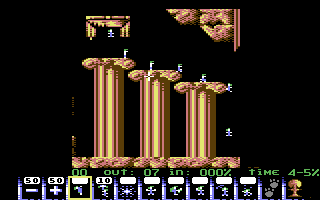
The Amiga version's gameplay - lemmings marching toward hazards while the player assigns skills to guide them.
Eight Skills, a Hundred Levels, One Problem at a Time
The gameplay of Lemmings is elegant in the way that very few game designs manage:
its rules can be explained in under a minute, but mastering them takes far longer.
Each level begins with a trapdoor opening and a stream of lemmings falling into
the environment. Left alone, they march forward indefinitely, walking off edges,
into fire, and into walls. The player must get a minimum percentage of the lemmings
to the level exit before the time limit or the lemming count runs out.
To do this, the player assigns skills to individual lemmings from a limited supply.
The eight core skills cover: digging downward (Digger), building a staircase (Builder),
bashing horizontally through terrain (Basher), mining diagonally (Miner), blocking
other lemmings' movement (Blocker), parachuting from heights (Floater), climbing
vertical surfaces (Climber), and self-destructing to create a crater (Bomber).
Each skill costs one from the supply. Running out means improvising with what remains.
The puzzle design scaled from accessible to genuinely devious. Early levels introduced
mechanics gently, providing enough skills that multiple solutions worked. Later levels
reduced the skill counts, tightened the required completion percentages, and introduced
time pressure that forced faster execution. The hardest levels in the original game's
"Mayhem" difficulty tier remain challenging by modern standards.
Builder lemmings constructing staircases - the core multi-skill chain that advanced puzzle design required.
Thirty Platforms and One Idea That Worked on All of Them
The technical achievement of Lemmings is not a specific graphical technique or hardware
exploit - it is the portability of the design. A puzzle game built around small sprites
and procedural level traversal translated naturally to every platform of the era and
several that followed. Lemmings appeared on Amiga, Atari ST, DOS, Mac, SNES, Mega Drive,
Game Boy, C64, Amstrad, ZX Spectrum, PlayStation, 3DO, and eventually on mobile.
Each port worked because the core design did not depend on hardware capability.
The audio was handled differently per platform. The Amiga version's music - arrangements
of folk songs and popular tunes rendered in the Amiga's four-channel chip audio - is
considered the definitive version. Tim Wright contributed to the Amiga audio production,
working alongside the DMA Design team. The Game Boy version's compressed mono audio
retained recognisable versions of the same tunes, demonstrating the melodies'
robustness across hardware constraints. Audio context is available on the
music page.
Ninety-Seven Percent and a Cultural Moment
Amiga Power, in its very first issue (May 1991), awarded Lemmings 97% - one
of the highest scores the magazine gave to any game in its five-year run. The score
was not promotional hyperbole: the review justified every point with specific praise
for the design's elegance, its replayability, and its unusual accessibility to players
who did not ordinarily play video games. Lemmings was, the review argued, the kind
of game that made the platform worth owning.
CU Amiga awarded it the CU Super Star - the magazine's highest accolade.
The consensus across the Amiga press was effectively unanimous: Lemmings was exceptional.
What distinguished the coverage was the repeated note that it appealed to people who
did not consider themselves gamers. Partners, parents, and flatmates who would not
ordinarily pick up a joystick were photographed playing Lemmings for magazine features.
The game appeared in mainstream television and newspaper coverage in a way that almost
no British video game had managed before it. It was referenced in sitcoms. It was
used as a metaphor in business journalism. It entered the cultural vocabulary in the
way that Tetris and Pac-Man had, despite being considerably more complex than either.
Later levels introduced layered geometry that required planning the entire solution before assigning the first skill.
The Template That Outlasted the Studio
Lemmings spawned a direct sequel (Oh No! More Lemmings, 1991), a Christmas
edition, Lemmings 2: The Tribes (1993), All New World of Lemmings
(1994), and 3D Lemmings (1995). The DMA Design-Psygnosis relationship that
produced the original continued through these releases, though commercial returns
diminished as the market moved on.
The franchise was later revived by other developers - a 2006 PlayStation Portable
entry, a 2013 mobile version, and finally Flockers (2014) by Team17,
the Worms developer that had its own roots in the Amiga scene, which presented
a spiritual successor under a different animal. None of these recaptured the original's
cultural impact, because that impact was partly a product of timing: Lemmings arrived
at the exact moment when home computing reached a mass audience large enough to make
a puzzle game into a social phenomenon.
For Psygnosis, Lemmings demonstrated something the company had not previously proved:
that it could publish titles by external developers to the same quality standard as
its internal productions, and that commercial success and creative ambition were not
mutually exclusive. The lesson informed every subsequent Psygnosis publishing decision.
A game that sold a platform - and a generation.
1995PlayStation / Saturn / DOS
Wipeout
The racing game that made the PlayStation look cool.
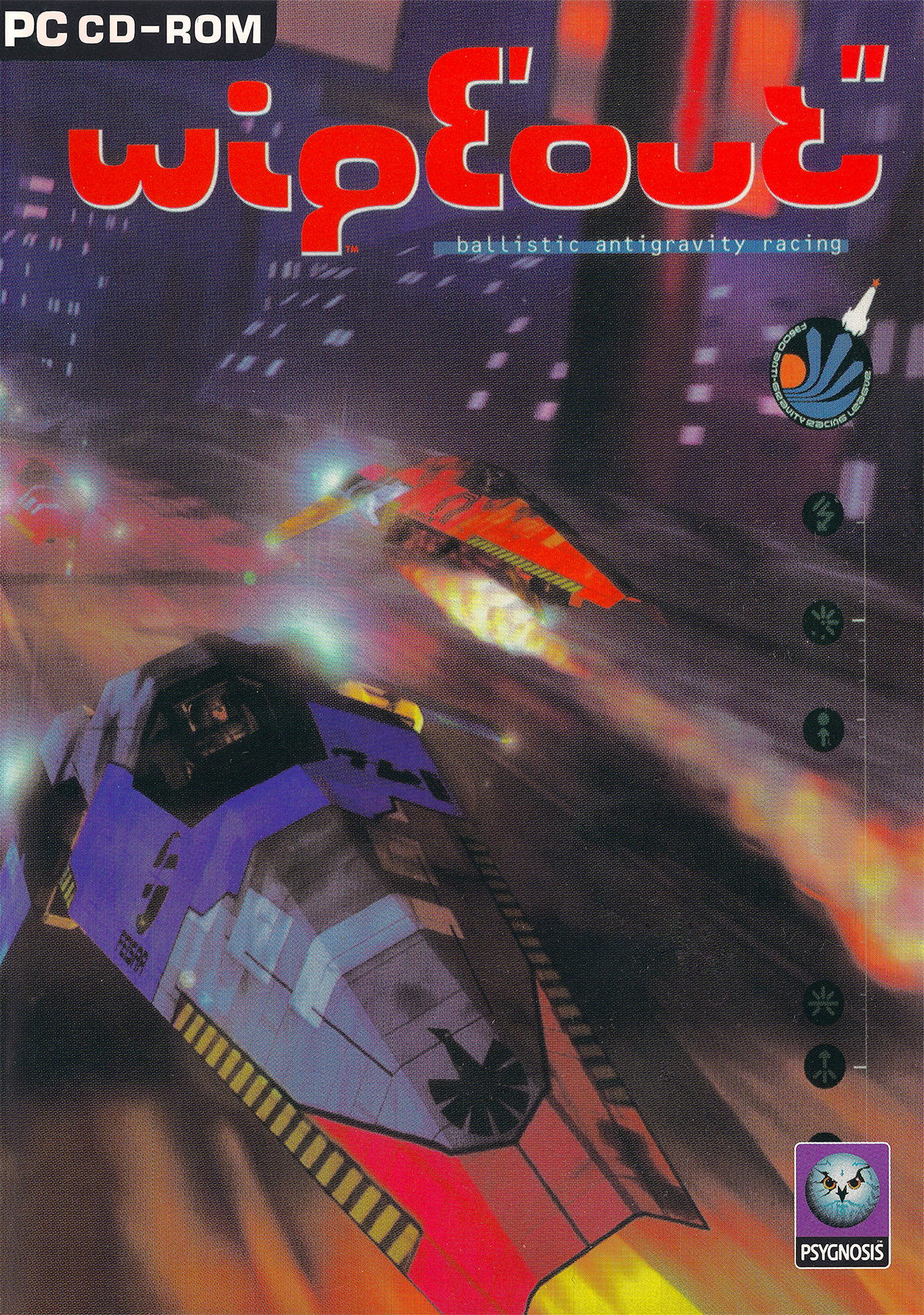
The Designers Republic's visual identity for Wipeout - clean, typographic, adult.
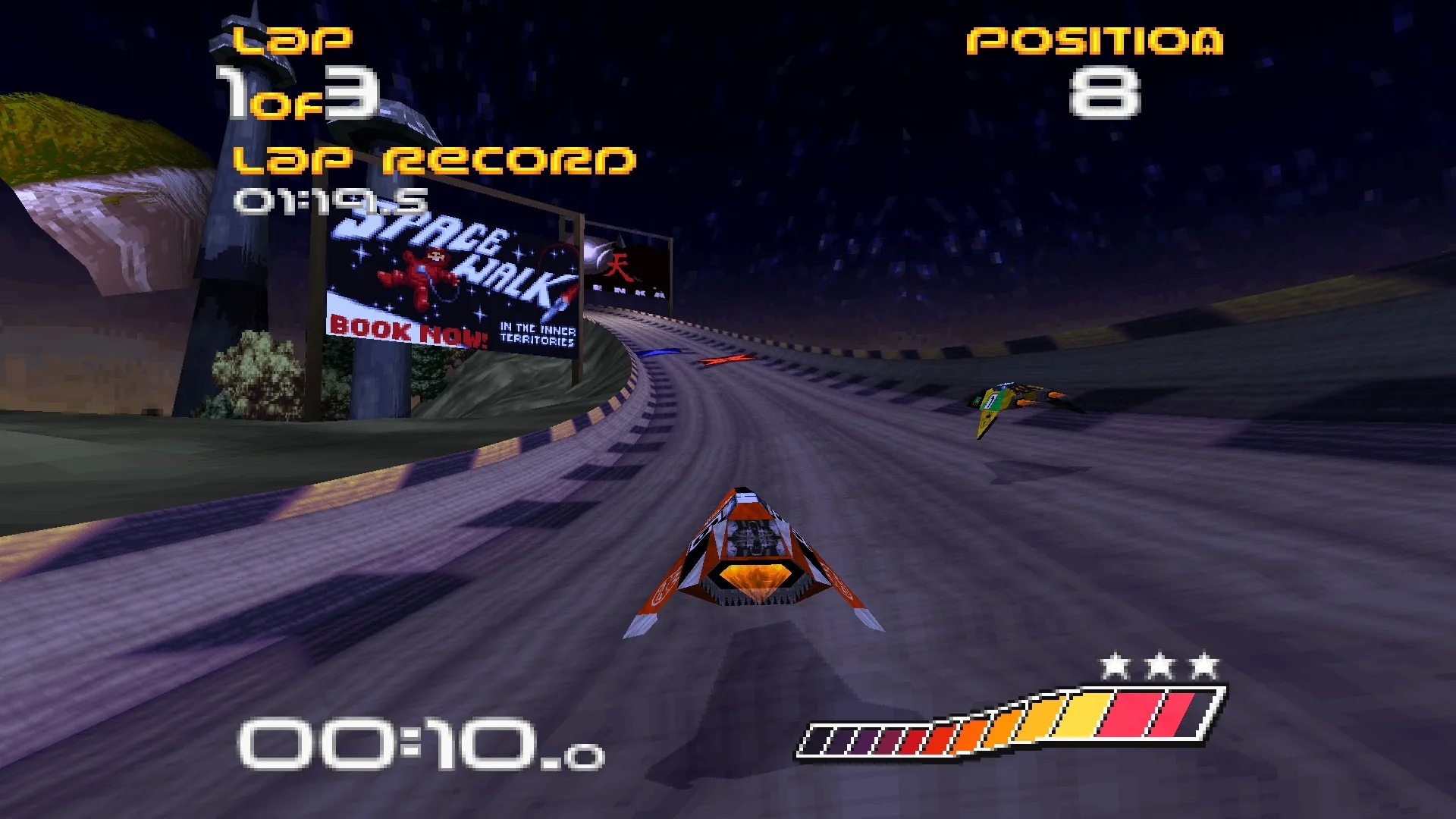
Wipeout is a futuristic anti-gravity racing game released in 1995 as a
PlayStation launch window title in Europe. Players pilot craft from competing
corporations - Feisar, AG Systems, Auricom, Qoron - around circuits suspended
above the Earth's surface, using weapon pickups to hinder rivals and boost pads
to maintain speed through turns.
That description is accurate and entirely inadequate. Wipeout was not primarily a
racing game. It was a cultural statement. Psygnosis had decided that the
PlayStation needed a title that looked, felt, and sounded like it belonged in the
same world as the music its target audience danced to on weekends - and they built
one. The result was a game that changed what people believed video games could be.
See the full entry in the catalogue.
How a Racing Game Became a Scene
The development of Wipeout began in 1993, shortly after Sony's acquisition of Psygnosis.
The brief from Sony was to produce a racing game for the PlayStation launch that would
demonstrate the console's 3D capabilities. Nick Burcombe
led the design, working with a small internal team at Psygnosis's Liverpool headquarters.
The anti-gravity concept emerged early. Burcombe and the team wanted something
faster than road cars and more visually distinctive - craft that did not follow
conventional racing game conventions of tyres, grip, and realistic physics.
Anti-gravity craft could bank through curves, hover at speed, and behave in ways
that emphasised visceral momentum over mechanical simulation.
The visual identity decision was the most consequential of the project. Psygnosis
chose to commission The Designers Republic - the Sheffield graphic
design collective led by Ian Anderson, whose work defined the visual language of
electronic music in the early 1990s - to design the entire game's interface, HUD,
advertising, and typography. The Designers Republic had designed sleeves for Warp
Records artists including Aphex Twin and Autechre; their visual language was
genuinely contemporary and immediately legible as belonging to electronic music culture.
"We wanted Wipeout to feel like a night out. The whole aesthetic - the music,
the visuals, the way the interface looked - was designed so that someone who'd
been to a rave would pick it up and immediately feel like it was made for them."
Nick Burcombe, Wipeout lead designer, Edge magazine retrospective, 2005
The anti-gravity racing that defined Wipeout - craft banking through curves with weapon pickups visible on the circuit ahead.
Chess at Sixty Frames Per Second
Playing Wipeout well required two separate skill sets. The first was mechanical:
learning the track layouts, understanding the craft's handling characteristics,
timing the use of shield energy (which depleted both from weapon hits and from
aggressive racing). The second was tactical: using weapons not just for offence
but for defence, understanding when to conserve energy and when to spend it,
reading the positions of rival craft ahead and behind.
The craft handled distinctly from conventional racing games. Steering was responsive
but anti-gravity physics meant that momentum carried differently through corners;
over-correcting a turn could cost a half-second that an opponent would immediately
convert into a lead. The game rewarded precision over aggression, though weapons -
rockets, plasma bolts, mines, the devastating Quake missile - allowed a skilled
player to nullify a rival's speed advantage through timing.
At higher difficulty levels, Wipeout became a memorisation challenge as much as a
reflexes test. The Venom and Rapier classes were accessible; Vector and Phantom
required knowing every chicane, every boost pad, and every weapon spawn location
to place consistently on the podium. The game's circuit design - Altima VII,
Karbonis V, Terramax, Korodera, Arridos IV, Silverstream, Firestar - was varied
enough that each track rewarded a different approach.
The Music That Belonged in a Record Shop
The most radical decision in Wipeout's production was the soundtrack. Rather than
commissioning original game music, Psygnosis licensed actual electronic music from
artists who were selling records to the same demographic that bought games.
The Chemical Brothers contributed "Chemical Beats".
Leftfield provided "Afro-Left". Orbital licensed
"P.E.T.R.O.L." These were not specially recorded game versions - they were the
same tracks playing in clubs and on pirate radio in 1994-95.
Tim Wright, working under his CoLD SToRAGe
alias, composed the original tracks that filled the gaps: "Messij", "Cairodrome",
and others that matched the licensed material's energy and production style so
closely that players often could not identify which tracks were licensed and which
were original. Wright's compositions were not background texture - they were
sequenced, produced electronic music at the standard of the licensed material.
Full soundtrack context is on the music page.
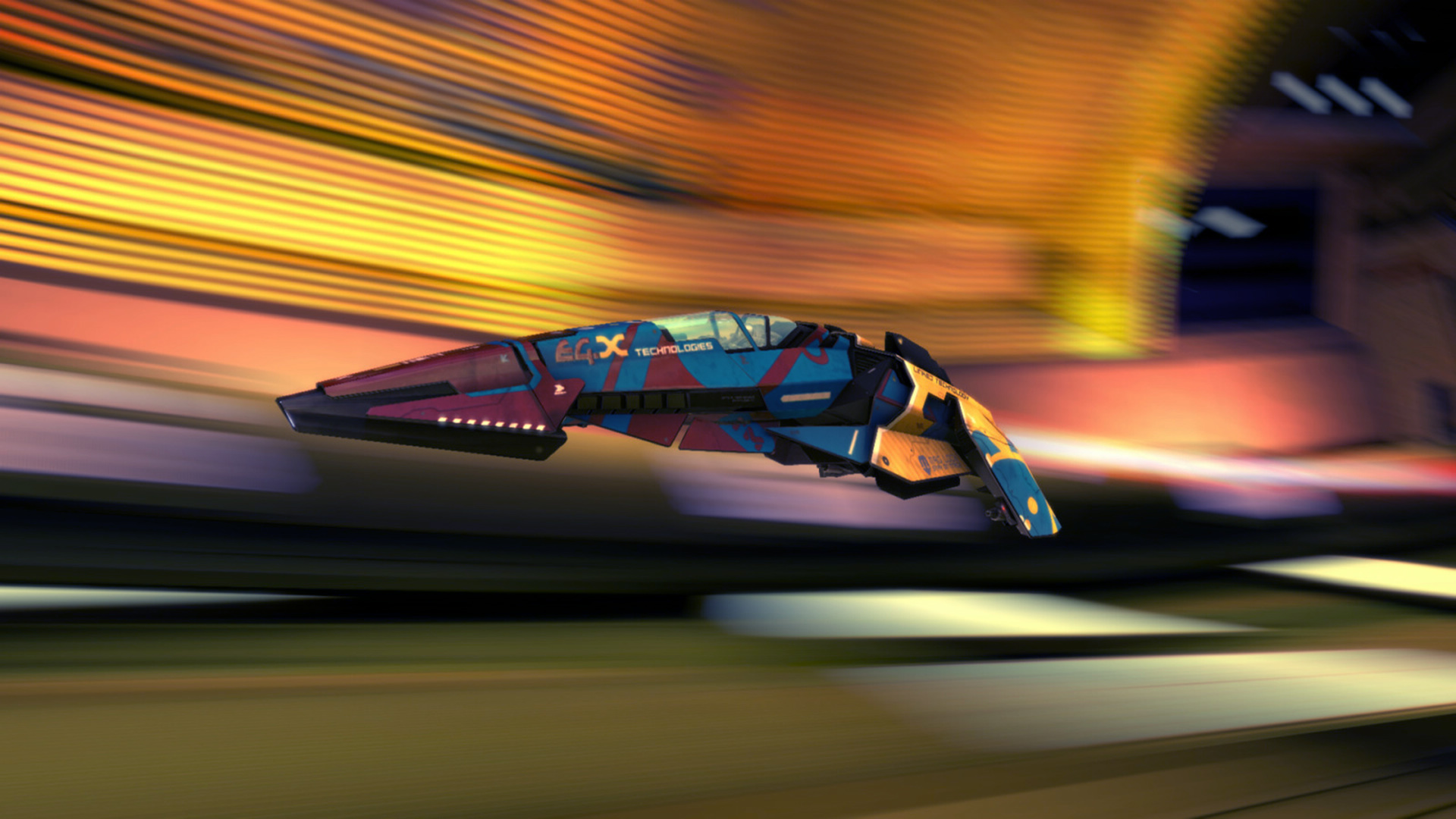
The Designers Republic's promotional art for Wipeout - the same visual language as a Warp Records release.
The Console That Played at Clubs
The critical reception to Wipeout was strongly positive across the PlayStation press.
The game was widely identified as the launch title that most convincingly demonstrated
the console's capabilities and its intended audience positioning. Where other launch
games showed what the PlayStation's hardware could render, Wipeout showed what the
PlayStation was: a machine aimed at people who had money, went to clubs,
and would use it to show off at parties.
Edge magazine, whose aesthetic sensibility aligned closely with Wipeout's,
gave it a strong review emphasising the game's cultural positioning as much as its
mechanics. The mainstream gaming press followed. In Japan, the game performed
moderately; in Europe and North America, where the electronic music scene it
referenced had a larger audience, it was a significant commercial success.
The Franchise Psygnosis Left Behind
Wipeout spawned a franchise that continued under the SCE Studio Liverpool name long
after Psygnosis itself had been renamed. Wipeout 2097 (1996) is often cited
as the high point of the series by players who experienced it at the time: a sequel
that extended everything the original established with harder tracks, more developed
craft handling, and a second licensed soundtrack that featured The Prodigy, Daft Punk,
and Future Sound of London alongside further CoLD SToRAGe originals.
Subsequent entries - Wipeout 64 (1998), Wipeout Fusion (2002),
Wipeout Pure (PSP, 2005), Wipeout HD (2008), Wipeout 2048
(PS Vita, 2012) - extended the franchise across two further console generations.
The Wipeout Omega Collection (2017), released five years after Studio
Liverpool's closure, collected HD, Fury, and 2048 in a remastered 4K package.
The modern legacy is covered in the Modern Legacy section.
The cultural impact of the original 1995 game is harder to overstate. It established
a visual and sonic identity for the PlayStation that the console carried through its
entire first generation. It demonstrated that licensed popular music was a legitimate
game design tool. And it proved, definitively, that a video game could be cool in
the same way that a record or a fashion item was cool - that the medium could participate
in contemporary culture rather than existing alongside it.
The Chemical Brothers, Leftfield, Orbital, and Psygnosis walked into a record shop.
1992Amiga only
Agony
The shooter where the art direction was the game.
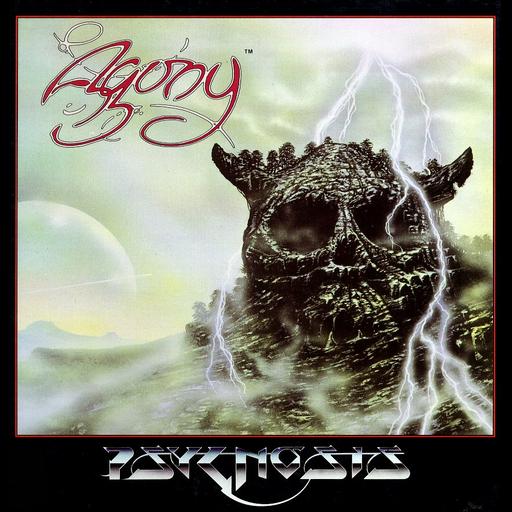
Agony's box art - dark fantasy that matched the game's own visual ambition.
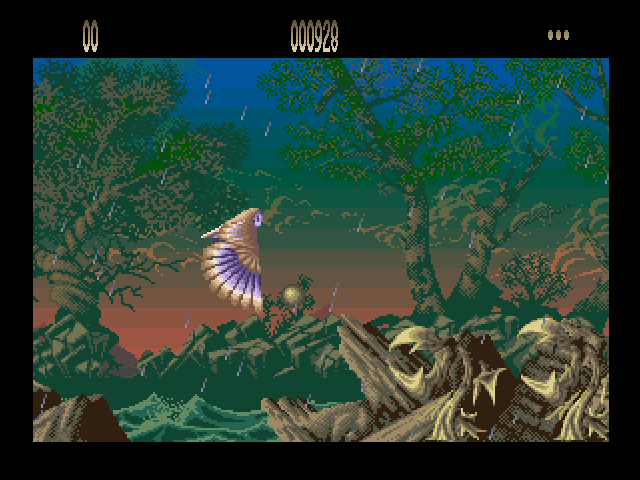
Agony is a vertical scrolling shoot-em-up released exclusively for the
Amiga in 1992. The player controls an owl - the vehicle for a wizard's soul -
navigating through dark fantasy environments, defeating enemies, and progressing
through six distinct zones. On a mechanical level, it is a competent example of
its genre, no more and no less.
On a visual and audio level, Agony occupies a category of its own. Developed by
the Belgian AMF Team and published by Psygnosis, the game deployed an artistic
ambition in its environment design that went substantially beyond functional game
graphics. It looked, quite plainly, like interactive fine art. That claim is not
hyperbole; it is the considered assessment of the Amiga press of the period, and
it holds up. See the full entry in the catalogue.
The Belgian Studio That Surprised Liverpool
Agony was developed by the AMF Team, a small Belgian development studio. Their
earlier work was technically competent but not extraordinary. Agony represented a
step-change in their ambition - a decision to make something that looked unlike any
Amiga game before it, using the platform's colour capabilities and the art team's
skills in a way that prioritised visual quality above all other constraints.
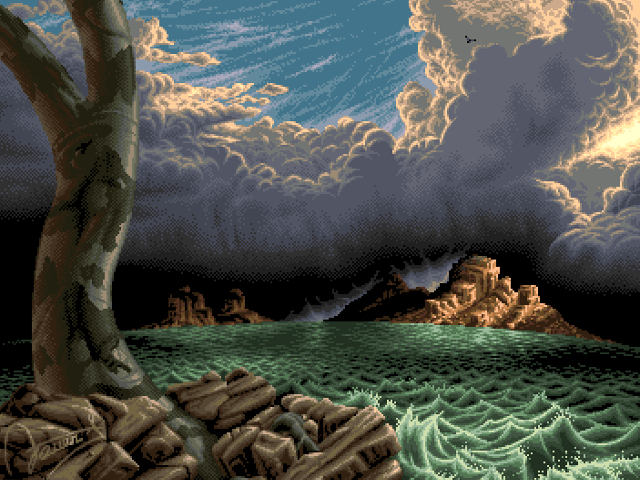
The game's six zones were each given their own distinct visual identity: ancient
forests of impossible density; cyclopean towers against twilight skies; underground
caverns lit by bioluminescent organisms; sky regions where cloud formations became
geography. The colour palettes were carefully chosen for emotional register -
deep purples and blues for dread, amber and ochre for warmth corrupted by malevolence,
acidic greens for the uncanny. No zone recycled another's visual vocabulary.
The owl protagonist was animated with more care than any previous Amiga shoot-em-up
had given its player character. Banking turns, attack dives, and idle hovering were
each separately animated. The enemy designs drew from medieval bestiaries and dark
fantasy illustration traditions: serpentine aerial creatures, armoured insectoid
forms, spectral entities that moved with unnatural fluidity.
Agony's environments - each zone a separately conceived visual world with its own palette and creature design.
The Owl and Forty Demons
As a shoot-em-up, Agony followed established vertical-scrolling conventions. The owl
attacks by firing orbs of magical energy and gains power-ups from defeated enemies.
Health is managed as a limited reserve that depletes on contact with enemies or
projectiles. Each zone ends with a boss encounter that requires pattern recognition
to defeat efficiently.
The game's difficulty was calibrated to provide a substantial challenge without
the brutal death curves of Japanese arcade-derived shoot-em-ups. European players
who found titles like Turrican demanding but rewarding found Agony accessible -
hard enough to require multiple attempts, but not so hard that the visual experience
was permanently gated behind technical skill. The pacing allowed players to absorb
the environments rather than spending all attention on survival.
What the Amiga Could Do When No One Was Compromising
Agony's technical achievement was not a specific hardware trick in the manner of
Shadow of the Beast's parallax engine. It was something less quantifiable but
equally significant: the demonstration that the Amiga's colour capabilities, properly
deployed by artists who were not constrained by time pressure or commercial formula,
could produce images of genuine aesthetic quality.
The game used the Amiga's Extra Half-Brite mode in some sections -
a hardware feature that doubled the available colours by adding half-brightness
versions of the 32-colour palette, producing a 64-colour display with a distinctive
twilight quality that matched Agony's visual register precisely. In other areas,
standard OCS (Original Chip Set) capabilities were pushed to their usable limit
through careful palette management - choosing colours that exploited dithering
patterns to suggest more tonal range than the hardware formally provided.
Roger Dean's influence on the Psygnosis visual
culture was visible throughout Agony's environments - not through Dean's direct
involvement, but through the aesthetic DNA that his long collaboration with Psygnosis
had established. The organic quality of the architecture, the sense that every surface
was alive and breathing, the preference for curved forms over rectilinear geometry:
these were Dean's contributions to how Psygnosis thought about visual design,
transmitted through the company's publishing aesthetic into the AMF Team's work.
Music That Demanded to Be Listened To
Raphaël Gesqua's soundtrack for Agony is one of the most accomplished
pieces of Amiga game music ever recorded. Gesqua, a Belgian composer who later worked
on games including Elvira: Mistress of the Dark, brought a cinematic approach
to the Amiga's four-channel audio that went substantially beyond the conventions of
game music in 1992.
The Agony soundtrack uses the Amiga's MOD format (sampled audio replayed at different
pitches through the four channels) with orchestral samples that maintained their
atmospheric quality despite the channel limitation. The compositions were structured
as pieces of music - with development, tension, and release - rather than as loops
designed to be ignored during play. At a time when most game music was functional
background texture, Gesqua created something that rewarded undivided attention.
The music is available in its original Amiga module form via the
music page. Listening to it separately from the game
confirms what the period reviews noted: Gesqua's Agony score is genuinely
accomplisehd music, not merely competent game audio.
"On the Amiga you had four channels and whatever samples fit in memory. The constraint
forces you to make decisions about what matters in the music - you can't fill space,
so every note has to earn its place. Agony gave me the freedom to take that seriously."
Later zones in Agony - the visual complexity that made the game a demonstration piece for the Amiga platform.
Reviewed as Art, Played as a Game
The Amiga press received Agony with the kind of reverence usually reserved for
platforms-defining releases. CU Amiga awarded it high marks and focused
substantially on the visual quality in its review coverage. Amiga Power
praised the art direction extensively. Reviewers struggled, in many cases, to
separate their assessment of the game as a shoot-em-up from their response to
the game as a visual experience - which was itself revealing about what kind of
object Agony was.
Sales were respectable but not spectacular. Agony was never going to match the
commercial reach of Shadow of the Beast or Lemmings: it was an Amiga exclusive in
a period when multi-platform release was becoming commercially necessary, and
its visual strengths were inseparable from the specific hardware. A Atari ST port
was discussed but never materialised.
The Purest Expression of What Psygnosis Believed
Agony represents something specific in the Psygnosis catalogue: the moment when
the company's aesthetic philosophy was expressed without compromise or commercial
hedging. Shadow of the Beast was also visually ambitious, but it existed within
the platform action genre with clear commercial expectations. Wipeout's artistry
served the goal of defining a new console's identity. Lemmings was, by design,
a mass-market product.
Agony was a niche Amiga exclusive published in 1992, when the market was already
moving toward consoles and the commercial logic of a platform-specific art game
was questionable at best. Psygnosis published it anyway. That decision - to support
a Belgian studio's vision of a vertical shooter as a work of visual art, without
requiring the compromises that commercial logic might have demanded - says something
about the company's identity that no other title in the catalogue captures so purely.
In the context of the people who built Psygnosis's reputation -
Ian Hetherington, Roger Dean, David Whittaker, Tim Wright - Agony is the work that
most fully reflects what they collectively believed a video game could aspire to.
It is not the most successful game in the catalogue. It is, in its way, the most
honest one.