Flagship Title · HuCard · 1988 (JP) / 1989 (NA)

R-Type

The port that proved what the PC Engine could do. Hudson Soft’s technically astonishing conversion of Irem’s arcade masterpiece — declared impossible, delivered perfectly.

Game Overview

Release

JapanJune 3, 1988 (Part I)
July 14, 1988 (Part II)
North America1989 (combined HuCard)
PlatformPC Engine / TurboGrafx-16
FormatHuCard (2 cards JP, 1 card NA)
PublisherHudson Soft

Credits

Original DeveloperIrem
PC Engine PortHudson Soft
Original Arcade1987
GenreHorizontal Shoot-em-up
Stages8 (same as arcade)

Legacy

Hardware ImpactProved PC Engine superiority
Sales400,000+ copies (Japan)
AccuracyNear-perfect arcade conversion
ScoreUniversally acclaimed
StatusDefining platform title
R-Type arcade promotional art - Irem's horizontal shooter
R-Type (1987) - Irem’s arcade masterpiece, featuring some of the era’s most distinctive enemy design inspired by H.R. Giger’s Alien artwork.

Screenshots

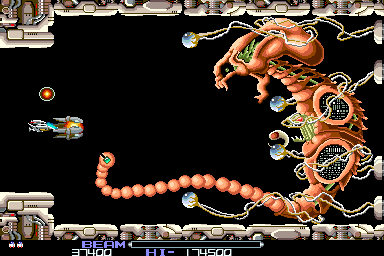
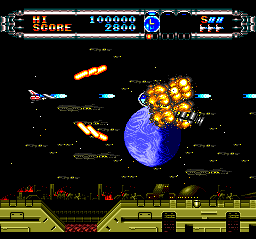
Hudson Soft’s PC Engine conversion in full - all eight stages, the Force Pod, and the Bydo Empire.

R-Type PC Engine - Stage 1 opening sequence with R-9 spacecraft R-Type PC Engine - mid-game confrontation with Force Pod deployed R-Type PC Engine - enemy wave formation with Bydo forces R-Type PC Engine - large boss encounter demonstrating sprite scale
R-Type PC Engine - tunnel navigation section requiring precision R-Type PC Engine - power-up sequence with Force Pod upgrades

The Arcade Game

Irem’s Masterwork: 1987

R-Type debuted in arcades in 1987 from Irem Corporation, the Japanese developer also known for Moon Patrol and 10-Yard Fight. It was immediately recognised as something different. Where most horizontal shooters prioritised reflex and memorisation through overwhelming bullet counts, R-Type emphasised puzzle-like stage design and a single innovative mechanic: the Force Pod.

The Force Pod — an indestructible orb that attached to the front or rear of the player’s R-9 spacecraft — served simultaneously as shield, weapon emitter, and tactical tool. Players could detach it and send it ahead as a proxy fighter, or anchor it defensively against incoming fire. The mechanic transformed the shooter’s vocabulary.

The Bydo Empire and H.R. Giger

R-Type’s enemy design was distinctive to the point of controversy. The Bydo Empire — an alien civilisation the R-9 pilot fights across the game’s eight stages — was visually and thematically influenced by H.R. Giger’s work on Alien. Organic, biomechanical, visceral. Stage 6 in particular featured a giant serpentine creature wrapping around the stage architecture in a way that had never been seen in a scrolling shooter.

The music, composed by Masato Ishizaki, was equally memorable: aggressive, industrial-tinged synth that matched the game’s oppressive atmosphere precisely. The arcade game was not only technically impressive — it was felt.
Hudson Soft’s Achievement

The Impossible Port

When Hudson Soft announced they were bringing R-Type to the PC Engine, the announcement was met with scepticism in the Japanese gaming press. The arcade board R-Type ran on was significantly more powerful than any home console of the era. The sprites alone — particularly the enormous boss creatures — were assumed to be beyond the PC Engine’s hardware capabilities. Compromises were expected.

The finished product silenced the doubters. Hudson’s conversion reproduced all eight stages, preserved the Force Pod mechanic completely, and maintained the boss designs at their full, screen-filling scale. The sprite count was remarkable: the PC Engine’s 64 hardware sprites were pushed hard throughout, and the result looked arcade-accurate on consumer television hardware. For 1988, it was extraordinary.

The Two-HuCard Solution

To fit the full game, Hudson split the Japanese PC Engine release across two HuCards: R-Type I (stages 1–4) and R-Type II (stages 5–8). Players who completed Part I received a password to continue in Part II from an appropriate point. The split was an engineering compromise — ROM density limitations on HuCards at the time made a single card version impossible at reasonable manufacturing cost.

When NEC Technologies launched the TurboGrafx-16 in North America in 1989, R-Type came with it — as a single HuCard, at higher ROM density. The NA version remains the most convenient way to play the complete game on original hardware.

Did You Know?

The PC Engine version of R-Type contained a secret developer room accessible via a specific code. Hudson programmers hid their names and messages in a hidden area of the game not visible during normal play — a tradition of Easter eggs that would become common in later years.

The Commercial Impact

R-Type sold over 400,000 copies in Japan and became the PC Engine’s defining proof-of-concept. Retailers reported selling out of PC Engine hardware on the back of R-Type demonstrations. NEC’s console had already been performing well in Japan; after R-Type, it was undeniable.

The port established Hudson Soft’s reputation as the premier technical house for the platform — a reputation they would confirm repeatedly with Super Star Soldier, Blazing Lazers, and Gate of Thunder. It also established that the PC Engine could receive serious arcade content, opening the door for the wave of arcade conversions that followed.

We never once considered not doing all eight stages. The arcade game was R-Type. If we couldn’t do R-Type completely, there was no point doing it at all. — Hudson Soft developer interview, Famitsu magazine, 1988

Stage Design & Mechanics

The Eight Stages

R-Type’s eight stages represent a curriculum in horizontal shooter design, each teaching a specific skill while building on the last. Stage 1 introduces the Force Pod and basic enemy patterns. Stage 3 brings the first of the game’s most famous sequences: the approach to the giant battleship boss, where the player must navigate confined spaces with minimal room for error.

Stage 6 — the serpentine creature stage — remains the game’s most visually striking level and one of the most technically impressive sequences in 1988 console gaming. The creature fills the screen, creates and closes corridors as it moves, and tests the player’s mastery of the Force Pod’s defensive applications. Completing it feels earned in a way few gaming challenges do.

The Force Pod System

The Force Pod mechanic gives R-Type its strategic depth. Players can collect power-up modules to upgrade the Pod’s firing mode — eight options including laser, anti-air missiles, and terrain-following bombs — while the Pod itself serves as both shield and secondary weapon. Attaching it to the rear of the ship protects against enemies approaching from behind; detaching it sends it forward as an independent weapon platform.

Learning to exploit the Force Pod’s full range of applications is the game’s primary skill expression. The stages are designed around it: corridors that require specific Pod positions, enemy waves that demand switching between offensive and defensive Pod usage, boss encounters that test knowledge of the Pod’s characteristics against specific weak points.

The stages weren’t designed for the ship. They were designed for the Force Pod. The ship is just the vehicle. Understanding that changes how you play the game entirely. — Irem design document, 1987 (paraphrased in Japanese gaming press)

R-Type Longplay

PC Engine Longplay: R-Type

A complete longplay of R-Type on the PC Engine, courtesy of World of Longplays. All eight stages, the Force Pod mechanics in full operation, and Hudson Soft’s landmark port demonstrated from start to finish.

Longplay · World of Longplays