Deep Editorial · Three Platform-Defining Games

Flagship Titles

R-Type, Gate of Thunder, and Dracula X: Rondo of Blood - the three games that showed what the PC Engine was capable of, and why they still matter thirty years on.

R-Type

Irem’s arcade masterpiece, ported by Hudson Soft with an accuracy that silenced every doubter.

Release

JapanJune 3, 1988 (Part I)
July 14, 1988 (Part II)
North America1989 (combined HuCard)
PlatformPC Engine / TurboGrafx-16
FormatHuCard (2 cards JP, 1 card NA)
PublisherHudson Soft

Credits

Original DeveloperIrem
PC Engine PortHudson Soft
Original Arcade1987
GenreHorizontal Shoot-em-up
Stages8 (same as arcade)

Legacy

Hardware ImpactProved PC Engine superiority
Sales400,000+ copies (Japan)
AccuracyNear-perfect arcade conversion
ScoreUniversally acclaimed
StatusDefining platform title
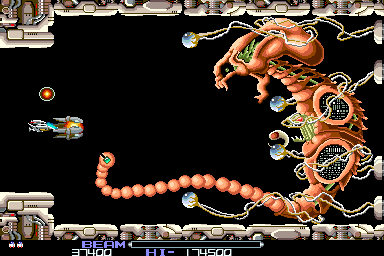
R-Type arcade promotional art - Irem's horizontal shooter
R-Type (1987) - Irem’s arcade masterpiece, featuring enemy design directly inspired by H.R. Giger’s Alien artwork.

Hudson Soft’s Conversion in Full

All eight stages, the Force Pod, and the Bydo Empire on PC Engine hardware.

R-Type PC Engine - Stage 1 opening sequence with R-9 spacecraft R-Type PC Engine - mid-game confrontation with Force Pod deployed R-Type PC Engine - enemy wave formation with Bydo forces R-Type PC Engine - large boss encounter demonstrating sprite scale
R-Type PC Engine - tunnel navigation section requiring precision R-Type PC Engine - power-up sequence with Force Pod upgrades

Irem’s Masterwork: 1987

A Game Built Around One Mechanic

R-Type debuted in arcades in 1987 from Irem Corporation, the Japanese developer also known for Moon Patrol and 10-Yard Fight. It was immediately recognised as something different. Where most horizontal shooters prioritised reflex and memorisation through overwhelming bullet counts, R-Type emphasised puzzle-like stage design and a single innovative mechanic: the Force Pod.

The Force Pod — an indestructible orb that attached to the front or rear of the player’s R-9 spacecraft — served simultaneously as shield, weapon emitter, and tactical tool. Players could detach it and send it ahead as a proxy fighter, or anchor it defensively against incoming fire. The mechanic transformed the shooter’s vocabulary.

The Bydo Empire and H.R. Giger

R-Type’s enemy design was distinctive to the point of controversy. The Bydo Empire — an alien civilisation fought across eight stages — was visually and thematically influenced by H.R. Giger’s work on Alien. Organic, biomechanical, visceral. Stage 6 in particular featured a giant serpentine creature wrapping around the stage architecture in a way that had never been seen in a scrolling shooter.

The music, composed by Masato Ishizaki, was equally memorable: aggressive, industrial-tinged synth that matched the game’s oppressive atmosphere precisely. The arcade game was not only technically impressive — it was felt.
Declared Impossible, Delivered Whole

What the Sceptics Said

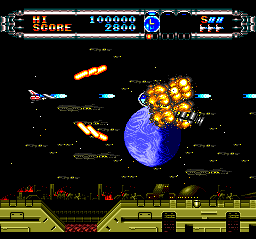
When Hudson Soft announced they were bringing R-Type to the PC Engine, the Japanese gaming press was sceptical. The arcade board R-Type ran on was significantly more powerful than any home console of the era. The sprites alone — particularly the enormous boss creatures — were assumed to be beyond the PC Engine’s hardware capabilities. Compromises were expected. A cut-down experience was assumed.

The finished product silenced the doubters. Hudson’s conversion reproduced all eight stages, preserved the Force Pod mechanic completely, and maintained the boss designs at their full, screen-filling scale. The sprite count was remarkable: the PC Engine’s 64 hardware sprites were pushed hard throughout, with scanline multiplexing employed to display more than the hardware’s documented maximum simultaneously. For 1988, it was extraordinary.

The Two-HuCard Solution

To fit the full game, Hudson split the Japanese PC Engine release across two HuCards: R-Type I (stages 1–4) and R-Type II (stages 5–8). Players who completed Part I received a password to continue in Part II from an appropriate point. The split was an engineering compromise — ROM density limitations on HuCards at the time made a single-card version impossible at reasonable manufacturing cost.

When NEC Technologies launched the TurboGrafx-16 in North America in 1989, R-Type arrived with it — as a single HuCard, at higher ROM density. The North American version remains the most convenient way to play the complete game on original hardware, and was one of the strongest launch-window titles any console had seen up to that point.

Engineering Note

The PC Engine version of R-Type contained a hidden developer room accessible via a specific code. Hudson programmers embedded their names and messages in an area of the game not reachable during normal play - a tradition of Easter eggs that would become common across their subsequent PC Engine releases.

The Commercial Impact

R-Type sold over 400,000 copies in Japan and became the PC Engine’s defining proof-of-concept. Retailers reported selling out of PC Engine hardware on the back of R-Type demonstrations. NEC’s console had already been performing well in Japan; after R-Type, it was undeniable.

The port established Hudson Soft’s reputation as the premier technical house for the platform — a reputation they would confirm with Super Star Soldier, Blazing Lazers, and Gate of Thunder. It also demonstrated that the PC Engine could receive serious arcade content without significant compromise, opening the door for the wave of conversions that followed.

We never once considered not doing all eight stages. The arcade game was R-Type. If we couldn’t do R-Type completely, there was no point doing it at all. — Hudson Soft developer interview, Famitsu magazine, 1988

Eight Stages Built Around a Single Decision

A Curriculum in Shooter Design

R-Type’s eight stages represent a curriculum in horizontal shooter design, each teaching a specific skill while building on the last. Stage 1 introduces the Force Pod and basic enemy patterns. Stage 3 brings the first of the game’s most famous sequences: the approach to a giant battleship boss, where the player must navigate confined spaces with minimal room for error.

Stage 6 — the serpentine creature stage — remains the game’s most visually striking level. The creature fills the screen, creates and closes corridors as it moves, and tests the player’s mastery of the Force Pod’s defensive applications. Completing it feels earned in a way few gaming challenges do.

What the Force Pod Actually Means

The Force Pod gives R-Type its strategic depth. Players can collect power-up modules to upgrade the Pod’s firing mode — eight options including a focused laser, anti-air missiles, and terrain-following bombs — while the Pod itself serves as both shield and secondary weapon. Attaching it to the rear protects against enemies from behind; detaching it sends it forward as an independent weapon platform.

The stages are designed around this decision, not around the ship. Corridors require specific Pod positions. Enemy waves demand switching between offensive and defensive Pod usage on the fly. Boss encounters test knowledge of the Pod’s characteristics against specific weak points. Learning to exploit the full range of Pod applications is the game’s primary skill expression — a depth that rewards mastery rather than memorisation alone.

Critics Had No Precedent for It

Japan’s Response in 1988

Famitsu, Japan’s most authoritative gaming weekly, awarded R-Type Part I near-perfect marks on its June 1988 release — scoring it among the highest-rated HuCard releases of the year. The magazine’s panel praised the fidelity of Hudson’s conversion and the platform’s ability to handle the arcade’s demanding sprite requirements, noting in particular the preservation of Stage 6’s serpentine boss sequence, which had been assumed impossible to replicate on home hardware.

Japanese retail responded with unusual speed. Hardware bundles sold out in the weeks following the game’s release as buyers who had seen R-Type in arcades sought the home version. For many consumers, R-Type Part I was the reason they bought a PC Engine.

The Western Consensus

When the TurboGrafx-16 launched in North America in August 1989 with R-Type as a centrepiece title, Western gaming publications were broadly enthusiastic. UK gaming magazines covering the import scene had already praised the PC Engine version as the finest home conversion of R-Type available — better than the Amiga version, better than the contemporary Sega Master System port. The consensus was clear: this was not merely a good port of a good game. It was the definitive home version.

The Port That Opened the Floodgates

What Hudson Built On This

R-Type’s success had two lasting effects. The first was on the platform itself: it demonstrated that the PC Engine could receive serious arcade content at near-perfect fidelity, opening the door for the wave of conversions that followed — Space Harrier, Pac-Land, and eventually Fighting Street (the first home port of Street Fighter, which the PC Engine received before any other console). The second was on Hudson Soft’s standing: the R-Type port made them the most technically respected developer on the platform, a position they used to greenlight Blazing Lazers, Super Star Soldier, and ultimately Gate of Thunder.

The Franchise It Launched

R-Type itself became a franchise. Irem released R-Type II in arcades in 1989, followed by R-Type III: The Third Lightning (1993, Super Nintendo) and R-Type Final (2003, PlayStation 2). Each sequel built directly on the Force Pod mechanic and the puzzle-driven stage design that the original established. The PC Engine port, 400,000 copies sold in Japan alone, remains the canonical home version of the original game — the version by which all subsequent ports were measured.

In 2018, R-Type Final 2 launched via crowdfunding, explicitly reviving the franchise after a long hiatus. The development team cited the original game’s Force Pod mechanic as the core they were working to preserve. That mechanic — conceived in 1987 by Irem, faithfully reproduced in 1988 by Hudson Soft on the PC Engine — was still the thing worth saving thirty-five years later. See R-Type in the full catalogue →

R-Type Longplay

PC Engine Longplay: R-Type

A complete longplay of R-Type on the PC Engine from World of Longplays. All eight stages, the Force Pod mechanics in full operation, and Hudson Soft’s landmark port demonstrated from start to finish.

Longplay · World of Longplays

Gate of Thunder

Hudson Soft’s showcase for what the TurboDuo could do when a developer used every tool at their disposal.

Release

Japan1992 (TurboDuo launch)
North America1992 (TurboDuo bundle)
PlatformPC Engine CD-ROM²
FormatCD-ROM²
PublisherHudson Soft

Credits

DeveloperHudson Soft
ComposerT’s Music
GenreHorizontal Shoot-em-up
Stages7
PlayerSylphia

Impact

Bundled withTurboDuo hardware
AudioCD redbook soundtrack
StatusDefinitive TurboDuo title
Followed byLords of Thunder (1993)
Gate of Thunder PC Engine CD-ROM - horizontal shooter gameplay showing parallax scrolling and enemy formations
Gate of Thunder (1992) - Hudson Soft’s showcase title for the TurboDuo. The parallax-scrolling backgrounds and fluid enemy movement were matched by a CD audio soundtrack that set a new standard for game music.

Gate of Thunder is a horizontal shoot-em-up released in 1992 for the PC Engine CD-ROM², developed by Hudson Soft and designed from the ground up as the centrepiece title for the new TurboDuo hardware. It came bundled with the TurboDuo on launch alongside Bonk’s Adventure and Bomberman, a triple-pack that made the hardware an extraordinary value proposition. Of the three, Gate of Thunder was the technical statement: a game that demonstrated what CD-ROM storage and CD audio quality meant for action games when a skilled developer chose to use them properly.

Music First, Then the Game Around It

The CD Audio Decision

When Hudson Soft began development on Gate of Thunder, the central design decision was made early: the soundtrack would be the game’s primary technical showcase. Rather than treating the CD-ROM²’s audio as a bonus over HuCard quality, Hudson commissioned T’s Music — an external music studio — to compose a full redbook audio soundtrack: uncompressed CD audio, playable in any standard audio CD player, running live from the disc during gameplay.

This was a deliberate statement. The PC Engine’s CD-ROM² format had been in use since 1988, but most titles used the medium primarily for storage and voice acting. Gate of Thunder used it for sound in the way that would define what CD gaming could feel like: loud, layered, unmistakably better than anything achievable from chip-based synthesis.

Designed for the Hardware It Shipped With

Because Gate of Thunder was built specifically for the TurboDuo — a hardware revision that combined the PC Engine and the CD-ROM² unit into a single console — Hudson’s development team had certainty about the base configuration. Every player would have the CD hardware. Every player would have the additional RAM the CD-ROM² system unlocked. There were no HuCard constraints to design around, no compromises to plan for. The result is a game that uses its format thoroughly and without apology.

Seven Stages of Escalating Intensity

The Weapon System

Gate of Thunder casts players as Sylphia, a lone fighter pilot navigating seven stages of increasingly complex enemy formations. The weapon system centres on three distinct shot types — spread, lightning, and missile — each upgradeable through a power-up chain that rewards sustained performance. Unlike R-Type’s Force Pod, which rewards strategic positioning, Gate of Thunder’s weapon system rewards aggression: killing enemies in sequence builds power-up density, and maintaining a high weapon level is the key to managing the later stages.

Stage Design That Earns the Music

Each of Gate of Thunder’s seven stages is set to a specific track from T’s Music’s redbook soundtrack, and the stages are designed to sync with the rhythm of the audio — enemy wave timing, boss introduction moments, and transition sequences all arrive at musically appropriate points. Whether this was intentional design or an artefact of how Hudson structured the game’s pacing, the effect is that the game flows in a way most shooters do not.

Boss encounters are substantial: multi-phase constructions with distinct attack patterns that require weapon management and positioning across extended durations. The final boss sequence is one of the more demanding in the genre, placing the game squarely in the ‘challenging but fair’ tradition that Hudson’s shooter catalogue consistently maintained.

What CD-ROM Storage Actually Sounded Like

Parallax Layering and Sprite Density

Gate of Thunder’s visual approach stacked multiple independently scrolling background layers across each stage, producing a sense of spatial depth unusual for horizontal shooters of the era. The PC Engine’s VDC was capable of two hardware background planes, and Hudson supplemented these with sprite-based pseudo-layers for foreground detail — a technique they had refined across multiple previous titles but deployed here at greater density than anywhere before.

Audio as a Technical Argument

The redbook audio soundtrack was Gate of Thunder’s most technically consequential feature. CD audio runs at 44.1 kHz / 16-bit stereo — the same specification as a commercial music CD. No chip synthesis, no FM approximation, no sample compression. T’s Music’s compositions for Gate of Thunder could be aggressive metal, sweeping orchestral, or driving rock — and they sounded like those things, not like approximations of them.

In 1992, the Nintendo Super Famicom and Sega Mega Drive were the dominant home consoles. Neither could deliver audio at this quality during gameplay. Gate of Thunder made that comparison audible in real time.

The CD format gives us space, but space is only useful if you fill it with something worth hearing. We knew from the start that the music had to be the reason people turned the volume up. — Hudson Soft, PC Engine Fan magazine developer feature, 1992

The Killer App for a Console No One Had Yet Bought

Critical Reception

Gate of Thunder was received as the TurboDuo’s showcase title in both Japan and North America. Japanese gaming press praised the audio presentation as the most impressive in any action game then available on home hardware, and the game’s visual fluidity drew favourable comparisons with contemporaneous arcade shooters. In North America, where the TurboDuo launched at a higher price point than its competition, Gate of Thunder was consistently cited as justification for the hardware investment: a game that only this platform could deliver in this form.

A Legacy Measured in Successors

Gate of Thunder’s commercial success and critical profile led directly to Lords of Thunder (1993), a spiritual successor from Hudson Soft that pushed the formula further with non-linear stage selection, elemental armour systems, and a heavy metal soundtrack by T’s Music that many regard as even better than Gate of Thunder’s. The two games form the definitive pair of PC Engine CD shooters.

Both titles remain among the most discussed PC Engine games among collectors and genre enthusiasts. Gate of Thunder in particular is consistently cited as one of the finest examples of CD audio’s potential in a game context — a benchmark that was not surpassed until CD-ROM gaming became mainstream on PlayStation and Saturn. See Gate of Thunder in the full catalogue →

Dracula X: Rondo of Blood

Konami’s masterpiece for the platform — Japan-exclusive for fourteen years, still considered one of the finest action games ever made.

Release

JapanOctober 29, 1993
North AmericaNot released
Western release2007 (PSP, via Dracula X Chronicles)
PlatformPC Engine CD-ROM²
PublisherKonami

Credits

DirectorToru Hagihara
DeveloperKonami
GenreAction / Platform
PlayersRichter Belmont, Maria Renard
Stages9 (with branching routes)

Legacy

Famitsu score28 / 30
ConnectionPrequel to Symphony of the Night
HD Remaster2018 (Castlevania Anniversary Collection)
StatusCanonical Castlevania entry
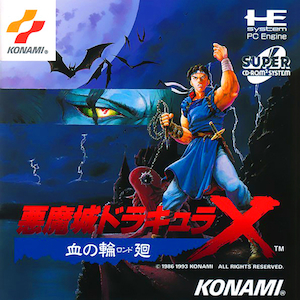
Dracula X: Rondo of Blood PC Engine CD-ROM box art - Richter Belmont and Annette
Akumajo Dracula X: Chi no Rondo (1993) - Konami’s Japan-exclusive Castlevania for the PC Engine CD-ROM². The box art depicted Richter Belmont and the rescued Annette in Konami’s distinctive animated style.

Dracula X: Rondo of Blood — released in Japan as Akumajo Dracula X: Chi no Rondo — arrived on PC Engine CD-ROM² in October 1993 and was immediately recognised as Konami’s most accomplished Castlevania game to that point. It did not leave Japan in its original form until 2007, creating a fourteen-year gap during which its reputation grew entirely by word of mouth, imported hardware, and the reverence of those who had played it. By the time Western players gained legal access, it was already legendary.

Built to Use What No Cartridge Could Provide

Konami’s CD-ROM Ambition

By 1993 Konami had established itself as the platform’s most artistically ambitious developer. Directed by Toru Hagihara, Rondo of Blood was designed to use the CD-ROM² format’s storage and audio capabilities as central creative tools rather than optional enhancements. The game would feature fully voiced Japanese dialogue throughout, animated anime-style cutscenes at chapter breaks, and a redbook audio soundtrack that Konami’s internal composers — drawing on the long Castlevania musical tradition — recorded to CD quality.

The ambition was to make a Castlevania that felt like an animated series as much as a game — something the NES and SNES hardware configurations could not support without significant compromise. The PC Engine CD-ROM² had the storage and audio throughput to do it. Rondo of Blood was built to prove that.

A Scenario With Consequences

Unlike previous Castlevania entries, Rondo of Blood built a story with emotional stakes into its stage design. Richter Belmont arrives at Dracula’s castle to rescue Annette, his fiancee, along with three other imprisoned young women. These captives are held in specific locations throughout the castle, and rescuing them — or failing to — is woven into the game’s branching route structure. Each playthrough is shaped by which rescues the player manages.

Every Stage Has More Than One Path Through It

Richter Belmont and the Whip

Rondo of Blood plays as a direct evolution of the classic Castlevania template: Richter Belmont moves through side-scrolling stages, using the Vampire Killer whip to defeat enemies, collecting sub-weapons (axe, holy water, cross, knife) powered by hearts, and managing health through carefully placed pork chops and other food. The controls are crisp and responsive in a way that the NES originals were not always — Richter can duck, has an extended whip reach, and can perform a back-dash that briefly makes him invulnerable.

Routes and Rescues

What distinguishes Rondo of Blood from every previous Castlevania is its stage branching. Most stages contain hidden alternate routes, accessible through observation and exploration. These alternate paths lead to different stages, different bosses, and different rescued characters — some of whom are required to reach the game’s true final boss and best ending.

This structure rewards repeated play. The shortest path through the game reaches Dracula relatively quickly; the fullest path, rescuing all four captives and reaching the true final stage, requires understanding the map’s hidden architecture. The design anticipates replay in a way that no Castlevania entry before it had attempted.

Cinematic Storytelling Before That Phrase Existed

Voice Acting and Cutscenes

Rondo of Blood’s use of the CD-ROM² for storytelling was, in 1993, genuinely unusual for a console action game. Fully voiced Japanese dialogue ran throughout the game’s animated cutscenes, produced by Konami using the CD’s audio capacity without compression. The voice cast delivered performances calibrated to match the animated visual style, and Konami’s artists produced cutscene sequences that felt closer to a short OVA than to the limited between-stage text cards that characterised most action games of the era.

The Boss Roster and Sprite Work

Rondo of Blood features a boss roster that spans Castlevania’s monster mythology — the Minotaur and Werewolf in one encounter, Shaft as a recurring antagonist, the Dullahan, Carmilla — realised through sprite work that pushed the PC Engine’s VDC into configurations its designers had not originally anticipated. The final Dracula encounter, particularly the second phase, remains one of the most technically accomplished sprite presentations the platform produced.

The PC Engine let us tell a story with voice and image that we had been imagining for years. It was not about making Castlevania bigger — it was about making it feel like something you were inside of. — Toru Hagihara, Konami director, CONTINUE magazine retrospective, 2004

Fourteen Years of Growing in Absentia

Famitsu and the Japanese Press

Famitsu awarded Rondo of Blood 28 out of 30 on its October 1993 release — one of the highest scores the magazine had given a PC Engine title. The review panel praised the game’s visual presentation, the depth of its stage design, and the quality of its voice acting, noting that Konami had produced a title that matched the ambitions of the hardware in a way few previous releases had. Other Japanese publications were equally enthusiastic, and the game sold through its initial print run quickly despite being available only in Japan.

The Western Absence

Konami released a significantly simplified SNES version — Castlevania: Dracula X — in North America in 1995. It retained the character names and some visual elements but removed the alternate routes, most of the rescued characters, and the animated cutscenes. Western players who encountered it had no way of knowing what the PC Engine original contained.

The reputation of the PC Engine original grew through the 1990s and early 2000s on import communities and early gaming forums, passed along by players who had imported hardware or visited Japan. By the time the PSP compilation Castlevania: The Dracula X Chronicles (2007) gave Western players legal access to an enhanced remake alongside the original, Rondo of Blood was already considered one of the finest action games of the 16-bit generation.

Symphony of the Night and the Wider Canon

Rondo of Blood’s canonical significance extends beyond its own quality. Castlevania: Symphony of the Night (1997, PlayStation) is its direct sequel — Richter Belmont appears as the opening boss, Alucard must defeat him to understand what happened five years prior, and the events of Rondo are the mystery that Symphony’s narrative resolves. Players approaching Symphony without having played Rondo miss the full weight of what the game is doing.

For many years, that knowledge — that the context of the most celebrated game in the Castlevania franchise lived on a Japan-exclusive PC Engine CD-ROM — was itself part of the PC Engine’s mythology. The platform that produced the game that the most important game in its series was a sequel to. See Rondo of Blood in the full catalogue →