One Against All: The Premise in Eight Seconds
Barbarian: The Ultimate Warrior was released by Palace Software in 1987 on Commodore 64, ZX Spectrum, Amstrad CPC, Amiga, and Atari ST. It is a one-on-one sword-fighting game: two warriors in an arena, sixteen moves between them, and a goblin waiting in the wings for the loser's head.
The game is programmed by Steven Brown, with music composed by Richard Joseph for the C64 and Amiga versions. In North America, Epyx published the Amiga version under the title Death Sword.
Barbarian received critical acclaim on every platform. Zzap!64 awarded it 96% in issue 27 (July 1987). Crash gave the Spectrum version a Gold Award. ACE scored the Amiga version 917 out of 1000. It reached number one in the UK all-format charts in 1987 - and remained a chart presence for months. Catalogue entry →
A Pub Meeting and a Fantasy Artist's Name on a Magazine Cover
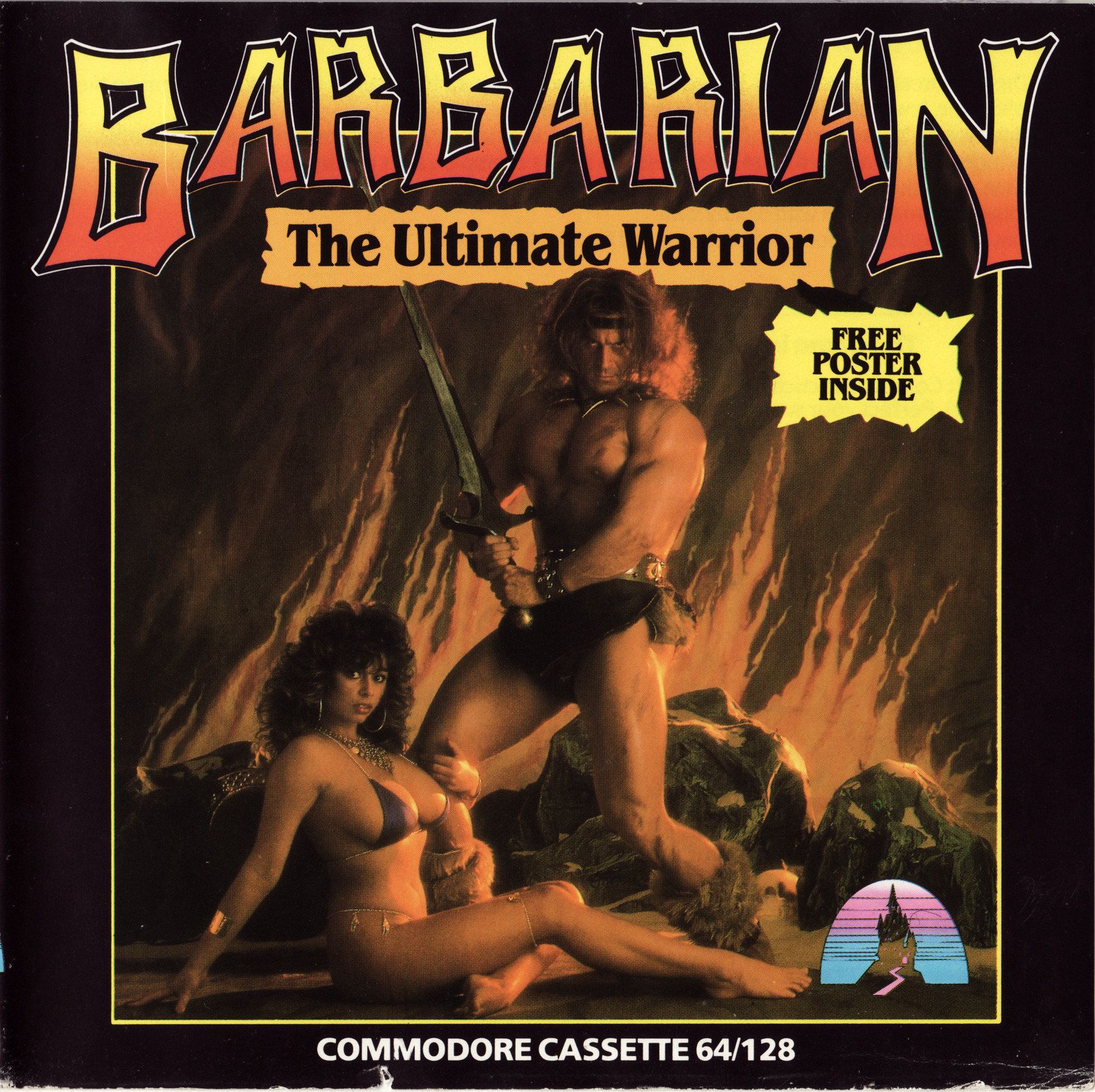
The game originated in a conversation between Steven Brown and Palace co-founder Pete Stone. Brown had a clear picture of what he wanted: a fighting game unlike the small-character sprites common to the era, built around fantasy warrior aesthetics in the style of Boris Vallejo and Frank Frazetta.
You know these fighting games? They're okay, but the characters are too small. I really want a game with huge, huge characters - like, the whole screen.
Steve Brown, designer and programmer - Britsoft (book), as quoted in Den of Geek
Stone agreed, and the cover art concept followed directly from the game's aesthetic. Feeling that most game box art of the era was "pretty poor," Brown proposed using real people in warrior costume - iconic fantasy imagery rather than illustrated characters. Palace arranged a photo shoot with bodybuilder Michael Van Wijk and model Maria Whittaker. The palette of the resulting image - warm amber fur, bronzed skin, arena sand - became inseparable from the Palace brand.
Pete Stone later described the cover concept as rooted specifically in swords and sorcery genre conventions: "He wanted a sword fighting game based round the swords and sorcery theme, and he wanted a cover in the style of the fantasy artist Boris." (Pete Stone, ACE magazine)
Sixteen Combinations, One Goblin Waiting in the Wings
The game runs on joystick combinations. From a standing or running position, each directional input - diagonal, lateral, or combined with fire - executes one of sixteen distinct moves: thrusts, swings, blocks, rolls, and jumps. The controls are responsive enough that skilled players could chain offensive sequences, while a newcomer could contribute meaningfully within minutes.
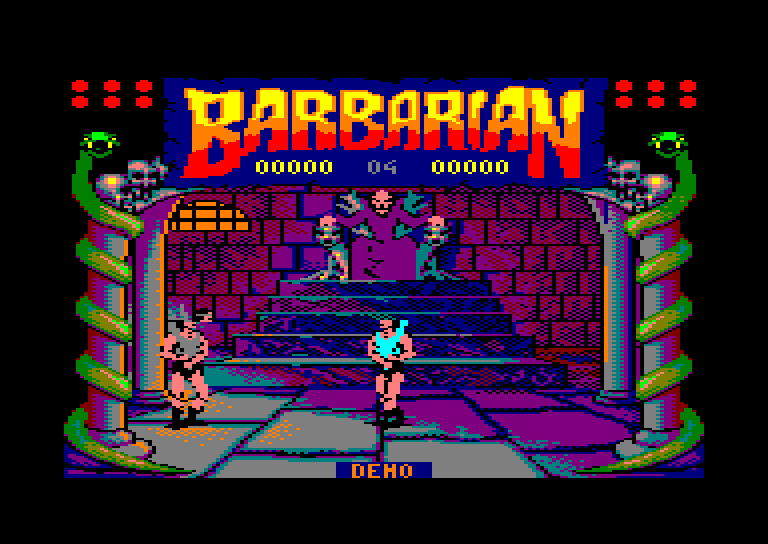
What made Barbarian unusual among fighting games of its era was the size and animation quality of the fighters. The characters occupied a large portion of the screen, their movements traced from live footage of performers. The visual weight of each swing - the recovery frames, the opponent's reaction - gave combat a physical presence that most 8-bit games could not approach.
The defining moment is the decapitation finisher: a successful stroke against a stunned opponent removes the head. A small green goblin then runs on, kicks the head offscreen, and drags the body away. It takes approximately three seconds and was, by the standards of 1987 home gaming, genuinely shocking. That was entirely the point.
Barbarian also supported two-player simultaneous combat, allowing both players to compete directly. The single-player mode pits Hegor against a sequence of increasingly skilled opponents, building toward the sorcerer Drax as final adversary.
Multiplexed Sprites and Three SID Voices
Getting large, smoothly animated characters onto the C64 required engineering the hardware's sprite system beyond its standard limits. The C64 has eight hardware sprites available simultaneously; displaying the two large fighters required multiplexing - cycling sprites rapidly enough that the human eye perceives more objects on screen than the hardware officially supports. Richard Leinfellner, Palace's technical director, described the approach as using "different look-up tables for different frames" to manage the multiplexed sprite data. (Richard Leinfellner, "Blimey It's Only..." interview, 2021)
On the Amiga, the additional hardware colour depth and larger sprite capacity allowed richer colours and sharper detail - visible in the amber and brown tones of the warriors' costumes and the sand-coloured arena floor. The Amiga version is often cited as the graphically definitive release.
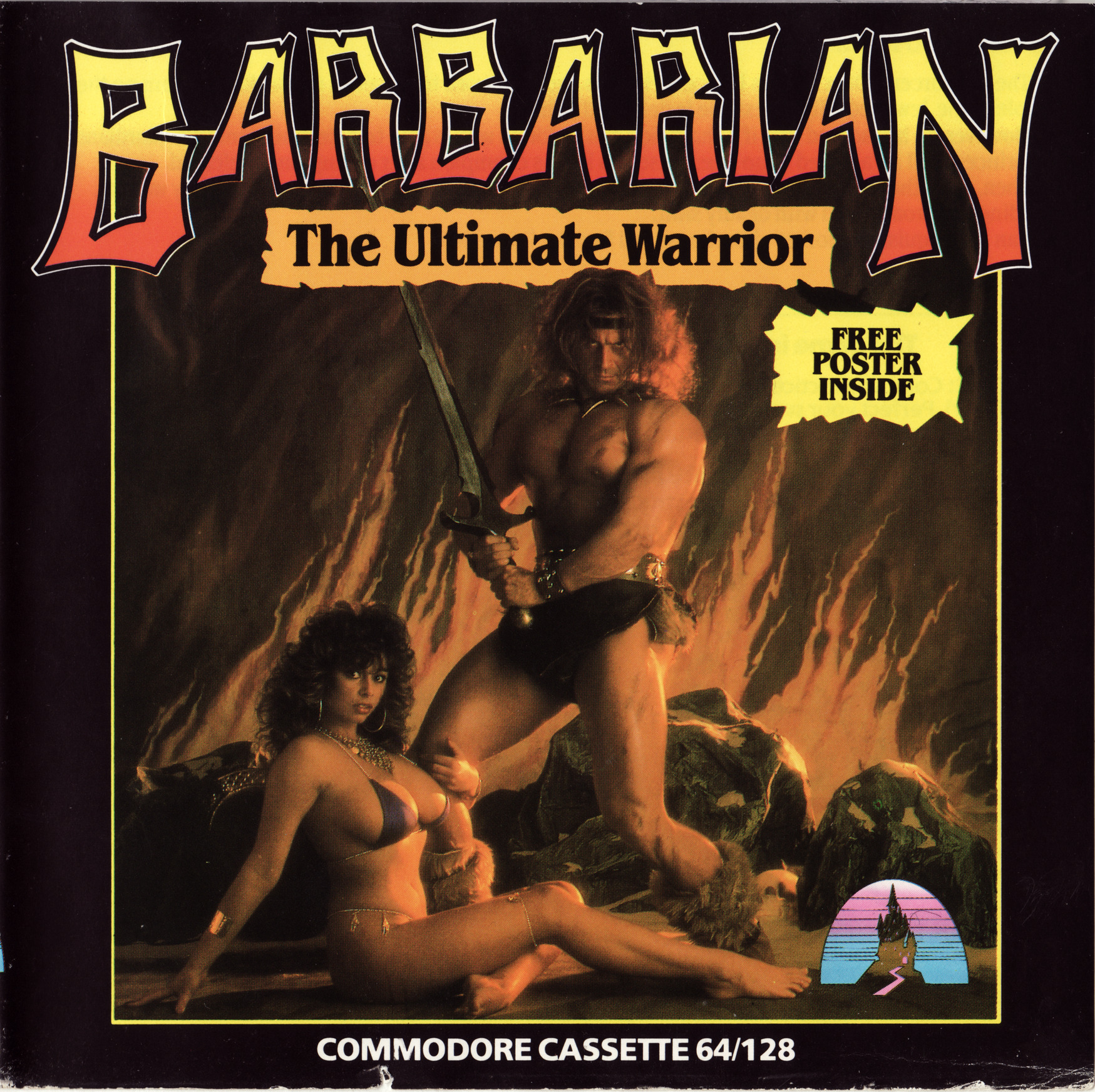
The C64 fighters at scale - Steve Brown's rotoscoped animation and multiplexed sprites
Richard Joseph's C64 title theme is among the most widely recognised SID compositions ever made. It uses two melodic voices against a rhythmic bass, with the filter sweep providing forward momentum. The theme runs continuously during the character selection screen and became the sonic signature of the game before a single sword was swung. Joseph's compositions for Barbarian - across C64 and Amiga - are preserved in the HVSC and remain active in the chip music community.
Zzap!64 Said 96%. Mary Whitehouse Said Something Else.
Period scores and contemporary reaction
Zzap!64 issue 27 (July 1987): 96% - "Utterly brilliant... an adrenalin-pumping experience." Crash issue 40 (May 1987): Gold Award for the Spectrum version - "Stunning gameplay... the best beat-'em-up on the Spectrum." ACE (Amiga version): 917/1000 - "Superb animation and excellent two-player combat."
The critical reception was uniformly strong. The controversy that followed had nothing to do with review scores.
Mary Whitehouse's National Viewers' and Listeners' Association complained about the cover art, arguing that it was sexually inappropriate for a product marketed toward children. Boots the Chemist refused to stock the original inlay card. Religious bodies wrote to Electron User magazine calling the cover "offensive and particularly insulting to women." None of this reduced sales. Every column inch of moral outrage was free advertising.
People who complained that it was a sexist cover seem to forget that it was an idea set in a certain genre.
Pete Stone, co-founder, Palace Software - ACE magazine interview
The German Prosecution and the Boy Who Could Play It
The game's violent content attracted attention from German authorities. The prosecution in the resulting obscenity case needed to demonstrate the decapitation move in open court. They could not input the correct joystick combination, failed to produce the finishing move, and the case was initially dismissed.
When the prosecution returned for a second hearing, they brought a child who could actually play the game. He demonstrated the goblin-kick finisher for the jury. Barbarian was banned in Germany. Palace Software changed the blood from red to green, resubmitted the game, and it was cleared for sale. The green-blooded German version became a collector's curiosity - one of the most cited examples of regional content censorship in 8-bit gaming history.
Seven Years of Royalty Cheques
Barbarian: The Ultimate Warrior reached number one in the UK all-format charts in 1987 and stayed a chart presence well into 1988. The controversy did not reduce sales - it amplified them. Palace began planning a sequel before the first release had finished charting.
Barbarian II: The Dungeon of Drax (1988) continued the series, shifting from one-on-one combat to side-scrolling action, with Hegor pursuing the sorcerer Drax. Richard Joseph returned for the score on C64 and Amiga. The sequel sold well but never replicated the cultural impact of the original. Barbarian II catalogue entry →
A modern port - Barbarian+ - was released in 2018 by Staircase Games for PC, Mac, iOS, and Android, demonstrating the title's continued recognition three decades on. Read about modern ports →
Richard Joseph's C64 title theme lives in the HVSC, remixed hundreds of times by the chip music community. The theme is among the most covered SID compositions in the archive. Listen to the Barbarian SID theme →