Eight years on the frontier of what home computers could do
From a bedroom in Coventry to a solar-system simulator on the Amiga, Novagen Software pushed further than almost any other British studio of the era.
1953 -- 1984
Before Novagen
The programmer who built worlds alone
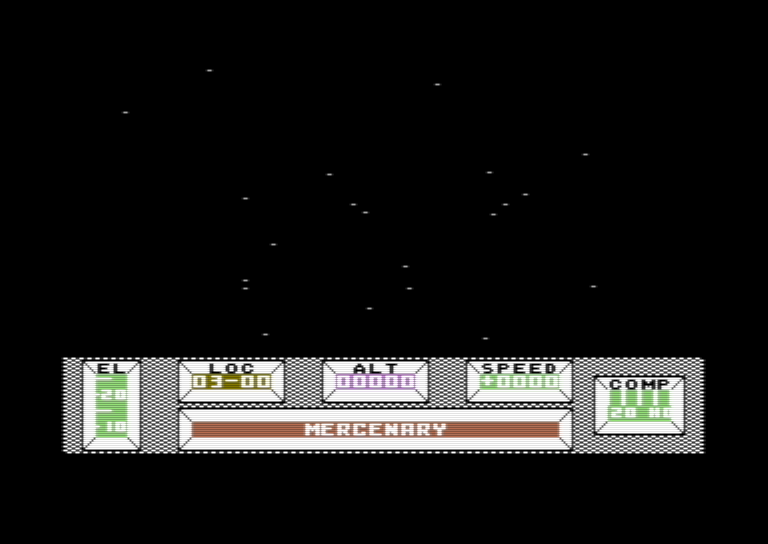
The title screen of Mercenary: Escape from Targ (1985, C64) -- Paul Woakes's first published commercial release under the Novagen name.
Paul Woakes was born in 1953 and came to programming through the early 1980s British home computer boom. Like many self-taught programmers of the era, he worked in 6510 assembly language directly on the Commodore 64 -- writing code that talked to hardware registers rather than through abstraction layers. This direct, low-level approach would define everything Novagen produced.
By 1984, Woakes and Bruce Jordan had founded Novagen Software as a small company based in Coventry, England. The team at peak was described as comprising around eighteen people, though the creative and technical core of each game traced back to Woakes himself. The founding proposition was straightforward: make the C64 do things nobody had managed before.
Most British studios of 1984 were producing sprite-based platform games, shoot-'em-ups, and text adventures. Woakes had a different idea: a fully navigable 3D world on an 8-bit machine, with real objects to interact with, an economy that responded to player actions, and a story that could end multiple ways. The ambition was borderline absurd for the hardware. He built it anyway.
1984 -- 1985
C64 Era
Writing the wireframe engine that should not have worked
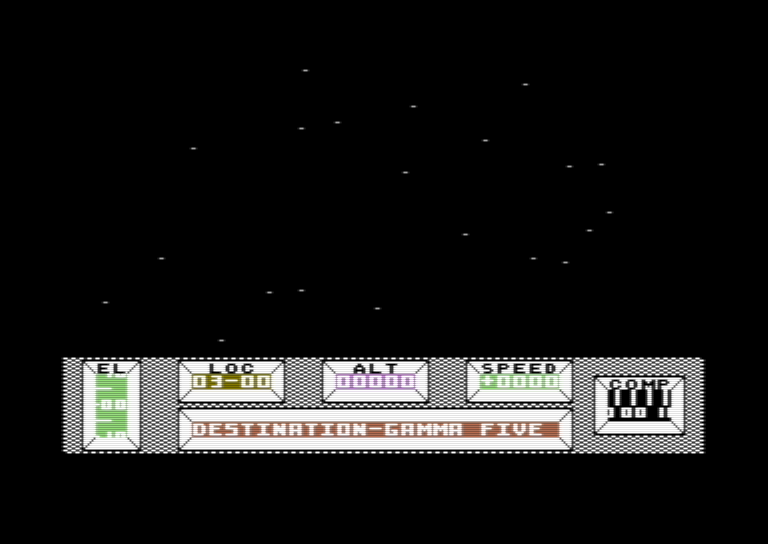
Exterior view from Mercenary C64: the wireframe rendering engine calculated perspective in real time at machine code speed.
Mercenary: Escape from Targ, published in 1985 by Novagen and distributed by Activision, put players on the planet Targ -- a world locked in civil war between two factions, the Mechanoids and the Palyars. The premise was deliberately light on moral instruction: the player arrived as a mercenary whose spacecraft had crashed, with one practical goal -- acquire enough credits, find a working ship, and escape.
What made the game extraordinary was its execution. Woakes had written a real-time 3D wireframe renderer that ran on the C64's 1 MHz processor fast enough to feel navigable. Players could walk through exterior city streets, enter buildings, descend into underground complexes, and fly spacecraft between surface and orbit. Every object in the world was interactive. Buildings could be entered. Vehicles could be stolen or purchased. NPCs had prices and items. The open-world systems that would become genre conventions a decade later were all present in 1985, on an 8-bit machine, coded by one programmer.
"This is essentially Mercenary 2 written again by the late great Paul Wokes."
Perifractic, Retro Recipes YouTube channel, 2020
The press responded with astonishment. Zzap!64 gave Mercenary 97% and a Gold Medal -- the magazine's highest award -- and declared it unlike anything previously published on the C64. Commodore User awarded 9 out of 10. The reviews were not simply enthusiastic: they expressed something closer to disbelief that the machine could do what Woakes had made it do.
Building interiors in Mercenary rendered as wireframe volumes -- every door opened, every room was navigable.
Novagen followed Mercenary with a data disk, The Second City, which added an entirely new city to explore on Targ and extended the main game's play time considerably. It was an early example of what would later be called DLC -- additional purchasable content expanding an existing world. In 1985, it arrived on a separate floppy disk.
1986 -- 1990
Amiga Era
Upgrading to 16-bit and expanding the universe
Damocles: Mercenary II (1990, Amiga) -- Novagen's most ambitious release, set across five planets of the Gamma System.
When the Commodore Amiga arrived in 1985, it gave programmers like Woakes a dramatically expanded canvas. With more memory, a faster processor, dedicated graphics and sound chips, and colour depth far beyond the C64, the Amiga was the natural home for what Novagen wanted to build next. Woakes spent the latter half of the 1980s porting the Mercenary engine and then rebuilding it for 16-bit hardware.
Mercenary arrived on the Amiga and Atari ST, bringing the C64 original to a new audience. Woakes then began work on something far larger. Damocles: Mercenary II, published in 1990, replaced Targ with an entire solar system: five planets -- Damocles, Eris, Midas, Mergatroid, and Eden -- plus multiple moons, space stations, and asteroid belts, all interconnected and fully traversable.
The game's central scenario was a comet on a collision course with the planet Eris. Players had to find a way to destroy it or redirect it before impact. The solutions Woakes built into the game ranged from the obvious to the architecturally clever, and the open-ended physics system allowed players to discover approaches that Novagen had not anticipated. The comet could be deflected by crashing a nuclear-armed spacecraft into it. It could be destroyed using a device assembled from components scattered across multiple planets. It could also be ignored until the timer ran out and Eris died.
One of Damocles's planetary surfaces: buildings, vehicles, and space access points were distributed across five worlds.
The Amiga press reviewed Damocles with the same quality of astonishment that Zzap!64 had brought to Mercenary five years earlier. CU Amiga awarded 95%. ACE gave it 920 out of 1000. Amiga Power called it one of the most ambitious games ever made for a home computer. The praise was earned. Nothing else on the Amiga offered a navigable, interactive solar system where every object had physics and every problem had multiple solutions.
Space travel between Damocles's five planets was handled in real time through a consistent 3D coordinate space.
In 1988, between Mercenary and Damocles, Novagen published Backlash -- a spacecraft combat game that used the Mercenary engine in a more focused setting. It served as both a commercial release and a testbed for engine improvements that would feed into Damocles. The game received solid reviews and demonstrated that the underlying technology was versatile beyond the open-world format.
1990 -- 1992
Final Chapter
The third act, and the silence that followed
Space station interiors in Damocles extended the navigable environment beyond planetary surfaces.
Mercenary III: The Dion Crisis arrived in 1992. Set in the Dion planetary system, it used a revised version of the Damocles engine with improved graphics and an expanded interactive object vocabulary. The game followed the format established by the first two titles: crash-land on an alien world, navigate an unfamiliar political situation, solve a crisis, and escape. Critics praised it as a solid conclusion to the trilogy, though the market had shifted -- the early 1990s Amiga scene was more crowded than it had been in 1985 or 1990, and Mercenary III arrived without the element of complete surprise that had driven the reception of its predecessors.
After Mercenary III, Novagen went quiet. The studio produced no further games. The reasons were never publicly detailed by Woakes or Jordan. The early 1990s were difficult for independent UK studios: rising production costs, a consumer software market moving toward CD-ROM, and competition from larger publishers all compressed margins for small teams. Novagen's games required one extraordinarily skilled programmer working at the limit of what was technically possible -- a model that did not scale and did not survive the transition to the next hardware generation.
Paul Woakes died on 15 July 2017. The tributes that followed came from programmers, game designers, and players across the UK and internationally who had tracked the Mercenary series through the 1980s and early 1990s. Many noted that what Woakes had built in 1985 would not feel out of place in a conversation about open-world design principles written thirty years later.
Tribute video published on YouTube in 2017 following the announcement of Paul Woakes's passing.
The Mercenary series is preserved at the Internet Archive and is playable today through C64 and Amiga emulators. For those who want to experience the games firsthand, the Play page has emulation guides. For a deeper look at how each game works as a piece of design, see Flagship Games.
Paul Woakes, 1953 -- 2017
Woakes built the Mercenary engine without a team of engineers, without a licensed renderer, and without the benefit of established conventions for the kind of game he was making. He made the rules. The open-world games that followed, across decades and platforms, share a conceptual DNA with what he shipped on a C64 floppy disk in 1985. This site exists as a record of that work.