Editorial
Flagship Titles
A deep look at the two games that defined Novagen Software.
C64 / Atari / Amiga -- 1985
Mercenary: Escape from Targ
The game that brought real-time 3D to the 8-bit home computer.
Escape or Die Trying
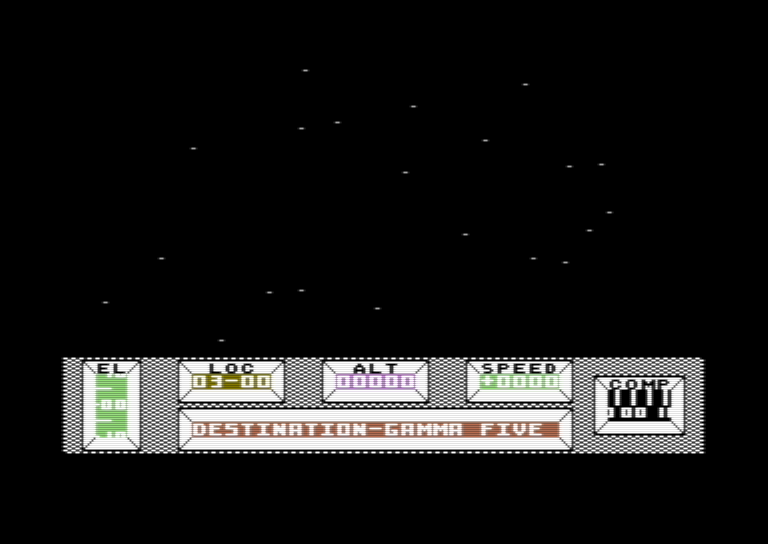
Your ship crash-lands on the planet Targ. You have no money, no transport, and no immediate way off the surface. The only exit from this situation is through your own initiative -- buying and selling items, flying between locations, and making increasingly dangerous decisions about who to trust and who to betray. This was the opening premise of Mercenary: Escape from Targ, and in 1985 nothing quite like it existed on any home computer.
The game gave players a fully navigable 3D city, a working economy, multiple factions to align with or exploit, and several distinct ways to reach the ending. You were not guided. You were not told what to do next. The manual provided enough information to get started, and the rest was survival instinct. At a time when the dominant home computer genre was the fixed-screen arcade game, Mercenary was operating in a different conceptual space entirely.
Paul Woakes wrote the game alone, in 6502 assembly language, targeting the Commodore 64's 1 MHz processor. What he produced was not a technical curiosity but a genuinely playable game that felt like a small world -- one where actions had consequences and exploration had genuine purpose.
One Man's Machine Code
Paul Woakes founded Novagen Software in 1984 with a specific ambition: he wanted to build a 3D wireframe world on the C64 that players could move through freely. His background was in mathematics and low-level programming, and he approached the problem as an engineering challenge. The 6502 processor in the C64 runs at roughly 1 MHz with 64 kilobytes of RAM -- tight constraints by any standard. Woakes had to develop his own rendering pipeline from scratch, writing the code in assembly to extract every available CPU cycle.
The development period covered 1984 and most of 1985. Woakes worked without a team, designing the city geometry, the flight model, the economy system, and the faction logic himself. The wireframe renderer he created could draw a navigable 3D city at playable frame rates -- something that, at the time, most programmers considered impossible on 8-bit hardware without dedicated graphics chips.
The game was completed and released through Novagen's own label. Its scope -- a first-person 3D world with economic systems and multiple story resolutions -- would not be matched by most other 8-bit titles even years later.
"the late Paul Walks and the late Bruce Jordan... created memories which shall last a lifetime" Stu-dog, YouTube tribute, 2017
No Hand-Holding on Targ
Mercenary drops you into Targ without a map and without objectives beyond the implied one: get off the planet. The surface consists of a city with buildings you can enter, a surrounding landscape you can fly across, and a cast of characters from two competing factions -- the Palyar and the Mechanoids -- who each want your help and offer payment for it.
The gameplay loop is open from the first minute. You can walk, acquire a vehicle, fly at low altitude or high, dock with structures, buy and sell objects, and accept or ignore missions from either side. The currency you accumulate can be spent on equipment that changes what paths are accessible. Some routes require specific items to unlock. The ending can be reached by siding with one faction, the other, or by finding a third solution that serves neither.
This structure -- open traversal, economic agency, multiple resolutions -- was not common language in game design in 1985. Players arrived without a framework for what kind of game this was. Reviews from the period frequently noted that early sessions were spent simply understanding what Mercenary was asking of them, followed by the realisation that it was asking far more than a typical game.
Real-Time 3D on 1 MHz
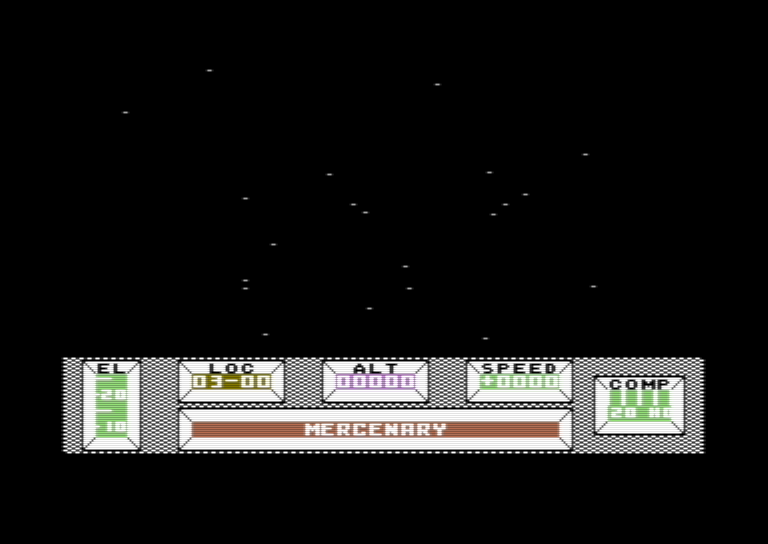
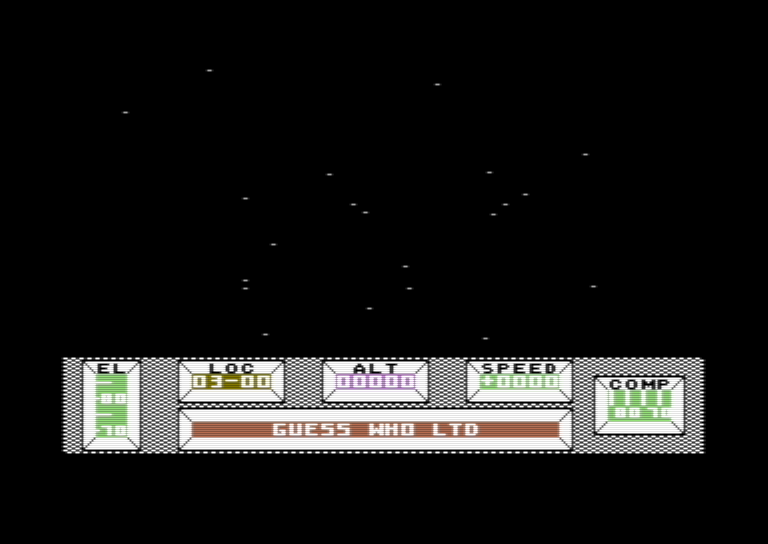
The C64's 6510 processor -- functionally a 6502 -- runs at approximately 1 MHz and was designed for general computing, not 3D graphics. There is no hardware floating point, no dedicated 3D pipeline, and no z-buffer. Drawing a single wireframe polygon in real time requires the CPU to perform perspective transforms, clip against the view frustum, and rasterise the result -- all in software, all within the frame time, while also handling input, physics, and game logic.
Woakes achieved playable frame rates by working in fixed-point arithmetic rather than floating point, aggressively pre-computing geometry, and using hand-optimised assembly routines for every inner loop. The city geometry was designed to fit within the data budget while presenting enough visual complexity to feel like a real environment. Buildings are solid in presentation even though the renderer uses wireframes -- the visual style was a deliberate choice that made the technical constraints into an aesthetic.
The result ran at a frame rate that, while not fast by modern standards, was smooth enough for a first-person navigation experience. No published C64 title had achieved this before. The same engine was later extended to produce the Amiga and Atari versions, though on those platforms the headroom allowed for additional content rather than fundamentally better rendering -- a sign of how fully optimised the original C64 code was.
Zzap!64 Goes Gold
When Mercenary reached reviewers in late 1985, the critical response was exceptional. Zzap!64, the leading UK specialist magazine for C64 owners, awarded the game 97% and a Gold Medal in Issue 7, published November 1985. The Gold Medal was Zzap!'s highest recognition, reserved for games the editorial team considered outstanding achievements -- not just for the platform, but as games outright.
The review cited both the 3D rendering and the open-world structure as individually remarkable, and found the combination genuinely unprecedented. Commodore User similarly awarded high marks, focusing on how the game expanded what players could expect from C64 software. The consensus was not merely that Mercenary was a good game, but that it occupied a different category from everything else on the platform.
Sales reflected the critical response. Mercenary became Novagen's defining commercial release, reaching players across the C64 userbase and establishing the Mercenary name as a franchise with real audience investment.
Mercenary: Escape from Targ -- full C64 longplay showing the city, vehicles, and multiple routes to completion.
The Open World Before Open Worlds
The game design vocabulary that emerged in the 2000s -- open world, sandbox, emergent narrative -- describes what Mercenary was already doing in 1985. A player-navigable 3D environment, an economy that responds to player actions, multiple valid solutions to the core objective, and no enforced path through the content: these were the building blocks of a genre that would not be named for another decade.
Mercenary's influence on the games that came after it is difficult to trace directly, partly because Novagen operated outside the major publishing networks of the period and Woakes rarely sought press attention. The game circulated widely through the C64 userbase but did not generate the same cultural momentum as titles from larger studios. Its significance has been more fully recognised in retrospective coverage, where historians of game design consistently place it among the key precursors to the open-world genre.
The game is preserved across multiple platforms. Archive.org hosts disk images for the C64, Atari, and Amiga versions. The C64 version runs cleanly under VICE; the Amiga version under WinUAE or FS-UAE. Community preservation efforts at Lemon64 and the Amiga community have ensured that the title remains playable for anyone who wants to experience what 1985 looked like through the eyes of a programmer who built a world by hand.
Amiga / Atari ST / DOS -- 1990
Damocles: Mercenary II
A solar system fit inside 512K of RAM, with a comet on a countdown.
The Comet Will Not Wait
A comet named Damocles is on a collision course with Eris, a colonised world in a solar system of five planets and numerous moons and space stations. You are a mercenary. Your job is to prevent the impact -- or, if you choose, to profit from the chaos and get out. The clock is real. The comet moves. And the solar system surrounding you is not a backdrop but a navigable space, every object in it accessible by ship.
This was the premise of Damocles: Mercenary II, released in 1990 for the Amiga and Atari ST. Where the original Mercenary placed you in a city on a single planet, Damocles gave you an entire solar system to move through. Five planets. Moons. Space stations. Surface towns. Interior corridors. All rendered in real-time 3D by Paul Woakes working alone, extending the engine he had written for the C64 into territory that pushed the Amiga to its practical limits.
"You are a 21st century soldier of fortune, a mercenary. Your fight, should you choose to take on the challenge, is against the forces of nature. Your objective in any event is to gain a fortune in return for your endeavour." Damocles: Mercenary II user guide, Novagen Software, 1990
A Solar System in 512K
After Mercenary's success, Woakes spent four years developing a sequel. The scale of the ambition required rebuilding significant portions of the rendering engine: the C64 wireframe system worked for a single city, but representing multiple planets with coherent geometry and smooth transitions between space travel and surface navigation demanded a different approach to how the world was represented in memory.
The Amiga 500's standard configuration was 512K of chip RAM, expandable to 1MB with a trapdoor expansion. Woakes designed Damocles to run on the base configuration, which meant every byte of the solar system had to be accounted for. The planets, their surfaces, the space stations, and the items distributed across all of them had to fit within tight constraints while still feeling varied and expansive during play.
The solution was procedural generation and clever data compression: geography was generated algorithmically from seed values, with hand-authored details layered on top for the locations that mattered to the game's objectives. The result is a world that feels authored even though much of it was computed. Five years after writing the original Mercenary engine, Woakes was still working alone and still extracting performance from the hardware by understanding it at the machine code level.
"this is essentially mercenary 2 written again by the late great Paul Wokes" Perifractic, Retro Recipes, 2020
Five Ways to Save the World
Damocles gives the player a goal -- stop the comet or escape its consequences -- and then steps back. There is no single correct method. Players who explored deeply enough would eventually discover that the comet can be deflected through multiple distinct mechanisms: acquiring specific technology, reaching particular locations, or triggering narrative events that change the outcome. The game was designed to support multiple complete playthroughs with different solutions.
The traversal system covered all scales simultaneously. On foot inside a building, movement feels like the original Mercenary. Boarding a ship and lifting off puts you above a planet surface you can see curving away below. Accelerating further puts you in space with other planets visible as bodies in the distance. Selecting a destination and engaging travel compresses the journey into a transition, then deposits you in orbit around a new world. The continuity between these scales -- no load screens within a session, no break in the first-person perspective -- was technically demanding and experientially unlike anything else available on home computers in 1990.
The economy and item system from Mercenary returned in expanded form. Objects found on one planet could be needed on another. Information obtained from one character could unlock a route only accessible elsewhere. Players who kept notes found the game rewarding; players who did not could spend dozens of hours exploring without converging on a solution. Both were valid ways to engage with it.


Polygon Physics Before the Term Existed
Damocles rendered not just a city but a solar system in real-time 3D on hardware without a GPU. The Amiga's custom chips -- Blitter, Copper, and Paula -- provided graphics acceleration for 2D operations but offered no direct support for 3D polygon rendering. Woakes wrote the perspective transform, polygon fill, and hidden surface removal routines himself, in 68000 assembly, for every frame the game drew.
The transition between surface and space navigation required the engine to represent the same geometry at radically different scales. A building that occupies most of the screen at ground level becomes a speck from orbit. The planet that fills the sky from its surface becomes a sphere you can watch recede as you accelerate away. Managing numerical precision across these scales without floating-point hardware required careful use of fixed-point arithmetic with extended precision at the boundaries.
Filled polygon rendering was a step beyond the wireframe of the original Mercenary. Surfaces had colour and shading; buildings had interiors that connected to exteriors without discontinuity. The frame rate under heavy load was not always fast, but the engine never failed -- it was stable, deterministic code that had been written by someone who understood exactly what the hardware could and could not do. Commercial games with larger teams and bigger budgets would not routinely produce this level of simulation fidelity on home computers for several more years.
Critics Searched for Words
Period reviewers approached Damocles with a problem: the vocabulary for what it was doing did not fully exist yet. Amiga Power, ACE, and CU Amiga all awarded high scores while acknowledging that the game defied straightforward category. The sheer navigable scale -- five planets, functioning interiors, space travel without a loading break -- provoked comparisons to games that did not yet exist.
ACE (Advanced Computer Entertainment) awarded 920 out of 1000, singling out the scope of the interactivity: the ability to land on any planet, enter any building, and affect the state of a solar-system-wide problem through local actions. The consensus across publications was that Damocles was among the most ambitious home computer games produced to that point, and that its creator's achievement deserved recognition beyond the usual review scoring framework.
Sales were strong across the Amiga userbase, and the game was subsequently ported to Atari ST and DOS, extending its reach. Retrospective coverage from Retro Gamer and the wider gaming history community has consistently upheld the original assessment -- Damocles was not just a good game for its era, but a genuinely singular technical and design accomplishment.
Damocles: Mercenary II -- Amiga longplay demonstrating space travel, planetary surfaces, and the comet mechanic.
The Sandbox Blueprint
The design principles that Damocles assembled in 1990 -- a navigable open world at multiple scales, multiple valid solutions to a single overarching problem, an economy and item system that rewards lateral thinking, and a real-time event that creates urgency without scripted pacing -- form the skeleton of what later became known as the sandbox genre. Games like Elite had explored open-world space travel earlier, but Damocles combined that spatial freedom with interior environments and a narrative problem requiring deduction rather than combat.
Paul Woakes continued developing the Mercenary universe after Damocles, producing Mercenary III: The Dion Crisis in 1992. He passed away in 2014, and the tributes that followed from the C64 and Amiga communities reflected how deeply his work had marked the people who played it. The specifics of his technical approach -- writing 3D engines in assembly for 1 MHz and 7 MHz processors without specialist support tools -- represent a form of craft that has largely passed from the industry.
Damocles is preserved and playable. Archive.org hosts Amiga, Atari ST, and DOS versions. The Amiga version runs under WinUAE with minimal configuration. For players approaching it for the first time, reading the manual before starting is advisable -- not because the game is obscure, but because understanding the comet's mechanics changes how the session feels from the first minute. This is a game that rewards knowing what you are looking at.