Two compositions at the edge of what the SID chip could do.
Click Play on any entry to hear it in the persistent player bar below.
Wizball (1987, Ocean Software)
C64 · Developers: Jon Hare & Chris Yates · Music: Martin Galway ·
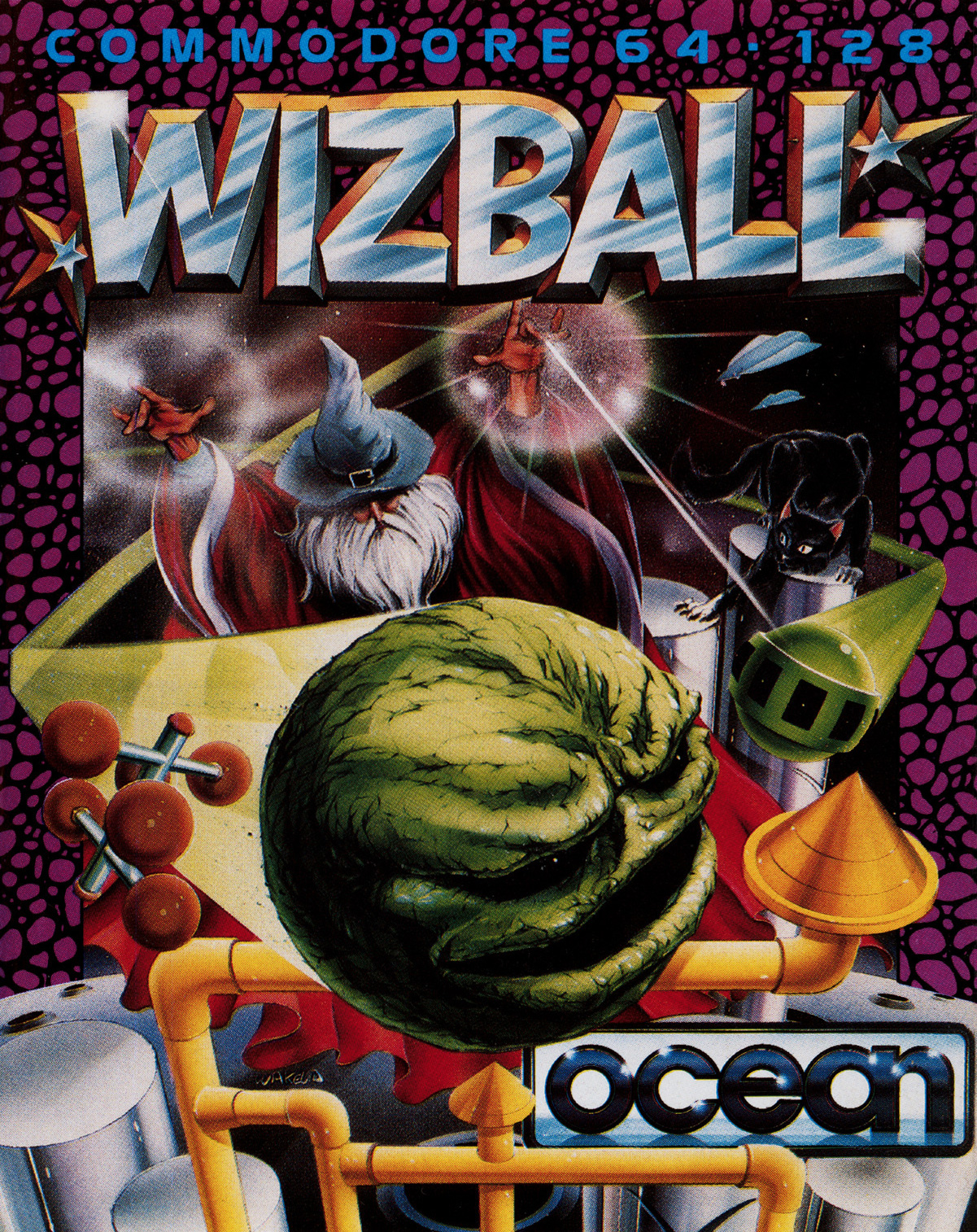
Wizball - Ocean Software, 1987. Box art for the C64 version.
A World Waiting to Come Back to Life
Wizball (1987) begins with a premise unlike any other 8-bit game: the villain Zark has
drained all colour from Wizworld, leaving it a flat grey landscape of enemies and terrain.
The player controls Wiz - a wizard imprisoned in a rolling ball - who must navigate hostile
environments while a sidekick, Nifta, collects the colour droplets that enemies leave
behind. As colour accumulates, the world is restored. The game ends when all colour
has returned to Wizworld.
What made Wizball unusual was that this colour-restoration premise became the structural
backbone of its entire audiovisual design - including, crucially, its music. Martin Galway
was given a compositional brief that no C64 composer had faced before: write music that
reflects a world being progressively restored to life, with each in-game theme corresponding
to a different emotional state of that world.
The result was seven distinct compositions: a title theme, five in-game themes tracking
the arc of the restoration, and a game-over cue. Together they form the most conceptually
unified musical suite the SID chip had produced. For full SID playback of all subtunes,
visit the Music catalogue. For Galway's career biography, see
the People page.
Composer's Brief: Write the Sound of Restoration
Ocean Software's Manchester office in the mid-1980s operated as a tight creative unit.
Programmers, artists, and musicians worked in proximity, and music was often composed
in parallel with the game rather than added at the end. For Wizball, this close
collaboration was significant: Galway had visibility of the game's design as it developed,
and the colour-restoration concept shaped how he structured his score from the outset.
Jon Hare and Chris Yates's design established five distinct environmental states through
which Wizworld would pass as colour was restored: the opening grey desolation, the
underground Cauldron section, deeper underground passages, open sky, and the fully-restored
warm Wizworld of the final stages. Each state needed its own musical character. Galway
wrote a distinct piece for each - not just a different loop, but a piece with its own
harmonic identity, tempo, and emotional register.
His musical influences at the time were Jean-Michel Jarre and Tangerine Dream - composers
who worked with synthesiser layering and timbral variation to create a sense of movement
and progression. The SID chip offered three voices to Jarre's studio full of hardware,
but the challenge was the same: make each voice count, and give the whole thing a sense
of emotional forward motion.
Jean Michel Jarre was a big influence - the layering of synthesiser voices, creating
a sense of space and movement. With the SID you only have three voices, but if you treat
each one as an independent part rather than just melody, bass, and filler, you can get
something much richer than the hardware suggests.
Martin Galway, Remix64 written interview
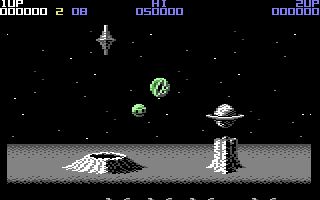
Wizball gameplay on C64: Wiz navigates Wizworld while Nifta collects the colour droplets enemies leave behind.
Wiz, Nifta, and the Colour Droplets
Wiz begins the game as an almost uncontrollable rolling ball - steering requires gaining
momentum and applying directional force against the ball's natural trajectory. Over time,
collected power-ups grant Wiz better control, and the progression of movement from
clumsy rolling to precise steering runs parallel to the game's restoration narrative.
Nifta, a smaller companion craft controlled by the same player via a second fire button
that switches input focus, is responsible for catching the colour droplets that enemies
drop on defeat. Each drop must be caught before it disappears. Managing both Wiz's movement
and Nifta's positioning creates a split-attention mechanic unusual for the period.
The in-game music tracks the emotional state of the world rather than the gameplay tempo.
The five in-game themes form a musical arc corresponding to the restoration cycle:
In-Game 1 - Wizworld: The opening theme. Minor harmonics and an unresolved bass pattern convey the desolate, colourless world - music that is waiting for something to change.
In-Game 2 - Cauldron: A more rhythmically active piece for the underground sections. The tempo increases and the melodic line becomes urgent.
In-Game 3 - Underground: Darker and more atmospheric, using the SID's filter to create a muted, cave-like quality. The harmony narrows inward.
In-Game 4 - Above: As colour begins to return, the music opens up. Major key passages emerge for the first time. A sense of possibility enters the harmony.
In-Game 5 - Restored: The most melodically elaborate theme - warm, flowing, and joyful. This is the sound of a world come alive.
Together with the title theme and game-over cue, these seven pieces form a coherent
musical arc - something without precedent in C64 game music.
Three Voices, Seven Movements
The SID chip - MOS Technology 6581 - provides three independent oscillator voices, each
with its own envelope (attack, decay, sustain, release) and waveform selector, plus a
shared filter and master volume register. For most C64 composers of the era, three voices
meant one melody, one bass line, and one harmony or rhythm part. Galway used all three
contrapuntally - giving each voice melodic independence and allowing them to weave around
each other in a manner closer to chamber music than to arcade game scoring.
The title theme demonstrates this most clearly. The primary voice carries the main melody.
The second voice runs a countermelody that reinforces and occasionally contradicts the
harmonic direction of the lead. The third handles the rhythmic bass, but with enough
melodic content that it functions as a harmonic participant rather than purely a pulse.
The three voices create a sense of depth that most listeners perceive as a richer texture
than three independent oscillators should produce.
The Digi-Drums technique - routing short PCM samples through the SID's master volume
register at high frequency to produce percussion sounds - appears in sections of the
Wizball score. It was in Arkanoid, released the same year, that Galway built an entire
score around the technique. The full story of Digi-Drums is in the
Arkanoid section below.
A later stage of Wizball: as colour droplets are collected, the world's visual palette shifts - and the music shifts with it.
Zzap!64 Issue 27: The Music That Stopped the Review
Zzap!64 reviewed Wizball in issue 27, dated July 1987, and awarded it a Gold Medal - the
magazine's highest recognition, reserved for the most exceptional releases of each issue.
All three panellists gave the sound dimension high marks. The reviewers identified the
music not merely as an accompaniment to the game but as a central component of its
quality - an editorial position unusual in Zzap!64 coverage of the period, where gameplay
typically dominated the analysis.
The game was a commercial success in the UK market. Ocean Software's distribution network
ensured wide availability, and Galway's score accompanied hundreds of thousands of cassette
copies. On cassette-format C64 software, loading screens with music were standard - which
meant the Wizball title theme was heard by players for several minutes before they ever
touched the joystick.
The Benchmark Every SID Composer Knows
Wizball's music has had an unusually long and active legacy. Project Galway, produced by
Alistair "Boz" Bowness, recorded full orchestral arrangements of Galway's C64 catalogue,
with the Wizball suite among the centrepiece recordings. The 8-Bit Symphony included
Ocean Software C64 music in their live concert programme, performing to audiences across
the UK. Fan remixes of the Wizball suite on the Remix64 database number in the hundreds,
spanning virtually every genre.
Among SID chip composers and musicians who grew up with the C64, Wizball is the canonical
reference - the piece cited when discussing the upper limit of what the chip could achieve.
Its influence on subsequent composers on the platform is difficult to quantify but widely
acknowledged by those composers themselves.
Wizball - Oscilloscope Visualisation
Oscilloscope view of Wizball - the three SID voices drawn in real time as the title theme plays.
Wizball - Full Longplay
The complete Wizball game - all five in-game themes play as colour is progressively
restored to Wizworld.
Arkanoid (1987, Ocean Software / Imagine)
C64 · Original arcade: Taito 1986 · Music: Martin Galway ·
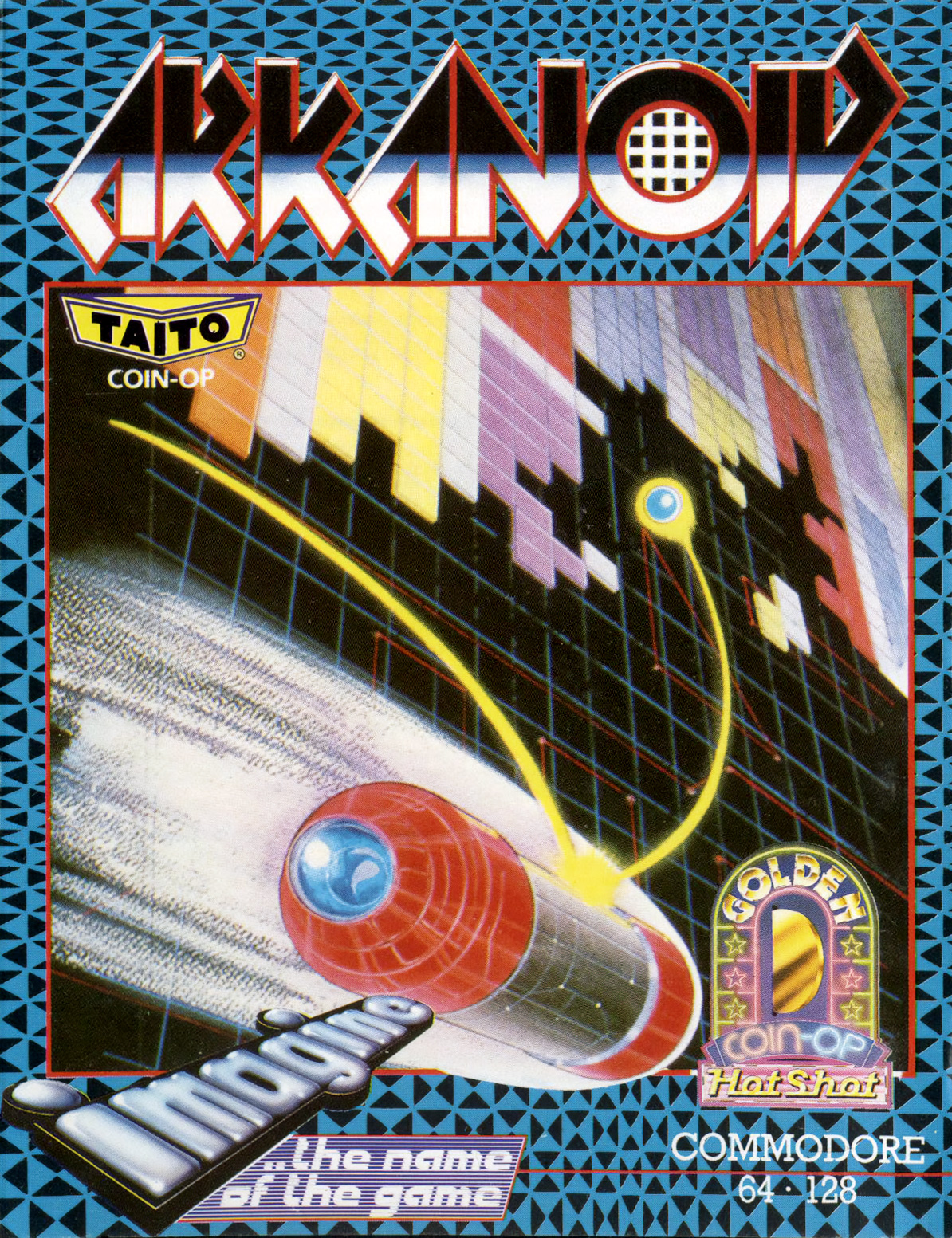
Arkanoid - Ocean Software / Imagine, 1987. The C64 conversion of Taito's 1986 arcade block-breaker.
Taito's Space Breakout, Ocean's Musical Showpiece
Arkanoid (1987) is a C64 conversion of Taito's 1986 arcade block-breaker - itself a
reimagining of the Breakout concept set in a science-fiction context: the spaceship
Arkanoid has been destroyed, and the player controls a lone paddle craft called Vaus,
working through stages of enemy blocks while facing an alien entity called DOH.
The C64 version was published under the Imagine Software label by Ocean Software and
arrived in 1987, the same year as Wizball. Where Wizball was an original game with an
original compositional brief, Arkanoid was a licensed arcade conversion with its own
existing musical identity. Galway wrote an entirely new score for the C64 version rather
than adapting the Taito original - and wrote it on a scale unprecedented for the platform.
Most significantly: Arkanoid was the first commercial C64 game to feature sampled
percussion - the Digi-Drums technique that would define Galway's signature sound and
influence C64 composers for years to come. See the full catalogue of Arkanoid subtunes
in the Music catalogue.
Fourteen Cues and Zero Quiet Moments
The Arkanoid SID file contains fourteen distinct subtunes - a number that exceeded
the total music output of most contemporary C64 arcade conversions. A typical conversion
of the period offered a title theme and, at best, a single looping in-game piece. Galway
wrote distinct music for every gameplay state: opening title, multiple in-game tracks
cycling through stage groups, bonus screen cues, victory jingles, game-over music, and
hi-score entry music.
Writing fourteen coherent pieces within the SID chip's constraints required maintaining
sonic consistency across radically different emotional registers. Each cue had to serve
a specific gameplay function while remaining recognisably part of the same musical world.
Galway achieved this through consistent rhythmic language - the Digi-Drums percussion
pattern recurs across cues in varied forms - while allowing the melodic material to
change character entirely between title theme, combat music, and celebration stings.
The fourteen-subtune scope was also a technical challenge: each piece had to occupy
minimal memory, load reliably from cassette or disk, and play back correctly on the
entire range of C64 hardware variants in circulation in 1987.
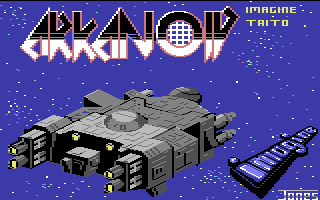
Arkanoid on C64: the block-breaking gameplay that fourteen distinct musical cues would accompany through every state of play.
Point, Launch, Break, Listen
The core mechanic is familiar: a paddle at the bottom of the screen launches a ball that
destroys blocks on contact. As blocks are cleared, power-ups fall - the player can
catch them with the paddle to gain capabilities including laser fire, multi-ball, paddle
expansion, and slowdown. Boss enemies appear at the end of stage groups.
Galway's score engages directly with the gameplay rhythm. The in-game music maintains a
tempo that complements the visual pace without overwhelming it - fast enough to energise
during dense block sections, structured enough not to distract during the precise timing
moments that block-breaker gameplay demands. The variety across subtunes means different
stage groups have different sonic contexts, preventing the score from becoming monotonous
across a full session.
The bonus screen music demonstrates Galway's range: shorter, lighter in character than
the combat themes, clearly designed to function as a reward - a brief sonic acknowledgement
that the player has cleared something difficult.
The Volume Register That Was Never Supposed to Do That
The SID chip's master volume register - address $D418 - was designed to control the
overall output level of all three voice oscillators simultaneously. At any fixed value,
it does exactly that. Galway discovered that by writing rapid, precisely timed sequences
of PCM sample data to this register, the chip could produce crude but recognisable
drum sounds: kick, snare, and hi-hat equivalents that no purely oscillator-based SID
composition could replicate.
The technique required writing sample data at frequencies between 6kHz and 8kHz - fast
enough to produce a recognisable waveform, but within the timing constraints of the C64's
main processor. This meant the sample-playback routine had to interleave with the main
music routine without either dropping data or consuming CPU cycles the game engine needed
for collision detection and sprite management. The scheduling problem was significant, and
solving it was part of what made Arkanoid's score technically distinctive.
The resulting percussion had a character unlike anything achievable through the SID's
native synthesis: a snare crack on a downbeat with real transient attack, a kick with
low-frequency impact, a hi-hat with a noise-like quality that synthesised waveforms
could not match. It became known in the C64 community as the "Galway noise."
The master volume register at $D418 - if you write sample data to it at high speed,
you get a drum sound the chip was never designed to produce. That was the whole technique.
Arkanoid was the first time I built an entire score around it.
Martin Galway, c64.com interview
Zzap!64 Issue 22: Drums They Had Not Heard Before
Zzap!64 reviewed Arkanoid in issue 22, dated February 1987. The review identified the
music as a significant component of the conversion's quality, with the percussion noted
as a technical novelty - something C64 game reviewers had not previously heard on the
platform. The sound dimension received high marks across the panel.
The Arkanoid score was commercially prominent: the game sold well in the UK market, and
the title theme became familiar listening for C64 owners who purchased the cassette version
- the loading time meant players heard it repeatedly before gameplay began.
The Technique That Spread Across the Platform
The Digi-Drums technique - and the broader approach of using the volume register as a DAC
for sample playback - was adopted and extended by subsequent C64 composers after Arkanoid
established it as viable. Several prominent composers of the following years cited
Arkanoid as the piece that convinced them rhythmic impact was achievable on the platform.
Galway's Arkanoid music has been performed as part of the 8-Bit Symphony concert programme.
On the Remix64 fan remix database, the Arkanoid title theme has been arranged in genres
spanning trance, orchestral, jazz, and metal. The fourteen-subtune scope of the original
is cited by the community as an example of compositional generosity unusual in commercial
game development of the period.
See the full Music catalogue for every Arkanoid subtune with SID
playback. For period context on Ocean Software's music programme, see
History.