Flagship Titles
Four titles that defined the Magnetic Scrolls canon - editorial deep-dives into The Pawn, The Guild of Thieves, Corruption, and Wonderland.
The Pawn (1985)
Before The Pawn, British interactive fiction was competent, sometimes inventive, rarely remarkable. After it, the baseline shifted. Magnetic Scrolls' debut arrived in 1985 on the Sinclair QL before Rainbird published the illustrated version across Amiga, Atari ST, DOS, C64, Apple II, Apple IIGS, and Mac - and the question the industry had been asking, whether British studios could compete with Infocom on parser sophistication and production quality, was answered conclusively.
From One Programmer's QL to Eight Platforms
Rob Steggles wrote The Pawn at home on his Sinclair QL, the home computer Sinclair Research had launched in 1984. The QL's more powerful processor made it an attractive development platform, and Steggles's first version of the game was published by Sinclair Research in 1985 as a text-only interactive fiction. It found an audience immediately, demonstrating that the British public would pay for a text adventure of genuine quality.
Rainbird Software, the Telecomsoft label that had built its reputation on quality premium releases, saw the potential and invested in the illustrated version. Geoff Quilley, an artist working in oil and watercolour, was commissioned to paint a set of full-colour illustrations - one for each significant location in the game. His work was then digitized for each supported platform, a painstaking process given the different display capabilities of the C64, Amiga, and Atari ST. The result was a game that looked unlike anything British software had produced.
Hugh Steers contributed to the technical framework of the parser engine, which was the component that translated typed player commands into game actions. The final result handled compound sentences and multi-clause input with a reliability that impressed players and reviewers alike. The vocabulary was broad, the disambiguation intelligent, and the rejection messages often witty.
"The Pawn started as something I wrote for myself on the QL. I wanted to build a text adventure that worked the way I thought text adventures should work - where you could actually talk to it, not just prod it with two-word commands. The parser was everything."
Rob Steggles, Magnetic Scrolls Memorial memoir
A Parser That Actually Listened
Kerovnia is a fantasy land that feels genuinely inhabited: a kingdom with a history, a social order, and internal logic. The player character arrives without explanation, carrying an amulet of unknown significance, and must navigate taverns, forests, wizard towers, and underground passages to discover what they are and why they are there. The premise is light - Steggles's writing has a dry irony that keeps the register comic rather than portentous - but the puzzle design is serious.
Objects have weight, containers have capacity, and the world operates by a consistent set of rules the player can learn and exploit. Puzzles require identifying what an object is for and applying it correctly - lateral thinking within a system that makes logical sense. Nothing in Kerovnia is arbitrary. When a solution works, it works because the game's internal model supports it, not because the designer chose to allow it.
Writing "PUT THE SWORD IN THE SCABBARD AND THEN GO NORTH" and having the game understand both instructions was not merely a technical achievement; it changed the player's relationship to the game world. Instead of simplifying their instructions to fit the parser's limitations, players could express what they actually wanted to do. The cognitive overhead of parser interaction dropped sharply, and the game became more immersive as a result.
The Engine That Understood Compound Sentences
What separated The Pawn's parser from British competition was its handling of complex input. Most contemporary parsers expected verb-noun pairs: TAKE SWORD, GO NORTH, OPEN DOOR. The Magnetic Scrolls engine understood conjunctions, prepositions, and relative clauses. It could parse a sentence like "PUT ALL THE COINS EXCEPT THE GOLD ONE IN THE BAG" and understand which objects were being manipulated, which were being excluded, and where they were going.
Quilley's illustrations contributed to the same effect. Each location image was painted to match the prose description precisely - the visual and textual elements reinforced each other rather than competing. The effect was closer to an illustrated novel than a computer game, and this was precisely what Magnetic Scrolls intended.
Critics Ran Out of Superlatives
The critical reception was exceptional. Zzap!64 reviewed the C64 version and praised the parser as a step beyond anything they had seen in British software. ACE covered the multi-format release and focused on the illustrations as both a technical and artistic achievement. Your Sinclair was enthusiastic about the Spectrum port, despite its more limited graphics capability.
Commercial sales matched the critical response. The Pawn sold strongly across all supported platforms, demonstrating that the British public would pay a premium price for interactive fiction of exceptional quality. The Rainbird partnership was vindicated, and the template for future Magnetic Scrolls releases was established.
The Blueprint That Defined British Interactive Fiction
Every subsequent Magnetic Scrolls game - The Guild of Thieves, Jinxter, Corruption, Fish!, Myth, Wonderland - built on what The Pawn established: a sophisticated parser, hand-painted illustrations, and writing of genuine literary ambition. The studio's identity was fixed by its first title, and it never deviated from the model.
The Pawn also established the Rainbird relationship that would sustain the studio through its most productive years, and placed Magnetic Scrolls firmly in the upper tier of international interactive fiction developers. The games of Infocom were the benchmark against which everyone measured - and The Pawn, to critics at the time, compared favourably.
Today the game is accessible via the Magnetic interpreter, available through the Magnetic Scrolls Memorial. See also: Catalogue entry · Period reviews · Rob Steggles · Geoff Quilley · Longplay video
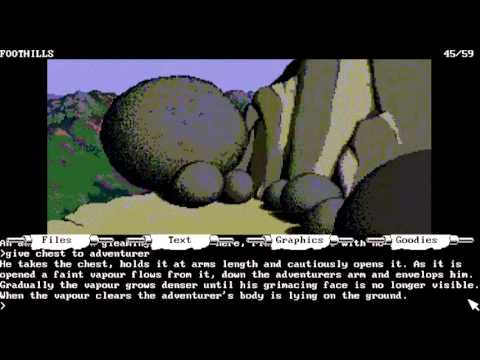
The Pawn playthrough - Kerovnia in play, with Geoff Quilley's illustrations alongside the text parser.
The Guild of Thieves (1987)
If The Pawn established that Magnetic Scrolls could compete at the highest level, The Guild of Thieves proved they could excel there. Tim Findley's 1987 design is generally regarded as the studio's critical peak - a game so consistently, precisely crafted that every puzzle, every object, every room feels deliberate. No adventure game from Britain surpassed it.
Back to Kerovnia, With Everything Improved
Tim Findley's arrival as lead writer marked a significant creative shift. Where Rob Steggles had established the Kerovnia setting with a light comic touch, Findley deepened it into something more intricately designed. The Guild of Thieves returns to the same fantasy world as The Pawn - a decision that gave returning players a familiar geography while allowing Findley to build something structurally distinct on well-known ground.
The premise is the game's greatest asset: as an initiation into the Thieves' Guild, the player must steal every valuable object in a medieval English village. This is simultaneously a puzzle frame and a design constraint. Every location had to contain something worth taking; every valuable had to have a puzzle attached; every puzzle had to have a solution the world's own rules supported. Findley met all three requirements without exception.
Geoff Quilley returned to illustrate, and the partnership produced his finest work for the studio. Where The Pawn's illustrations ranged across a fantasy landscape, The Guild of Thieves concentrated them in a medieval village environment - allowing Quilley to develop interiors (the inn, the bank, the church) and character studies alongside the outdoor scenes. The compositional variety showed a painter given more room to work.
Steal Everything, Solve Everything
The Guild of Thieves is one of the cleanest examples of puzzle design in British interactive fiction. Each puzzle has a solution that follows logically from the information available to the player. Nothing requires arbitrary guessing; nothing requires the player to have read the designer's mind. The game rewards observation and inference.
The multi-clause parser, improved from The Pawn, handles the inventory management that extensive theft demands. The player accumulates objects, needs to organise them, and eventually must transport the complete collection to the Guild. The logistics of the heist are part of the gameplay - not busywork, but another puzzle layer embedded in the game's central fiction.
The tone is lighter than Corruption and more playful than The Pawn. Findley writes Kerovnia with a dry wit that never condescends - the game is funny when it chooses to be, and the comedy emerges from the world's own logic rather than from authored jokes inserted into otherwise neutral description.
A World That Knew Its Own Rules
The game's primary achievement is a design one. The world model underlying The Guild of Thieves was the most consistent Magnetic Scrolls had built - every object tracked, every container handled correctly, every location accessible through the geography of the village map. Players attempting the unusual or the creative were rewarded with sensible responses rather than parser errors.
Quilley's illustrations for the game showed what the format could produce when an artist was given strong subject matter and sufficient time. The medieval English village setting - with its stone architecture, seasonal weather, and period details - played to his naturalistic oil-painted style more directly than Kerovnia's generic fantasy had, and the range of scenes demonstrated a painter working at full capability.
"The finest text adventure available."
Your Sinclair, 1987
The Gold Medal the Industry Was Waiting For
Zzap!64 awarded The Guild of Thieves a Gold Medal on the C64, the magazine's highest honour, reserved for games considered exceptional across all criteria. Your Sinclair called it the finest text adventure available. ACE praised the puzzle consistency as setting a new benchmark. The critical response was the most unanimous the studio had received, and it arrived from every corner of the press simultaneously.
Commercial performance matched. The Guild of Thieves sold strongly across all platforms and confirmed Magnetic Scrolls' position in the upper tier of British software. Rainbird had the studio it needed; the studio had the publisher it needed. The relationship worked, and this was the game that proved it.
Ken Gordon's First Choice When Strand Games Came Calling
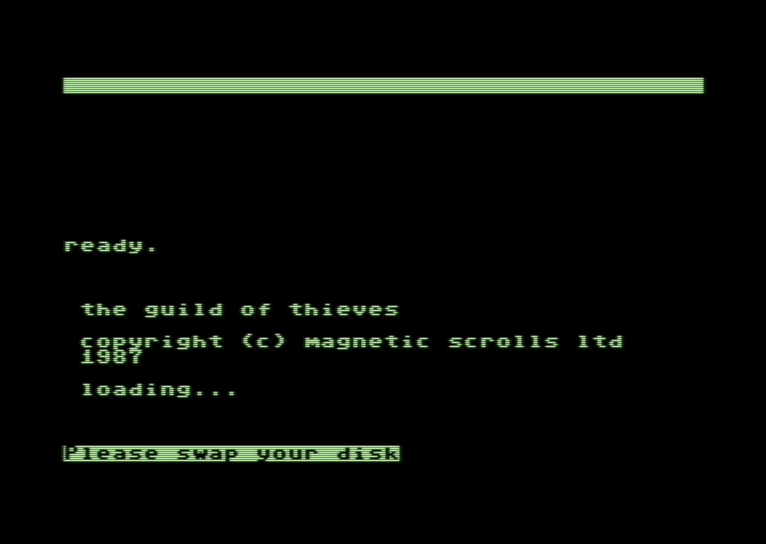
When Ken Gordon founded Strand Games in 2017 with the intention of bringing the Magnetic Scrolls catalogue to modern mobile platforms, The Guild of Thieves was his first release. The choice was not sentimental. It was the game most consistently cited as the studio's creative peak - the one most likely to reach a new audience if presented on contemporary hardware with enhanced graphics and audio.
The Strand Games iOS and Android remaster remains the most accessible version of the game currently available. For those who want the original experience, the Magnetic interpreter allows play on modern computers. See also: Catalogue entry · Period reviews · Tim Findley · Longplay video · Strand Games remaster
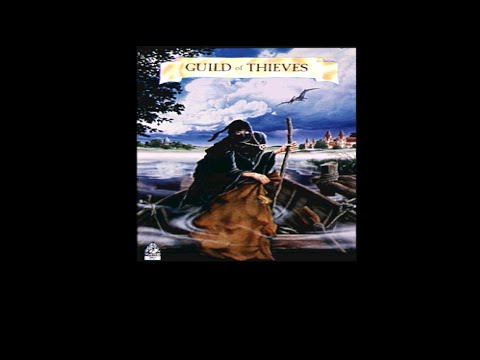
The Guild of Thieves on Amiga - Quilley's village illustrations at their finest, with the full multi-clause parser in play.
Corruption (1988)
In 1988, with Margaret Thatcher's deregulated City of London at the height of its "Big Bang" transformation, Magnetic Scrolls published a text adventure about financial corruption, insider trading, and moral compromise among City professionals. The audacity of the choice was not lost on anyone. Corruption was the first game in the catalogue to engage with contemporary adult reality rather than fantasy, and it is among the most ambitious things British interactive fiction ever attempted.
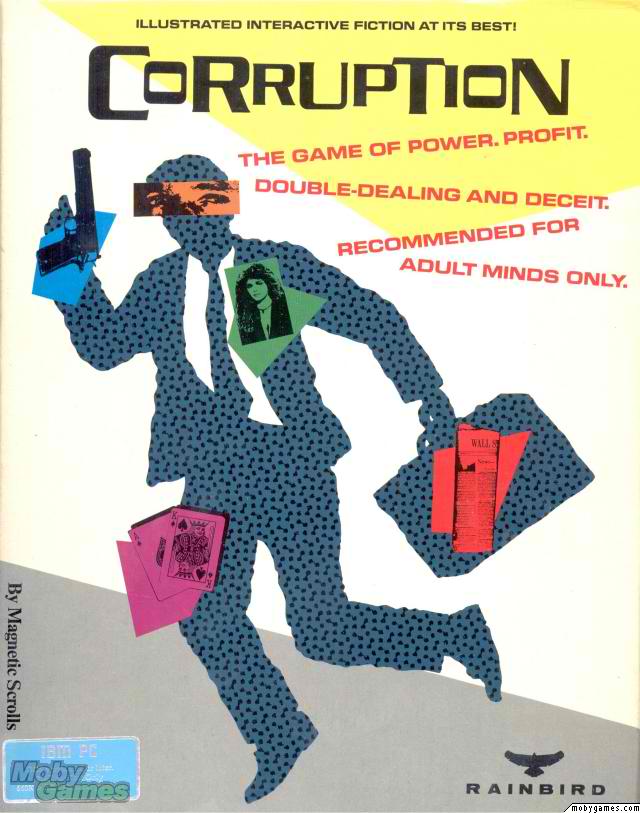
The Big Bang, Brought to Interactive Fiction
Rob Steggles and Michael Bywater co-wrote Corruption, and the partnership was deliberate. Bywater was a well-known British journalist and satirist whose work appeared in The Observer, The Guardian, and Private Eye. He understood the City of London from the inside - the social codes, the jargon, the culture that had developed in the aftermath of the 1986 financial deregulation. His contribution gave the game a specificity that Steggles alone could not have provided.
The player character is a financial dealer implicated in an insider trading scheme. They may or may not be guilty - the game's central ambiguity is never cheaply resolved. As they investigate, colleagues and employers reveal their own compromises, and the circle of betrayal widens. The premise is a thriller structure applied to an environment - the Docklands-era City of London - that was already becoming synonymous with moral compromise in the British popular imagination.
Terry Humphries was commissioned to illustrate, and his response to the material was exactly right. Where Geoff Quilley had painted warm rural England and fantasy landscapes, Humphries worked in angular, cool tones - glass office buildings, corporate lobbies, docklands architecture. The palette of Canary Wharf rather than Kerovnia. The illustrations told you, before you read a word, that this was a different kind of game.
"The City in 1987 was extraordinary material. The Big Bang had turned it into something genuinely new and genuinely strange. It was the obvious setting for a game about moral compromise, because everyone in it was compromised - that was the premise, and it came from the reality of the place."
Michael Bywater, The Digital Antiquarian
Time Is Running Out, and You Don't Know Why
Corruption introduced something no major British text adventure had attempted: a real-time clock. Specific events in the game world occur at specific game times, regardless of what the player is doing. Evidence appears and disappears. People arrive and leave. The window for discovering the truth is finite. Players who spent too long in any one location would find that crucial developments had occurred without them.
This mechanism changed the relationship between player and game. The Guild of Thieves was a puzzle to be solved at the player's own pace; Corruption demanded responsiveness. The investigation structure - gathering evidence, inferring relationships, confronting suspects - required the player to move purposefully through the day, not simply explore at leisure.
The moral dimension of the gameplay matched the subject matter. Players who investigated fully discovered that the corruption extended to people they had trusted. The writing refused to provide a simple guilty/innocent resolution: context complicated every judgment, and the game's multiple endings rewarded different investigative approaches differently.
A Clock That Kept Ticking
The technical achievement of Corruption was the event-timed world. Implementing this required the Magnetic Scrolls engine to track game time independently of player input and trigger specific narrative events at predetermined times. This was not a feature any previous British text adventure had offered, and the implementation was clean enough that players experienced it as story logic rather than mechanical constraint.
Humphries' illustration style contributed a specific achievement: demonstrating that the visual language of interactive fiction could shift completely between titles while maintaining coherence within each one. The Quilley-to-Humphries transition showed that Magnetic Scrolls' art direction was responsive to subject matter, not locked to a house style.
Praised for What It Was Trying to Do
The critical reception recognised Corruption's ambition without always fully engaging with its subject matter. Reviewers noted the adult themes, the contemporary setting, and the departure from fantasy. The real-time mechanism received specific praise as an innovation. Zzap!64 and Your Sinclair both reviewed the game positively; CU Amiga was enthusiastic about the Amiga version's illustrations and its thematic boldness.
Some players found the time pressure frustrating, unused to an adventure game that penalised inattention. Others found it exactly right for the genre the game was attempting. The divided reception reflected how far Corruption had moved from the conventions of British text adventure gaming.
Still Ahead of Most Things That Came After
Corruption arrived before "serious games" discourse made adult subject matter in interactive fiction critically acceptable. It preceded by years the conversation that would develop around games engaging with moral ambiguity and contemporary social reality as seriously as literary fiction could. Corruption did this in 1988, with a text parser and oil paintings.
The game has never received a Strand Games remaster, and the Magnetic interpreter is required for modern play. It is among the most undervalued pieces of British interactive fiction from the 1980s, and rewards the effort of finding it. See also: Catalogue entry · Period reviews · Michael Bywater · Rob Steggles · Corruption longplay
Wonderland (1990)
Magnetic Scrolls' final game was also its most technically spectacular. Wonderland appeared in 1990 as an adaptation of Lewis Carroll's Alice in Wonderland, and it was the vehicle in which the Magnetic Windows technology the studio had been building toward reached its complete expression: multiple simultaneous scrollable windows for text, illustrations, status, and inventory - with animation and music running alongside the parser. No British text adventure had ever looked like it.
Every Window Tells a Story
Georgina Sinclair chose Lewis Carroll as source material for reasons that went beyond the obvious commercial appeal of a beloved classic. Carroll's Wonderland is fundamentally a story about a world where normal rules are suspended and replaced by dreamlike, internally consistent alternatives. The logic of Wonderland is not illogical - it is a different logic. This made it ideal material for interactive fiction, where the player's authority over the world is mediated by the parser's own rules. The fit was structural, not merely thematic.
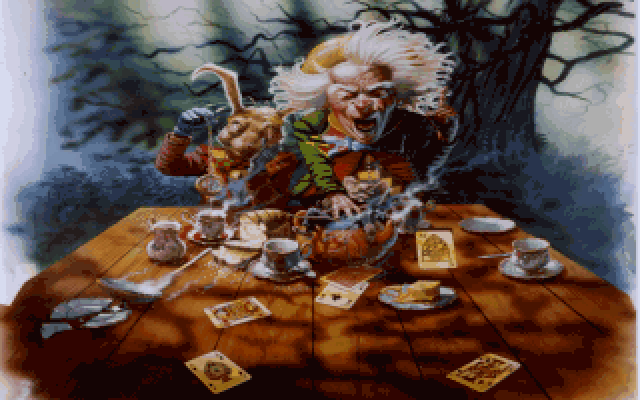
Ghislaine Selby's illustrations represented a deliberate departure from everything that had come before in the catalogue. Geoff Quilley painted warm, naturalistic oil images of the real and the fantastic. Terry Humphries rendered a recognisable contemporary England in angular tones. Selby embraced the surreal: compositions that overflowed with controlled excess, animal characters rendered with more personality than anatomy, architectural spaces that defied the geometry they implied. The illustrations matched the source material in spirit.
The Rainbird imprint had been discontinued by 1990, and Wonderland appeared under Virgin Games' banner. The change of publisher did not alter the studio's approach, but it marked a structural shift that would prove significant. The commercial environment the game entered was different from the one The Pawn had found five years earlier.
Alice's Logic, Parser-Strict
The gameplay of Wonderland follows Carroll's narrative structure while imposing the puzzle logic that Magnetic Scrolls had refined across six previous games. Alice must navigate Wonderland's encounters - the tea party, the Queen's croquet ground, the caterpillar's mushroom - and solve problems using the internal rules of each situation. The puzzles work because Carroll's world, however strange, is internally consistent; Georgina Sinclair identified those consistencies and built from them.
The Magnetic Windows interface changed the player's relationship to the game space. Rather than a single text window with occasional graphics, Wonderland presented the text, an illustration panel, an inventory list, and a status display simultaneously. The player could see where they were and what they carried while reading the room description and typing their command. The cognitive load of tracking game state was distributed across the screen rather than held in memory.
Music played continuously in the background of the Amiga and Atari ST versions, adding a layer of environmental texture that no parser game had previously offered. Animation occurred in the illustration panel - not video, but triggered visual events responding to game state. The whole presentation was closer to illustrated software than to the text games of the 1970s and early 1980s.
Five Windows Running at Once
The Magnetic Windows technology had been developed incrementally across the studio's catalogue. The Pawn introduced the illustrated format; subsequent games refined the display engine. Wonderland was the intended destination: a system capable of running multiple independent scrollable windows simultaneously, each updated in real time as the game state changed.
In practice: the illustration panel updated when the player moved. The inventory panel updated when objects were taken or dropped. The status window tracked time, health, and score. The text window received commands and provided responses. All of this happened simultaneously, on hardware that in 1990 was not considered powerful by later standards. The engineering behind it was exceptional.
"Wonderland was where everything we had been building toward came together. The multi-window display, the animation, the music running in parallel with the parser - it was the most technically complete thing we had ever made. We knew it was the culmination of the system."
Ken Gordon, Kim Justice documentary, 2022
Technically Lauded, Commercially Difficult
The critical reception was enthusiastic. CU Amiga praised the Magnetic Windows implementation as the most impressive display technology seen in a text adventure. ACE noted the technical achievement while acknowledging that the Carroll licence gave the game a different kind of accessibility than Magnetic Scrolls' original work. The illustrations received consistent praise.
Commercial performance was disappointing relative to the game's scope and cost of production. The market had shifted. LucasArts and Sierra were demonstrating that graphical point-and-click adventures could reach audiences that text parsers could not. The Secret of Monkey Island launched in 1990; Loom appeared the same year. The medium was transforming, and the text adventure was becoming a minority taste even as Wonderland demonstrated what it could still achieve.
The Road Not Taken
The MicroProse acquisition followed Wonderland's release. The studio was restructured and wound down by 1993. There was no successor to the Magnetic Windows technology, no follow-up to see where the engine might have gone. Wonderland pointed toward a version of interactive fiction that was closer to illustrated software than to either pure text or pure graphics - a direction the market did not follow.
The game has not received a Strand Games remaster. Ken Gordon's remaster project began with The Guild of Thieves in 2017; Wonderland's technical complexity - the Magnetic Windows system, the animation, the music - makes it the most demanding of the catalogue to bring to modern platforms. It is playable through the Magnetic interpreter, which handles the multi-window display on current operating systems.
Kim Justice's 2022 documentary devoted significant time to Wonderland and the Magnetic Windows technology, discussing both as the studio's technical legacy and the fullest expression of what Magnetic Scrolls was attempting. The documentary is the most comprehensive account of the game's development currently available. See also: Catalogue entry · Georgina Sinclair · Wonderland longplay · Studio history
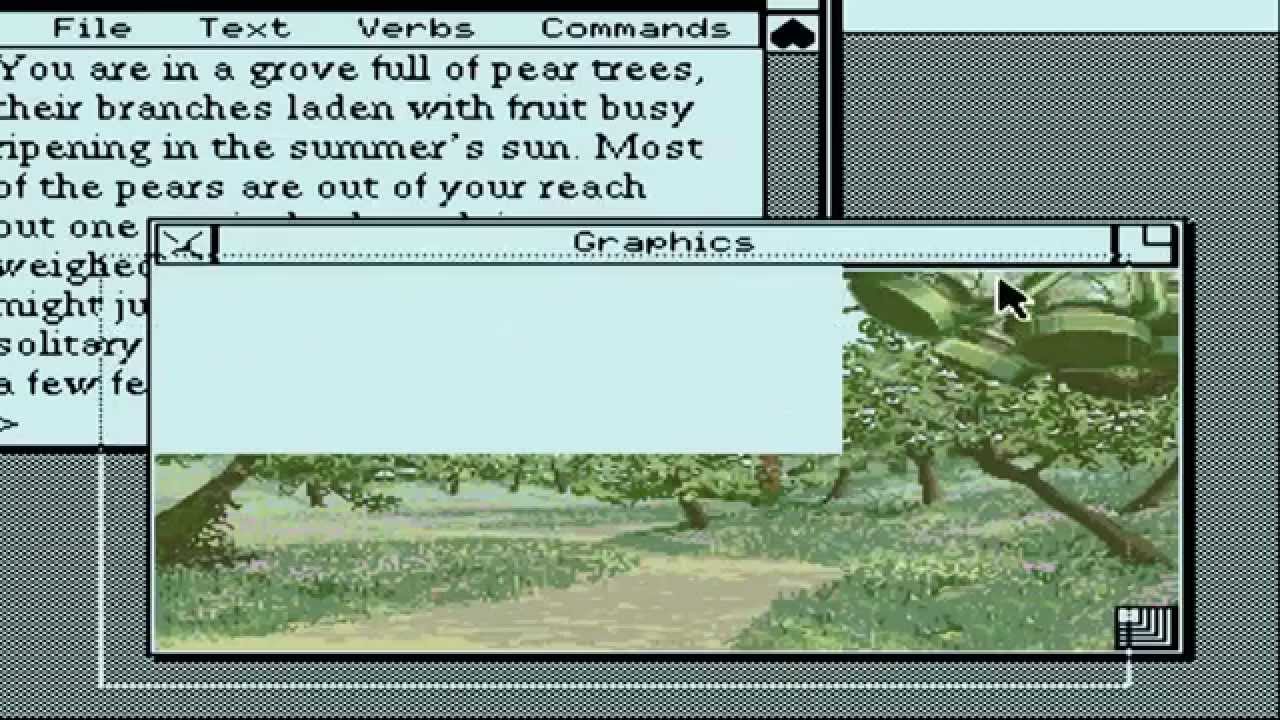
Wonderland on Amiga - the Magnetic Windows multi-window display in full operation, with Selby's surrealist illustrations and music running alongside the parser.