Coin-Op Dominance, 1969–1985
Konami was founded in 1969 by Kagemasa Kozuki, Yoshinobu Nakama, and Tatsuo Miyasako as a jukebox rental and repair business in Osaka. The company name is a portmanteau of the founders’ surnames. Through the 1970s, Konami built electronics expertise servicing coin-operated machines, and by the late 1970s it had entered the video game market with simple coin-op titles.
The pivotal year was 1981. Scramble — released in February 1981 — was among the first arcade games to feature forced horizontal scrolling across multiple distinct levels: a cave, an asteroid field, a city. The player controlled a jet fighter, managing fuel while destroying missile batteries and fuel depots. It was technically and commercially significant: Scramble spawned imitators worldwide and established Konami as a serious arcade hardware developer.
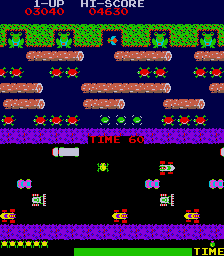
That same year, Frogger arrived — co-developed with Sega (Konami developed; Sega published in North America). A deceptively simple concept — guide a frog across a road and river to safety — it became one of the best-selling arcade titles of 1981 and one of the most-ported games in history, appearing on virtually every home platform from the Atari 2600 to the Commodore 64.
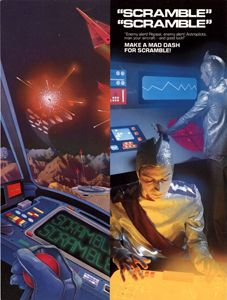
“Scramble was the template for everything that followed in scrolling shooters. It proved that levels with distinct identities could exist in a single arcade game.”
— RetroGamer magazine retrospective on Konami’s arcade origins
Gradius (1985) was Konami’s masterwork of the arcade era — a horizontal scrolling shooter featuring the Vic Viper starfighter and a revolutionary power-up selection bar. Rather than automatically receiving power-ups, players collected tokens and chose their enhancement from a scrolling menu: speed, missile, double shot, laser. The mechanic created a genuine strategic layer on top of the action and spawned an entire sub-genre. The Gradius franchise would define Konami’s identity through the SNES era.
NES Dominance, 1986–1992
As the Nintendo Famicom (NES in North America) swept the home market in the mid-1980s, Konami positioned itself as one of Nintendo’s most important third-party publishers. The company’s discipline — high production values, consistent quality, technical innovation — made its cartridges instantly recognisable.
Castlevania arrived on the Famicom Disk System in 1986 and on NES cartridge in 1987. A gothic action platformer set in Dracula’s castle, it was distinguished by its deliberate pacing (Simon Belmont could not change direction mid-jump), its atmosphere, and Kinuyo Yamashita’s extraordinary soundtrack — “Vampire Killer”, “Wicked Child”, “Heart of Fire” — among the finest music ever produced on the NES hardware.
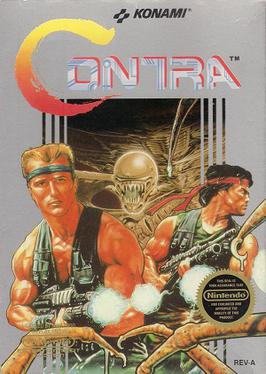
Contra (1988) was the defining co-op run-and-gun. Bill Rizer and Lance Bean battled alien forces through jungle, base, and alien lair environments. The two-player simultaneous mode was its commercial and cultural heart: shared lives, shared screen, shared glory. And, for those who knew the Code, 30 lives.
Metal Gear (1987, MSX2; 1988, NES) was designed and directed by Hideo Kojima, who had joined Konami in 1986. Assigned to the MSX division, Kojima created a stealth game in which the player avoided enemies rather than confronting them — a radical concept for the era. The game established stealth as a viable game genre. The NES port was produced without Kojima’s direct involvement; he has since distanced himself from it.
Konami’s NES output extended across genres: “Teenage Mutant Ninja Turtles” (the 1989 arcade four-player beat-’em-up became one of the highest-grossing arcade games of its era); “Life Force”, the Gradius spin-off with two-player simultaneous; “Jackal” (a top-down vehicular shooter); and many more.
A collection of Konami NES cartridges from the peak years: Contra, Castlevania, Gradius, Metal Gear, TMNT, Life Force, and more.
“Every screen of Castlevania felt like it had been drawn and redrawn until it was right. The attention to aesthetic detail was unlike anything else on the NES.”
— GameFan magazine, Castlevania retrospective (1993)
Castlevania (NES, 1987) — full longplay of Konami’s landmark gothic platformer, featuring Kinuyo Yamashita’s celebrated soundtrack.
16-Bit Expansion, 1991–1995
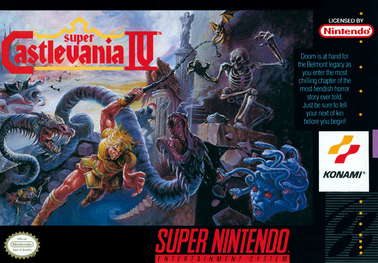
The transition to 16-bit hardware offered Konami a new canvas. Super Castlevania IV (1991) expanded Simon Belmont’s moveset to include eight-directional whip attacks and made extensive use of the SNES’s Mode 7 scaling and rotation effects in its rotating room and boss sequences. Gradius III (1989 arcade; 1990 SNES) arrived as a launch-window title, though its SNES version suffered noticeable slowdown under heavy sprite loads — an honest reflection of the hardware pushing its limits.
Axelay (1992) showcased the SNES at its most technically impressive: alternating between horizontal and vertical scrolling stages, with Mode 7 used to simulate perspective and depth in its asteroid and planetary approach sections. Its soundtrack, composed by Taro Kudo, was equally celebrated.
International Superstar Soccer (1994) was Konami’s breakthrough in simulation sports: a football game that prioritised authentic player physics and tactical depth over arcade accessibility. ISS and its sequels defined football gaming through the PlayStation era and eventually became Pro Evolution Soccer (PES).
“ISS changed what football games could be. Before it, you scored by exploiting the AI. After it, you had to actually play football.”
— Edge magazine retrospective on International Superstar Soccer (1995)