The Coin-Op Years
Between 1981 and 1985, Konami produced a remarkable series of arcade games that established the company’s technical and commercial credibility. Starting from Scramble (February 1981) — a forced-scrolling shooter requiring players to manage fuel while navigating terrain — Konami moved rapidly through Frogger, Gyruss, Track & Field, and eventually Gradius: one of the most influential games in the scrolling shooter genre.
This output was not merely commercial. Konami was developing proprietary hardware, building engineering expertise, and establishing the team structures that would later produce the NES powerhouse of the late 1980s. Each new arcade title represented an advance in hardware capability and design sophistication.
The Arcade Catalogue
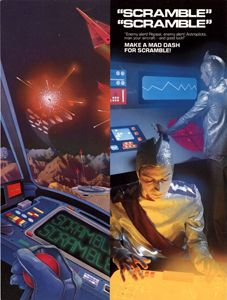
Scramble (1981)
Konami’s breakthrough title. Six distinct levels: caves, a city, missile batteries, starfields. Horizontal forced-scrolling with a fuel mechanic that punished passive play. Widely cited as one of the first scrolling shooters with multiple distinct stage environments.
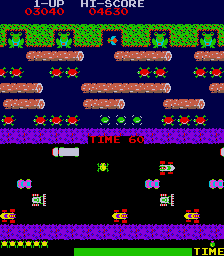
Frogger (1981)
Co-developed with Sega. Guide a frog across a road full of traffic and a river full of logs and crocodiles to reach a lily pad. Deceptively simple; extremely difficult at higher speeds. One of the most-ported arcade games in history, appearing on over 20 platforms.
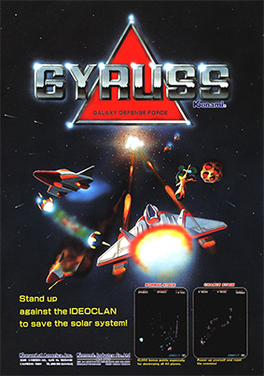
Gyruss (1983)
A tube shooter in which enemies approach from a circular starfield perspective. Two highlights: the distinctive 360° rotation system and the in-game music — an arrangement of Bach’s Toccata and Fugue in D minor, one of the first uses of Western classical music in an arcade game.
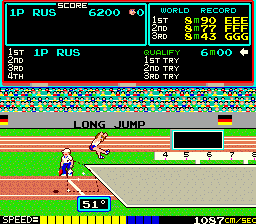
Track & Field (1983)
Multi-event sports game (100m sprint, long jump, javelin throw, 110m hurdles, hammer throw, high jump). Button-mashing intensity that wore out more hardware per quarter than almost any other arcade title of its era. Known in Japan as Hyper Sports.
Gradius (1985)
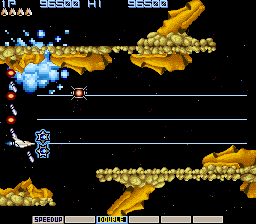
Konami’s masterwork of the arcade era. The Vic Viper starfighter battles through organic planet surfaces, asteroid fields, Moai head stages, and a final fortress. The defining innovation: the power-up selection bar. Players collected tokens and chose their enhancement from a scrolling menu — Speed, Missile, Double, Laser, Option, Shield — creating genuine strategic depth.
The Gradius arcade PCB demonstrated Konami’s custom hardware capability. Later Gradius sequels used the Konami Twin-16 hardware family. The franchise established Konami’s identity as the premier scrolling shooter developer of the 8-bit and 16-bit era.
Arcade PCBs & VRC Mapper Chips
Konami’s hardware story runs in parallel to its software output. In the arcade, the company developed custom PCB families that enabled their visual and audio ambitions. As the industry shifted to home consoles, Konami transferred that engineering discipline to developing custom mapper chips for the Famicom/NES — chips that extended the platform’s capabilities well beyond Nintendo’s standard hardware.
Konami Arcade PCB Families
| Hardware | Years Active | Key Titles |
|---|---|---|
| Konami Scramble hardware | 1981 | Scramble, Super Cobra |
| Konami TMNT hardware | 1989 | TMNT arcade (68000 + custom sprite chips) |
| Konami Twin-16 | 1987–1990 | Gradius II (Gofer), Vulcan Venture |
| Konami GX series | 1991+ | Sunset Riders, TMNT II: Turtles in Time |
VRC Mapper Chips - NES/Famicom Extensions
| Chip | Capability | Notable Use |
|---|---|---|
| VRC2 | ROM banking, attribute support | Gradius II, Contra (JPN) |
| VRC4 | Extended banking, scanline IRQ | Gradius II, Teenage Mutant Ninja Turtles |
| VRC6 | +2 pulse channels, sawtooth wave generator | Castlevania III (Famicom), Madara |
| VRC7 | FM synthesis (Yamaha YM2413 derivative) | Lagrange Point (1991) |