RoboCop (1988) · Batman: The Movie (1989) · Ghostbusters II (1990)
RoboCop (1988)
Developer & Publisher: Ocean Software ·
Platforms: C64, ZX Spectrum, Game Boy, NES, Amstrad CPC ·
Music: Jonathan Dunn
The Score That Launched a Career
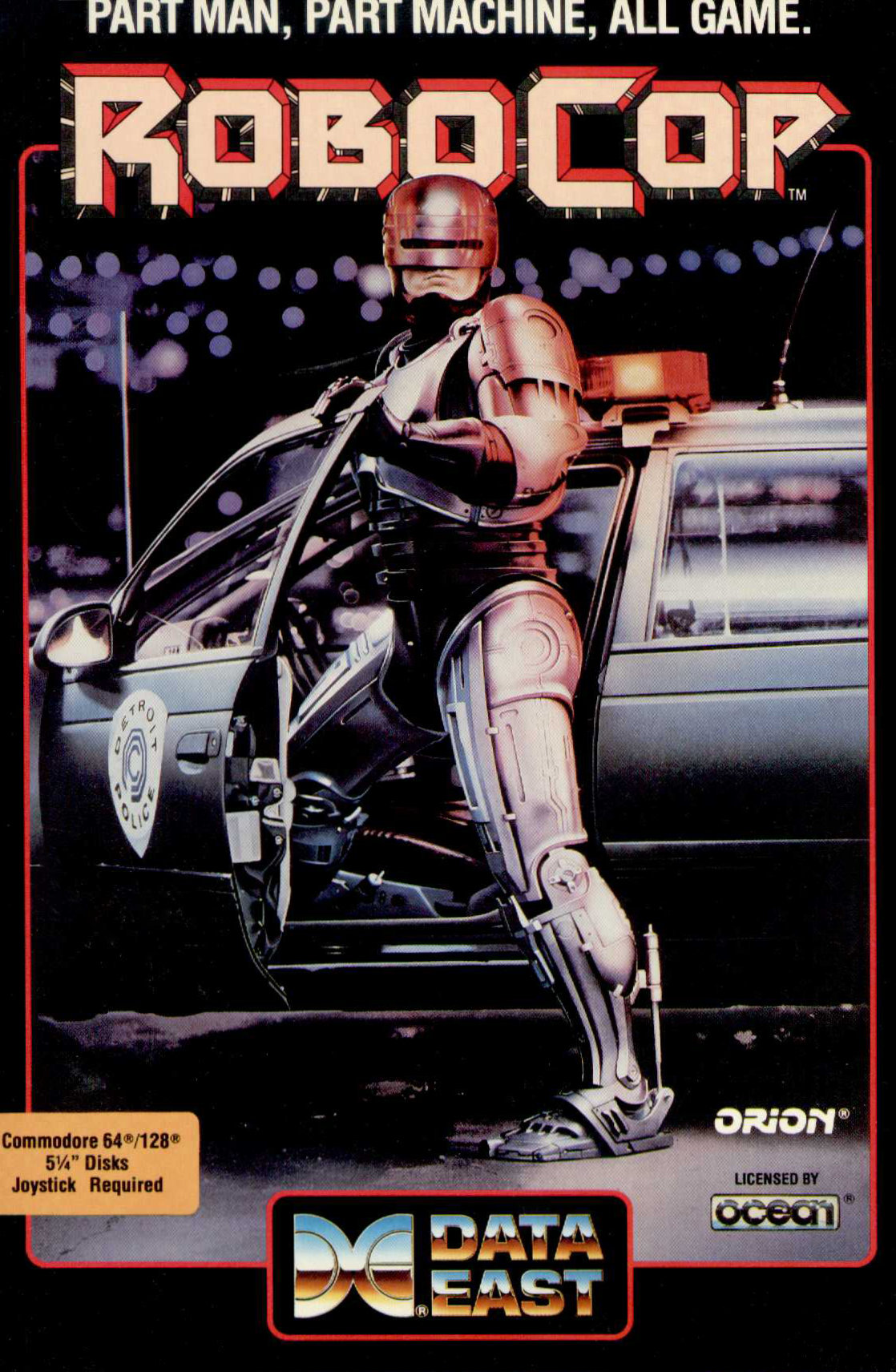
RoboCop C64 box art (Ocean Software, 1988)
Paul Verhoeven’s RoboCop landed in UK cinemas in January 1988 and immediately
became the film event of the year. Ocean Software had moved fast on the licence, and when the
game appeared later that year across five platforms it carried something unexpected: music that
could compete with the film itself as a piece of industrial art. Jonathan Dunn, Ocean’s
in-house composer, had written a title theme for the ZX Spectrum that used the machine’s
single-bit beeper speaker to produce a chromatic, propulsive march that stopped players before
they had clicked past the title screen. It was the kind of music people talked about in
playgrounds, not just in reviews.
The C64 SID version arrived alongside it with three complete subtunes. Together the two
platforms established Dunn as the most technically ambitious composer in Ocean’s
Manchester studio, and the RoboCop score became the reference point against which his
subsequent work would be measured. Read the full career context on the
career history page.
Scored Under Pressure, Shipped on Time
Ocean’s model for film licence games in the late 1980s was built on speed. A title
had to ship within weeks of the film’s release window to capture the promotional momentum;
anything later meant depleted box-office hype and reduced shelf presence. RoboCop gave the
development team a fixed target: the film score was Basil Poledouris’ churning,
brass-heavy industrial march, and the game needed music that felt cinematically connected to
it without infringing on the composition itself.
Dunn’s approach was to absorb the mood rather than transcribe the notes. He identified
the elements that gave Poledouris’s score its character - the chromatic descent,
the rhythmic pulse that drove the industrial drone, the sense of mechanical inevitability -
and rebuilt them from first principles in SID and beeper syntax. The result was not an
arrangement but a parallel composition: the same emotional territory reached by a different
route. For the Spectrum, this meant solving a hardware problem that most composers avoided
entirely.
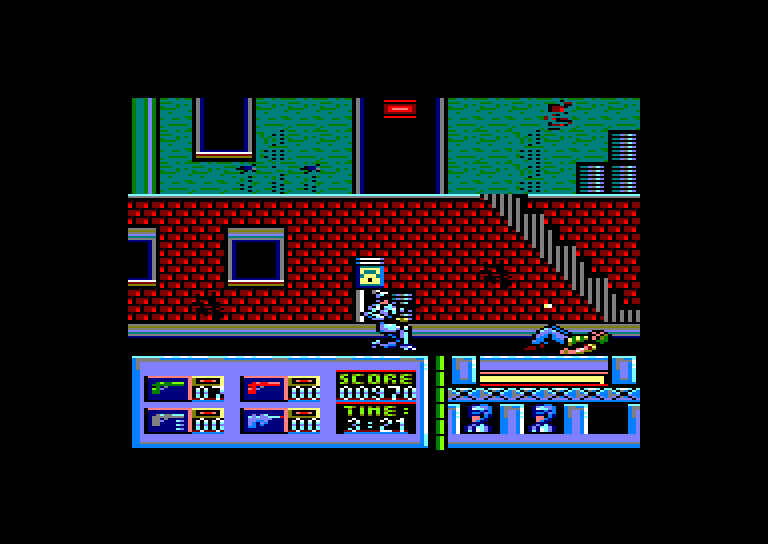
The game unfolds across six stages plus boss encounters, tracking RoboCop through the
OCP-corrupted streets of Detroit. Each section is essentially a side-scrolling action sequence
with platforming elements: walk, shoot, duck, survive. The music’s role is structural -
it establishes the stakes before the player has seen a single enemy.
The three C64 subtunes map directly to emotional function. The Title theme is the longest
and most complete, establishing the score’s rhythmic and harmonic language. The
In-Game theme compresses that language into a loop short enough to repeat without becoming
irritating over extended play - a compositional discipline distinct from writing a concert
piece. The Game Over cue is a brief, descending cadence that closes the experience without
belaboring it. Browse the SID catalogue to play all three subtunes.
RoboCop
1988C643 subtunes
1Title
2In-Game
3Game Over
One Bit. No Compromise.
The ZX Spectrum’s internal speaker is a single-bit device. In hardware terms it is
a buzzer: it either produces a voltage or it does not. There are no levels, no gradients,
no frequencies determined by the hardware itself. Every frequency, every apparent chord,
every suggestion of harmonic richness has to be produced by the software driving the toggle
fast enough that human hearing averages the pulses into something that sounds like pitch.
Dunn used rapid pulse-width modulation to drive the speaker at controlled rates, producing
what listeners perceived as sustained tones while the machine was actually toggling between
on and off states hundreds of times per second. The technique was known but its upper limits
had not been reached. Dunn pushed to those limits: the RoboCop beeper theme suggests melodic
layers that the hardware cannot actually produce simultaneously, achieving the illusion of
polyphony through timing precision alone.
The C64 SID version operated in a completely different technical space. The MOS 6581 chip
offered three independently programmable oscillators, each with its own envelope generator
and filter routing. Dunn used all three to layer the chromatic march: one oscillator carries
the melody, one drives the bass pulse, and the third handles the mid-frequency counterpoint
that gives the title theme its industrial density. Where the Spectrum achievement is
improvisational within brutal constraints, the C64 version is architectural - a precise
assembly of the chip’s capabilities into a coherent whole.
The ZX Spectrum market in late 1988 was saturated with film licences of variable quality.
Ocean’s RoboCop cut through that noise in period reviews principally on the strength
of the music. CRASH! magazine and Your Sinclair both noted the beeper composition as a
standout achievement. The Your Sinclair Megagame rating (one of the publication’s
highest honours, typically reserved for games they considered essential purchases) reflected
a score that reviewers described as redefining what they expected from licensed software music.
"The music in RoboCop is absolutely fantastic - without doubt the best beeper sound I've
heard on the Spectrum, full stop. Dunn's pulled off something that really shouldn't work on
this hardware, and the result is a title theme you'll find yourself whistling days later."
Your Sinclair, review of RoboCop (ZX Spectrum), issue 37 (January 1989)
The C64 SID version received equally strong coverage in ZZAP!64, where the music was praised
as the equal of anything in Ocean’s existing C64 catalogue. The HVSC (High Voltage SID
Collection) community has since rated RoboCop.sid among the most significant SID compositions
of 1988, noting the coherence of the three-subtune structure as a compositional achievement
beyond the typical single-loop approach of contemporary film licences.
The Blueprint No One Could Quite Copy
The RoboCop beeper theme was dissected and discussed in Spectrum communities for years after
its release. Composers attempting to replicate the technique on other titles found that the
result depended not just on the pulse-width approach but on Dunn’s specific choices
about rhythm, note duration, and harmonic interval - decisions that were not visible in the
code and had to be reverse-engineered from the audio output. The music is preserved in the
HVSC archive and is among the most frequently cited examples in technical discussions of
Spectrum 1-bit audio.
Beyond the Spectrum community, RoboCop established Dunn as Ocean’s primary composer
for blockbuster licences. Batman: The Movie followed within a year, with a larger production
scope and a more complex brief. Read the career history for the
full context of how RoboCop fit into Ocean’s publishing strategy.
C64ZX SpectrumGame BoyNES1988
Batman: The Movie (1989)
Developer & Publisher: Ocean Software ·
Platforms: C64, ZX Spectrum, Game Boy, NES, Amiga, Amstrad CPC, Atari ST ·
Music: Jonathan Dunn
Gotham in Eight Bits
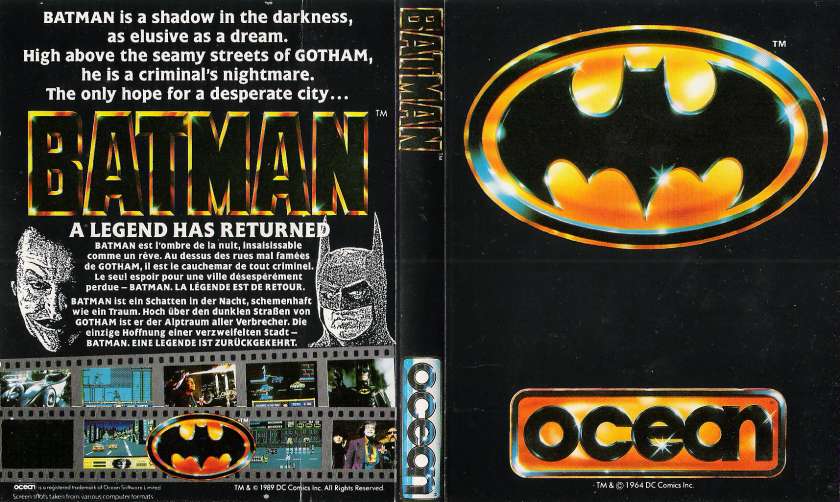
Batman: The Movie C64 box art (Ocean Software, 1989)
Tim Burton’s Batman was the most anticipated film of 1989 - and Ocean had
the game rights. The release spanned seven platforms simultaneously, a logistical and
compositional challenge that had no clear precedent in the UK games industry. Each platform
had different audio hardware, different technical possibilities, and a different audience.
Dunn had to score the same emotional material - the gothic Gotham atmosphere of Danny
Elfman’s film score - in at least three distinct technical languages at once.
The brief was harder than RoboCop. Elfman’s score was more harmonically complex,
more atmospheric and less rhythmically driven, than Poledouris’s industrial march.
Dunn could not rely on the same propulsive pulse-and-melody formula. Batman required something
darker, more sustained, more chromatic. The game’s commercial stakes were enormous -
Batman merchandise was everywhere that summer, and the game had to be worthy of its licence.
Seven Systems, One Deadline
Ocean’s multi-platform Batman: The Movie release required a different production model
to RoboCop. Porting audio across seven hardware configurations meant Dunn’s compositions
had to be abstract enough to translate, while retaining the atmospheric coherence that made
the score recognisably ‘Batman’ on each platform. The C64 and ZX Spectrum versions
were the primary scoring targets; the Game Boy, NES, Amiga, CPC, and Atari ST adaptations
followed with platform-specific modifications.
Ocean’s Manchester office was producing multiple major licences in parallel throughout
1989. The Batman game was developed under the same compressed timeline that had characterized
RoboCop - the game needed to arrive in shops while the film was still in cinemas. This was
the norm for Ocean’s film licence operation in its peak years; it imposed a discipline
on every department that showed in the final products. See the
career history for how Batman fit into Ocean’s 1989 publishing
calendar alongside New Zealand Story and the Ocean Loader 4 jingle.
Batman: The Movie ZX Spectrum cassette inlay (Ocean Software, 1989)
Through the Axis Chemical Plant
The game adapts the film’s set pieces into platform and vehicle stages: the Axis
Chemical Plant opening, the Batmobile chase sequence, the rooftop confrontations, and the
Gotham Cathedral finale. Each section presents a slightly different gameplay challenge -
the Batmobile stage is a side-scrolling vehicle section; the Axis Chemical Plant is
platformer combat. The music adapts its character to match.
The C64 SID score uses three subtunes mapping to the same Title/In-Game/Game Over structure
as RoboCop, but the harmonic palette is completely different. Where RoboCop was a chromatic
march built on rhythmic momentum, Batman is a sustained atmospheric piece - lower in its
bass register, slower in its harmonic rhythm, more reliant on the SID chip’s filter
routing to produce the characteristic ‘Gotham fog’ texture.
Batman: The Movie
1989C643 subtunes
1Title
2In-Game
3Game Over
The Descent Motif and How Dunn Built Gotham
The C64 Batman score is unified by a descending bass figure that appears in the title theme
and returns in varied form across the subtunes. This gives the score an internal coherence
unusual for licence games of the period, which typically treated each subtune as an
independent piece rather than part of a through-composed structure.
The SID’s filter routing is more aggressively used in Batman than in RoboCop. Dunn
routes the bass oscillator through the chip’s low-pass filter to produce a muffled,
subterranean quality that suggests depth and shadow rather than surface energy. The result
is a score that sounds like it is happening underground - appropriate for a game set in
Gotham’s sewers and rooftops after dark.
The Game Boy version, released in 1990 alongside Ocean’s growing portable catalogue,
adapts Dunn’s C64 themes for the DMG-01’s four-channel hardware. The pulse-wave
channels carry the melodic content while the wave channel provides bass - a different
compositional balance from the SID version, where the filter does most of the atmospheric
work. The Game Boy Batman score is brighter and more rhythmically defined than the C64
original, a natural consequence of hardware that cannot produce the SID’s filtered
bass texture.
Eight Platforms, All Reviewed Well
Batman: The Movie was one of Ocean’s strongest-selling releases of 1989 and the
licence context dominated its coverage. Period reviewers in CRASH!, Your Sinclair, and
ZZAP!64 all gave the game strong marks. The music on the C64 and Spectrum versions was
frequently cited as a high point - CRASH! reviewers specifically compared the Batman score
favourably to RoboCop, noting that Dunn had taken a genuinely different harmonic approach
rather than repeating the formula that had worked so well twelve months earlier.
"The music has a brooding quality I haven't heard in a C64 game before - it actually
sounds like a Batman score should, dark and slightly menacing, and it gives the game an
atmosphere that the graphics alone couldn't quite manage."
CRASH! magazine, review of Batman: The Movie (C64 version), 1989
The Ocean Gothic Sound
Batman: The Movie defined what Dunn’s C64 work could do at the far end of its
atmospheric range. RoboCop was propulsive; Batman was immersive. The two scores together
represented the full span of his C64 SID capability, and the community’s assessment
of both has remained consistent in the decades since - they are regularly cited among the
finest film-licence SID compositions of the 8-bit era.
The HVSC archive includes both C64 scores. Batman_The_Movie.sid is among the collection’s
most-downloaded Jonathan Dunn entries, reflecting ongoing interest in the score’s
atmospheric qualities. The SID catalogue page on this site
includes both titles with interactive playback.
C64ZX SpectrumGame BoyNES1989
Ghostbusters II (1990)
Developer & Publisher: Ocean Software ·
Platforms: ZX Spectrum, Game Boy ·
Music: Jonathan Dunn
The Theme Everyone Already Knew
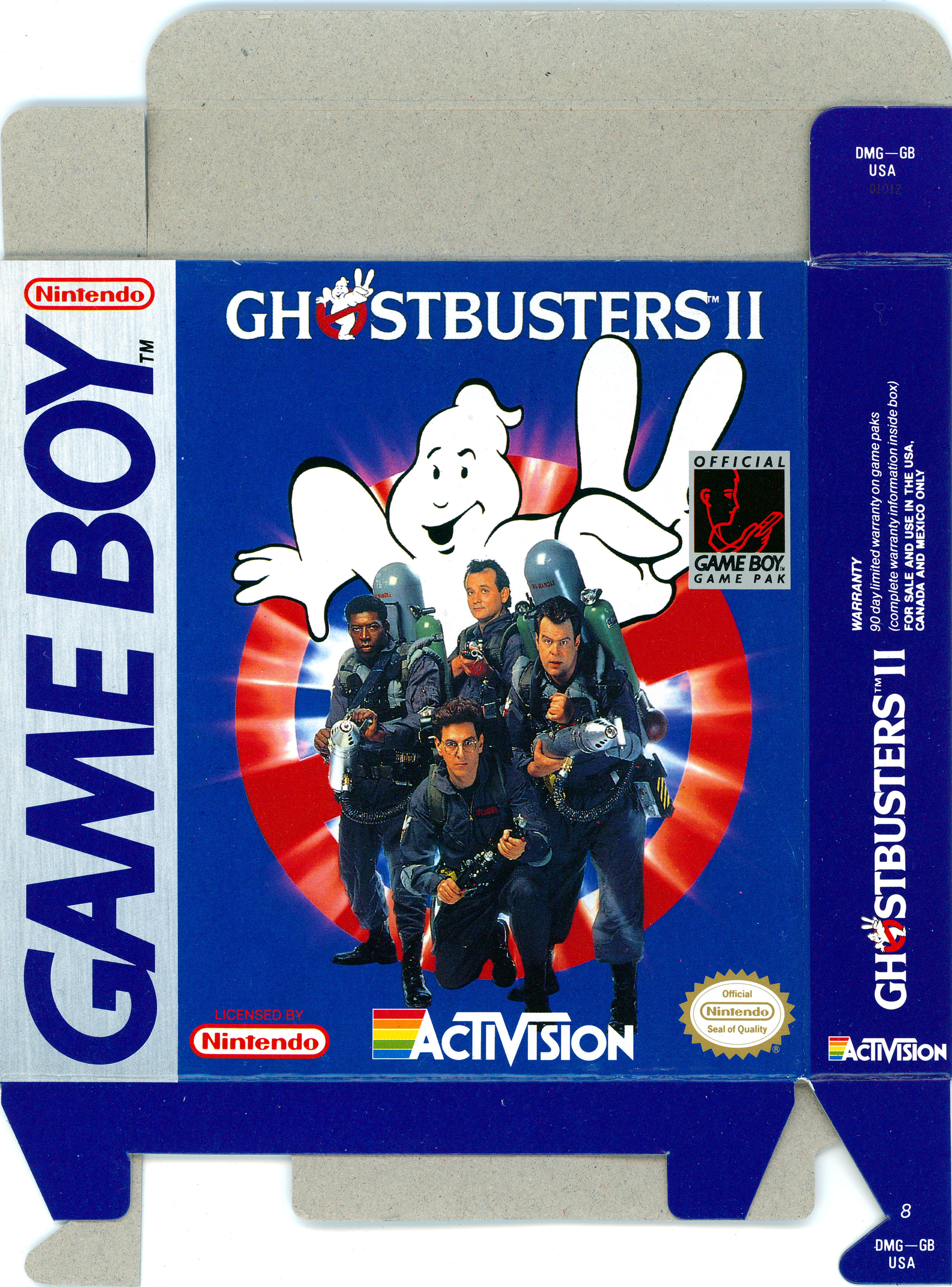
Ghostbusters II Game Boy box art (Ocean Software, 1990)
The challenge with Ghostbusters II was unlike anything Dunn had faced on RoboCop or Batman.
Both of those films had original scores that could be absorbed and reimagined; Ghostbusters
carried a pop song as its primary musical identity. Ray Parker Jr.’s Ghostbusters
theme (1984) was one of the most recognisable pieces of music in popular culture by 1989,
when the sequel film arrived. Every player who loaded the game would arrive with the hook
already in their head. Anything that did not deliver that hook immediately would feel
like a failure.
Dunn composed the Game Boy and ZX Spectrum versions of Ghostbusters II in 1990. The brief
required him to include the Ghostbusters theme as a recognisable element while also
producing original in-game compositions that carried the action without relying on
continuous repetition of a five-second pop hook. The
career history page covers where Ghostbusters II fits in
Dunn’s most prolific year, 1990.
Balancing a Licensed Hook with Original Underscore
Ocean’s deal for Ghostbusters II covered the film rights, but the
Ray Parker Jr. theme required a separate music licence from its publishers. This was a
common complication in film licence games of the era: the game rights and the music rights
were often held by different parties, and the negotiation sometimes resulted in the game
shipping with only a fragment of the recognisable theme rather than a full arrangement.
For Ghostbusters II, the licence allowed use of the theme as a recognisable element,
giving Dunn the foundation he needed.
The Game Boy was becoming Ocean’s primary portable platform by 1990. The company
had established a pipeline for rapid Game Boy development, and Dunn was scoring multiple
Game Boy titles in parallel that year - Ghostbusters II alongside RoboCop Game Boy and
other titles. The portable format suited the game’s design, which centred on
compact, contained level structures that worked well on the small screen.
Proton Packs, Platform Sections, and a Very Familiar Bass Hook
Ghostbusters II is a platform action game tracking the Ghostbusters team through the
events of the sequel film. Players navigate multi-screen levels, encounter ghost enemies,
and use proton pack mechanics to trap or eliminate them. The structure is episodic: each
level corresponds to a location from the film, and the music shifts register and tempo
between sections.
The Ghostbusters theme appears prominently in the title and level-transition sequences,
where its five-note bass hook delivers the instant recognition the licence required.
The in-game music is original composition - Dunn wrote looped themes that sustained the
ghostly atmosphere without relying on the pop song to carry the action sections. The
distinction between title music and in-game music is sharper in Ghostbusters II than
in either RoboCop or Batman, reflecting the different character of the source material.
Ghostbusters II
1990C64Multiple subtunes
1Title / Ghostbusters Theme
2In-Game
Four Channels, One Very Specific Hook
The Game Boy DMG-01 audio hardware provided four channels: two square-wave pulse channels,
one programmable wave channel, and one noise channel. This was more capable than the
ZX Spectrum’s single-bit beeper but significantly more constrained than the C64 SID.
The Ghostbusters theme’s characteristic bass hook - the rising fifth that opens the
song - needed to be rendered recognisably on hardware that could not reproduce the synth-bass
timbre of the original recording.
Dunn assigned the bass hook to the wave channel, which could be programmed with a custom
waveform closer to a sawtooth wave than the standard square-wave pulse channels. This gave
the bass line a slightly richer timbre that improved its proximity to the original recording.
The pulse channels carried melodic and harmonic content above it. The arrangement is
compressed but effective: a player who knew the song would recognise it within two bars,
which was the operative test.
The Game Boy Soundtrack That Got Noticed
Ghostbusters II received positive contemporary coverage. The Game Boy version was specifically
noted in publications covering Nintendo’s portable as a strong musical achievement for
the platform - the early Game Boy library was still establishing its musical vocabulary in
1990, and Dunn’s Ghostbusters II score was among the better examples of what the
hardware could deliver in its early commercial years.
"The music is the game’s strongest suit - the Ghostbusters theme comes across
really well on Game Boy hardware, and the in-game tracks hold their own throughout. It’s
better than most of what we’ve heard from the machine so far."
Nintendo Magazine System, review of Ghostbusters II (Game Boy), 1990
The ZX Spectrum version’s beeper music drew comparisons to the RoboCop score from two
years earlier - reviewers in Crash! and Your Sinclair recognised Dunn’s signature
technique in the Spectrum treatment of the Ghostbusters theme, though the pop hook imposed
a different structure on the composition than the original-score licences had allowed.
Dunn’s Game Boy Peak
Ghostbusters II is regularly cited alongside Batman: The Movie and The Amazing Spider-Man
as the high points of Dunn’s Game Boy output. The three titles appeared in quick
succession between 1990 and 1991, establishing him as Ocean’s most capable composer
for the portable format. The HVSC archive preserves the Ghostbusters_II.sid C64 file;
the Game Boy versions exist in the Game Boy music preservation community via GBS format.
The Ghostbusters licence itself continued to generate game releases into the 1990s, but
none of the subsequent games used Dunn’s arrangements. His Ghostbusters II score
is specific to Ocean’s 1990 release and has not been officially revisited - making
the HVSC and Game Boy preservation archives the primary means of access for anyone
returning to the music now. The SID catalogue includes
Ghostbusters_II.sid for interactive playback.