How one composer turned NES hardware constraints into the sound of alien isolation -
and defined the atmospheric dimension of video game music.
The game
What Metroid Is and Why It Matters
Released on August 6, 1986 for the Famicom Disk System in Japan,
Metroid was unlike anything Nintendo had released before. Where
Super Mario Bros. was exuberant and relentlessly forward-moving, Metroid
was lateral, lonely, and atmospheric - an open-world action-adventure set on an
alien planet where the player had no map, no guidance, and no company.
The game tasked its composer with something no Nintendo title had attempted: music
that felt genuinely alien and isolated. Hirokazu Tanaka’s response was to treat
NES hardware constraints not as limitations but as instruments - using deliberate absence
as much as sound.
Metroid’s score is widely regarded as the origin point of the
“atmospheric” strand of video game music - a thread that runs through
Castlevania, the survival horror genre, and the franchise’s own subsequent
entries to the present day. See the full entry in the
game catalogue.
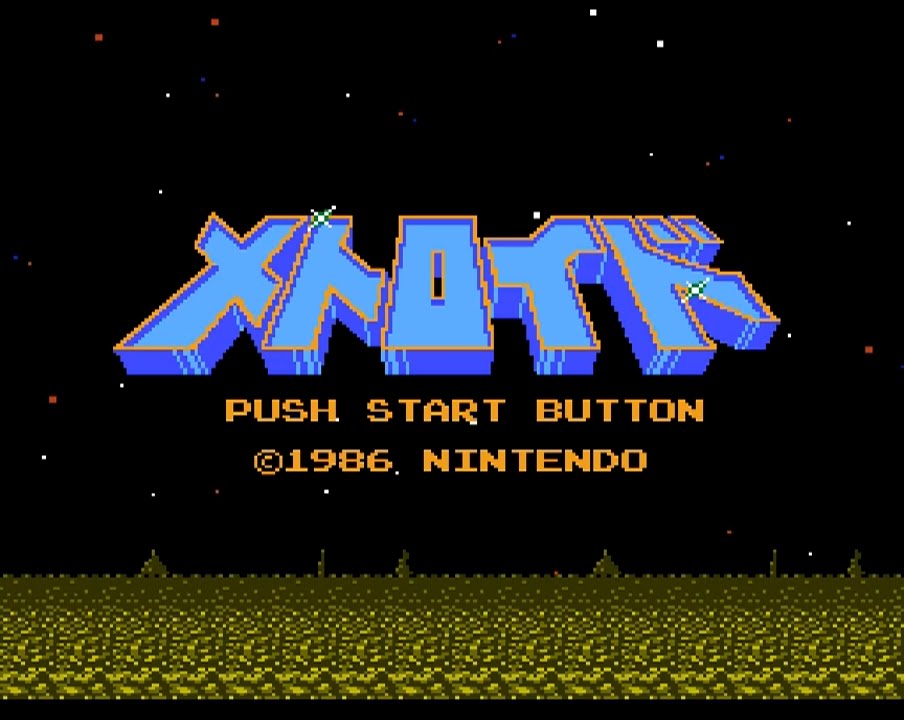
Metroid - Famicom Disk System (1986). Sole composer: Hirokazu Tanaka.
Behind the game
A Brief to Make Zebes Sound Empty
Metroid was developed by Nintendo R&D1, Gunpei Yokoi’s
team - the same division that produced the Game & Watch series and would later
create the Game Boy. The core design team was led by Hiroji Kiyotake on character
design and Yoshio Sakamoto as director, working alongside Makoto Kano on game design.
The project began in 1985 and reached Famicom Disk System shelves in August 1986.
The creative direction was a deliberate departure from Nintendo’s established
output. Where Mario was defined by momentum and reward density, Metroid was built
around isolation, exploration, and the sensation of being genuinely alone in a
hostile environment. The Alien film series was a clear tonal reference. The planet
Zebes was designed as a labyrinth without signposting: no arrows, no tutorial,
no map. Players were expected to remember the layout themselves.
Tanaka joined the project after the core design was set. His brief, as reconstructed
from retrospective accounts, was to score a world that felt empty - not the
joyful emptiness of a landscape, but the frightening emptiness of somewhere you are
not supposed to be. He had composed energetic, melody-driven scores for
Balloon Fight and Excitebike (both 1984). Metroid required
something entirely different.
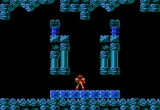
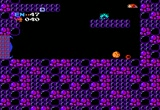
Early Brinstar. The visual design of empty corridors matched the sonic design of near-silent channels.
The FDS hardware gave Tanaka a sixth audio channel - the wavetable synthesiser -
unavailable on standard NES cartridges. This channel could produce arbitrary waveforms,
giving the FDS version of Brinstar a richer, more textured ambient quality. When the
NES cartridge port was produced for North American release in August 1987, Tanaka’s
compositions had to be adapted within the five standard NES channels. The core
architecture survived intact; the timbre changed perceptibly.
The Famicom Disk System version shipped with no on-screen staff credits - unusual
even by 1986 standards. The NES port also omitted credits. Tanaka’s authorship
was confirmed only through external sources: later interviews, internal Nintendo records,
and retrospective game history coverage. For years, many Western players did not know
who had written one of the most influential scores in NES history.
“The music of Metroid was intended to make you feel like you were alone -
truly alone - in a place that was not built for you. The planet Zebes does not
care about Samus. The music had to reflect that indifference.”
- Hirokazu Tanaka, as summarised in retrospective coverage of the Metroid series
The experience
How Metroid Plays - and How the Music Plays With It
Metroid is an open-world action-platformer built around the acquisition of power-ups
that unlock previously inaccessible areas. Samus begins nearly defenceless and expands
her capabilities through the Morph Ball, Bomb, various beam weapons, Missiles, and
movement enhancements like the High Jump Boots and Screw Attack. The world is a
continuous interconnected labyrinth - Zebes has no discrete level breaks, no screens
telling the player where to go, and no in-game map.
This design was radical for 1986. The exploration loop - enter unknown territory,
find an upgrade, return to areas previously blocked, explore further - created a
player experience of genuine discovery and genuine disorientation. Getting lost was
not a failure state; it was the game. The structure would be codified as
“Metroidvania” decades later, but in 1986 it had no name.
Tanaka’s music is load-bearing architecture in this loop. Each area of Zebes
has a distinct theme that communicates not just location but psychological state.
Brinstar (the surface) is the most melodically accessible. Kraid’s Lair is
heavier and more oppressive. Norfair, the deepest zone, is the most dissonant and
abstract. The music tells the player, without text or instruction, that they are
descending into somewhere worse.
The Themes as Gameplay Signals
Brinstar (surface) - The iconic entry-point. Pulse 1 carries a
memorable three-note figure that repeats with harmonic variation; the Triangle channel
provides the cave floor. Of all Metroid’s themes, Brinstar is the most
melodic - but even here the content is sparse against implied silence. The theme loops
without resolution, reinforcing the absence of a narrative endpoint. Players can spend
hours in Brinstar; its music never signals urgency.
Kraid’s Lair (boss dungeon) - More minimal than Brinstar.
The pulse waves move in contrary motion at reduced tempo; the triangle bass is heavier
and geological. It builds menace through restraint - implying something vast and
terrible without stating it. Players navigating Kraid’s Lair for the first time
knew from the music alone that something significant was ahead.
Norfair (lower depths) - The deepest and most alien of Zebes’s
areas. The melodic content is more dissonant, the pulse wave textures more abrasive.
If Brinstar is “alone,” Kraid is “threatened,” Norfair is
“lost.” The three themes chart Samus’s psychological descent as much
as her physical movement through the planet.
Item Fanfare - Among the most minimal reward cues in Nintendo history.
A short, bright ascending figure that sounds almost intrusive against the surrounding
atmospheric silence. Its brevity is deliberate: the game returns to cave ambience
immediately, reinforcing that the world does not stop for Samus. The interruption
itself communicates urgency and isolation.
Technical approach
The NES 3-Channel Atmosphere Technique
The NES / Famicom’s audio processor (Ricoh RP2A03 in NTSC; RP2A07 in PAL)
provides five audio channels:
Pulse 1 - square wave, variable duty cycle
Pulse 2 - square wave, variable duty cycle
Triangle - triangle wave, fixed amplitude, no volume control
For the Brinstar theme, Tanaka’s channel assignments (as documented
in chiptune community analyses) are approximately:
Pulse 1: primary melodic line
Pulse 2: supporting harmony or counter-melody
Triangle: atmospheric bass pedal tone
Noise: minimal - percussion used extremely sparingly
DMC: unused or near-silent in most of the score
The absence of full noise percussion - standard in NES game music - and the
near-absence of the DMC channel creates the distinctive empty quality that made
Metroid’s caves feel genuinely vast. When the noise channel does appear, it
functions as textural accent rather than rhythmic backbone. This is what separates
Tanaka’s Metroid approach from every other NES score of the era: the used channels
are not the point. The near-unused channels are.
Koji Kondo - composing for Mario and Zelda simultaneously - filled his channel budgets
with melody, countermelody, and rhythmic drive. Both approaches are masterworks.
They are simply doing opposite things. Where Kondo’s music energises, Tanaka’s
isolates.
Hardware comparison
FDS vs NES - What Changed
The Famicom Disk System version of Metroid (1986) uses the FDS’s additional
wavetable synthesis channel - a 6th audio channel that can produce
arbitrary waveforms by writing 64 4-bit samples. This is conceptually similar to the
Game Boy’s wave channel and provides richer, more varied timbres than the NES’s
fixed triangle wave.
In the FDS Brinstar theme, the wavetable channel is used to create the distinctive
ambient texture that characterises the original version. The NES cartridge port (1987)
lacks this channel and must approximate the same passages using only the 5 standard NES
channels - the result is perceptibly different, though Tanaka’s core compositional
architecture is preserved.
For players who experienced Metroid first on NES cartridge (the majority of Western
players), the NES version is the “authentic” Tanaka score they know.
The FDS version offers a richer harmonic palette - but the compositional genius is
equally present in both.
Channel Summary
Channel
NES
FDS
Pulse 1
✓
✓
Pulse 2
✓
✓
Triangle
✓
✓
Noise
✓
✓
DMC
✓
✓
Wavetable
—
✓ FDS only
Critical response
Reception - How Metroid Was Heard
Metroid sold moderately in Japan on FDS launch - strong enough to justify the North
American cartridge port, but not the runaway success of Mario or Zelda. The game’s
difficulty and lack of hand-holding divided contemporary opinion: some players found the
non-linear structure liberating; others found it impenetrable.
In North America, the NES release in August 1987 found a more receptive audience.
Computer Entertainer - one of the period’s leading NES review publications -
praised the game’s atmosphere and scope, noting that it achieved something few
NES titles had managed: a sense of genuine scale and isolation. The music was
consistently cited in reviews as central to this effect, though reviewers lacked the
technical vocabulary to describe precisely what Tanaka had done with the hardware.
Nintendo Power’s coverage in its early issues established Metroid as one
of the must-own NES library titles - a position it held throughout the late 1980s.
British publications including Computer and Video Games gave the NES version
high marks, again foregrounding the atmospheric qualities of both the visual and audio
design. Famitsu’s retrospective coverage gave the original 30 out of 40, noting
the game’s lasting influence on action-adventure design.
Contemporary players noted the music as something distinct from the rest of the NES
library without always articulating why. The retrospective critical consensus, formed
across the following two decades, is that Tanaka’s score represented a
compositional approach that had no real precedent on the platform - and would not be
fully understood until later writers and musicians could describe atmospheric game
audio as a deliberate design category.
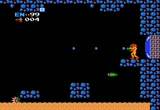
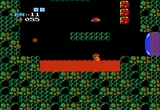
Mid-Brinstar. The visual emptiness of the corridors and the sonic emptiness of the score worked in the same direction.
“Metroid was trying to create an atmosphere that no Nintendo game had attempted
before. The music had to make the player feel genuinely alone in an alien world - not
threatened by enemies, but by the silence itself.”
- Retrospective analysis of Tanaka’s compositional approach, drawn from NES music documentation
Cultural legacy
Legacy - Samus’s Sonic Identity
Tanaka’s Metroid score did more than accompany a game - it created a character.
Before the visual design of Samus was understood by most Western players (the reveal of
her gender at game’s end was one of gaming’s first major plot twists), it
was the music that defined who she was: alone, capable, moving through a world that did
not acknowledge her existence.
The score’s treatment of silence as a compositional element - the implied emptiness
of near-unused channels - perfectly matched the visual emptiness of Zebes’s
corridors. Music and environment reinforced each other in a way that few NES games
achieved, and that became a template for atmospheric game design that persists to the present.
Super Metroid (1994) on SNES expanded the blueprint with a richer audio palette and a
fully orchestrated approach. The Metroid Prime trilogy (2002-2007) placed the franchise
into first-person perspective and built its audio around Kenji Yamamoto’s
compositions - which are in direct dialogue with Tanaka’s Brinstar and Norfair
themes. Metroid: Other M (2010) revisited the atmospheric approach. Metroid Dread (2021)
cited the original NES score as a tonal touchstone.
The concept of “atmospheric” game audio - music designed to create a sense
of place and psychological state rather than to entertain in isolation - has antecedents
elsewhere, but Metroid 1986 is the most widely cited early example on mass-market
home console hardware. Its influence is visible in the survival horror genre (Resident Evil,
Silent Hill), the Souls series, and any game that uses sparse audio to build dread.
Tanaka himself moved on from composing after EarthBound (1994), eventually becoming
president of Creatures Inc. The hirokazu-tanaka.fan-site explores his full career
on the people page and across the
music collection.
“Tanaka’s score for Metroid stands as one of the earliest and most complete
examples of music designed not to delight but to unsettle - sound that serves the
architecture of loneliness rather than fighting against it.”
- Video game music retrospective, The History of Game Music documentation project