Flagship Titles
Five titles that define the Hewson legacy. Full catalogue entries are in Catalogue. Music context is in Music. Developer profiles are in People.
Uridium (1986)
Developer: Graftgold (Andrew Braybrook) - Music: Steve Turner - Platforms: C64, ZX Spectrum, Amstrad CPC - see full entry in Catalogue
Fifteen Dreadnoughts and a Golden Joystick
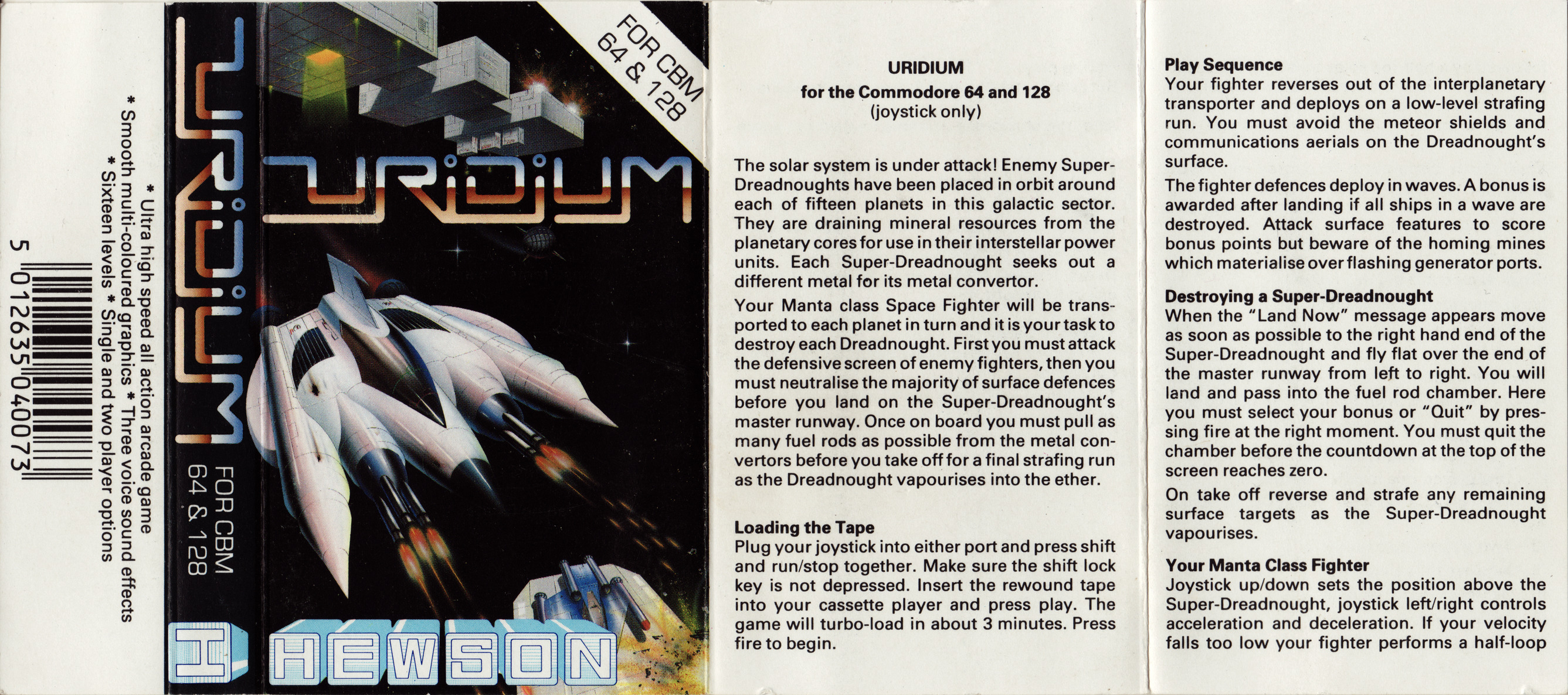
Uridium is one of the defining games of the British home computer golden age. Released for the Commodore 64 in 1986 and developed by Andrew Braybrook at Graftgold, it is a horizontal shoot 'em up set on a scale that no competitor had attempted: the player pilots a Manta fighter across the surface of fifteen alien super-ships, each one a vast scrolling level with its own surface texture, gun emplacements, and enemy fighter configurations. The objective on each dreadnought is to destroy enough enemy craft to trigger a landing sequence, then fight through a corridor of surface infantry to reach the self-destruct control.
Braybrook had already made his name with Gribbly's Day Out and Paradroid before turning to Uridium. The shift to a pure action game did not mean a simpler design: Uridium is demanding and precise, and it won the Golden Joystick Award for Best Arcade-Style Game in 1986, the most coveted prize in the British gaming industry at the time.
A Ship with Real Mass
The single most important element in Uridium's design is momentum. The Manta fighter builds speed when flying in the same direction as the scrolling dreadnought surface and decelerates when flying against it. Braybrook designed this physics model deliberately: the Manta should feel like a craft with genuine mass moving through a real environment, not a sprite sliding across a background.
The effect on gameplay is profound. At high speed, moving with the scroll, the player can outrun most enemies but has less time to react to obstacles. Against the scroll, movement slows, giving more reaction time but making the player more vulnerable to pursuit from behind. Every engagement on a dreadnought surface requires the pilot to manage this momentum system - when to accelerate, when to brake, when to use the scroll direction as cover.
Fifteen Ships, Zero Repeated Architecture
Each of Uridium's fifteen dreadnoughts has a distinct surface design and a distinct set of enemies. The first ships are spacious, with wide lanes and predictable enemy patterns. Later dreadnoughts feature tighter corridors, new fighter types with more aggressive behaviour, and architectural features that force the player to change approach. The escalation is considered: no individual jump in difficulty is unfair, but the cumulative demand by the fifteenth ship is significant.
Steve Turner's SID score anchors the action. The driving melody suits the game's rhythm - urgent without being frantic, propulsive without dominating. The audio-visual combination contributed to Zzap!64's enthusiasm. The SID audio holds up as a strong mid-1980s C64 composition on its own terms. See the Music page for full context on Turner's work.
Uridium is visually awesome, sonically sound, technically stunning - brilliant shoot 'em up.
Zzap!64 magazine, 1986 review
Near-Perfect Scores and the Award that Settled It
Zzap!64's review awarded Uridium an exceptional score and singled out the momentum system and scrolling engine as technically superior to anything then available on the C64. The Golden Joystick win confirmed the game's position in the market. ZX Spectrum and Amstrad CPC ports followed and were well-received, though the C64 version with its SID audio remained the definitive experience.
Uridium established Braybrook's reputation at Hewson before Paradroid had even been recognised, and Hewson's position as a publisher willing to back technically ambitious games. See period reviews and scores in Reviews.
Uridium+ and the Amiga That Came After
A year after release, Graftgold released Uridium+ for the C64 - an enhanced version that added new enemy types, a two-player simultaneous mode, and additional dreadnought designs. The original fifteen ships were retained. Uridium+ is now considered the definitive C64 version.
In 1993, Braybrook produced Uridium 2 for the Amiga. Seven years after the original, the sequel expanded the dreadnought concept with a larger weapon system, more complex surface layouts, and Amiga-quality audio and visuals. In 2018, the independent developer Fee Good Ltd released Hyper Sentinel - a spiritual successor to Uridium that Hewson endorsed, providing continuity between the 1986 original and the modern retro revival. See the Modern Era page for the full Hyper Sentinel story.
Paradroid (1985)
Developer: Graftgold (Andrew Braybrook) - Platforms: C64 - see full entry in Catalogue
The Weakest Droid on Nine Ships
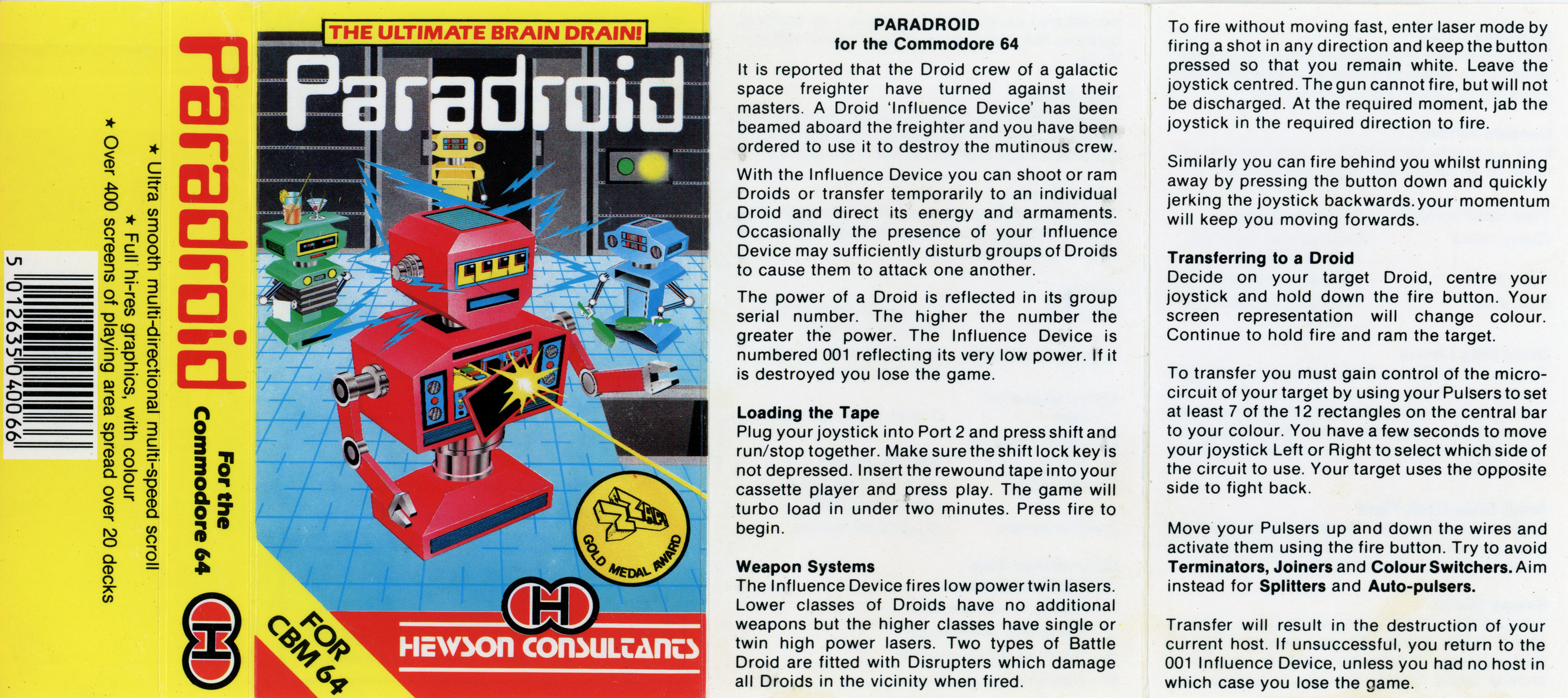
Paradroid arrived a year before Uridium and is a different kind of achievement. Where Uridium is a precision action game, Paradroid is a hybrid - part shoot 'em up, part strategy, with a transfer mechanic that gives the game its identity. The player controls the Influence Device, designation 001 - numerically the weakest droid on the ship, with minimal firepower and fragile construction. Nine derelict spacecraft are overrun with rogue droids. The 001's task is to clear them all.
The 001 cannot survive prolonged direct combat with most droids. Its power lies in the circuit connection transfer: by initiating contact with an enemy droid, the player enters a real-time logic mini-game where both sides compete to capture circuit nodes. Win the transfer and the player inhabits the defeated droid's body - gaining its weaponry, its durability, and its number. Higher-numbered droids are more powerful but harder to defeat in the transfer. The 001 can always initiate but rarely wins against heavy opposition without preparation.
Chess at Arcade Speed
The circuit battle is elegant in its simplicity: a grid of connections, two competing colours, the player clicking to capture nodes before the opponent completes a path. The grid changes with each new opponent, and the target droid's strength affects how much of the grid it starts with pre-filled. Against a 999 (the most powerful class), the player begins at a severe disadvantage and must play the transfer optimally to win.
This creates a game of continuous tactical assessment. Which droid is worth the risk of a transfer attempt? Which should be destroyed outright from the safety of a current body? A droid with high firepower is valuable but drains faster; a weaker body is expendable but limits combat effectiveness. Droid bodies also expire after a time - a full-power 999 won't last forever - pushing the player back toward the transfer mechanic repeatedly.
Nine Ships, Nine Layouts, One Engine
The nine ship layouts differ in architecture, droid population density, and the placement of lifts connecting decks. Ships later in the sequence are larger, more densely populated, and harder to navigate efficiently. Braybrook's level design ensures the game's tactical demands compound across the run - the same approaches that work on Ship 1 are insufficient by Ship 7.
The C64 hardware is pushed carefully. Multiple droids move simultaneously across multi-deck layouts without slowdown, and the circuit battle mini-game runs as a seamless overlay on the ship map. Braybrook's programming efficiency throughout Paradroid reflects a deep understanding of the platform's capabilities.
Paradroid is one of the most innovative games ever released for the Commodore 64. The circuit board transfer system is a stroke of genuine design genius - tense, fair, and endlessly replayable.
Zzap!64 magazine, 1985 review (Sizzler award)
The Best C64 Game of 1985
Zzap!64 awarded Paradroid a Sizzler - the magazine's highest recognition - and singled out the transfer mechanic as an original game design concept with no precedent. The game appeared in end-of-year best-of lists and built Braybrook's reputation as one of the most inventive designers working in British software. See Reviews for full press coverage.
The game's influence extended within the Hewson catalogue: Steve Turner designed Quazatron as an explicit ZX Spectrum reimagining of Paradroid. The developer profiles for Braybrook and Turner are on the People page.
Quazatron and the Spectrum Answer
Paradroid was a C64 exclusive; the Spectrum community got its equivalent in 1986 with Quazatron, developed by Steve Turner at Graftgold. Rather than a port, Turner rebuilt the concept from scratch for the Spectrum's hardware, adapting the circuit battle and droid mechanics for the different platform. Quazatron was received as warmly on the Spectrum as Paradroid had been on the C64, and both remain played at retro gaming events today.
Nebulus (1987)
Developer: John Phillips - Platforms: C64, ZX Spectrum, Amiga, Atari ST, Amstrad CPC, Game Boy - see full entry in Catalogue
One Programmer, Eight Towers, an Effect Nobody Else Could Do
Nebulus is the work of a single developer, John Phillips, and it contains a technical achievement that stopped reviewers in their tracks when the C64 version appeared in 1987. The game is a climbing puzzle: Pogo, a small amphibious creature, must ascend a series of cylindrical towers while avoiding enemies descending from above and obstacles blocking the path. The towers rotate as Pogo walks around their circumference, creating a full 360-degree pseudo-3D effect with no dedicated 3D hardware, no co-processor, and no additional chips.
Phillips achieved this through precise sprite manipulation - the tower's surface wraps continuously as Pogo moves left or right, the geometry implied by how each sprite scales and repositions as it curves around the cylinder. The effect is convincing and completely original for the platform. In 1987 on the C64, no other commercial game had done it.
Around and Up
The gameplay mechanics are built around the rotation. Pogo can walk clockwise or anti-clockwise around the tower, jumping to avoid obstacles and enemies, and fire a weapon to clear threats. The path to the top is never a straight vertical climb - the safest route weaves around the tower's circumference, and the rotation means the player must track position relative to enemies descending on both sides of the cylinder simultaneously.
Eight towers form the game. Each introduces new enemy types and obstacle configurations; the pacing escalates carefully. Between tower stages, brief underwater sequences provide a change of environment before the next climb begins. The difficulty curve is considered: Nebulus does not demand arcade reflexes so much as spatial reasoning and route planning under pressure.
The rotating tower effect was technically remarkable - genuinely the first time any reviewer had seen that kind of perspective simulation on the C64 without additional hardware. Phillips had solved a problem the platform wasn't supposed to be able to solve.
Zzap!64 magazine, 1987 review
Six Platforms Including the Original Game Boy
The engine Phillips built for Nebulus proved flexible enough to port across six platforms: C64, ZX Spectrum, Amiga, Atari ST, Amstrad CPC, and the original Nintendo Game Boy. The Game Boy port was not a visual compromise but a genuine adaptation, with the rotation effect implemented on Nintendo's 160x144 monochrome screen. That the game could be made to work on hardware as different as the Amiga and the Game Boy speaks to how cleanly the core mechanic translated.
The C64 version is still considered the original and best. The SID audio and the colour palette suit the game's aesthetic; the Amiga version has more visual detail but loses something of the original's atmosphere. The Music page covers the Nebulus audio. The People page has John Phillips's profile.
John Phillips's Only Major Solo Title
Nebulus was Phillips's most significant work for Hewson and arguably his best known output. He did not produce another title of equivalent reach, which makes the achievement more striking: one game, one developer, technically and commercially important enough to be ported to every major home computer platform of the era and then to a hand-held console. The game remains in print through digital platforms.
Cybernoid: The Fighting Machine (1988)
Developer: Raf Cecco - Music: Jeroen Tel - Platforms: C64, ZX Spectrum, Amiga, Atari ST, Amstrad CPC - see full entry in Catalogue
Not a Shooter - an Arsenal
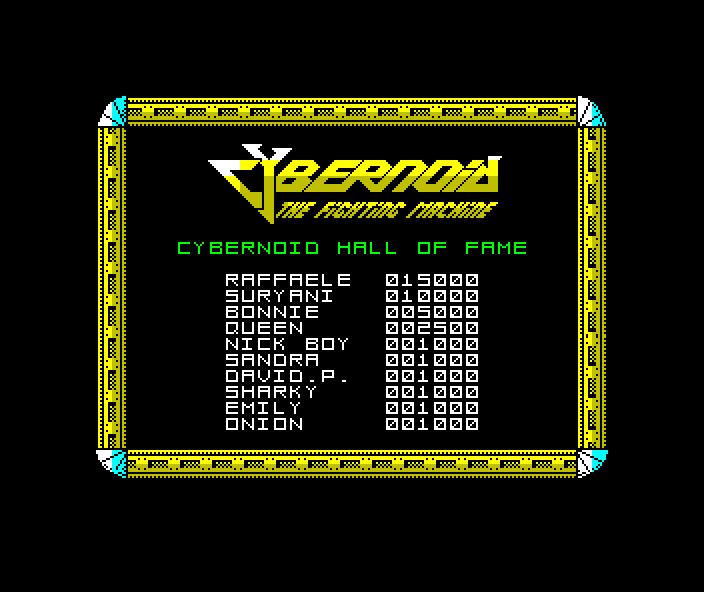
Cybernoid: The Fighting Machine is the title that confirmed Raf Cecco as one of the most important programmers of the late 1980s home computer scene. Released in 1988 for the C64, ZX Spectrum, and subsequently the Amiga, Atari ST, and Amstrad CPC, it is a shoot 'em up structured around armament management rather than pure reflex. The Cybernoid fighting machine carries multiple weapons simultaneously: a primary cannon, homing missiles, bombs, a deployable drone that attacks independently, and a deflector shield. Each engagement demands a choice of weapon rather than a single fire button held down.
Select Your Weapon or Die Confused
Cecco's design philosophy in Cybernoid is that every enemy has a correct response. Certain targets are behind cover that the primary cannon cannot reach but that bombs travel under. Others approach at speeds that require the homing missile rather than aimed fire. The drone handles threats while the player focuses on environmental navigation. The deflector shield absorbs fire for a limited time but must be redeployed.
Ammunition for each weapon is finite and must be replenished by collecting power-ups from destroyed enemies. Running out of homing missiles mid-screen against the enemy types that require them is a recoverable situation - but only if the player has the other weapons to fall back on and the spatial awareness to use them. Cybernoid does not reward button-mashing; it rewards understanding each weapon's arc, timing, and appropriate target.
Screen-by-Screen and Brutally Fair
The level structure is screen-by-screen rather than a continuously scrolling environment. Each screen presents a fixed configuration of enemies and obstacles, allowing the player to analyse the situation before acting. Enemies emerge in patterns that can be learned; death teaches rather than frustrates. The difficulty is high - Cybernoid demands multiple playthroughs before the full weapon system is understood - but the design is entirely fair. Every enemy placement is deliberate and every death has a cause.
Cybernoid is a masterpiece of shoot 'em up design. The multi-weapon system transforms what could have been a straightforward blaster into something with real tactical depth. Cecco has produced a game that demands understanding, not just reflexes.
CRASH magazine, 96% review, 1988
Jeroen Tel's SID at Full Volume
Cybernoid's C64 SID score by Jeroen Tel is the game's second major achievement. The title tune's driving melody is widely recognised as one of the finest pieces of SID composition from the era - aggressive, technically sophisticated, and rhythmically suited to the game's screen-by-screen tension structure. The in-game cue maintains momentum without distracting from weapon selection decisions.
Tel was seventeen years old when he composed Cybernoid. The title tune's reputation sustained itself long after the game's commercial run: it appears regularly in SID compilation albums, the High Voltage SID Collection, and has been recorded by live Commodore 64 orchestra ensembles. See the Music page for full context and the People page for Tel's profile.
96% and a Sequel That Pushed Harder
CRASH magazine's 96% review established Cybernoid as one of the most acclaimed ZX Spectrum titles of 1988. Zzap!64 was similarly enthusiastic about the C64 version. The Amiga release added graphical detail while retaining the mechanics. See Reviews for period scores and quotes.
Cybernoid II: The Revenge followed in 1988 with the same weapon system, more complex screens, and a new Jeroen Tel score. The sequel was received as well as the original, though some reviewers considered the original's enemy design more inventive. Both titles defined the Hewson late-period catalogue. See the Catalogue for Cybernoid II's entry.
Exolon (1987)
Developer: Raf Cecco - Music: Steve Jones / Martin Walker - Platforms: C64, ZX Spectrum, Amiga, Atari ST, Amstrad CPC - see full entry in Catalogue
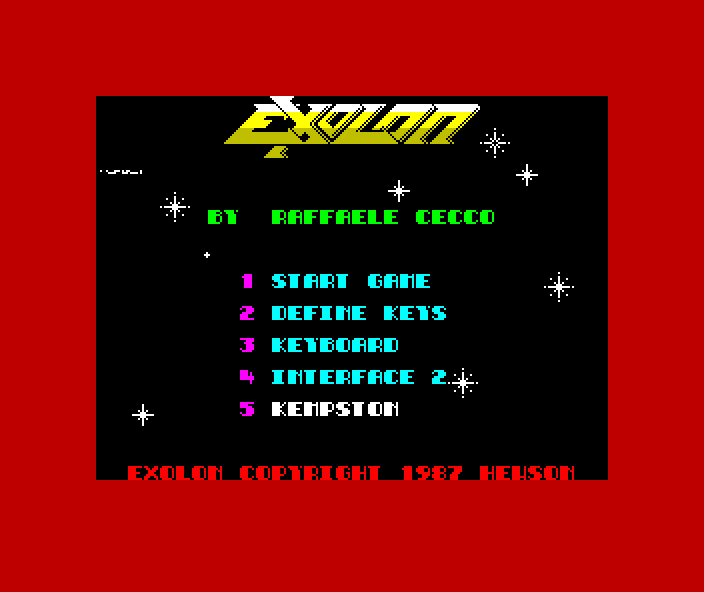
Cecco's First Gun, and He Knew What He Was Doing
Exolon is Raf Cecco's debut title for Hewson and the game that established his reputation before Cybernoid confirmed it. Released in 1987, it is a run-and-gun in which Vitorc, a soldier in a powered exoskeleton, must traverse alien terrain and destroy enemy installations. Cecco was twenty-one when he designed and programmed Exolon. The game is precise, mechanically coherent, and demanding in exactly the way that Cybernoid would later be - the same designer, the same philosophy, the first public statement.
Gun, Grenades, and When to Lose the Suit
Vitorc's primary weapon is a gun for targeting moving enemies; he also carries grenades for destroying fixed installations, bunkers, and barriers that cannot be shot down. Certain enemies and installations require specific weapons: attempting to clear a bunker with the gun wastes ammunition and time. The player must read each screen and select the correct tool before advancing.
The exoskeleton adds a third mechanic: in tight spaces, the suit's bulk becomes a liability. Vitorc can shed the exoskeleton to move more freely through narrow passages, but loses the weapon systems and durability it provides. The suit can be retrieved; the decision of when to remove it and how far to move without it is a recurring tactical question throughout the game. This is the same design instinct that Cecco would apply to Cybernoid's multi-weapon system: tools have optimal uses and optimal moments, and identifying them is the game.
Exolon is a confident debut: smooth controls, intelligent level design, and a mechanic nobody else had implemented. The exoskeleton removal is not a gimmick - it changes how you think about every screen.
Your Sinclair, 1987 review
Five Platforms in One Year
The ZX Spectrum version is the strongest of the five releases. Cecco's understanding of the Spectrum's hardware meant the conversion matched the C64 version's precision rather than compromising it. The Amiga and Atari ST releases added visual detail. The Amstrad CPC conversion is functional but the weakest of the five; the C64 version has the SID audio advantage, while the Spectrum version offers the sharpest gameplay on its native hardware.
The Year Before Cybernoid
Exolon's reception positioned Cecco as Hewson's most significant in-house designer. Where Andrew Braybrook and John Phillips worked through Graftgold or independently, Cecco worked directly with Hewson. Exolon's success in 1987 led directly to Cybernoid in 1988, which confirmed what Exolon had suggested: that Cecco was designing games around a coherent philosophy of fair challenge, weapon systems with distinct roles, and mechanics that rewarded understanding over reflex.
Cecco remained the designer most associated with Hewson's identity in its final years. His profile and the full output of his work for the company are on the People page.