Deep editorial on four defining Gremlin titles - development stories, how they play,
and what they left behind. Cross-references to the catalogue,
people, and music player.
Lotus Esprit Turbo Challenge is the game that transformed Gremlin Graphics
from a prolific mid-tier publisher into a studio people talked about. Released in 1990 on the
Amiga and Atari ST, it is a pseudo-3D racing game built around a genuine Lotus Cars licence -
specifically the Lotus Esprit Turbo S2 - and its combination of smooth scrolling, competitive
split-screen two-player, and a Barry Leitch soundtrack made it a commercial and critical landmark.
It sold well at launch and still shows up on every credible list of the finest Amiga games ever made.
Lotus Esprit Turbo Challenge (1990) - box art showing the iconic deep-green Lotus Esprit at speed.
Built by Magnetic Fields on a Sheffield Contract
Lotus was developed not inside Gremlin's own studio but by
Magnetic Fields, a small development house led by Shaun Southern
and Andrew Morris who had previously created the well-regarded Supercars series for Gremlin.
Gremlin handled the Lotus Cars licensing deal and the commercial side; Magnetic Fields wrote the code.
The result of that partnership was efficient: Magnetic Fields understood the brief from the start,
had already developed a fast pseudo-3D road engine for Supercars, and could evolve it to match
the prestige of the new licence.
The Lotus Esprit was chosen partly for its recognisability and partly because the marque had
a strong aspirational cachet in Britain during the late 1980s. Licensing a real car for a budget
home computer game was unusual in 1990 - it raised the game's profile and set expectations that
Magnetic Fields then had to meet with the technology.
Music was commissioned from Barry Leitch at
Imagitec Design, the Sheffield audio contractor that Gremlin used for several of its most
important titles. Leitch composed the soundtrack in parallel with the game's development;
the title theme was finished early, and its driving pulse became the target the rest of
the game's atmosphere had to match. Listen in the Music section.
"The Lotus trilogy was the project that really established what Imagitec Design could do for a publisher.
Gremlin gave us the brief and the licence details, and I had to work out what the racing was going to
feel like musically - something faster and more urgent than the 8-bit work. The Paula chip was liberating
in terms of sample quality. The four-channel limit meant you still had to be disciplined, but the warmth
you could get from real samples was something the SID chip simply could not do."
Barry Leitch, Remix64 interview (Imagitec Design and the Lotus trilogy)
Lotus Esprit Turbo Challenge (Amiga, 1990) - the Portugal opening circuit. The Amiga OCS scrolled this at speed with no hardware sprites trick.
Thirty-Two Courses and a Fuel Gauge
The game's structure is a traditional circuit championship: three difficulty tiers (Easy, Medium, Hard),
each with a different track roster drawn from international locations. Portugal, Norway, Kenya, Malaysia -
the setting changes visually with each stage: colour palettes shift from sun-bleached
asphalt to night tarmac to dusty red-earth roads. The courses get progressively harder,
introducing rocks, oil slicks, and water hazards on the road surface as the championship progresses.
The Lotus Esprit is the only car available, but the racing system rewards technique.
Fuel consumption is managed in real time - the game requires pit stops on longer courses,
and the decision of when to pull in is a genuine tactical element. Run the fuel gauge into
the red and the car dies on the track. Collisions slow the player significantly; the handling is
tight enough that late-braking into a corner to pass a slower car feels genuinely satisfying.
Two-player split-screen is the game's social centrepiece. The Amiga's screen is divided
horizontally, each player getting their own viewport at full racing speed. Head-to-head on
the same course, both players see their opponent's racing line in real time. This is where
Lotus Esprit Turbo Challenge earns most of its longevity. See the full entry in the
catalogue for platform and play details.
Two Viewports, One Chip, No Excuses
Maintaining smooth, fast pseudo-3D racing across two simultaneous viewports on the OCS Amiga
was a significant technical accomplishment in 1990. Magnetic Fields achieved this without
hardware sprites for the background scrolling; the road rendering used bitplane manipulation
to produce the receding tarmac effect, and the colour copper list was carefully managed to
produce the gradient sky and varied roadside colour without eating frame time.
The PAL version runs at a native 50fps update rate for the road layer, giving the sense of
speed that reviewers consistently praised. An NTSC mode (documented in community patches)
runs approximately 15-20 per cent faster, and the difference is immediately perceptible.
The AI opponents - twenty cars in total - are simple in their movement patterns but numerous
enough to produce the sensation of a packed field, particularly in the early laps.
A night-stage course in Lotus Esprit Turbo Challenge (Amiga, 1990). The colour palette shift from day to night stages was a visual highlight of the game's track variety.
High Eights Across the Board
Lotus Esprit Turbo Challenge received strong but not exceptional review scores at launch.
CU Amiga gave it 87%, Amiga Action 88%,
Amiga Format 89%, with AUI and Amiga Joker both at 86%.
The aggregate sat around 88 per cent - impressive, but a step below the 90-plus scores
that would mark Gremlin's very best releases in the years that followed.
The most consistent criticism in reviews was the absence of a full-screen single-player mode.
Reviewers who valued the two-player mode - which was genuinely excellent - found the lower
scores difficult to justify. Community retrospectives have since re-evaluated the game more
generously: Lemon Amiga's aggregate sits above 8.4, and the game placed 45th in Amiga Format's
all-time top 100 reader poll. The Amigos podcast devoted a full episode to arguing that
the game deserved nearer 97 per cent, and the discussion section in the
reviews page covers period scores in detail.
Three Sequels and a Franchise
Lotus Esprit Turbo Challenge directly spawned two sequels: Lotus Turbo Challenge 2
(1991) added weather effects (rain, snow, night tunnels), a full-screen single-player option,
and an expanded track roster, becoming the most celebrated entry in the trilogy.
Lotus III: The Ultimate Challenge (1992) extended the formula to SNES and Mega Drive
and introduced on-road and off-road course variety.
All three games feature Barry Leitch soundtracks
and all three remain playable via Internet Archive. The complete trilogy is documented in the
catalogue with platform notes and play links. The music across
all three games is collected and annotated in the Music section.
Lotus Esprit Turbo Challenge (Amiga, 1990) - full longplay. Barry Leitch soundtrack via Imagitec Design.
Amigos: Everything Amiga (Episode 520) - full retrospective discussion of Lotus Esprit Turbo Challenge, covering gameplay, music, and its place in the Amiga racing canon.
Zool: Ninja of the Nth Dimension
Amiga / Amiga 1200 / SNES / Mega Drive / C64 / DOS / Game Boy - 1992 - Gremlin Graphics
Zool: Ninja of the Nth Dimension arrived in 1992 as Gremlin's most
commercially ambitious game to date and one of the highest-reviewed platform games ever
released on the Amiga. Amiga Computing awarded 97%, Amiga Action
96%, and Amiga Format 95% - scores that placed Zool
among the handful of Amiga games that occupy the very top tier of the format's library.
It was Gremlin's mascot play, their answer to Sonic the Hedgehog, and it worked.
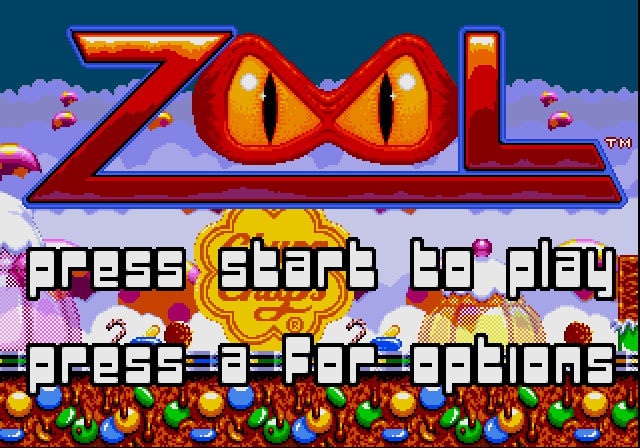
Zool: Ninja of the Nth Dimension (1992) - cover art for the Gremlin US release via Electronic Arts. The character design was built to compete with Sonic on the console platforms.
Gremlin's Answer to Sonic
By 1991, the SNES and Mega Drive had fundamentally changed the British games market.
Sonic the Hedgehog had demonstrated that a mascot character with a distinctive movement
identity could sell a platform in quantity. Gremlin's leadership recognised the threat to
the Amiga's position and authorised an internal development to create a platform character
that could hold its own against the console competition.
The resulting game was developed internally at Gremlin under lead programmer
Steve Crow, with the character design and world-building
shaped by the team's understanding of what made the Amiga's capabilities distinctive.
Rather than trying to produce a Sonic clone, Crow built a game that was faster and denser
than anything then available on 16-bit home computers - a game that argued the AGA-equipped
Amiga 1200 could outperform the SNES and Mega Drive on their own terms.
The Chupa Chups arrangement came from Gremlin's commercial team rather than the
development side. The Spanish sweet brand paid for prominent placement of their logo
and products throughout several levels of the game - making Zool one of the earliest
British games to carry in-game advertising at a meaningful level of integration.
The arrangement funded part of the game's development and gave both parties a marketing
story that generated significant press attention at launch.
"We knew that Zool had to be fast - faster than anything on the Amiga at the time.
The SNES and Mega Drive context was everything we were thinking about. We wanted to show
that the Amiga could still compete, that the platform had not run out of road.
Zool was built to make that argument as loudly as possible."
Ian Stewart (Gremlin co-founder), Bitmap Books "A Gremlin in the Works" (Mark Hardisty, 2022)
Fast Enough to Make Your Eyes Water
Zool is immediately identifiable as a speed game. The character moves at a pace that
requires anticipation rather than reaction - you need to read the screen two or three
seconds ahead of your position at all times, because Zool does not slow down for
obstacles. The first world is candy-themed and introduces the movement vocabulary:
diagonal attacks, wall-climbing, and a projectile weapon that can be upgraded
by collecting power-ups throughout each level.
The game's seven themed worlds span candy, music, toys, and sport, each with
its own enemy design and background aesthetic. The variety is one of Zool's
genuine achievements: each world feels genuinely different, not just recoloured.
The toy world in particular - with clockwork enemies and a platform structure
that uses the vertical space aggressively - is among the better-designed
Amiga platform levels of the era. Music by Matt Furniss
shifts register between worlds; listen in the Music section.
Zool in the candy-themed first world (Amiga, 1992). The enemy design and background density are immediately apparent at full game speed.
The AGA Chipset Running Flat Out
The Amiga 1200 version of Zool, released alongside the standard OCS build,
used the new AGA chipset's extended colour palette to produce a game that looked
visually superior to anything available on the SNES or Mega Drive at the time.
Where the OCS version used a 32-colour palette with careful dithering, the AGA
version pushed 256 colours onto the screen simultaneously, giving backgrounds and
sprites a depth of colour that the console competitors could not match.
The AGA build also made use of the enhanced blitter and chip RAM to maintain
the game's speed at higher colour depths - a non-trivial achievement given that
more colours typically meant slower rendering on the Amiga hardware. Steve Crow's
code was tight enough that the AGA build did not noticeably slow compared to
the OCS version. This made the Amiga 1200 release the definitive version of the
game and contributed significantly to the platform's launch momentum.
Zool (Amiga) - the game's speed and visual density on screen simultaneously. The AGA 1200 version rendered this at 256 colours.
Ninety-Six Per Cent and Change
The review consensus at launch was one of the most uniform in Amiga publishing history.
Amiga Computing gave it 97%, citing its speed and visual quality.
Amiga Action followed with 96%, Amiga Format with 95%.
The scores were consistent enough to make Zool effectively unchallengeable as the
finest platform game available on the Amiga at the time.
The SNES and Mega Drive ports were reviewed more cautiously - the console versions
did not match the AGA Amiga's visual quality, and the Mega Drive version in particular
was considered a competent but uninspiring adaptation. Period reviews for all versions
are collected in the reviews section.
Two Games and a Three-Decade Comeback
Zool 2 followed in 1993, this time with a two-player cooperative mode and
an expanded arsenal. It received slightly lower scores than the original - Amiga Format
gave it 87% - but remained a strong title. Both games are available on the
Evercade Gremlin Collection 1, Blaze Entertainment's official compilation cartridge.
In 2021, Zool received an official remake: Zool Redimensioned was
developed by Sumo Digital and published by Secret Mode, with Steve Crow involved
in an advisory capacity. The remake updated the graphics and controls for modern
platforms while retaining the speed and level structure of the original.
See the full catalogue entry at catalogue.
Zool: Ninja of the Nth Dimension - Amiga 1200 longplay. The AGA version at its best-quality release.
Switchblade
Amiga / Atari ST / DOS / C64 / Atari Lynx - 1989 - Gremlin Graphics
Switchblade (1989) is the game that demonstrated Gremlin Graphics could
build a world as well as a game. Where most Amiga titles of 1989 were mechanically
competent but visually conservative - still essentially 8-bit games that happened to run
on new hardware - Switchblade committed to a coherent atmospheric identity that set it
apart from its contemporaries. The result is a cyberpunk action platformer that feels
genuinely inhabited, a quality rare enough in 1989 to mark the game as something distinct.
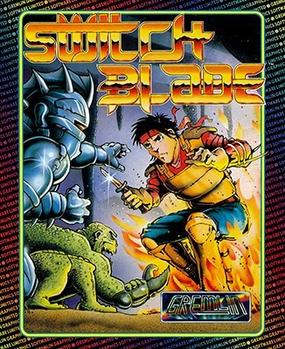
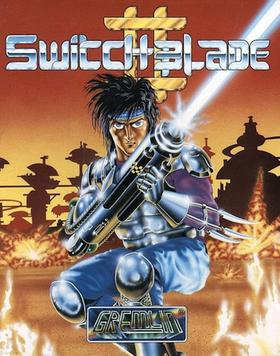
Switchblade (1989) - Amiga cover art. The cyberpunk aesthetic was established in the marketing as firmly as in the game itself.
A World Built Underground in 1989
Switchblade was developed for Gremlin and published in 1989, arriving at a moment when
the 16-bit transition was accelerating and publishers were learning what the new hardware
could do. The game's setting - a subterranean city beneath a post-apocalyptic surface world -
was deliberately far from the contemporary British game design defaults of football,
puzzles, and scrolling shoot-em-ups. The brief from Gremlin was for something dark,
action-focused, and atmospheric.
Music was provided by Matt Furniss,
whose Switchblade compositions represent some of his earliest significant work for
Gremlin. Furniss matched the game's cyberpunk register precisely: bass-heavy, driving,
with melodic lines that suggested threat rather than resolution. Listen in the
Music section.
"Switchblade was early in my time with Gremlin, and the brief was very clear about
the atmosphere - underground, threatening, but with energy. I started with the bass and
built the tracks around that subterranean feel. The Amiga gave you room to create
something genuinely cinematic compared to what I had been doing on 8-bit hardware.
You could use samples with real weight, real bottom end. That mattered for the kind
of music Switchblade needed."
Matt Furniss, Arcade Attack video interview (Matt Furniss - Sheffield, Gremlin, and the SID chip)
Collecting Sixteen Fragments
The game casts the player as Hiro, a mercenary tasked with recovering sixteen fragments
of the Fireblade - a legendary weapon scattered across a vast underground city.
The structure is non-linear for its time: rather than progressing through fixed levels,
the player moves through interconnected zones of the underground city, finding and
collecting the Fireblade fragments in whatever order the map allows. Some zones are
locked until enough fragments are held.
Combat is direct and punishing - Hiro has a kick and a punch attack, and enemies respond
with their own attack patterns. Health management is important; the game does not
offer infinite lives, and returning to earlier zones to find missed pickups becomes
increasingly necessary as the difficulty climbs. The density of enemy design -
droids, robots, mutants - gives the underground city a populated, threatening quality.
The Atari Lynx port of Switchblade was notable as one of the first games available on
that handheld at its launch. See the full platform and play options in the
catalogue entry.
Atmosphere as Technical Ambition
Switchblade's technical achievement is not in any single rendering trick but in the
management of scale. The underground city is large - genuinely large for a 1989
home computer game - with distinct zones that each carry their own visual identity
while remaining consistent with the overall aesthetic. Scrolling is smooth in both
directions on the Amiga build. Enemy variety is high, requiring different approaches
to each encounter type.
The colour palette is constrained by the 16-bit hardware limits but used carefully:
dark backgrounds, bright enemy sprites, consistent lighting that reinforces the
underground setting. The result is a game that looks designed rather than assembled,
which was not the default state of British platform games in 1989.
Noticed at the Time, Better Appreciated Later
Switchblade received favourable reviews at launch - CU Amiga praised the atmosphere
and the scale of the game world, noting that it compared well with the more linear
action games that made up most of the competition. Amiga Power's retrospective coverage
placed it among the genre's notable titles of the 16-bit transition period.
The consensus was that Switchblade was a strong but not exceptional game - better
than its production budget might suggest, with a coherent vision that most titles at
the budget price point did not achieve. Period review scores are available in the
reviews section.
The Sequel That Outscored the Original
Switchblade II (1991) arrived two years after the original and improved
on it in almost every measurable respect. The game world was expanded, the combat was
refined, the enemy design was more varied, and the visual quality of the Amiga version
was significantly higher. Amiga Power gave Switchblade II an exceptional score, placing
it among the finest action games of its year.
The original Switchblade's value is partly as the proof of concept: it established that
Gremlin could build a coherent game world, and Switchblade II demonstrated what they
could do when they had more time and a clearer sense of the hardware's capabilities.
Both games are in the catalogue.
Switchblade II (1991) - the sequel expanded the game world and improved the combat system to earn some of Gremlin's highest Amiga review scores.
Trailblazer (1986) is the game that announced Gremlin Graphics as a studio
worth taking seriously. Released in the middle of the 8-bit era, it introduced a genuinely
original gameplay concept - tube-racing - that had no clear precedent on home computers
and created a genre template that other publishers would spend years trying to replicate.
The core mechanic is so clean, and the implementation on the Commodore 64 so effective,
that the game still feels fast and demanding in emulation forty years later.
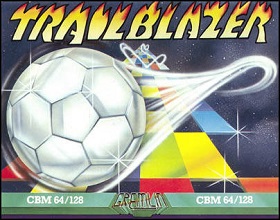
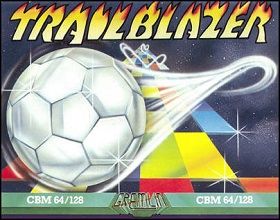
Trailblazer (1986) - cover art for the C64 original. The tube-racing concept was unprecedented on home computers at the time of release.
Invented a Genre Before the Genre Had a Name
Gremlin developed Trailblazer internally in Sheffield in 1985, publishing it in 1986.
The design brief was deceptively simple: a ball rolls along a tube, the player steers it,
the tube rotates to challenge the player's spatial orientation. There were no obvious
antecedents in the British home computer market - the closest comparison would have been
Atari's coin-op Marble Madness, but Trailblazer predates the home computer ports of that
game and was built independently. Gremlin created this one from the ground up.
The game was developed with the Commodore 64 as the primary platform, and the C64 version
remains the definitive release. It was then ported to the ZX Spectrum, Amstrad CPC,
and later the Amiga and Atari ST as those platforms became commercially significant.
The 16-bit ports are technically accomplished but lack the focus and personality of the
original C64 build, partly because the SID soundtrack is integral to the experience
in ways that other hardware could not fully reproduce.
The Ball, the Tube, and the Panic
The gameplay loop is brutal in its simplicity. The ball is always moving; the tube is
always rotating; the player steers left and right to stay on the panels. At low speed the
game is manageable. As the tube speeds up - and it speeds up quickly - the rotation
creates a spatial disorientation effect that is genuinely difficult to compensate for.
Experienced players develop a sense of the tube's rhythm and use the panel colour changes
as landmarks, but the first ten sessions with the game are almost universally frustrating.
The C64 version runs at a smooth pace that belies the hardware's age. The tube rotation
was achieved through a combination of pre-calculated graphics and careful sprite management
that made the tube appear to wrap around the ball rather than tile beneath it.
The sense of speed in the later stages - when the tube is rotating fast and the
panel sequence is punishing - is remarkable for a 1986 C64 game.
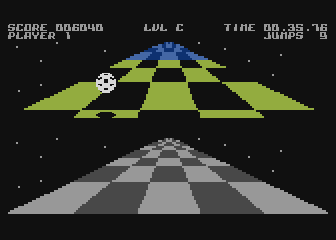
Trailblazer (C64, 1986) - the tube surface at speed. The coloured panels demand memorisation and spatial anticipation at full game pace.
Speed on Eight Bits, No Compromise
The technical achievement of Trailblazer on the C64 is the smoothness of the tube
rotation at the speed the game demanded. The C64's display hardware is well-suited
to horizontal scrolling but not to the kind of perspective-rotation effect Trailblazer
required. Gremlin's programmers achieved the rotation through a series of pre-rendered
frames rather than real-time calculation, a technique that kept the animation smooth
without overwhelming the 6510 processor.
The SID chip soundtrack by Ben Daglish is perfectly
suited to the game's demands. High-tempo, relentlessly forward-moving, and melodically
confident, it gives the tube-racing experience exactly the push it needs.
The Gremlin era of Daglish's work is among the most celebrated in C64 music, and
the Trailblazer soundtrack represents an early peak. Listen in the
Music section.
"Trailblazer was the kind of brief I found compelling - pure speed, no narrative,
just the game asking you to keep up. I needed to write something that made you feel
the tube spinning even when you were at the menu. The SID chip is very good at
that kind of relentless forward motion. The oscillator waveforms have a natural
intensity that you can push until the whole thing is driving forward. The faster
I pushed the tempo, the better it worked with what was on screen."
Ben Daglish, c64audio.com archived interview (Ben Daglish - Gremlin and the C64 years)
Top of the Charts in 1986
Trailblazer received strong reviews at launch. Zzap!64 awarded the C64 version its
Gold Medal, an honour reserved for the highest-quality releases
in the magazine's judgement. Crash magazine covered the ZX Spectrum version favourably,
noting the game's originality and the smoothness of the tube effect on the Spectrum
hardware (a platform not known for this kind of rotation technique).
The game sold well enough to become one of Gremlin's most commercially significant
early titles and was later republished as a budget release. It was included in the
Mastertronic catalogue at a lower price point, extending its reach significantly.
Period reviews for all platforms are in the reviews section.
The Race Game Nobody Could Quite Copy
Trailblazer's influence on the tube-racing genre it created is more visible in the
games it inspired than in any direct sequels. A number of C64 and Amiga titles in
the late 1980s used tube or pipe-racing mechanics that owed an obvious debt to
Gremlin's 1986 design. The concept also fed into later 3D racing games that used
rolling-surface mechanics.
Gremlin did not produce a direct Trailblazer sequel, though the studio's later
racing work - particularly the Lotus trilogy - carried the same emphasis on speed
and clean game feel that distinguished the original. Trailblazer's place in the
Gremlin catalogue is as the title that proved the studio could create genuinely
original gameplay concepts, not merely competent executions of existing genres.
See the full entry in the catalogue.
Trailblazer (1986) - the game launched at a time when tube-racing as a genre did not exist. It both defined and dominated the form.