Origins - Designing for Mode 7
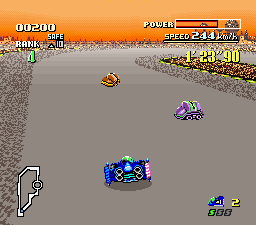
The F-Zero project began alongside the Super Nintendo hardware specification. Nintendo EAD's brief was to create a game that would demonstrate Mode 7 - the SNES's signature graphics mode capable of rotating and scaling a flat texture plane - in the most dramatic way possible.
Producer Shigeru Miyamoto and the EAD team considered several genres before settling on racing. A flat track viewed from a high angle maps perfectly onto Mode 7's tile-rotation system: every corner, bend, and chicane could be rendered by rotating a single background plane, without the polygon counts or sprite multiplication that would have been required for a 3D approach. The racing format also benefited from the smoothness of Mode 7's 60-frames-per-second operation - speed was the point, and the hardware could deliver it.
The futuristic setting - the year 2560, anti-gravity machines, an interplanetary Grand Prix - was chosen to justify the abstract, stripped-down track environments that Mode 7 produced. There were no three-dimensional buildings, no trackside trees, no grandstands full of spectators. The tracks floated in space, above cities, over oceans. The absence of scenery was reframed as a design choice: this was the distant future, where racing circuits were engineered platforms rather than adapted roads.
SNES Launch - Japan
F-Zero launched the Super Famicom in Japan on 21 November 1990, alongside Super Mario World. Two games, two genres, one message: the SNES was unlike anything that had come before. Where Mario World provided the familiar comfort of a platformer fans understood, F-Zero provided the shock of the new - the sensation of speed at 60 frames per second that no home console had previously achieved.
The game's four playable machines - Blue Falcon, Fire Stingray, Wild Goose, Golden Fox - each had distinct handling profiles, and the four pilots attached to them received brief character sketches in the manual: Captain Falcon the champion bounty hunter, Samurai Goroh the space bandit, Pico the alien assassin, and Dr. Stewart the surgeon racing in honour of his late father. None of these characters appeared on screen or spoke during gameplay. Their stories existed entirely in the manual.
“We wanted to show what the Super Famicom hardware could do in the most dramatic way possible. Racing at that speed, on that kind of track - Mode 7 made it look like genuine 3D. People genuinely did not believe it was 2D.”
- Nintendo EAD development team, on designing F-Zero for the SNES launch
North American Release
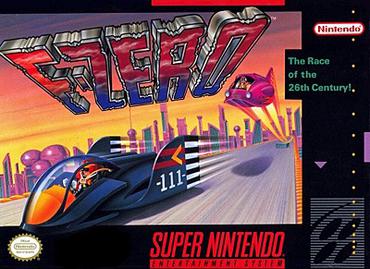
F-Zero arrived in North America in August 1991 as a launch title for the Super Nintendo Entertainment System. American players encountered the same speed and Mode 7 technology that had impressed Japanese audiences, with localised packaging and a new subtitle dropped: the game was simply F-Zero in both markets.
The North American critical reception was enthusiastic. Nintendo Power gave it significant coverage as a showcase for SNES capabilities. The racing press highlighted the smoothness of the Mode 7 perspective and the challenging difficulty of the Knight, Queen, King, and Master class rankings. F-Zero became one of the defining titles of the SNES's first year in North America.
Mode 7 - How It Works
Mode 7 Explained
Mode 7 is one of seven background modes available on the SNES graphics chip (PPU). In Mode 7, the SNES can rotate, scale, and translate a single 128×128-tile background layer in real time. The result is a flat plane that can be viewed from any angle and at any scale - simulating a three-dimensional perspective from a top-down source image.
For F-Zero, the track is stored as a single large texture. Every frame, the SNES PPU recalculates the transformation matrix for that texture based on the player's position and direction. The result is the smooth, curved-horizon perspective that players experienced as genuine 3D. In reality, the track is always flat - Mode 7 creates the illusion of curvature through mathematical projection, not geometry.
The F-machines (the player's vehicle and the AI opponents) are sprites layered on top of the Mode 7 background. Because they are 2D sprites, they do not have genuine 3D depth - but at the speed F-Zero operates, this is imperceptible. The CPU load required to compute the Mode 7 transformation 60 times per second, while tracking AI opponents and managing game logic, consumed the entire SNES processor. This is why F-Zero has no multiplayer mode.
“Mode 7 creates a flat texture plane that rotates and scales. The track is always flat. The curvature you see is mathematical projection. But at 60 frames per second, at those speeds, no one notices. It feels three-dimensional.”
- Contemporary explanation of Mode 7 technique, 1990
F-Zero X - Nintendo 64
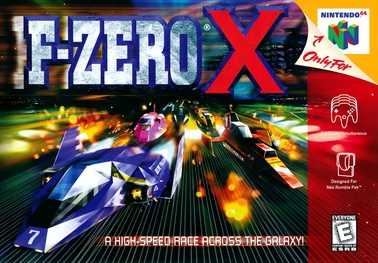
Eight years after the original, F-Zero returned on Nintendo 64 in a form that would have seemed impossible on the SNES: genuine three-dimensional geometry. Tracks looped, twisted, barrel-rolled, and ran upside-down. Thirty machines raced simultaneously. The game ran at 60 frames per second.
The technical achievement required a significant sacrifice: F-Zero X stripped all trackside scenery from its circuits. Every polygon in the game's rendering budget went to the track surfaces and the 30 machines racing on them. The result was a striking minimalism - pure speed, pure geometry, the racing line and nothing else. Critics noted that the absence of scenery paradoxically emphasised the sensation of speed rather than diminishing it.
F-Zero X expanded the roster from four pilots to 30, introduced the Death Race mode (eliminate all opponents instead of finishing first), and added a Practice mode for individual track time trials. The original four pilots - Captain Falcon, Samurai Goroh, Pico, and Dr. Stewart - returned alongside 26 new characters from across the galaxy.
“We chose 30 racers at 60fps as our target and then worked backwards from that to figure out what we had to cut. The answer was: everything except the track and the machines. No scenery. No decoration. Just racing.”
- F-Zero X development team, on the N64 hardware decisions
Maximum Velocity - Game Boy Advance
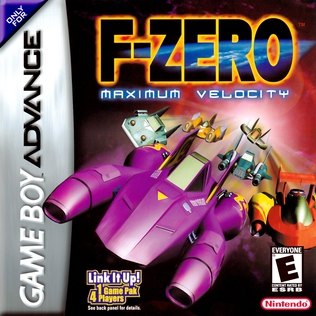
F-Zero: Maximum Velocity launched the Game Boy Advance in Japan and North America in 2001, continuing the series tradition of launching with new Nintendo hardware. Developed by NDcube rather than EAD, the GBA title used Mode 7-style rotation and scaling to recreate the feel of the original F-Zero on portable hardware, with 20 new tracks across five cups and a new roster of five machines.
The game was set 25 years after the original F-Zero Grand Prix, with none of the original four pilots returning. A new generation of racers competed for the championship. The Falcon MK-II machine - one of the five available - referenced Captain Falcon's Blue Falcon by name, suggesting continuity with the original series lore without requiring his presence.
F-Zero X - 30 Racers at 60fps
F-Zero X on Nintendo 64 - 30 machines, true 3D tracks, 60 frames per second, 1998