F-Zero
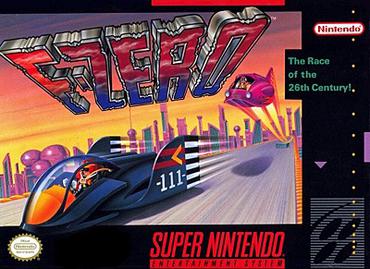
Released in Japan on 21 November 1990 alongside the Super Nintendo, F-Zero was not just a launch title - it was a demonstration. An argument, made at 60 frames per second, that the new console could produce something genuinely unlike anything seen before on a home console. Racing games existed. Futuristic settings existed. But nothing moved like this.
Set in the year 2560, F-Zero placed players in anti-gravity vehicles called F-machines competing in the F-Zero Grand Prix across five circuits. The genre it founded - futuristic racing with a strong sense of speed - had no real precedent in gaming before it. See the games catalogue for platform availability and technical details, and the racers page for all four original pilots.
Producer: Shigeru Miyamoto · Director: Tadashi Sugiyama · Music: Yumiko Kanki & Naoto Ishida
How F-Zero Was Built
Nintendo EAD received an unusual brief when development began: build a game that demonstrates Mode 7 in the most dramatic way possible. Mode 7 was a new graphics mode on the SNES hardware, capable of rotating and scaling a flat texture plane 60 times per second to simulate a three-dimensional perspective. The question was what kind of game would show it off best.
Racing was the answer, and for a technically elegant reason. A flat track viewed from above at a high angle maps perfectly onto Mode 7's tile-rotation system. Every corner, every chicane, every banked bend could be represented as a mathematical transformation of the tile plane - no sprite multiplication, no polygon counts, no mode switching required. The entire racing surface was one large texture being rotated and scaled in real time.
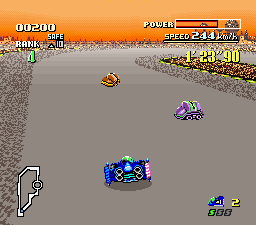
Director Tadashi Sugiyama and his team had no 3D design tools of any kind. The circuits were conceived on paper graph grids - literally squared paper where each grid square corresponded to a tile in the Mode 7 rotation plane. The 15 tracks you race today were drawn by hand before a single line of code was written. The team would sketch a circuit, translate it into tile coordinates, and then test it in the engine to check whether the mathematics produced the intended racing experience.
The futuristic setting, the four pilot characters, and the energy strip mechanic were all developed by the EAD team under Miyamoto's oversight. The fiction of the year 2560, the Grand Prix as an interplanetary sporting event drawing pilots from across the galaxy, and the specific lore of each racer - Captain Falcon as a bounty hunter, Samurai Goroh as his rival and sometime enemy - were created specifically to give the racing a human dimension beyond the tech showcase.
“Mode 7 allowed us to make a racing game that felt genuinely three-dimensional on hardware that was not three-dimensional at all. The track is flat. The perspective is a mathematical illusion. But at those speeds, on that hardware, players did not believe it was 2D. That was the achievement.”
- Nintendo EAD, on the Mode 7 illusion in F-Zero (1990 development notes)
Speed That Costs Something
F-Zero's gameplay is built on a single elegant design insight: speed should cost something. Every F-machine carries an energy meter that serves two functions simultaneously. It is the machine's health - run it to zero and the machine explodes, ending the race. And it is the fuel for the speed boost - press L or R during a race and the machine surges forward, but each burst drains the meter.
Energy strips on the track surface replenish the meter, but they are positioned precisely to force decisions. Boost now and collect the strip ahead, or conserve the meter for the critical corner approaching at speed? Run wide on a chicane and scrape the barriers - which drain energy continuously on contact, not in a single hit - or sacrifice position to maintain meter safety? At the Master difficulty class, these calculations are under constant pressure from AI opponents tuned to exploit vulnerability.
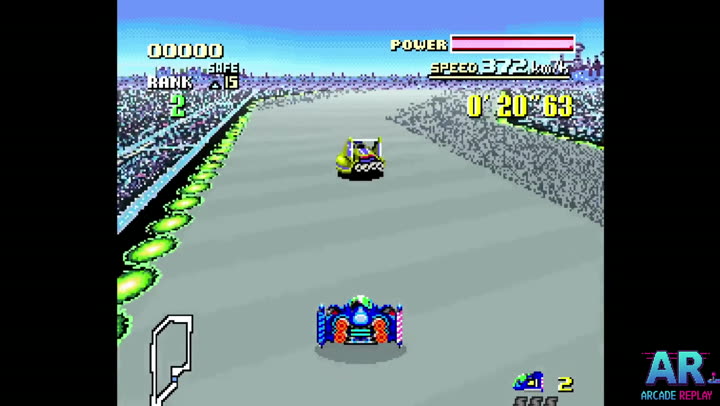
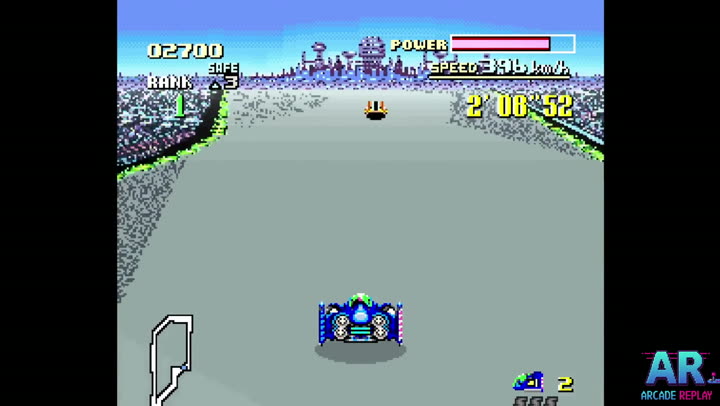
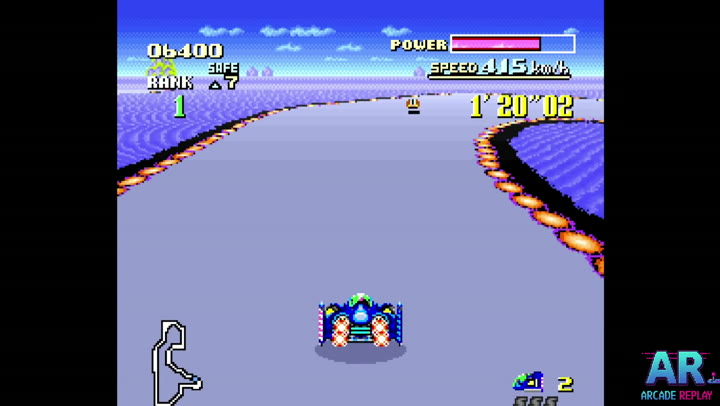
The four machines - Blue Falcon, Golden Fox, Wild Goose, Fire Stingray - each have distinct body, boost, and grip ratings that fundamentally change how the game plays. Blue Falcon (Captain Falcon's machine) offers the most balanced profile and suits all circuit types. Golden Fox is fastest but lightest - exceptional boost, poor grip, destroyed by wall contact. Wild Goose provides maximum body and grip for ramming opponents off the track. Fire Stingray hits hard and boosts well but corners poorly. These differences are not cosmetic: choosing the right machine for a circuit is a genuine strategic decision, especially on King and Master difficulty. See the racers page for full pilot profiles and machine ratings.
The 15 tracks are arranged across circuits including Mute City, Big Blue, Sand Ocean, Death Wind, Silence, Port Town, Red Canyon, White Land, Mutiple City, and Fire Field - each available across four difficulty classes: Knight, Queen, King, and Master. Master is unlocked only after completing the King class and presents significantly higher AI aggression with fewer energy strips on track.
Mode 7 - Inside the Hardware
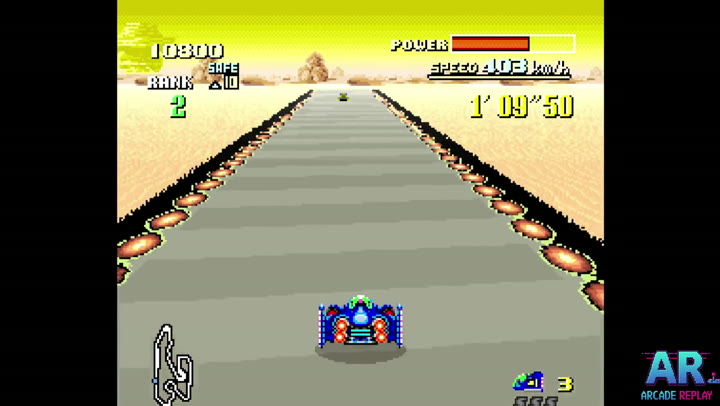
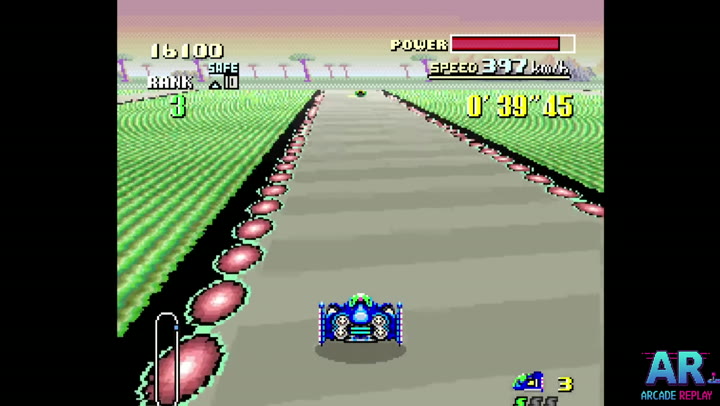
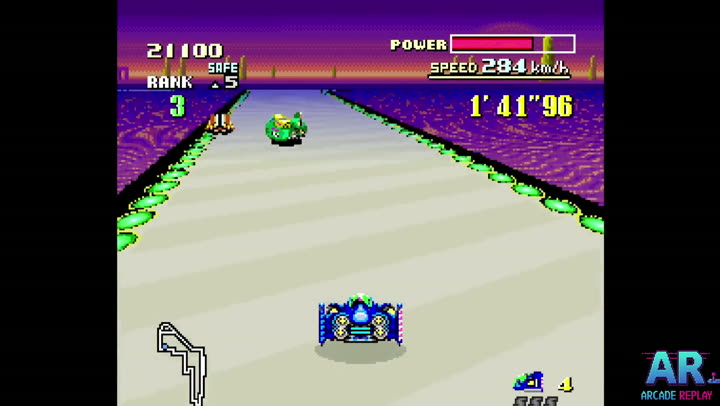
Mode 7 is one of seven background modes available on the SNES graphics processor (PPU2). In Mode 7, the hardware can rotate, scale, and translate a single 128x128-tile background layer in real time - 60 times per second. The result is a flat plane viewable from any angle and at any scale, creating the appearance of three-dimensional perspective from a two-dimensional source image.
How F-Zero Uses Mode 7
The track in F-Zero is stored as a single large texture map. Every frame, the SNES PPU computes a transformation matrix for that texture based on the player's current position, velocity, and direction. The matrix rotates and scales the texture plane to produce the racing perspective the player sees.
The F-machines are 2D sprites layered on top of the Mode 7 background. Because they are sprites rather than 3D geometry, they have no genuine depth - but at racing speed this is imperceptible. The CPU load required to compute the Mode 7 transformation 60 times per second, while tracking AI opponents and managing game logic, consumed the SNES processor entirely.
F-Zero SNES longplay - all five circuits, demonstrating Mode 7 in motion
Launch and Critical Response
F-Zero was universally praised at launch as a showcase for SNES hardware capabilities. Nintendo Power, which covered SNES launch titles extensively, highlighted Mode 7 as a breakthrough for home console gaming - and F-Zero as the clearest evidence of what the new hardware could do. The smoothness of the perspective scaling, the speed of the gameplay, and the visual clarity of the racing circuits were all cited as unprecedented for a console title.
Critics noted the absence of multiplayer, but the consensus was that the single-player experience fully justified the trade-off. The energy mechanic was recognised immediately as a significant design innovation - reviewers noted that no other racing game had treated speed as a spendable resource before. The Master difficulty class was praised as a genuine and demanding challenge that extended the game's life well beyond completion on easier settings.
Outside Japan, the SNES launched in North America in August 1991 with F-Zero as a prominent pack-in title in some markets. Electronic Gaming Monthly and GameFan both scored it among the highest of any launch-window titles. The game performed exceptionally well commercially and critically, establishing expectations for what SNES software could accomplish.
F-Zero’s lasting design contribution was the argument that speed itself could be a mechanic. Not speed as a backdrop to something else — speed as the entire experience, managed through the energy meter, expressed in every routing decision on every circuit.
What F-Zero Started
F-Zero created a genre. Before it, futuristic racing as a distinct category - with anti-gravity vehicles, sci-fi settings, and speed as the central mechanical tension - did not exist as a recognised form. After it, the genre had a template. Wipeout (1995) and its successors were explicitly designed in F-Zero's wake; their developers acknowledged the original as the defining reference point for the futuristic racing genre.
Captain Falcon's trajectory after F-Zero is one of gaming's stranger cultural stories. He was an anonymous pilot in 1990, notable mainly for having a balanced machine and a recognisable helmet. When Super Smash Bros. launched in 1999 and made him a fighter rather than a racer, his Falcon Punch became one of the most referenced moves in competitive gaming. Today, Captain Falcon is better known as a fighter than as a racing pilot - a fact the F-Zero community finds simultaneously gratifying and absurd. He appears in every Smash Bros. entry, but there has been no new F-Zero game since 2004.
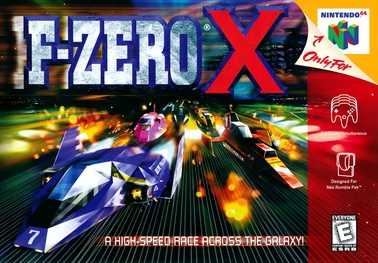
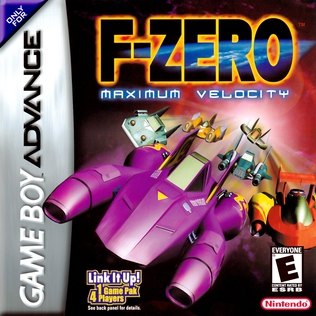
The franchise went dormant after F-Zero Climax (2004, Japan only). Neither F-Zero X nor F-Zero GX (2003, developed with Sega's Amusement Vision division) received sequels. Nintendo has periodically added Captain Falcon and Mute City to Smash Bros. DLC content, and the original F-Zero has been released on Virtual Console and Nintendo Switch Online - but a new racing title has not emerged in over two decades.