Flagship Titles
The Epyx Canon
Four games that defined a studio, a platform, and a decade: Impossible Mission, California Games, Summer Games, and Jumpman. Development stories, design analysis, and why they still matter.
Impossible Mission
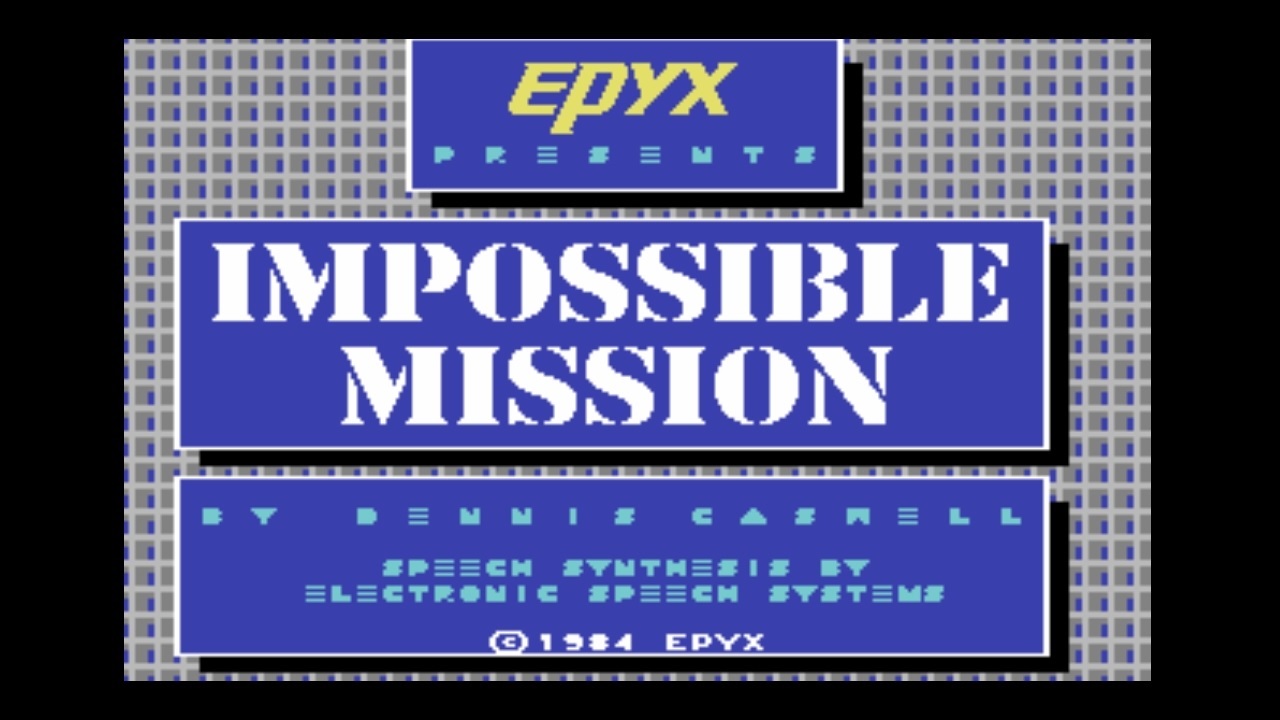
Programmed by Dennis Caswell. Speech by Electronic Speech Systems. Zzap!64 Gold Medal, 98%.
One Programmer, One Shock
In 1984, the Commodore 64 user community had seen fast games, good-looking games, and games with clever design. What it had not seen - what nobody had seen on a home computer - was a game that spoke to you in a human voice. Dennis Caswell changed that with Impossible Mission. The opening fanfare, the descent into the underground complex, and then that baritone: "Another visitor. Stay a while... stay forever!" Living rooms across the world went silent.
Impossible Mission is a platform-puzzle game in which the player infiltrates the underground complex of the evil Professor Elvin Atombender, searching rooms for puzzle pieces while avoiding his robots, and assembling those pieces into a password to stop him. The structure is more ambitious than any contemporary description makes it sound: there are 32 rooms across multiple towers, the puzzle piece placement is randomised every game, and a six-hour countdown runs from the moment play begins. In 1984, no other C64 game was doing anything close to this.
Animated Before He Knew Why
Dennis Caswell programmed Impossible Mission alone, working at Epyx in Sunnyvale in 1984. He designed the entire system - the sprite animation, the level structure, the puzzle mechanic, and the robot AI - as a single programmer. What came first was not the game concept but the animation: Caswell built the player character's movement system before the game design was fixed, and the famous somersault jump emerged from experimentation rather than planning.
"I animated the somersault before I had any clear idea how it would be used."
Dennis Caswell, programmer of Impossible Mission; quoted in Wikipedia: Impossible Mission (sourced from MobyGames developer interview)
The title itself was similarly unplanned. Caswell later noted that "Impossible Mission was more resorted to than chosen" - it was a working title that stuck. The speech integration came from Epyx's access to Electronic Speech Systems technology: the ESS chip could produce recognisable human voice from compressed audio data, and Caswell integrated it into the game's code. The voice actor was not someone Caswell ever met; he had imagined "a '50-ish English guy'" for the role. The actual recording was more theatrical than Caswell expected, but he found the over-acting "amusing and appropriate, and they were left as is."
Six Hours to Save the World, One Room at a Time
The game gives the player six hours of in-game time. The underground complex is divided into towers connected by elevators; each tower has multiple floors, each floor a self-contained room. To search furniture - wardrobes, cabinets, terminals - the player uses a pocket computer tool: move to the item, press the button, check for pieces. Robots patrol on fixed patterns, bouncing off walls and platforms. Contact with a robot costs ten minutes of game time. Traps - pits, conveyor belts, forcefields - kill or reset the player instantly.
Puzzle pieces collected from furniture are displayed as segments of a word grid. The final goal is to assemble those segments into a complete password and transmit it - but the pieces are randomised each game, and only certain combinations are valid. The puzzle mechanic forces players to actually engage with what they find rather than treating exploration as a mechanical checklist. It is, for 1984, a sophisticated design that rewards both speed and pattern recognition.
A Hundred and Forty Frames the Platform Had Never Seen
The technical core of Impossible Mission's reputation is its animation. The player character has over 140 frames covering running, jumping, somersaulting, searching, and dying. At a time when most C64 characters were represented by a handful of jerky sprites, Caswell's protagonist moved with a smoothness that players found genuinely startling. The animation system was built from the ground up to exploit the C64's sprite hardware efficiently - multiple sprites layered to create the illusion of a fully articulated figure.
The ESS speech synthesis integration was the second technical feat. Electronic Speech Systems had developed a chip and encoding method capable of producing human-quality voice from compressed audio data small enough to fit in a cartridge. Caswell's code triggered the speech at the appropriate moments - the opening taunt, robot alerts, the game-over announcement - integrating the ESS output with the game's audio system so the speech felt native rather than bolted-on. The result was the first time most C64 users had heard a computer speak in a recognisably human voice.
Beyond animation and speech, the game demonstrated level design sophistication: randomised piece placement for genuine replay value, interconnected tower navigation for non-linear exploration, and robot AI with distinct behaviour per robot type. Each of these elements was implemented by a single programmer in 1984.
Ninety-Eight Percent and No Argument
Zzap!64 awarded Impossible Mission a Gold Medal score of 98% - one of the highest scores in the magazine's history. Computer & Video Games named it Game of the Month and rated it 38 out of 40. Personal Computer Games gave it a perfect 10 out of 10. There was no critical dissent: every publication that reviewed Impossible Mission recognised it as exceptional. Compute!'s Gazette wrote in 1986 that Caswell was "one of those rare people who has all the skills necessary to create... an outstanding game."
Contemporary players agreed. The game sold strongly across its many ports and remained a fixture of best-of-platform discussions throughout the 1980s. For period reviews and full score listings, see the Reviews page.
The Voice That Defined a Platform
Impossible Mission was ported to virtually every home computer and console of the era: Amiga, Atari ST, DOS, ZX Spectrum, MSX, Apple II, and more. The C64 original with its ESS speech and sprite animation remains the definitive version - the one that made the first impression on the industry and on players. A sequel, Impossible Mission II, followed in 1988 - again programmed by Caswell. The game has been remade and re-released multiple times since, most notably in 2007, but none have fully recaptured the shock of the original.
The speedrun community maintains an active category for Impossible Mission on Speedrun.com, and the game appeared at Games Done Quick. The SID music and the ESS speech are preserved in the HVSC and available via the DeepSID player. Forty years on, "Another visitor. Stay a while... stay forever!" is the single most recognisable audio moment of the Commodore 64 era - and a reminder that one programmer, working alone in Sunnyvale in 1984, put it there.
California Games
Music by Chris Grigg. Epyx's best-selling title. Six sports, one summer. Zzap!64 97%.
Six Sports, One Summer, 300,000 Copies
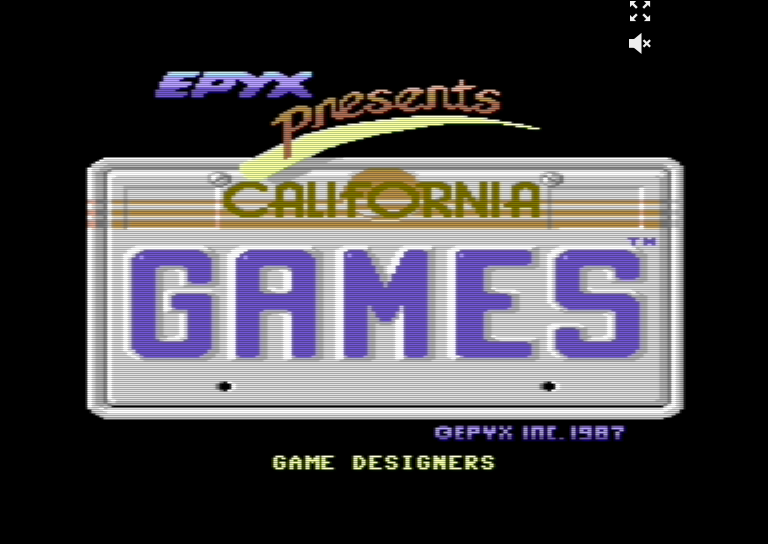
California Games arrived in 1987 at the peak of Epyx's commercial power, and it sold with a ferocity that no other Epyx title matched. Three hundred thousand copies in nine months. Six California-specific events - half-pipe skateboarding, footbag, BMX racing, surfing, roller skating, and flying disc - chosen not because they were Olympic sports but because they were California sports. The game captured something specific about a place and a moment, and buyers responded to it as if they recognised what they were seeing.
Where the Summer and Winter Games series borrowed the prestige of Olympic competition, California Games offered something more personal. These were the sports of beach towns and skate parks, of the 1980s West Coast counterculture - and Epyx, based in Sunnyvale, understood them well enough to render them with affection rather than parody. The game's enduring appeal comes from this authenticity: it is not a game about California in the abstract but California in 1987, specifically and joyfully.
The Composer Who Came From Negativland
California Games extended the format that Summer Games had established, applying it to a set of subjects that were geographically and culturally coherent rather than generically athletic. The development team designed six events with distinct visual identities: the neon and chrome of the half-pipe, the sun-bleached boardwalk of the surfing course, the cluttered suburban streets of the roller skating event. Each event required different control systems and different pacing. Building six coherent events with distinct mechanics, all in a single game, was a substantial design undertaking.
But the factor that most distinguishes California Games from its predecessors in the Games series is the music. Chris Grigg composed all six event themes for the SID chip - and every one of them is excellent. Grigg was also a member of the experimental audio collective Negativland, and his approach to the SID brought a sophistication to the arrangement that set his work apart from most contemporary C64 composition.
California Games was Epyx's first title that, in internal playtesting, appealed equally to male and female players - a fact CEO Dave Morse noted at the time. Compute! magazine called it "both inventive and charming" in its 1987 review, capturing a quality that the Games series had previously found harder to sustain across all six events.
"both inventive and charming"
Ervin Bobo, Compute! magazine, 1987, reviewing California Games for the C64
Half-Pipe to Surfboard to Flying Disc
Each of California Games' six events plays differently, and the variety is one of the game's principal strengths. The half-pipe event is the most demanding: the player builds speed through the pipe and launches off the top of the ramp, executing tricks in mid-air via joystick inputs. Timing is critical, and the scoring system rewards combination moves over single tricks. The surfing event requires reading incoming waves and positioning the surfer to ride them effectively - wipeouts are common, and the "Louie Louie" theme plays throughout with a relentlessness that quickly becomes inseparable from the experience. BMX puts the player on a course with obstacles to dodge and ramps to clear. The footbag event is a footwork rhythm challenge, roller skating involves navigating a course while avoiding other skaters, and flying disc is a throwing and catching simulation with a physics arc model.
Players could choose their event order freely and compete individually or against one another. The structural flexibility - six events, any order, competitive multiplayer available throughout - gave California Games a replay quality that its predecessors in the series hadn't fully achieved.
Six Themes, All of Them Correct
Chris Grigg's score for California Games is the game's most lasting technical achievement. The C64's SID chip was capable of producing complex music when composers understood its architecture - three oscillators, a noise channel, a filter, and a ring modulator, all programmable in real time. Grigg understood it thoroughly, and each of the six event themes demonstrates a different aspect of what the chip could produce.
The half-pipe theme is urgent and rhythmically driven, with a bass line that locks into the event's pacing and a lead melody that players can still hum forty years later. The surfing theme's arrangement of "Louie Louie" - transformed by Grigg's SID orchestration into something warm and propulsive - became one of the most recognised pieces of SID music ever written. The BMX theme carries a harder edge; the footbag theme has an almost jazz-influenced structure; the roller skating and flying disc themes are distinctly lighter. Together they create a coherent sonic world that reinforces the game's California identity at every turn. Listen to all six subtunes via the DeepSID player.
Three Hundred Thousand in Nine Months
California Games sold approximately 300,000 copies in its first nine months of release - a commercial performance that made it the best-selling game in Epyx's history. The game was distributed by US Gold in Europe, reaching the C64 market across the UK, Germany, France, and other European territories, and its Zzap!64 review score of 97% drove considerable sales momentum in the UK specifically.
The game was ported to virtually every platform of the era: Amiga, Atari ST, DOS, Apple II, Apple IIGS, Atari 2600, Atari 7800, NES, Sega Master System, Sega Mega Drive, and the Atari Lynx - where it was one of the launch titles for the hardware that Epyx itself had designed before selling the rights to Atari. For full score listings and period review text, see the Reviews page.
The Sound That Outlasted the Platform
California Games' legacy is inseparable from its music. The SID score is what players remember - the "Louie Louie" surfing theme especially, which achieved a recognition among C64 users that rivalled Impossible Mission's ESS speech as the platform's defining audio moment. Chris Grigg's work is preserved in the HVSC under his full composer credit, and the score is among the most played SID files in the collection.
California Games II followed in 1990, continuing the series with new events. The original remains the more celebrated title - the game that crystallised the Epyx formula at its most confident, connected it to a specific cultural moment, and gave one of the C64's greatest composers his most enduring platform.
Summer Games
The game that launched the Games series. Eight Olympic events. 400,000 C64 copies sold.
The Olympics at Home, Finally
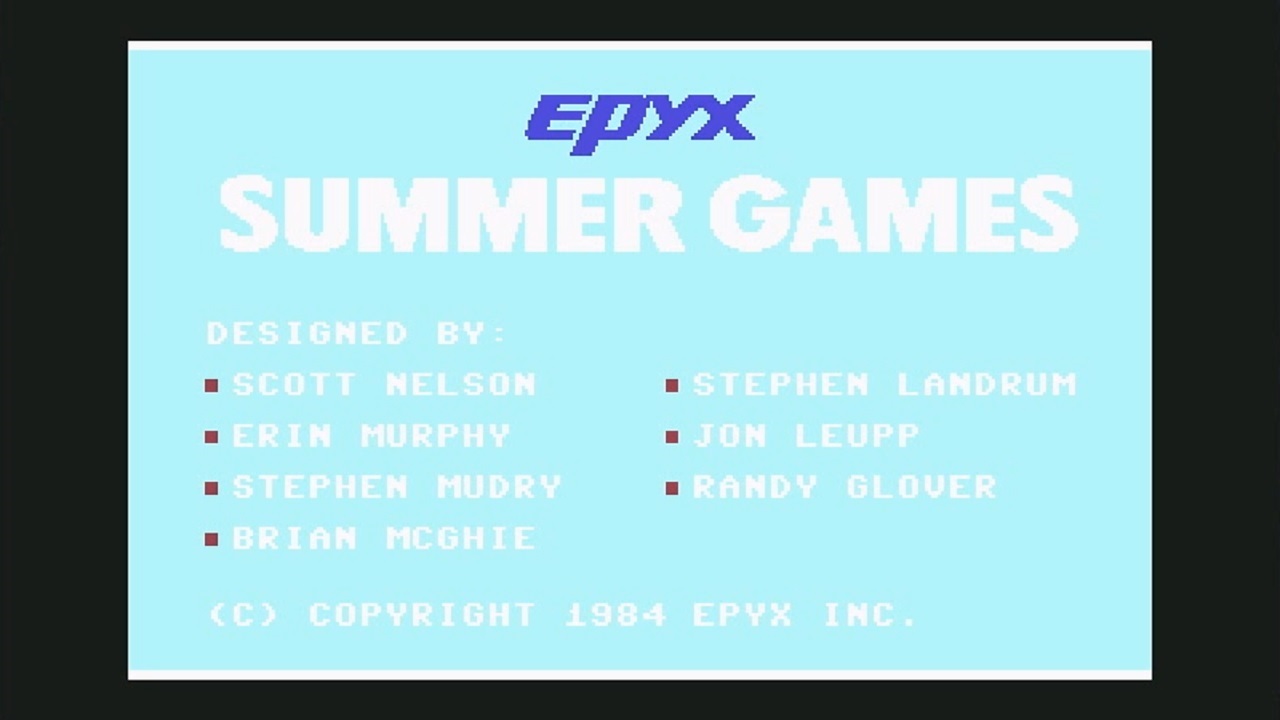
Summer Games (1984) was not the first multi-event sports compilation for home computers - Activision's Decathlon had established the format in 1983. But Summer Games was the one that understood something Decathlon had missed: production values matter. The opening ceremony, the national anthem playback, the podium sequence after each medal - these were not gameplay features, they were presentation choices, and they gave Summer Games a sense of occasion that transformed a collection of mini-games into something that felt, briefly, like the actual Olympics.
Eight events: the 100-metre dash, pole vault, high jump, rhythmic gymnastics, 4x400-metre relay, freestyle swimming, platform diving, and cycling. Each controlled differently, each demanding its own rhythm of inputs. Released in 1984 as the Los Angeles Olympics were dominating television coverage, Summer Games arrived at exactly the right cultural moment - and it sold accordingly.
Inspired by Decathlon, More Ambitious Than Decathlon
Epyx's decision to build a proper sports compilation was driven by the commercial success of Activision's Decathlon (1983). Epyx saw the market and planned something with greater ambition: more events, more variety in control systems, and - critically - a presentation that elevated the game beyond a simple collection of challenges. The opening ceremony was the key innovation: a flag-bearing parade of all competing nations, rendered with animation quality that was, for 1984, genuinely impressive. Players selected their national flag and carried it into a virtual Olympics that had its own internal logic of competition, nationality, and ceremony.
The development team built each event to be distinct in feel as well as mechanics. The diving and gymnastics events required memorising and executing specific button sequences. The relay and swimming events demanded sustained rhythmic input. The pole vault needed careful timing across multiple phases. By the end of the eight events, players had encountered a genuinely varied set of challenges - a structural achievement that most single-event sports games of the era couldn't claim.
Eight Events with Different Languages
Joystick waggling had a bad reputation even in 1984. Summer Games spread the physical demand across its eight events, with some requiring rapid movement, some precision timing, and some memorised button sequences. The result was a game variable in how it played rather than a single exhausting input mode repeated eight times.
The relay event demonstrated the design ambition most clearly: up to four players could compete simultaneously in a series of sprint heats, passing a baton between team members. The cooperative multiplayer element - players competing as a team rather than individually - was unusual for 1984. Up to six players could participate in Summer Games overall, with each player selecting events and competing for national standing across the full programme.
The Ceremony Was Worth the Asking Price
The opening ceremony is what separated Summer Games from its competitors in critical and commercial terms. The flag-bearing parade of nations, rendered in full C64 colour with individual national flags animated as banners, took several minutes to play through and was the first thing players showed anyone who hadn't seen the game. The national anthem playback system - which reproduced recognisable versions of the anthems of all competing nations for the medal ceremony - extended this sense of occasion through every event result. These were features with no gameplay function; they existed purely to make the experience feel meaningful in a way that a simple score display never could.
Ahoy! magazine described Summer Games as "tremendously successful," and the commercial response proved the assessment correct. The game sold over 400,000 copies on the C64 alone - numbers that, in 1984, rivalled the best-selling home console games in scale. Zzap!64's enthusiastic coverage drove strong UK chart performance throughout 1984. For period review text and scores, see the Reviews page.
"the most sustainedly popular in the long life of the Commodore 64"
Jimmy Maher, The Digital Antiquarian (filfre.net), describing the Epyx Games series that Summer Games launched
The Seed of a Five-Year Run
Summer Games' commercial success had one consequence that shaped the entire industry: it told Epyx, with numerical certainty, that the Games series format had a future. Summer Games II followed in 1985. Winter Games followed in 1985. World Games in 1986. California Games in 1987. Five years of annual releases, each commercially successful, each expanding the format. Without Summer Games' commercial performance, none of those subsequent titles would have been commissioned, and the entire Games series legacy - the California Games SID score, the Winter Games ice events that became genuine multiplayer classics, Epyx's defining period as a publisher - traces back to this single 1984 release.
The Internet Archive preserves the original disk image (IA: summer_games); the SID score is in the HVSC and playable via the DeepSID player.
Jumpman
Created by Randy Glover. 32 levels, zero filler. Published by Automated Simulations (later Epyx) in 1983.
Thirty-Two Levels, Zero Repeated Ideas
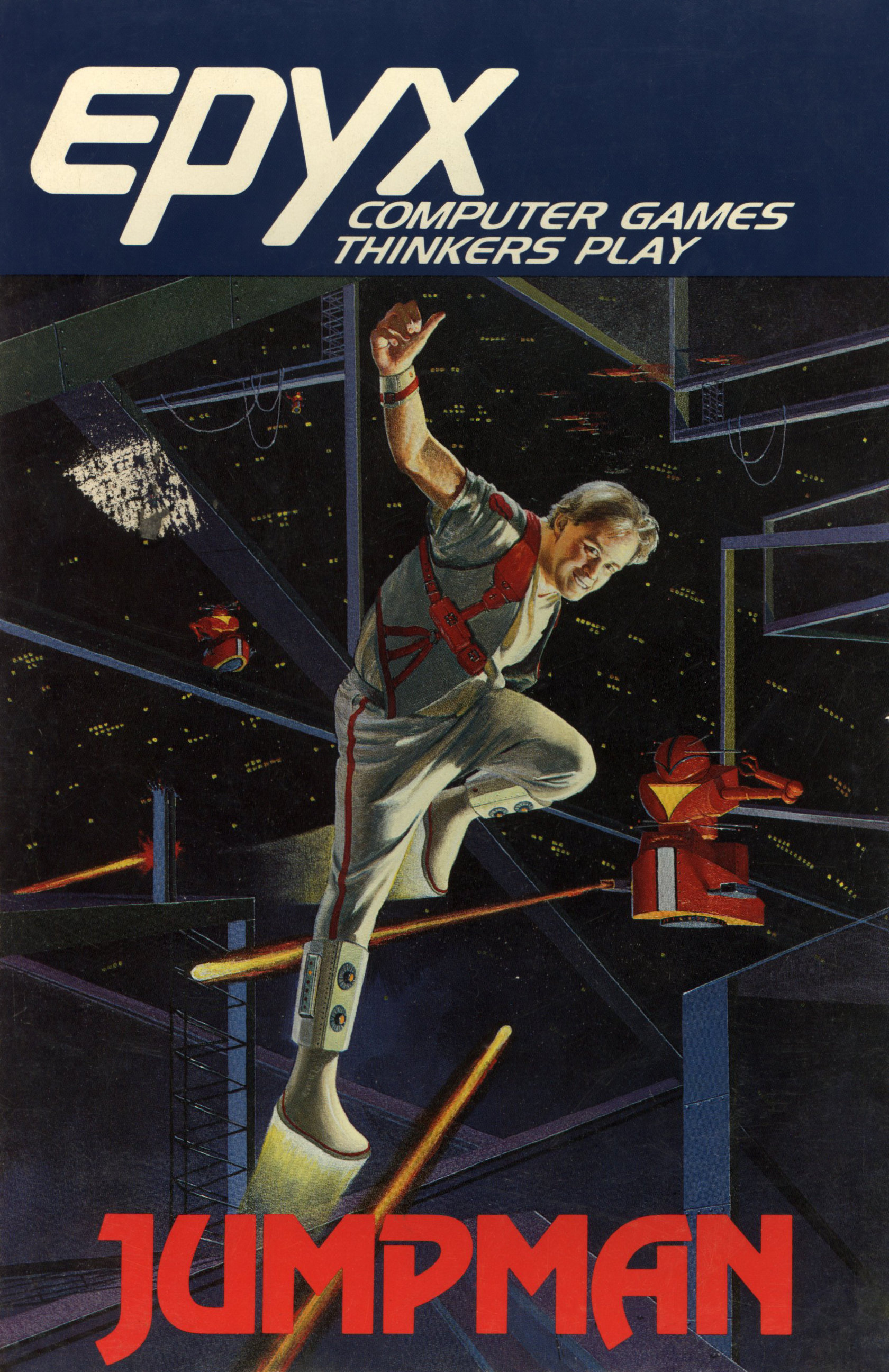
Randy Glover designed Jumpman (1983) around a constraint that most game designers of the era would have considered a disadvantage: every one of its levels uses the same physics, the same controls, and the same basic objective. The player must reach and defuse all the bombs on each single-screen stage while avoiding enemy robots and environmental hazards. There are no power-ups, no weapons, no changing mechanics. And yet Jumpman has 32 levels that feel genuinely distinct - because Glover found 32 different ways to make that same objective feel different, using only level geometry, hazard placement, and robot AI patterns.
Published by Automated Simulations (the company that would rename itself Epyx in 1983) and initially released for the Atari 8-bit, Jumpman was ported to the C64 and Apple II. By the time Epyx was established as a brand, Jumpman was already one of the defining early action games for the Atari platform and was earning similar recognition on the C64.
A Pizza Hut, a Donkey Kong Machine, and an Idea
Randy Glover's first encounter with Donkey Kong was at a local Pizza Hut in the early 1980s, and the game's platform-and-ladder structure gave him the central concept for Jumpman. He wanted to make something similar but different: not a game about dodging barrels thrown by a gorilla but a game about precision platform navigation across a series of increasingly devious challenge screens. He chose the Atari 8-bit as his development platform, built a prototype with 13 levels over four to five months, and initially submitted it to Broderbund before signing with Automated Simulations.
By the time the game was finished, the level count had grown to 32. Each level introduced something new: a different layout demanding different routing, a new hazard type, a robot with a different patrol pattern. The final levels of the game combine these complications in ways that require planning and memorisation as well as execution. Glover's systematic approach - establishing a mechanic in one level, then recombining it with other mechanics two levels later - created a game that taught itself without ever feeling didactic.
"Jumpman easily conquers that skepticism and establishes itself as a software classic."
Compute! magazine, 1983, reviewing Jumpman on the Atari 8-bit
Defuse the Bomb, Then Defuse It Differently
The core loop of Jumpman is simple enough to understand immediately: move your character across platforms, climb ladders and ropes, collect (defuse) each bomb on the screen. Contact with robots kills you. Environmental hazards add obstacles. Clear all bombs and the level ends. What makes Jumpman worth playing across 32 levels is Glover's level-by-level inventiveness. Some stages have bombs that regenerate if the player takes too long, forcing a specific route. Others feature falling bombs that respawn in new positions after collection, changing the target layout mid-level. One level reverses the controls. Another features a floor that disappears as the player walks across it. A third has robots that multiply when touched.
In each case, the complication emerges from the level design and the existing physics - Glover never adds a new mechanic when a new arrangement of the existing ones will produce a more interesting challenge. This economy of means is rare and remains the game's most instructive quality for anyone thinking about platform design.
Platform Design Before Platform Was a Category
In 1983, the platform game genre did not yet have a name or a settled vocabulary. Donkey Kong was an arcade game with a ladder-and-platform structure; Mario Bros. had arrived in arcades the same year. The home computer equivalents were scattered and inconsistently designed. Jumpman arrived into this uncategorised space and demonstrated, with unusual clarity, how to design progression and difficulty within a set of fixed constraints. The difficulty curve is the game's most underrated achievement: early levels teach the basic mechanics before introducing complications; mid-game levels add robot patterns and environmental hazards; late levels combine everything into stages that test everything the player has learned, without mercy but also without unfairness.
Softline magazine called Jumpman "wonderfully addicting" and declared it would be "bound to be a hit," praising its thirty unique screens rather than recycled layouts. K-Power recognised the same quality: players would keep returning due to "sheer enjoyment" that the variety of levels reliably produced. The Commodore 64 Home Companion (1984) put it most precisely: "it's really 30 games in one."
The Blueprint That Held Up
Jumpman Junior, released later in 1983, extended the design with twelve more levels at a slightly more accessible difficulty curve, serving players who found the later levels of the original too demanding. Randy Glover's follow-up demonstrated the same systematic approach: no recycled layouts, no filler, every level justified by the specific challenge it presents. Both games were published by Epyx and helped establish the company's identity as a publisher of technically and design-strong titles before the Games series made them famous for sports compilations.
The game is preserved in the HVSC (SID file playable via the DeepSID player) and at the Internet Archive. The MobyGames page for Jumpman documents the full platform list and credits. For Glover's broader profile, see the People page.