Bad Dudes vs. DragonNinja
What It Is
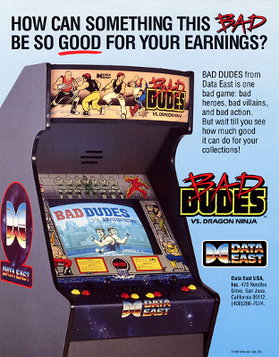
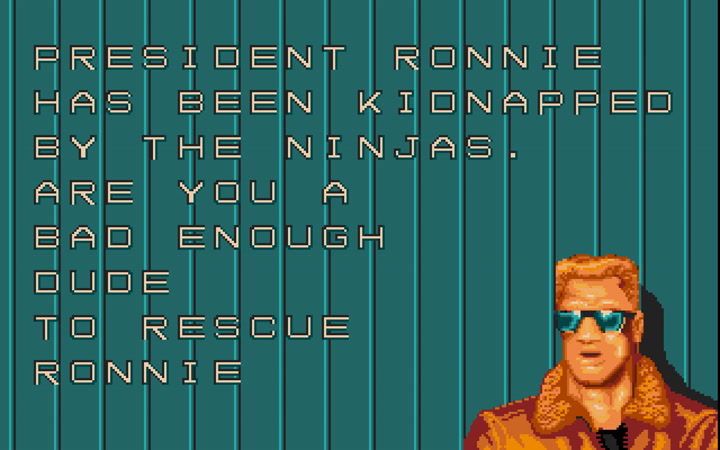
Bad Dudes vs. DragonNinja opens with one of the most celebrated title screens in arcade history: a police captain in sunglasses delivers the news that President Ronnie has been kidnapped by ninjas. Then comes the question that defines the game: Are you a bad enough dude to rescue Ronnie?
The question is rhetorical. Of course you are. You are a Bad Dude.
Released in US arcades in 1988 by Data East (the original Japanese release was titled Dragon Ninja), the game presents two street-tough brawlers - Blade and Striker - fighting through six stages of ninjas, sub-bosses, and environmental hazards to reach and defeat the ninja master DragonNinja and rescue the president.
It is a beat-‘em-up in the mould established by Double Dragon a year earlier, but with an identity that belongs entirely to Data East: earnest, absurd, committed to its B-movie premise without a trace of irony.
From Dragon Ninja to Bad Dudes
The game was developed in Japan under the title Dragon Ninja and localised for the US market by Data East USA, operating out of their San Jose, California office. The localisation process did more than translate text - it reframed the game’s entire premise around an American cultural moment: the late-1980s US fascination with ninja imagery.
In 1987, Teenage Mutant Ninja Turtles debuted as a comic and cartoon property. Ninja Gaiden appeared in arcades the same year as Bad Dudes. The American VHS market was saturated with martial arts films. Data East USA calculated - correctly - that transplanting ninjas into a modern American city would resonate with US arcade audiences in a way that the more straightforward Japanese framing might not.
The president angle compounded the appeal: kidnapping Ronald Reagan and making two street toughs his rescuers was a concept that required no setup and delivered its punchline within the first ten seconds of play. Whether this was calculated marketing or intuitive design is not documented - Data East’s internal development records from this period are not accessible in English, and individual credits for the title are not confirmed in any primary source.
The 1990 NES port was developed by Sakata SAS and published by Data East USA. Music was composed by Mark Van Hecke, replacing the arcade original’s soundtrack. The port reduced the two-player co-op to a single player character and compressed the arcade’s visual density to fit NES hardware constraints.
Six Stages, Two Bad Dudes
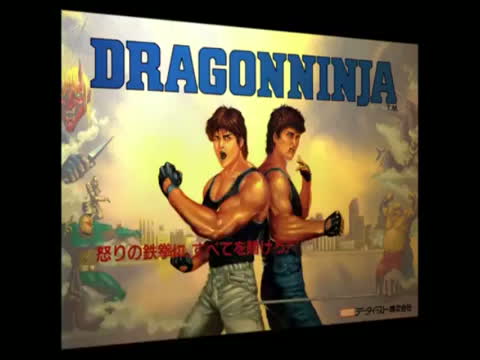
Two players choose Blade (player one) or Striker (player two). Both characters share the same move set: a basic punch and kick, a jump kick, and the ability to grab and use weapons dropped by defeated enemies. Nunchucks extend reach; knives can be thrown; ball-and-chain weapons hit enemies behind you.
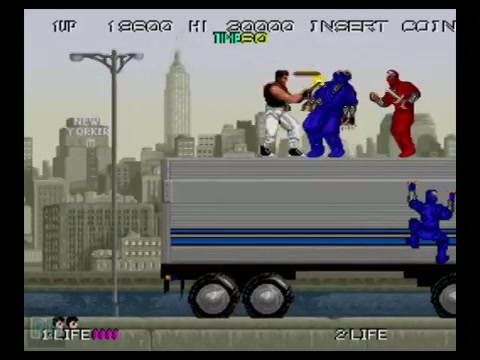
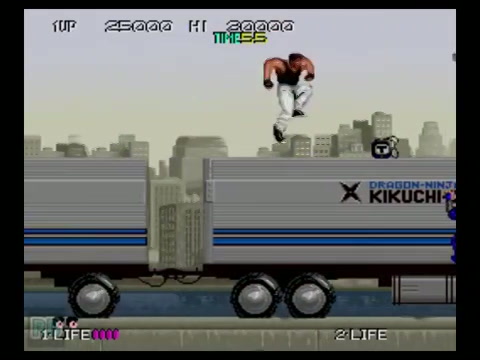
The game’s six stages escalate through locations drawn directly from B-movie sensibility: a city street at night, a moving truck, a forest, a subway car, an industrial factory, and a final confrontation with DragonNinja. Each stage ends with a boss fight. Enemy types include standard purple-clad ninjas, red ninjas who move faster, blue ninjas who can fire projectiles, and larger enemies who require more hits to defeat.
Two-player simultaneous co-op is the game’s defining feature. Both players share the screen, which creates natural cooperation (one distracting enemies while the other attacks) but also friction - players can block each other’s movement in tight corridors, and there is no friendly fire protection. The social dimension of playing the arcade original together is central to why it was remembered fondly; the NES single-player port loses this entirely.
B-Movie Design Philosophy
Data East’s arcade hardware allowed them to maintain a higher density of simultaneously active enemies than many contemporary beat-‘em-ups could manage. Bad Dudes fills its levels with ninjas - groups of three or four at a time, approaching from both screen edges - in a way that creates genuine crowd management pressure rather than the single-enemy attrition common in cheaper coin-op productions.
The stage structure is the game’s principal design achievement: six visually distinct environments, each communicating its premise immediately, without requiring new core mechanics. The moving truck stage changes the ground from stationary pavement to a shifting platform - enemies fall off edges, repositioning becomes tactical. The subway stage adds the vertical dimension of the train’s roof. Each stage delivers a different spatial relationship between the player and the battlefield without adding mechanical complexity.
This approach - maximum visual variety from minimal mechanical change - is a hallmark of Data East’s best arcade work. Karnov, Heavy Barrel, and Midnight Resistance all demonstrate the same principle: a single core loop, diversified through environment and enemy type rather than through new controls.
Arcade and Home Response
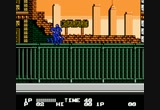
Period coverage of the arcade version praised the two-player co-op and the game’s visual identity. Electronic Gaming Monthly noted the simultaneous two-player mode as a major attraction in an era when most beat-‘em-ups asked players to take turns rather than fight together. The game drew quarters on its premise alone - the title screen was free to watch and created a reliable hook for passersby.
The NES port received broadly positive notices in Nintendo Power and consumer gaming press on its 1990 release, positioned as a solid action title in a genre the NES had popularised through Double Dragon. Critics noted the single-player conversion stripped the game of its most distinctive quality, but the six-stage structure remained intact and the president premise translated without loss.
In retrospect, period reviewers consistently positioned Bad Dudes as solid rather than exceptional in mechanical terms. The mechanical comparison to Double Dragon (Technos, 1987) and later Final Fight (Capcom, 1989) was unfavourable: both games offered more complex combat and greater mechanical depth. But neither of them asked whether you were a bad enough dude. That question, it turned out, was worth more than mechanical sophistication.
President Ronnie has been kidnapped by ninjas. Are you a bad enough dude to rescue Ronnie?
- Bad Dudes vs. DragonNinja title screen, Data East USA, 1988
Cultural Impact
Bad Dudes became a minor internet meme in the early 2000s, with the “bad enough dude” phrase circulating in gaming communities as shorthand for absurd 1980s arcade earnestness. The game’s sincerity - deployed without irony - made it a perfect target for affectionate parody. The phrase appeared in politics, sports commentary, and general pop culture as a marker of unambiguous, slightly ridiculous bravado.
In retro gaming culture, Bad Dudes holds a peculiar position: revered more for what it represents than for what it is. It is not the best beat-‘em-up of its era - Double Dragon and later Final Fight surpassed it mechanically. But it may be the most honest game of its genre: a title that knew exactly what it wanted to be and executed that vision completely.
The game appeared in digital storefronts under G-Mode’s IP licensing arrangements after Data East’s dissolution in 2003. It remains accessible through emulation and arcade preservation. See the people page for credit documentation notes, and the games catalogue for the full platform listing.
I’m bad.
- President Ronnie, after being rescued. Bad Dudes vs. DragonNinja, Data East, 1988.
Bad Dudes vs. Dragon Ninja - arcade longplay (complete run, both players)
Bad Dudes NES (1990) - complete longplay, World of Longplays (Archive.org)