History
The Phosphor Green Revolution
From a wood-chassis prototype assembled overnight for a Las Vegas trade show, to 219,000 machines in schools and offices across two continents — the full Commodore PET story, 1977–1982.
1977 — The Year Computing Changed
Three companies unveiled mass-market personal computers in 1977. Byte magazine would later call them the “1977 Trinity” — the PET, the Apple II, and the TRS-80.
CES, January 1977 — The Overnight Prototype
Chuck Peddle, chief designer of the MOS Technology 6502 CPU, arrived at the Winter Consumer Electronics Show in Las Vegas with a Commodore PET prototype that had been completed hours before the show opened. The chassis was made of wood. The monitor was a $90 black-and-white TV tube from Sanyo. But it booted, it ran Microsoft BASIC, and it had a built-in keyboard and storage. Nothing else at CES did all of that at once.
The reaction was intense. Commodore took orders. The race was on to turn the prototype into a shipping product.
West Coast Computer Faire, April 1977 — The 1977 Trinity Debuts
The first West Coast Computer Faire, held in San Francisco on April 15–17, 1977, was the moment personal computing went public. Commodore showed the production PET at $800 — a complete system, nothing extra required. Apple showed the Apple II. Tandy/RadioShack showed the TRS-80.
All three targeted the hobbyist and small-business market. All three ran on 6502 or Z80 processors. All three would ship before the year was out. The PET’s advantage was its integration: monitor, keyboard, and cassette in one metal box. The Apple II’s advantage was expandability. The TRS-80’s was price and retail distribution. Each found its market.
The first 100 PET units shipped in October 1977, mostly to developers and magazines. General consumer availability followed in December 1977.
The Microsoft BASIC Deal
Commodore founder Jack Tramiel had licensed Microsoft BASIC for the PET in 1977 for a flat fee of $25,000 — a perpetual licence covering all 6502-based Commodore machines. This made Commodore the first company to license Microsoft’s 6502 BASIC, and it proved extraordinarily valuable: the same deal covered the VIC-20 and Commodore 64, which between them sold millions of units. Bill Gates is said to have considered it the worst deal Microsoft ever made.
Hardware Design
The PET’s hardware was unlike anything else on the market. Every decision — the chiclet keyboard, the cassette drive, the 9-inch phosphor monitor — prioritised integration over flexibility.
The MOS 6502 at 1 MHz
The PET ran on a MOS Technology 6502 CPU at 1 MHz — the same family that would power the Apple II, Atari 8-bit computers, and later the NES. Peddle’s team had designed the 6502 to be inexpensive but capable: it cost $25 in 1975, compared to $360 for an Intel 8080. The PET’s 6502 accessed 4 KB RAM in the original 2001, expandable to 32 KB in later models.
The Built-in Cassette
The original PET 2001 (1977) included a Sanyo M1540A cassette recorder as the only built-in storage, running at approximately 50 bytes per second. Programs were saved twice for error correction via digital square-wave encoding. The built-in cassette was dropped in the 2001-N revision of 1979, replaced by an external connector. The Commodore Datasette (external, 1530) became the standard PET storage accessory.
The Phosphor Monitor
Early PET 2001 units (1977) used a P4 phosphor display — producing white or slightly bluish text on a dark background. From the 2001-N (1979), Commodore moved to P31 green phosphor, giving the PET its iconic green-on-black look. The 9-inch monitor was integral to the machine; the 12-inch was offered on some professional models. Green phosphor became so identified with the PET that “phosphor green” and “PET green” are essentially synonymous in retrocomputing circles.
PETSCII — The Only Graphics
Without a bitmap graphics mode, PETSCII was the entire visual vocabulary of PET games. Developers learned to turn the constraint into an aesthetic.
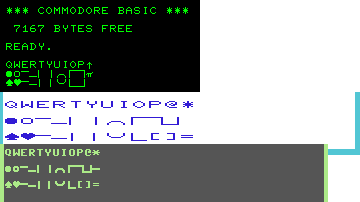
192 Characters, No Bitmap
PETSCII (PET Standard Code of Information Interchange) debuted on the PET 2001 in 1977 — the first computer with a fully graphical character set. Its 192 typeable characters included block graphics (█▓▒░), horizontal and vertical lines, triangles, circles, and card suits (♠♣♥♦). The card suits were included at Chuck Peddle’s personal request: he wanted card games to be easy to write in BASIC.
Because the PET had no bitmap graphics mode, PETSCII was the only way to draw anything on screen. Game developers arranged block characters into recognisable sprites; they used line-drawing characters to build mazes and dungeons; they used shading characters to add depth to otherwise flat images. The result was a distinct aesthetic that remains immediately recognisable today.
PETSCII Carried Forward
Commodore carried PETSCII forward to the VIC-20, Commodore 64, C128, and C16/Plus4. The C64 version required redesigned thicker glyphs for readability on a television set. But the core block-graphics vocabulary remained, making PETSCII one of the most persistent visual design systems in home computing history. PET game developers who mastered its idioms in 1978 found their skills directly transferable to C64 development in 1982.
Model Evolution
The PET family expanded steadily from 1977 to 1982, growing from 4 KB to 128 KB RAM and from 9-inch 40-column displays to 12-inch 80-column professional workstations.
PET 2001 Series (1977–1979)
The original PET 2001 came with 4 KB or 8 KB RAM, a 9-inch monitor, and a flat chiclet keyboard widely criticised for being unusable. The built-in cassette drive sat in the right side of the unit. BASIC 1 (and later BASIC 2) lived in ROM. Display was 40 columns by 25 rows.
The 2001-N (“New,” 1979) added a full-size typewriter-style keyboard, removed the built-in cassette, and increased RAM options to 8/16/32 KB. European models in this range were sold as the CBM 3000 series due to a Philips trademark dispute over the “PET” name.
PET 4000 Series (1980)
Released in Summer 1980, the 4000 series introduced BASIC 4.0 with built-in disk commands, and 40-column displays with 16 KB or 32 KB RAM. The 4032 became the most popular model in schools — its all-metal chassis and professional keyboard made it classroom-durable. Games written for earlier PETs generally ran on the 4000 series without modification.
CBM 8000 Series (c.1981) — 80 Columns
The 8000 series introduced an 80-column by 25-row display, nearly doubling the text capacity. A new CRTC chip drove the wider display. The standard model was the 8032 (32 KB RAM); expanded models reached 8096 (96 KB) and 8296 (128 KB). The 80-column format was suited to business applications but limited for games — most PET game development targeted the 40-column machines.
SuperPET SP9000 (1981)
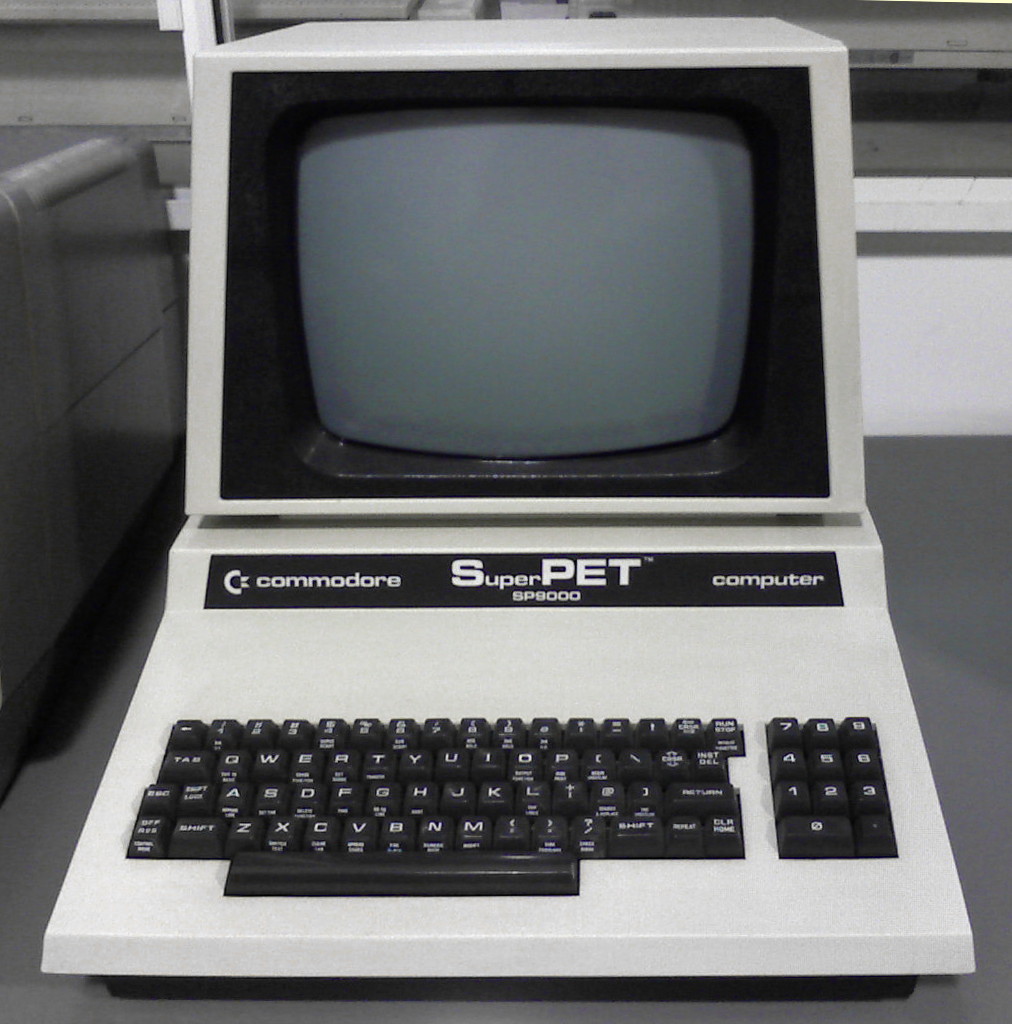
Designed in partnership with the University of Waterloo for computer science education, the SuperPET added a Motorola 6809 second CPU alongside the 6502. It shipped with APL, COBOL, FORTRAN, BASIC, Pascal, and a 6809 assembler. The SuperPET was a specialist machine, priced accordingly, and never reached consumer volumes.
Peak Years (1979–1981)
Education and Business Dominance
The PET reached its market peak in 1979–1981. In North America and Europe, the 4032 was the school computer of choice. Its combination of BASIC 4.0, durable metal construction, and integrated everything-in-one design made it the preferred machine for educational authorities purchasing in bulk. Programming classes in the UK and USA ran on PETs throughout the early 1980s.
The gaming ecosystem kept pace. MobyGames documents over 800 PET titles released between 1977 and 1982, spanning fixed shooters, dungeon crawls, strategy games, text adventures, educational software, and simulations.
The Key Releases
The peak years produced the titles still celebrated today: Microchess 2.0 (1978) established that software could be commercially viable; Temple of Apshai (1979) proved a home computer could host a real RPG; Cosmic Cosmiads (1981) and Cosmic Jailbreak (1982) showed that arcade-style shooters were achievable even without hardware sprites. PET Space Invaders (1980), written by high-school student Satoshi Matsuoka, demonstrated that teenagers could write commercial-quality software.
“I originally bought a PET to organise my Dungeons & Dragons notes. It wasn’t suitable for that, so I wrote a dungeon game instead.” — Jim Connelley, co-founder of Automated Simulations (Temple of Apshai, 1979), via The Digital Antiquarian
1982 — Decline and Discontinuation
The VIC-20 and the Commodore 64
Commodore’s own VIC-20 (launched 1980) was the first computer to sell over one million units. Its colour display, sound chip, and sub-$300 price point addressed the PET’s weaknesses for the home market. Then, at CES in January 1982, Commodore previewed the Commodore 64: 64 KB RAM, the SID sound chip, and hardware sprites, at $595. The C64 made the PET irrelevant for anything but institutional use.
Commodore discontinued the PET in 1982 after approximately 219,000 units sold. A final “Porsche PET” facelift range with a rounded plastic case appeared briefly in 1983 for European markets, but it was a swan song for institutional customers rather than a new product direction.
What the PET Started
The Developers Who Started Here
The PET launched careers that shaped computing history. Satoshi Matsuoka, who wrote PET Space Invaders as a high-school student, went on to co-found HAL Laboratory — where he and Satoru Iwata (later president of Nintendo) worked together. Peter Jennings, whose Microchess proved home software could be a business, merged his company with Personal Software and helped fund the development of VisiCalc, the first spreadsheet application and arguably the first “killer app.”
Jim Connelley and Jon Freeman’s Automated Simulations — founded on the PET with Temple of Apshai — became Epyx, one of the leading Commodore 64 game publishers of the 1980s, responsible for Impossible Mission, California Games, and the Summer Games series.
“HAL Laboratory started because we kept meeting at Seibu Department Store in Ikebukuro — the first place in Japan to sell Commodore and Apple computers. We were all there playing with the machines, and eventually we started a company.” — Satoshi Matsuoka, recalling the founding of HAL Laboratory (via shmuplations.com, translated interview)
Emulation and Preservation
The VICE emulator (VersatIle Commodore Emulator) supports all PET models with cycle-accurate 6502 emulation, including both 40-column and 80-column configurations and the 6809 SuperPET. Archive.org hosts over 900 PET games via the “pet-game-base-v-3-1” collection. Zimmers.net maintains a comprehensive PET software archive. The community that keeps the PET alive is small but extraordinarily dedicated.
CuriousMarc & Ken Shirriff: Hard to repair Commodore PET (Apr 2025). Detailed hardware restoration showing the PET’s internals.