The Game That Created a Market
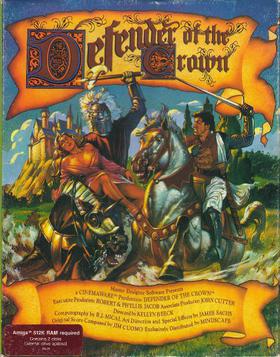
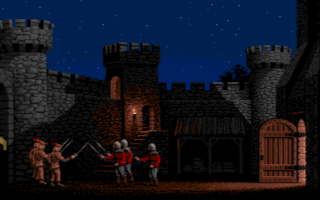
In November 1986, Defender of the Crown hit Amiga shelves and did something no home computer game had managed before: it looked like a painting. The scenes - castle courtyards at dusk, Saxon lords surveying medieval England, mounted knights in full heraldic regalia - were rendered in the Amiga's HAM (Hold-And-Modify) mode, accessing up to 4,096 colours simultaneously. The images were hand-painted, pixel by pixel, by a single artist.
The game casts the player as a Saxon noble in the aftermath of King Harold's death at Hastings, vying to unite Saxon England against Norman lords. On a strategic map of medieval England, players capture territories, build armies, and manage a treasury. Action sequences - siege catapults, jousting tournaments, swordfights, and covert raids on castles - play out as separate visual set-pieces, each rendered in the full quality of the Amiga hardware.
Risk, Rewritten for a New Medium
The design concept originated with Bob Jacob, Cinemaware's founder. His model was the board game Risk - a territory-control game he loved as a child - combined with action sequences that would replace dice rolls as the resolution mechanic.
"The original genesis for Defender of the Crown was actually pretty simple. I took the game Risk - the whole idea of conquering territories. And I thought, what we should do in a game is let's replace the dice rolling in Risk with your success or failure in various action sequences in the game. Up until that time, action sequences lived and died by themselves - they weren't in the context of a story. So if there was something revolutionary involved there, it was the idea of incorporating action into a game where your success or failure actually did have an effect on the story and how it progressed."
Bob Jacob, founder of Cinemaware - Matt Chat, episode 41 (YouTube, December 2009)
Jacob recruited artist Jim Sachs, whose C64 work had circulated on discs at Amiga user groups in 1985-86 and was already considered exceptional. Sachs took on the task of painting every scene in the game - castle interiors, landscape panoramas, portrait sequences, tournament arenas. The programmer initially attached to the project, from Amiga headquarters, fell badly behind. With months to the publisher deadline, Jacob replaced him with Robert J. McHale - one of the original Amiga hardware designers - who worked punishing hours to turn Sachs's artwork into a working game.
Pixel by Pixel, Scene by Scene
Before Deluxe Paint, Sachs was laying down pixels one at a time using Graphicraft, the only available Amiga drawing tool. The process was slow enough to be staggering - individual scenes took two to three weeks each. When Electronic Arts released Deluxe Paint during the production, the pace shifted dramatically.
"It would take two or three weeks to do a scene from Defender of the Crown. But then after Deluxe Paint came out, things changed dramatically and I was able to do a typical picture in maybe two or three days."
Jim Sachs, artist - The Retro Hour, episode 31 (YouTube, 2016)
Sachs worked around the clock during the crisis period, driven by both pride and the knowledge that extraordinary investors were watching the schedule. McHale's commitment was equally intense - he produced the game's core systems and interactive logic in under three months. Neither man worked with Cinemaware again after Defender of the Crown shipped.
Why the Catapult Was Barely Playable
The gameplay, despite its visual grandeur, was primitive in practice. The strategic layer - territory capture, army recruitment, treasury management - was deliberately simple, designed to let the action sequences carry the experience. Those sequences were a mixed success. The catapult siege was the closest thing to functional. The jousting was awkward. The swordfight, with its blocky sprites and lurching animation, frustrated players in ways Sachs himself acknowledged - the time simply ran out before the animation systems could be finished.
What rescued the experience was tone. The game understood that atmosphere could compensate for mechanical roughness. Robin Hood appeared as an ally. A love scene played out as an ink-drawn romantic encounter. The heraldic title theme by Bob Lindstrom opened with a brass fanfare that made the whole thing feel like a Saturday-afternoon historical epic. It worked - the game was one of the most-copied titles on the Amiga within weeks of launch.
The Amiga's Killer App
Contemporary press reception was overwhelming. CU Amiga awarded it 92%. ACE gave it 940/1000, calling it "the benchmark for Amiga game graphics." Zero said it was "a landmark - the game that proves software can be art." No score or review phrase captured what actually happened in the market: Defender of the Crown was the first true killer application for the Amiga as a games platform, demonstrating that a home computer could produce imagery of professional quality and that game developers could aspire to production values previously associated only with film.
Ports followed to DOS (EGA and VGA), NES (via Data East, substantially different), Atari ST, Mac, and C64. The later NES version was a competent but diminished version of the original. The Atari ST port - given more development time - was arguably a better game than the Amiga original, even if it looked worse. Jim Sachs later created a director's cut version for the Commodore CDTV, restoring elements the original release had missed, with orchestral audio and English narration.
Forty Years Later, It Has Not Been Surpassed
Defender of the Crown has appeared on magazine covers, in Amiga advertising, and in documentary retrospectives for four decades. Jim Sachs's artwork has been cited in articles on digital art history. The game's visual ambition set a standard that shaped how studios thought about artistic production for years - even those that never matched it.
For more on Jim Sachs and the artwork's creation, see the People page. The Amiga MOD score is documented on the Music page. All Cinemaware titles are listed on the Catalogue.