Deep-Dives

Flagship Games

Five games that made Cinemaware what it was - and what the Amiga could become.

01

Defender of the Crown

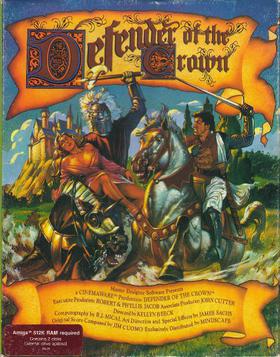
Defender of the Crown - box art
Oil painting by Ezra Tucker. The box art matched the ambition of the game inside.

The Game That Created a Market

In November 1986, Defender of the Crown hit Amiga shelves and did something no home computer game had managed before: it looked like a painting. The scenes - castle courtyards at dusk, Saxon lords surveying medieval England, mounted knights in full heraldic regalia - were rendered in the Amiga's HAM (Hold-And-Modify) mode, accessing up to 4,096 colours simultaneously. The images were hand-painted, pixel by pixel, by a single artist.

The game casts the player as a Saxon noble in the aftermath of King Harold's death at Hastings, vying to unite Saxon England against Norman lords. On a strategic map of medieval England, players capture territories, build armies, and manage a treasury. Action sequences - siege catapults, jousting tournaments, swordfights, and covert raids on castles - play out as separate visual set-pieces, each rendered in the full quality of the Amiga hardware.

Risk, Rewritten for a New Medium

The design concept originated with Bob Jacob, Cinemaware's founder. His model was the board game Risk - a territory-control game he loved as a child - combined with action sequences that would replace dice rolls as the resolution mechanic.

"The original genesis for Defender of the Crown was actually pretty simple. I took the game Risk - the whole idea of conquering territories. And I thought, what we should do in a game is let's replace the dice rolling in Risk with your success or failure in various action sequences in the game. Up until that time, action sequences lived and died by themselves - they weren't in the context of a story. So if there was something revolutionary involved there, it was the idea of incorporating action into a game where your success or failure actually did have an effect on the story and how it progressed."

Bob Jacob, founder of Cinemaware - Matt Chat, episode 41 (YouTube, December 2009)

Jacob recruited artist Jim Sachs, whose C64 work had circulated on discs at Amiga user groups in 1985-86 and was already considered exceptional. Sachs took on the task of painting every scene in the game - castle interiors, landscape panoramas, portrait sequences, tournament arenas. The programmer initially attached to the project, from Amiga headquarters, fell badly behind. With months to the publisher deadline, Jacob replaced him with Robert J. McHale - one of the original Amiga hardware designers - who worked punishing hours to turn Sachs's artwork into a working game.
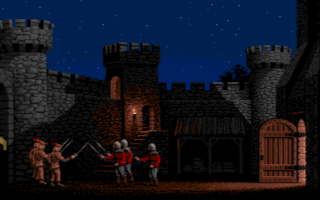
Defender of the Crown - Jim Sachs raid scene
Jim Sachs's raid sequence from Defender of the Crown. Each background was hand-painted in the Amiga's HAM display mode.

Pixel by Pixel, Scene by Scene

Before Deluxe Paint, Sachs was laying down pixels one at a time using Graphicraft, the only available Amiga drawing tool. The process was slow enough to be staggering - individual scenes took two to three weeks each. When Electronic Arts released Deluxe Paint during the production, the pace shifted dramatically.

"It would take two or three weeks to do a scene from Defender of the Crown. But then after Deluxe Paint came out, things changed dramatically and I was able to do a typical picture in maybe two or three days."

Jim Sachs, artist - The Retro Hour, episode 31 (YouTube, 2016)

Sachs worked around the clock during the crisis period, driven by both pride and the knowledge that extraordinary investors were watching the schedule. McHale's commitment was equally intense - he produced the game's core systems and interactive logic in under three months. Neither man worked with Cinemaware again after Defender of the Crown shipped.

Why the Catapult Was Barely Playable

The gameplay, despite its visual grandeur, was primitive in practice. The strategic layer - territory capture, army recruitment, treasury management - was deliberately simple, designed to let the action sequences carry the experience. Those sequences were a mixed success. The catapult siege was the closest thing to functional. The jousting was awkward. The swordfight, with its blocky sprites and lurching animation, frustrated players in ways Sachs himself acknowledged - the time simply ran out before the animation systems could be finished.

What rescued the experience was tone. The game understood that atmosphere could compensate for mechanical roughness. Robin Hood appeared as an ally. A love scene played out as an ink-drawn romantic encounter. The heraldic title theme by Bob Lindstrom opened with a brass fanfare that made the whole thing feel like a Saturday-afternoon historical epic. It worked - the game was one of the most-copied titles on the Amiga within weeks of launch.

The Amiga's Killer App

Contemporary press reception was overwhelming. CU Amiga awarded it 92%. ACE gave it 940/1000, calling it "the benchmark for Amiga game graphics." Zero said it was "a landmark - the game that proves software can be art." No score or review phrase captured what actually happened in the market: Defender of the Crown was the first true killer application for the Amiga as a games platform, demonstrating that a home computer could produce imagery of professional quality and that game developers could aspire to production values previously associated only with film.

Ports followed to DOS (EGA and VGA), NES (via Data East, substantially different), Atari ST, Mac, and C64. The later NES version was a competent but diminished version of the original. The Atari ST port - given more development time - was arguably a better game than the Amiga original, even if it looked worse. Jim Sachs later created a director's cut version for the Commodore CDTV, restoring elements the original release had missed, with orchestral audio and English narration.

Forty Years Later, It Has Not Been Surpassed

Defender of the Crown has appeared on magazine covers, in Amiga advertising, and in documentary retrospectives for four decades. Jim Sachs's artwork has been cited in articles on digital art history. The game's visual ambition set a standard that shaped how studios thought about artistic production for years - even those that never matched it.

For more on Jim Sachs and the artwork's creation, see the People page. The Amiga MOD score is documented on the Music page. All Cinemaware titles are listed on the Catalogue.
Catalogue entry Jim Sachs artwork gallery Amiga MOD music Jim Sachs profile Period press scores

Amiga Longplay — Defender of the Crown

Defender of the Crown - Full Amiga Campaign

Full Amiga campaign of Defender of the Crown. The definitive showcase of Jim Sachs's hand-painted artwork and Bob Lindstrom's orchestral score in context. See Videos for the full Cinemaware video archive.

02

Rocket Ranger

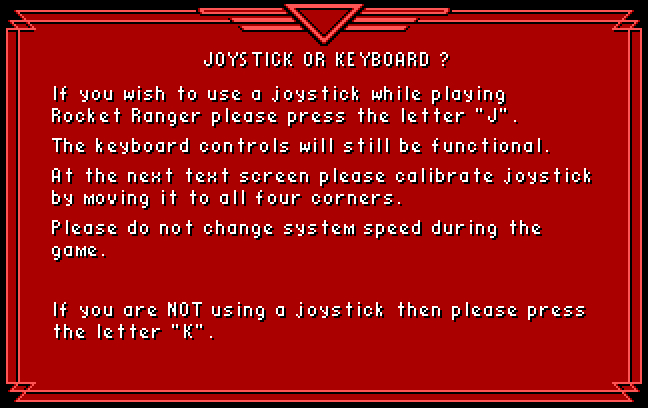
Rocket Ranger - cover screenshot
Rocket Ranger's opening screen sets the pulp science-fiction tone immediately.

Bob Jacob's Personal Favourite

Of all the games Cinemaware produced, Rocket Ranger was the one Bob Jacob felt most ownership of. It was the game he would have made purely for himself, had commercial considerations not existed. The premise drew on the American pulp serial tradition - 1940s adventure, alternate-history intrigue, Nazi villains, jet packs, and a moon base - rendered with the studio's now-proven production values.

The concept had a specific origin. Cinemaware had wanted to secure the rights to Commando Cody - a character from 1950s Republic cinema serials whose jetpack- wearing hero was an obvious fit for the studio's approach. That license was unavailable. Rather than abandon the concept, Jacob created an original character: a US Army scientist who dons a rocket suit and radium pistol to fight a world where the Nazis have already won.

"I also decided that movies would be a great motif - a great creative motif for doing games. People like movies. It gave us a virtually inexhaustible supply of ideas."

Bob Jacob, founder of Cinemaware - Matt Chat, episode 41 (YouTube, December 2009)

More Game Than Cinemaware Usually Gave You

Where Defender of the Crown had been thin on playable content, Rocket Ranger was dense with it. The game cycled through a variety of mini-games - strategic resource planning, hand-to-hand combat, rocket flight sequences, a final confrontation on the lunar surface - and bound them together with enough narrative momentum to keep players invested across a long play session.

The difficulty was another matter. Rocket Ranger was openly hostile. The anti-piracy code wheel, requiring players to calculate fuel loads from a physical cardboard dial, added friction on top of action sequences that already demanded precision. Fall out of a rocket flight sequence early and the mission failed. The difficulty reflected a deliberate response to the criticism that Cinemaware games were stylistically impressive but mechanically undemanding - the studio overcorrected towards punishing challenge.

Rocket Ranger - in-game screenshot
Rocket Ranger's action sequences - including rocket flight across a world map - gave the game more mechanical variety than any previous Cinemaware title.

Bob Lindstrom's Score at Its Peak

The Bob Lindstrom soundtrack for Rocket Ranger is the most fully realised of his Cinemaware work. Using the Amiga's Paula chip with four-channel MOD playback, Lindstrom produced something that genuinely resembled orchestral scoring - a main theme with brass-led fanfares, propulsive action tracks for the flight sequences, and romantic interludes for the game's recurring love-interest scenes.

The music was central to how the game communicated its tone. Where the visuals were accomplished but not at the level of Sachs's Defender work, the audio filled the gap and sustained the pulp-adventure atmosphere through sequences that might otherwise have felt sparse.

Best on NES, Which Cinemaware Didn't Expect

Contemporary press was strong across platforms - Amiga Power gave it 88%, CU Amiga 89%. The NES port, produced by Cinemaware in-house rather than outsourced, was arguably the most playable version of the game: the reduced visual fidelity was compensated by tighter controls and a difficulty curve calibrated for a different audience. The Amiga original's punishing design made the NES port the recommended entry point for modern players.

Rocket Ranger is catalogued alongside all Cinemaware titles on the Catalogue. The Bob Lindstrom score is documented on the Music page.

Catalogue entry Bob Lindstrom's score Studio profiles Period press scores

03

It Came from the Desert

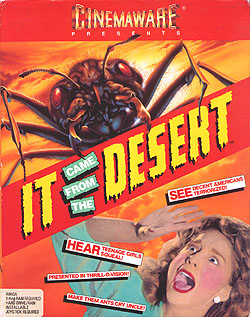
It Came from the Desert - box art
The box art for It Came from the Desert. Cinemaware's best-scoring game with contemporary critics.

The Game Where Everything Clicked

It Came from the Desert is the game Cinemaware had been building towards since King of Chicago. Where earlier titles had struggled to balance spectacle and substance, this 1989 release got both right. It drew on the 1950s B-movie horror tradition - giant ants emerging from a desert meteor strike, a small California town on the verge of catastrophe - and turned it into the most mechanically sophisticated game the studio had yet produced.

The player is Dr Greg Bradley, a geologist in Lizard Breath, California, in 1951. A meteor has just landed. Animals are dying. People are disappearing. Over fifteen real-time in-game days, Bradley must gather evidence, convince the town leadership of the ant threat, and ultimately coordinate a military response. The game's clock runs at all times: locations open and close, characters follow schedules, and events trigger in sequence regardless of whether the player reaches them.

"The industry was still in its infancy back then. Games looked pretty lousy. Graphics weren't very good. Most of the games were designed by programmers - they didn't really have a strong mass-market consumer sensibility to them. I developed certain concepts for what I liked about games - and I wasn't seeing it in the computer games that I bought."

Bob Jacob, founder of Cinemaware - Matt Chat, episode 41 (YouTube, December 2009)

A Living Town, Fifteen Days to Save It

Director David Reardon brought an unusual background to the project. Before joining Lucasfilm and later Cinemaware, Reardon had been a professional songwriter - co-writing the 1970 US number-one hit "Green-Eyed Lady" for Sugarloaf. The sensibility he brought to game direction was rooted in storytelling rhythms, not programming logic.

The Lizard Breath world Reardon designed had an internal consistency that no previous Cinemaware game had matched. Each location - the hospital, the sheriff's office, the Neptune Hall (a Masonic-style secret society), the airport, the drive-in, the mines - had its own visual identity, its own character population, and its own music theme. The bar played honky-tonk piano. The radio station had a different ambient sound. Travel time between locations was tracked: going to the far mine would eat most of an afternoon.

Mini-Games That Fit the World

The action sequences in It Came from the Desert were more varied and better integrated into the fiction than in earlier Cinemaware games. A first-person rifle sequence against ants at the mine entrance was genuinely tense. A game of chicken against a local gang member - two cars heading for the edge of a cliff - delivered its moment of 1950s Americana dread. The hospital escape sequence, where Bradley must evade nurses to avoid losing time convalescing, became notorious for being almost impossible.

None of the mini-games, taken in isolation, were remarkable. What elevated them was their narrative function. Failing the hospital escape was a legitimate consequence of an earlier action. Winning the chicken race changed a relationship that affected later evidence-gathering. The game was greater than the sum of its parts in a way that marked a genuine design evolution.

The Best-Reviewed Cinemaware Game

Contemporary press reception was the strongest of any Cinemaware title. Amiga Joker gave it 94%. CU Amiga scored it 96%. Average magazine scores across major Amiga publications were 88%. Amiga Action called it "the most ambitious Amiga game yet made." Critics who had questioned whether Cinemaware's presentation-heavy approach could survive mechanical scrutiny largely conceded the point with this release.

A standalone expansion, Antheads: It Came from the Desert II, was released by mail order only, using the same engine to tell a new story involving a second ant colony. The Mega Drive port was completed but not commercially released, the rights reverting after Cinemaware's bankruptcy. A film loosely bearing the title appeared in 2018 with essentially no connection to the game's plot.

See the Catalogue for all platform versions, or Reviews for the full contemporary press record.

Catalogue entry Contemporary press scores How the NEC deal ended Cinemaware David Reardon and the team

Longplay — It Came from the Desert

It Came from the Desert - Full Amiga Longplay (50fps)

Full playthrough of It Came from the Desert on the Amiga at 50fps. The opening desert sequence - narrated in 1950s pulp style - is one of the best introductions in Amiga gaming. More video coverage in the Videos archive.

04

Wings

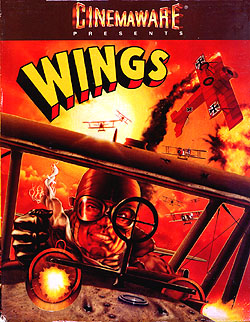
Wings - box art
Wings, Amiga, 1990. Amiga Power's Game of the Year. Remastered for Steam in 2014.

A Game About Dying Without Losing

Wings is unlike every other Cinemaware game. It began as an adaptation of the 1927 silent film of the same name - the first movie to win the Academy Award for Best Picture, famous for its WWI aerial combat sequences. The design task was given to John Cutter, Cinemaware's lead designer and the company's original internal hire. What Cutter delivered was not a film adaptation.

In researching the subject, Cutter encountered the actual diaries and accounts of WWI fighter pilots - particularly the personal record of British ace Mick Mannock, who achieved 61 victories before being shot down and killed in July 1918. The language of those accounts - matter-of-fact, stoic, increasingly tired - became the language of the game. Wings is a daily chronicle of a single Sopwith Camel squadron from 2 March 1916 to 11 November 1918, narrated through the pilot's journal.

"Wings achieves something no other game has managed - it makes you feel the weight of history. The diary entries, the fallen comrades, the creeping attrition of war. This is not just a game. It is an experience."

Amiga Power, Game of the Year award coverage, 1990

Two Hundred Missions and the Wrong Way to Think About Them

The game contains over 200 missions. Each one is brief - a dogfight against enemy aircraft, a bombing run on a German supply line, a low-level strafing of ground positions. Taken purely as action gameplay, the missions are repetitive. This is the wrong frame entirely. Wings is not a game about mission variety; it is a game about attrition.

Each morning, five pilots take off. Not all come back in the afternoon. When a pilot dies, the game does not end and does not send the player back to a checkpoint. The player assumes the identity of the next available pilot and the squadron continues. At the war's end, a memorial lists every pilot the player has lost, with their dates of service. The effect is genuinely affecting - a memorial to fictional people that functions as a small and specific document of what the actual Great War was.

The Amiga's MOD Music at Its Most Atmospheric

The Wings soundtrack matched the tone of the game precisely. Where Bob Lindstrom's work on Rocket Ranger was expansive and fanfare-driven, the Wings score - composed for the Amiga's Paula chip - was restrained and melancholic. Between missions, the journal plays out in text with minimal accompaniment. During flights, propulsive dogfight themes carry the action. The contrast heightened both.

See Music for the Cinemaware MOD archive and how to listen to the original Amiga soundtracks today.

Game of the Year, Then Remastered Three Decades Later

Amiga Power named Wings its Game of the Year for 1990. CU Amiga scored it 94%. ACE gave it 920/1000. For reviewers who had always suspected Cinemaware's presentation-over-gameplay model would eventually produce something genuinely great, Wings delivered. The emotional resonance of the pilot journals - passages that spoke of mess-hall arguments, of mail from home, of Richthofen's Flying Circus tearing through a squadron - reached a register that most action games never attempted.

The remastered Steam release demonstrated there was still an audience for the game thirty years later. The 2020 version remains available on Steam under Cinemaware Retro. For the full modern history, see the Modern page.

Catalogue entry Amiga MOD scores Wings Remastered (2014/2020) Contemporary press scores

05

King of Chicago

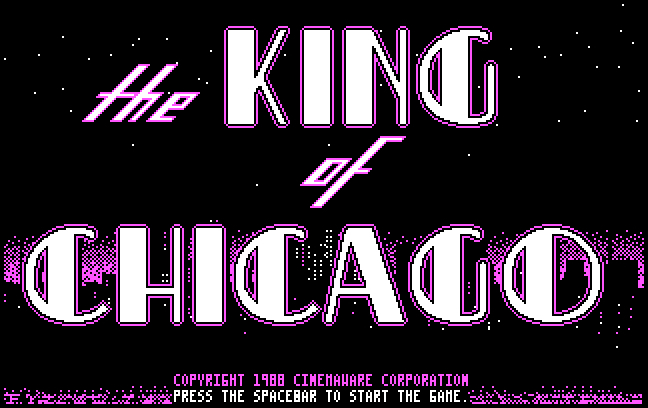
King of Chicago - cover screenshot
King of Chicago's opening. The gangster portrait art set the visual template for Cinemaware's character presentation.

The Game That Started It

King of Chicago was the first Cinemaware game to reach the market, released in 1986 on Macintosh and then ported to Amiga, DOS, and Atari ST. It was the work of Doug Sharp, a designer who had come from the Atari 8-bit and Macintosh scene, and who built the game almost entirely alone. Sharp wrote the code, designed the branching narrative, created the character portraits, and developed the storytelling system.

The setup is Al Capone's arrest for tax evasion in 1931. With the city's dominant gangster gone, the Chicago underworld is open. The player is Pinky, a mid-level operator who has exactly the ambition and ruthlessness to fill the vacuum - or not, depending on the choices made.

"I was a movie buff - you know what can I tell you. And I really wanted to add a sense of romantic byplay to our games, because no one had done it. The whole idea of trying to add a little bit of [adult drama] - that was new. No one had ever pulled it off before. But I think it helped. It just helped the vibe of the game."

Bob Jacob, founder of Cinemaware - Matt Chat, episode 41 (YouTube, December 2009)

Not a Linear Story

King of Chicago was frequently dismissed as an interactive choose-your-own-adventure book - a sequence of binary decisions with a predetermined ending. The actual structure was significantly more complex. The choices the player makes early in a session shape which options are available later. Multiple endings are accessible; some require very specific prior decisions to reach. Across repeated plays, new scenes emerge that a single run through could never encounter.

A single full play might represent only 20 percent of the available content. For 1986, this was genuinely innovative narrative design - a branching story system that predated the mainstream recognition of visual novels by more than a decade. Sharp's framework for building the interactive scenes was reportedly close to what would eventually become modern game scripting tools.

King of Chicago - gameplay screenshot
A decision scene from King of Chicago. Doug Sharp's portrait art gave the Amiga version a visual quality the original Mac release lacked.

When the Potato Heads Became Portraits

The original Macintosh version of King of Chicago used digitised face photographs rendered in black-and-white Macintosh resolution - contemporary critics called the characters "potato heads" for their rubbery, compressed appearance. When Sharp ported the game to the Amiga and Atari ST, he replaced all character images with hand-painted portraits in full colour. The improvement was dramatic. The gangster faces - each with its own characteristic expression and period costuming - gave the Amiga version a visual quality that made it feel like a different product entirely.

The Blueprint That Looked Like a Shortcut

Contemporary reception was mixed. Some critics saw King of Chicago as a point-and-click game with unusually limited player agency. Scores ranged across platforms and publications, with the Amiga port consistently rated highest for its visual upgrade. Sales were strong enough to give Cinemaware the confidence to continue and expand the interactive-narrative template.

In retrospect, King of Chicago did something more important than its immediate reception acknowledged. It demonstrated that the interactive-movie concept was viable in practice - that players would engage with a story driven by character choices and dramatic tension, even when the "game" elements were minimal. The lesson shaped every subsequent Cinemaware title and pointed forward to adventure-game design traditions that flourished through the 1990s.

The full game list is on the Catalogue page, which also covers ports and platform variants. For Doug Sharp's profile, see People.

Catalogue entry Doug Sharp profile Cinemaware founding story