From Atari Prototype to Living Franchise
How two Canadian programmers working independently created the same game, and what happened when First Star Software introduced them.
Two Programmers, One Idea
Around 1982, Chris Gray - an independent programmer based in Toronto - began developing a game on the Atari 8-bit. The concept was simple: a character digs through dirt, collects gems, and avoids rocks. It was written in BASIC, ran on a single screen, and reminded observers of an arcade game called The Pit. Gray called an early version "Pitfall" and submitted it to a small local publisher named In Home Software.
Peter Liepa was working nearby as a contractor and consultant, recently inspired by a friend's Atari 400. He had been learning Forth, writing demos from Byte magazine, and thinking about game ideas with no clear path to publishing them. In Home Software, recognizing Gray's concept had potential but needed engineering, connected the two men.
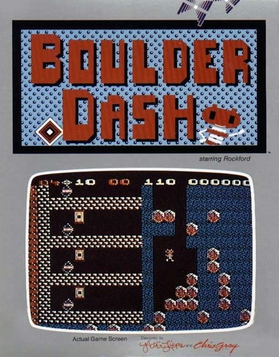
Liepa took the C64 port as his primary responsibility but quickly departed from Gray's design. The collaboration was long-distance and the two "found out pretty quickly that we were on fairly different wavelengths," Liepa later recalled. He more or less took off on his own. The result was a new game sharing only a concept with Gray's original.
"After playing it for a few hours, I just thought, you know, this needs more spice. This needs different dynamics."
Peter Liepa, Antic podcast interview, 2015
The C64 Version Changes Everything
Liepa's breakthrough was the cellular automaton physics model. Boulders would fall if the space below was empty, roll off curved surfaces if space allowed, and cascade in ways that created genuine emergent behaviour. Diamonds scattered through caves, amoeba creatures spread and solidified, fireflies patrolled corridors. Each element followed simple rules but the interactions created complex, surprising situations.
He built a scrolling cave system of 16 levels with four intermissions, doubling the sprite size from Gray's original design after a publisher told him the character wasn't recognizable enough. The music - a four-voice SID composition written using a music editor Liepa also coded from scratch - became one of the most recognized tunes in C64 history. See the Music page for the SID files and player.
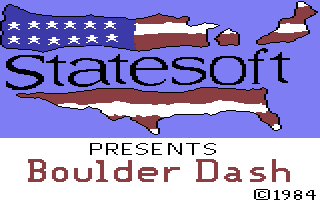
When In Home Software failed to produce a publishing contract, Liepa searched for American publishers. He chose First Star Software in New York - partly for geographic proximity - and they were "very happy to take the game." First Star published Boulder Dash simultaneously for C64 and Atari 8-bit in 1984, with Gray credited on the Atari version and Liepa on the C64.
Gold Medals and a Million Sales
Boulder Dash was an immediate commercial and critical success. By 1985 it had sold over one million copies across all platforms. Zzap!64 - reviewing the game in its very first issue in May 1985 - awarded it a Gold Medal with a score of 96%. The review called it "a classic that shouldn't be missed by any C64 owner." See the Reviews page for period coverage and excerpts.
Rockford's Revenge and the Construction Kit
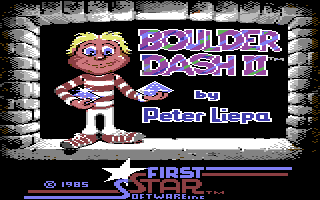
First Star indicated interest in a sequel. Liepa delivered Boulder Dash II: Rockford's Revenge in 1985, based directly on the first game with new cave layouts, new enemies including slime and a magic wall mechanic, and new SID music. The sequel maintained the quality of the original and expanded the franchise.
Boulder Dash Construction Kit arrived in 1986, giving players - and eventually a global fan community - the tools to design and share their own cave sets. It was a prescient product: user-generated content before the term existed. Caves were distributed on bulletin boards and later over the internet.
Boulder Dash III (1986) was published by Epyx in the United States under license, produced by a separate development team, and is considered distinct from the First Star canonical sequence. Liepa had limited involvement - he was consulted on some later projects but Boulder Dash III was largely out of his hands.
Dormancy, Devotion, and BoulderCaves
After the early 1990s First Star Software went quiet on the franchise. The Boulder Dash IP sat dormant for over a decade. What kept it alive was the fan community built around the Construction Kit. BoulderCaves.com emerged as the central hub for fan-created cave sets and an open-source engine that could run them. Thousands of caves were created and shared. The HVSC preserved Liepa's SID compositions, making them available to chiptune enthusiasts worldwide.
The 30th Anniversary and Beyond
In 2014, BBG Entertainment GmbH - with First Star Software's blessing - released Boulder Dash 30th Anniversary on Steam, iOS, and Android. The release included classic cave recreations and new content, with new music alongside Liepa's original compositions. Liepa contributed a cave pack for the mobile version, spending about a month designing 20 new caves using the same methodology he had used in 1983: throw elements on screen, tinker with them, and play until puzzles emerged.
Speedrunning of the original C64 version remains active - records tracked at speedrun.com. The BoulderCaves community continues to host thousands of fan caves. For the modern Boulder Dash landscape, see the Modern page. The key people behind the franchise are profiled on the People page.
"I think with First Star... yeah, this kind of longevity - it was basically one of their few properties and it seemed to be the one that had real legs. I suspect with Electronic Arts we would never have heard of Boulder Dash again."
Peter Liepa, Antic podcast interview, 2015