The Game That Made Gravity a Puzzle
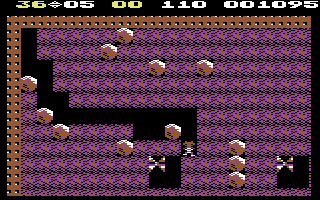
Boulder Dash is a physics puzzle game. Its protagonist, Rockford, navigates underground caves collecting diamonds while avoiding boulders that fall under gravity. That description makes it sound simple. It is not. The game's genius lies in the interaction between its simple rules and the player's movement through them - dig in the wrong direction and a boulder falls and kills you; dig in the right order and a cascade of boulders opens exactly the passage you needed.
What distinguishes Boulder Dash from the contemporaries it superficially resembles - Dig Dug, Miner 2049er, Lode Runner - is that it does not script its dangers. Nothing in Boulder Dash is pre-arranged to punish you. The physics determine what happens, and the physics can surprise both the player and the designer. Liepa called his creation a cellular automaton. It felt alive.

Six Months on Savings
Liepa quit consulting work and lived on savings for the duration of development, renting a desk in a friend's office. He started with Chris Gray's Atari BASIC prototype - a single-screen game with rocks and dirt that reminded him of The Pit. He played it for a few hours and set it aside. Then he started writing physics rules from scratch in Forth.
After two days he had boulders that fell, rolled, and cascaded in ways he found genuinely fascinating. He described sitting in front of a randomly generated grid, removing dirt tiles, and watching boulders interact. "I found myself quite fascinated. I just loved playing with it." That two-day prototype became the foundation for everything.
"After playing it for a few hours, I just thought, you know, this needs more spice. This needs different dynamics. And so I kind of put it aside and just went and started writing. I just started writing some prototype physics for rocks and dirt. Technically, it was a cellular automaton."
Peter Liepa, Antic podcast interview with Kevin Savetz, 2015
The development process involved building multiple tools from scratch: a Forth-based framework, a music editor, a sprite editor, and eventually a complete assembler to handle the final port from Forth to machine language. Liepa wrote his own assembler because the existing one was incomplete. The migration from Forth to assembly was done gradually, porting pieces at a time while keeping the game running.
What the Player Actually Does
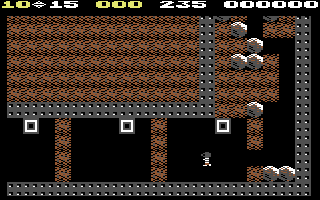
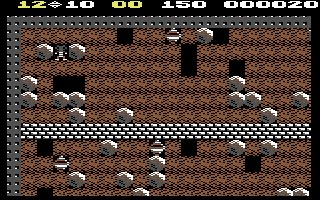
Each cave presents Rockford with a fixed number of diamonds to collect and a time limit. Collecting enough diamonds opens an exit. Reaching the exit completes the cave. In between, Rockford digs through dirt tiles (which disappear permanently), pushes boulders horizontally (when the space beyond is empty), and tries not to get crushed or caught by enemies.
The enemies - fireflies that patrol walls and amoeba that spreads and solidifies - add pressure without being the primary challenge. The primary challenge is physics management: understanding which boulders will fall when you remove which dirt tiles, and planning a path that collects diamonds while keeping boulders from becoming lethal. The game never explains this. It teaches entirely through consequence.
The magic of Boulder Dash is that a cave you complete on your fifth attempt feels genuinely solved - you understood it, built a mental model, and executed a plan. A cave that kills you feels fair. The physics do not lie. You can always work out what happened.
Cellular Automata in 1984
The technical achievement of Boulder Dash is the cellular automaton physics running in real time on an 8-bit computer. Every tile in a cave is either dirt, space, boulder, diamond, amoeba, wall, firefly, or exit. At each tick, the game applies rules to every tile simultaneously. Boulders fall. Amoeba spreads. Fireflies move. Rockford's actions remove dirt, push boulders, collect diamonds.
This model produced emergent behaviour that Liepa could not fully predict or pre-program. When a player digs a particular path, boulders can cascade in ways that create new passages, block exits, or kill enemies. Fireflies caught by falling boulders explode into diamonds - a mechanic that rewards creative use of the physics. These interactions were not scripted. They emerged from the rules.
96% in Zzap!64's First Issue
Zzap!64 reviewed Boulder Dash in its inaugural issue in May 1985, awarding it a 96% Gold Medal - the highest rating the magazine applied. The reviewers called it "a classic that shouldn't be missed by any C64 owner" and praised the addictive gameplay, the physics engine, and the SID music. The Gold Medal in Issue 1 established Boulder Dash as a system-defining title.
The game sold over one million copies across all platforms by 1985. By any measure it was a commercial and critical success. For the full period review coverage see the Reviews page.
What It Built For Everyone Else
Boulder Dash's influence is visible across forty years of game design. The physics-puzzle genre it helped define - where gravity, momentum, and player movement interact in a deterministic system - runs from Boulderdash clones of the 1980s to Sokoban variants, through to indie titles and mobile puzzle games. The cellular automaton model as a game mechanic was unusual in 1984 and became part of the design vocabulary for an entire generation of developers who grew up playing it.
Peter Liepa still receives royalties. The franchise has been in continuous exploitation for forty years. The SID music is preserved in HVSC. The fan community at BoulderCaves.com continues to create new cave packs.