Ten Years Old with a Screwdriver
Archer Donald MacLean was born on 28 January 1962 in Brentwood, Essex. By the time he was ten he had dismantled the family television. By fifteen he was working part-time in a TV repair shop. The technical instinct was congenital - not acquired in school, not learned from a course, but absorbed from a childhood spent taking things apart to see why they worked.
A meeting in 1976 led to work at Ambit International, a relationship that gave him, as he later put it, "unfeasibly large amounts of money on computer hardware, as a school kid." He used it to buy the machines that mattered. His first program was Death Race (1977), a simple machine code racing game for the Nascom 1 and 2 - Z80-based home computers that predated the mass-market microcomputer explosion by two years.
When the Atari 800 arrived in the UK - MacLean purchased one of the first imported units - he began working on something more ambitious. The concept was simple: take Williams Electronics' Defender arcade game, and make something better. He called it Dropzone.
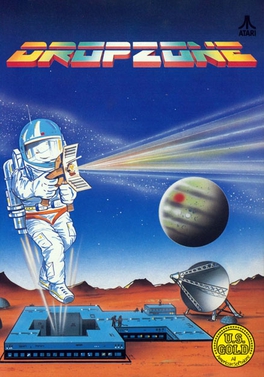
Dropzone and the Case of the Missing Royalties
Dropzone was published in 1984 by U.S. Gold for the Atari 8-bit family, developed under MacLean's company name Arena Graphics. The C64 conversion followed, also written by MacLean himself. He described porting it to the "less capable" C64 as "a real nightmare implementation" - the Commodore had less RAM, a different chip architecture, and a weaker graphics subsystem. He made it work anyway.
"The C64 conversion was a real nightmare implementation. But Dropzone was so strong on the Atari that we had to get it out there on the biggest-selling platform."
Archer MacLean, Halcyon Days interview, dadgum.com
The game reached number one in the UK charts. Zzap!64 awarded it a Gold Medal at 95% in Issue 3. Computer and Video Games called it "one of the finest Atari titles available." MacLean signed a European distribution deal with U.S. Gold - and after eighteen months, the royalty payments stopped. The publisher claimed the game was no longer selling. MacLean kept seeing it on shelves outside Europe and in the United States.
Karate That Wasn't Supposed to Exist
MacLean was asked to help improve the graphics on a karate game being developed by another team. He ended up taking the entire project over and rebuilding it from scratch. The result was International Karate, published in 1986 by System 3.
Under the name "World Karate Championship" in the United States, it became the first European-authored game to reach number one on the US Billboard software chart, in September 1986. Rob Hubbard composed the soundtrack for the C64 version - a rearrangement of a Ryuichi Sakamoto theme that became one of the most celebrated SID tunes in the HVSC archive.
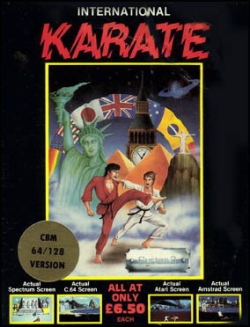
Data East then sued MacLean and System 3, claiming International Karate infringed on Karate Champ. A US appeals court ultimately ruled that no single developer could monopolise an entire sport. The lawsuit failed. MacLean pressed on.
Three Fighters at Once
International Karate+ (IK+) arrived in 1987 with a feature that had never been done before: three simultaneous fighters sharing the same screen. The third character was not an AI-controlled spectator - it was a full participant in every bout, with its own physics, its own animation, its own score. Zzap!64 gave it 97% and a Gold Medal. The Lemon64 community called it "quite simply the best 8-bit fighting game ever made on any platform."
Rob Hubbard's soundtrack won Best 16-Bit Soundtrack at the 1988 Golden Joystick Awards and was performed live at the Symphonic Game Music Concert in Leipzig in August 2005. See the Music page for in-browser SID playback of both the IK and IK+ scores.
The Physics of Snooker
Jimmy White's Whirlwind Snooker (1991), published by Virgin Games, occupied MacLean for long enough that the ball physics simulation alone took several months to perfect. The idea for the Jimmy White license came from TV presenter Jeremy Beadle, who met MacLean at a trade show. Virgin launched a UK nationwide tournament on the game's release; the winner challenged MacLean himself on Channel 4's GamesMaster. MacLean won the Golden Joystick Award for Games Programmer of the Year in 1991-92 largely on this title's strength.
The pool and snooker series continued across a decade: Archer Maclean's Pool (1992), Jimmy White's 2: Cueball (1998), Jimmy White's Cueball World (2001), and Archer Maclean Presents Pool Paradise (2004). In 1994, PC Gamer UK named Jimmy White's Whirlwind Snooker the 37th best computer game of all time.
Later Years and a Lasting Mark
Super Dropzone (1994), published by Psygnosis for the SNES, brought MacLean back to his signature subject with new weapon types and end-level bosses. Many ideas sketched for an unreleased C64 Dropzone sequel resurfaced here. MacLean's Mercury (2005) for PSP introduced a puzzle-game format and spawned a short series. He co-founded Awesome Studios in 2002, contributed a column to Retro Gamer magazine, and remained a visible presence at UK gaming events.
Archer MacLean died on 17 December 2022, at the age of 60, after a long battle with cancer. Dropzone's 40th Anniversary Edition was published in December 2024 by System 3 for PC, Switch, PS5, and Xbox Series X/S, based on his original source code. The game that launched his career, preserved and rereleased two years after his death.
Sources
- Halcyon Days interview - dadgum.com: dadgum.com/halcyon/BOOK/MACLEAN.HTM
- Wikipedia - Archer Maclean: en.wikipedia.org/wiki/Archer_Maclean
- Wikipedia - Dropzone: en.wikipedia.org/wiki/Dropzone
- Wikipedia - International Karate+: en.wikipedia.org/wiki/International_Karate_%2B
- PC Gamer obituary: pcgamer.com