Better Than the Game It Was Based On
Dropzone appeared in 1984, published by U.S. Gold for the Atari 8-bit family. It was written by one person - Archer MacLean, operating under the company name Arena Graphics - and it was unambiguously based on Williams Electronics' Defender. Critics said it was better. They were probably right.
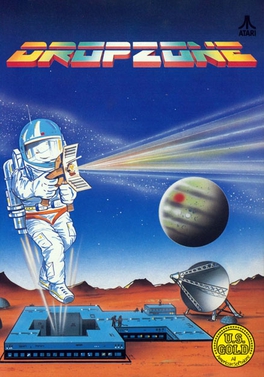
Defender was a technically demanding arcade game - a scrolling shooter with a wide playfield, multiple enemy types, a radar display, and a mechanic built around protecting humanoids from abduction. MacLean took the structure and rebuilt it for home hardware, retaining the complexity while tightening the gameplay loop. On the Atari 800, the results were remarkable. The game ran at a smooth frame rate with enemies that behaved distinctly, a radar that functioned correctly, and visual polish well beyond the norm for 1984.
One Atari, One Bedroom, Two Years
MacLean had purchased one of the first Atari 800s imported into the United Kingdom. The machine gave him a platform with genuine colour graphics, hardware sprites, and a sound chip capable of more than beeps. He spent the time between acquiring the machine and publishing Dropzone building up the technical knowledge to exploit it fully. There was no team, no publisher involvement in the development process, no QA department. Just MacLean, the code, and the hardware.
The C64 conversion came next. MacLean ported it himself, and described the experience in the Halcyon Days interview as "a real nightmare implementation." The Commodore 64's hardware was genuinely different from the Atari's - different memory map, different chip architecture, a more constrained sprite system. Getting Dropzone's engine to run on it at acceptable quality took sustained effort. He did it anyway.
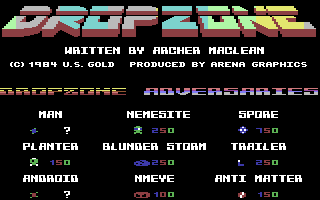
"The C64 conversion was a real nightmare implementation. But Dropzone was so strong on the Atari that we had to get it out there on the biggest-selling platform."
Archer MacLean, Halcyon Days interview, dadgum.com
What Made It Harder to Put Down Than Defender
Defender's difficulty curve was brutal in a way that often felt arbitrary. Dropzone's was precise. The wave design escalated in a manner that felt authored - each new enemy type introduced at a moment when the player had just mastered dealing with the previous set. The radar display was accurate and readable. The humanoid abduction mechanic created immediate, legible stakes without overwhelming the main shooting task.
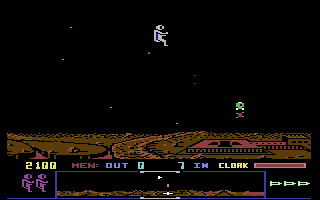
MacLean prioritised responsiveness. The ship controls felt tight and predictable. The hitbox on the player's ship was honest. When you died in Dropzone, you usually understood why. That clarity - that sense that the game was fair even when it was difficult - separated it from Defender and from most contemporary shooters. See the full screenshot gallery for the game in motion across C64 and Atari platforms.
Ninety-Five Percent and a Number One Chart Position
Zzap!64 reviewed Dropzone in Issue 3 (July 1985), awarding it a Gold Medal at 95%. "Graphically it's superb, sonically it's amazing, and playability is on a par with all the best arcade machines around today... Dropzone is an absolute gem of a game." Computer and Video Games called it "one of the finest Atari titles available." The game reached number one in the UK charts and remained on sale for five or six years.
Forty Years Later, Still in Print
Dropzone's 40th Anniversary Edition was published in December 2024 by System 3 for PC (Steam), Nintendo Switch, PlayStation 5, and Xbox Series X/S, built from MacLean's original source code. It included toggleable upgraded graphics, save states, and up to four-player multiplayer - features that the original could never have supported. The game that launched a career in 1984 was still selling in 2024. See the Resources page for the modern port link and the Games page for catalogue context.