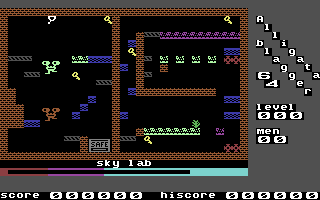
Blagger 1983 · C64
The bouncy, energetic arcade theme that became one of the most recognised SID tunes of 1983.
Crowther's composition perfectly captures the game's playful bank-robber energy:
melodic, rhythmic, and instantly memorable.
HVSC: MUSICIANS/C/Crowther_Antony/Blagger.sid
Haunted House 1983 · C64
Spooky, chromatic SID writing for one of Crowther's early Alligata horror titles.
Two subtunes covering the title screen and in-game play.
HVSC: MUSICIANS/C/Crowther_Antony/Haunted_House.sid
Loco 1983 · C64
Train-themed SID music driving a fast-paced arcade game inspired by Sega's Super Locomotive.
Crowther's early command of the SID chip: locked rhythm, energetic melody, and a tempo
that matches the game's mechanical intensity.
HVSC: MUSICIANS/C/Crowther_Antony/Loco.sid
Gnasher 1983 · C64
Pac-Man inspired gameplay with Crowther's own SID score. A tight, looping arcade theme
designed to serve the gameplay rather than showcase the chip.
HVSC: MUSICIANS/C/Crowther_Antony/Gnasher.sid
Suicide Express 1984 · C64
A harder, faster SID score for a harder, faster train game. Urgent and relentless
across four subtunes, demonstrating a deliberate step towards more intense atmospheric
SID writing. Title, In-Game, High Score, and Game Over.
HVSC: MUSICIANS/C/Crowther_Antony/Suicide_Express.sid
Monty Mole 1985 · C64
Crowther's contribution to the Monty Mole series. A bouncy, characterful SID piece
that suits the mole's underground escape narrative.
HVSC: MUSICIANS/C/Crowther_Antony/Monty_Mole.sid
Son of Blagger 1985 · C64
The sequel carries forward Blagger's musical energy with two subtunes. Crowther's
SID writing had matured by 1985 and the greater melodic range shows it.
HVSC: MUSICIANS/C/Crowther_Antony/Son_of_Blagger.sid
Blagger Goes to Hollywood 1985 · C64
The third Blagger title takes the franchise to Hollywood. Crowther's SID score keeps
the series' characteristic energy while nodding to its cinematic setting.
HVSC: MUSICIANS/C/Crowther_Antony/Blagger_Goes_to_Hollywood.sid
Aliens 1986 · C64
A significant step forward in Crowther's compositional maturity. Atmospheric and tense
rather than melodic, capturing the James Cameron film's sense of dread in three chip voices.
HVSC: MUSICIANS/C/Crowther_Antony/Aliens.sid
Fernandez Must Die 1988 · C64
Military run-and-gun SID score from Crowther's later career. More complex harmonic
writing than his 1983 work, showing the progression in his compositional approach.
HVSC: MUSICIANS/C/Crowther_Antony/Fernandez_Must_Die.sid
Blinky's Scary School 1990 · C64
A playful, cartoon-horror SID score perfectly suited to the ghost-in-a-school setting.
One of Crowther's final C64 compositions, showing his full command of the SID chip at
the end of the era.
HVSC: MUSICIANS/C/Crowther_Antony/Blinky's_Scary_School.sid
W.E.M.U.S.I.C. & Collaboration
In 1985, Crowther co-founded W.E.M.U.S.I.C. (We Make Use of Sound In Computers)
with Ben Daglish, the composer who had written the music for Crowther's
game Loco. The collective aimed to bring together talented computer musicians for the UK
games industry — recognising that SID chip composition was a specialist skill that
deserved professional organisation.
While Crowther continued to compose his own SID music for most of his games, the
W.E.M.U.S.I.C. connection brought him into the broader network of C64-era composers
— Rob Hubbard, Martin Galway, David Whittaker — who were transforming
what the SID chip could do.
About the SID Chip
The Commodore 64's SID (Sound Interface Device) chip, designed by Bob Yannes in 1981,
gave C64 programmers three independent voices with ADSR envelope control, ring modulation,
and filter capability. Crowther — approaching it as a programmer first — wrote
music that served his games: functional, characterful, and always appropriate to the
gameplay context.
The High Voltage SID Collection (HVSC) is the definitive archive of C64
SID music, containing over 50,000 tunes. Crowther's compositions are at
MUSICIANS/C/Crowther_Antony/.
Browse the archive at hvsc.c64.org →
DeepSID provides in-browser SID playback without plugins.
Open DeepSID →