Three games. One decade. The titles that trace the full arc of Crowther's career on the C64.
Flagship titles
1983 · Alligata Software · C64, ZX Spectrum, BBC Micro
Blagger
Programmed, graphics, and music by Antony Crowther
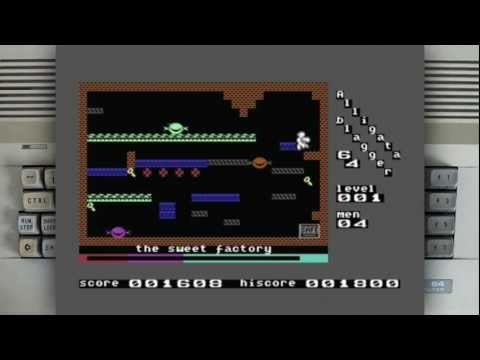
Blagger is a single-screen platform game in which the player controls
a bank robber navigating a series of platforms, collecting keys and avoiding hazards to
reach the exit. Its immediate forebear is the Atari arcade game Bagman (1982), and the
influence is visible — but Crowther translated it to the C64 with his own graphics
and SID score, producing something that felt native to the machine rather than ported.
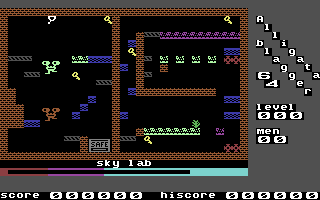
Blagger (C64) — the single-screen platform structure that defined the game
Published by Alligata in 1983, Blagger hit the UK C64 charts almost immediately. The
combination of tight, responsive controls, clear visual design, and addictive one-more-go
structure was precisely calibrated for the bedroom gaming market. Players returning to
it now find it holding up better than most of its contemporaries: the game communicates
what it wants from you instantly, and delivering it is genuinely satisfying.
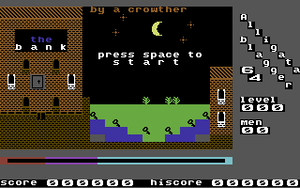
Blagger (C64) — title screen. Crowther's distinctive visual style established from the opening frame.
The SID music — Crowther's own composition — is a bouncy, characterful theme
that lodged itself in the memory of anyone who played the game in 1983. It is the kind
of SID writing that demonstrates the composer understanding both the constraints and the
opportunities of the chip: not trying to reproduce orchestral sounds, but finding something
that could only exist on the C64.
"I wrote Blagger very quickly. Alligata were happy to take whatever I produced.
I just sat down and did it — the programming, the graphics, the music.
Everything came from me."
— Antony Crowther, Your Commodore interview, 1984
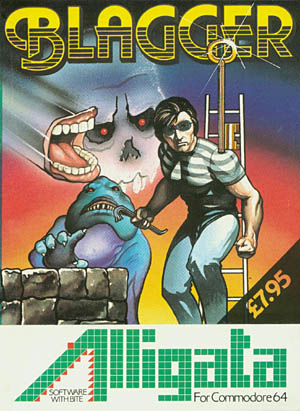
Blagger (1983) — Alligata Software. The physical product that hit the UK charts.
Blagger was followed by Son of Blagger and Blagger Goes to Hollywood,
both in 1985. The character and the brand had legs. The 1983 original, however, is the
one that matters: the game that made Crowther's name and established that a solo teenager
in a bedroom could produce something the market wanted.
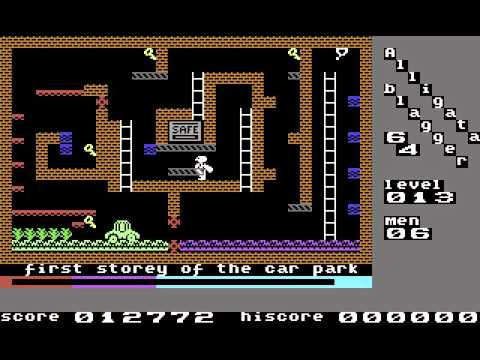
Blagger (C64 Longplay, 50 FPS)
1986 · Electric Dreams · C64
Aliens
Programmed, graphics, and music by Antony Crowther
James Cameron's Aliens (1986) was one of the defining film events of the decade,
and the licensed game — published by Electric Dreams — was
one of the most anticipated C64 titles of the year. Crowther handled all aspects of the
development solo.
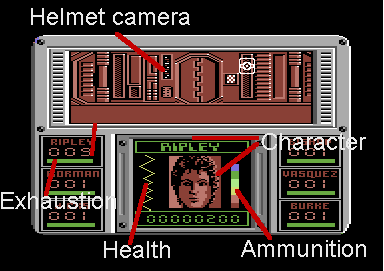
Aliens (C64) — the marine combat section, one of three distinct play styles
The game is a multi-section action title that works through the film's key sequences:
the colony, the APC approach, the dropship level, the alien hive. Each section plays
differently, a structural ambition that was unusual for licensed games of the era, which
typically settled on a single mechanic and repeated it. Crowther built a variety of
play styles into a single product.
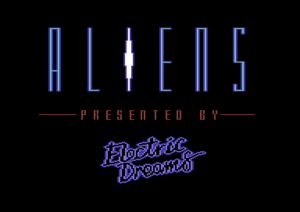
Aliens (C64) — loading screen. The atmospheric presentation matched the film's tension.
The SID score is Crowther at his most atmospheric. Rather than the bouncy arcade themes
of the Alligata years, the Aliens music captures the film's tension — slow, tense,
mechanically threatening. He was using the SID chip to do something harder than a melody:
to establish a mood and sustain it. Zzap!64 responded positively. The game reviewed well
and sold well, demonstrating that the solo-developer bedroom approach could scale to
major licence territory.
"Crowther has done the licence justice. Each section feels distinct, the graphics
are as good as the hardware allows, and the music genuinely creates tension."
— Zzap!64 review, Issue 18, October 1986
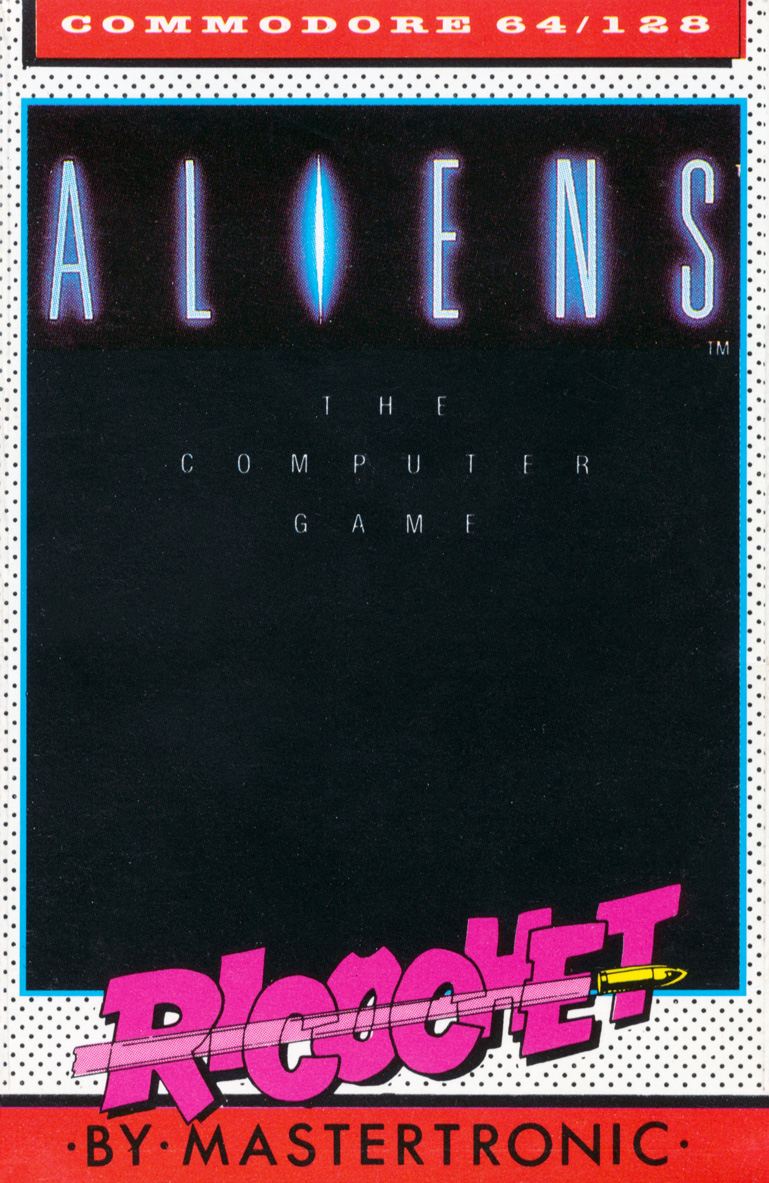
Aliens (1986) — Electric Dreams. The most high-profile release of Crowther's career.
Aliens sits at the high point of Crowther's C64 work. After the arcade simplicity of
Blagger and the prolific Alligata period, it shows a developer who had grown in
sophistication without losing the speed or the discipline.
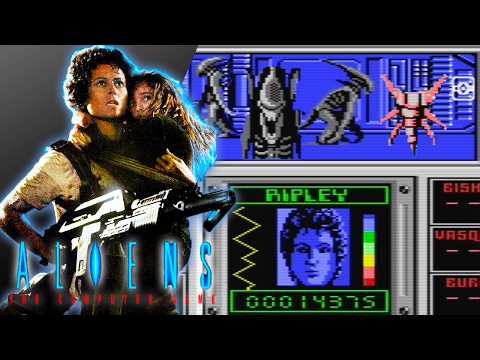
Aliens: The Computer Game (C64 Longplay)
1988 · Electronic Arts · C64, Amiga
Skimmer
Programmed, graphics, and music by Antony Crowther
Skimmer (1988), published by Electronic Arts, was Crowther's
most demanding production. EA was — by 1988 — the most commercially and technically
sophisticated publisher operating in the C64 / Amiga market. Their quality bar was different
from Alligata's, and their expectations of a developer were different too.
Skimmer (C64) — the smooth scrolling hovercraft action that met EA's quality bar
Crowther met them. Skimmer is a hovercraft action game — technically accomplished,
visually polished, and designed to showcase what the C64 and Amiga could do when pushed.
The C64 version is a remarkable piece of assembly programming: smooth scrolling, responsive
physics, and the visual texture of a developer who understood his hardware at the machine
level.
"Working for Electronic Arts was a different level of pressure. They expected everything
to be right, technically and commercially. With Skimmer I had to deliver C64 and Amiga
versions, both to their standard. I just got on with it."
— Antony Crowther, Commodore User interview, 1988
Skimmer (1988) — Electronic Arts. The EA imprint was a mark of quality expectations in 1988.
The Amiga version is the most technically demanding thing Crowther shipped. Moving from
the 6510 to the 68000, from SID to the Amiga's Paula chip, from PETSCII constraints to
the HAM colour mode — these are real transitions, not just resolution bumps. That
Crowther handled them without a team speaks to both his technical range and his work ethic.
Skimmer (Amiga) — the 16-bit conversion that demonstrated Crowther's cross-platform range.
Skimmer may not be the best-remembered Crowther title — Blagger and Aliens have
the stronger nostalgic footprint — but it is the most technically impressive. It
shows a developer who had moved from bedroom charts to major publisher quality at the
highest technical level the 8-bit / 16-bit transition demanded.