Deep reads

Flagship Titles

Four games that define what Graftgold stood for - and why they still hold up.

01 / 04

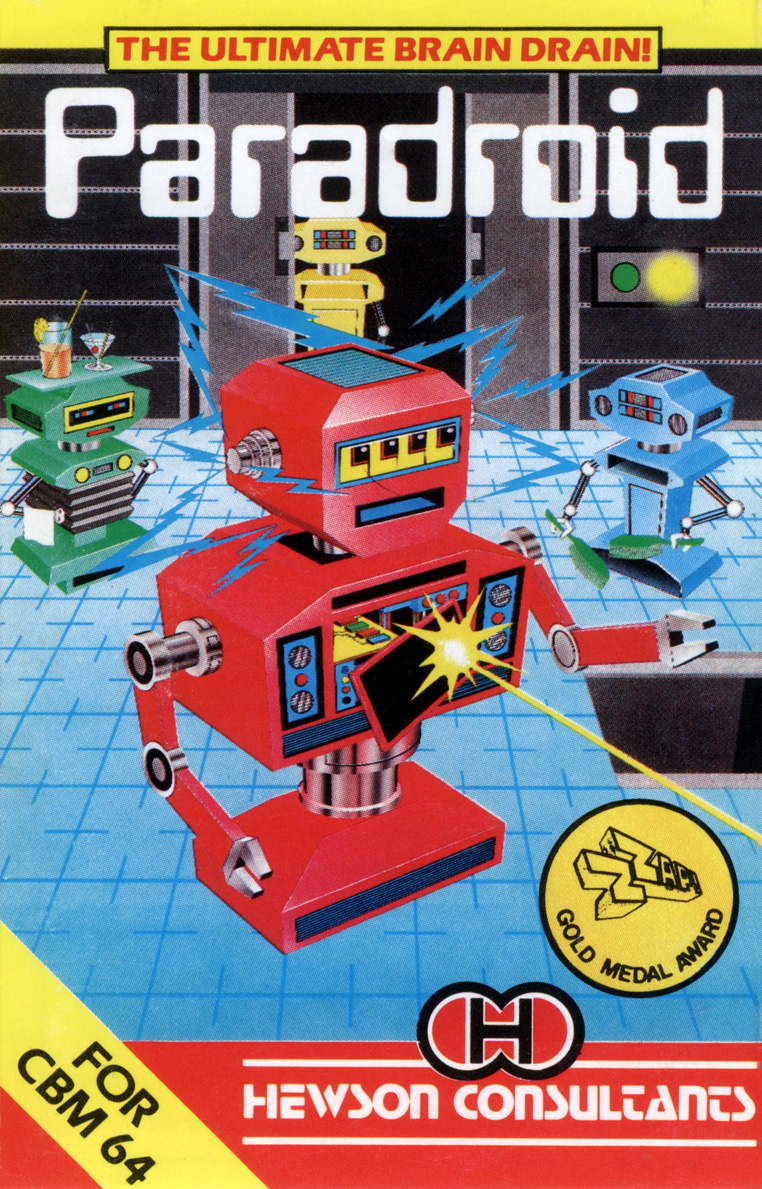
Paradroid

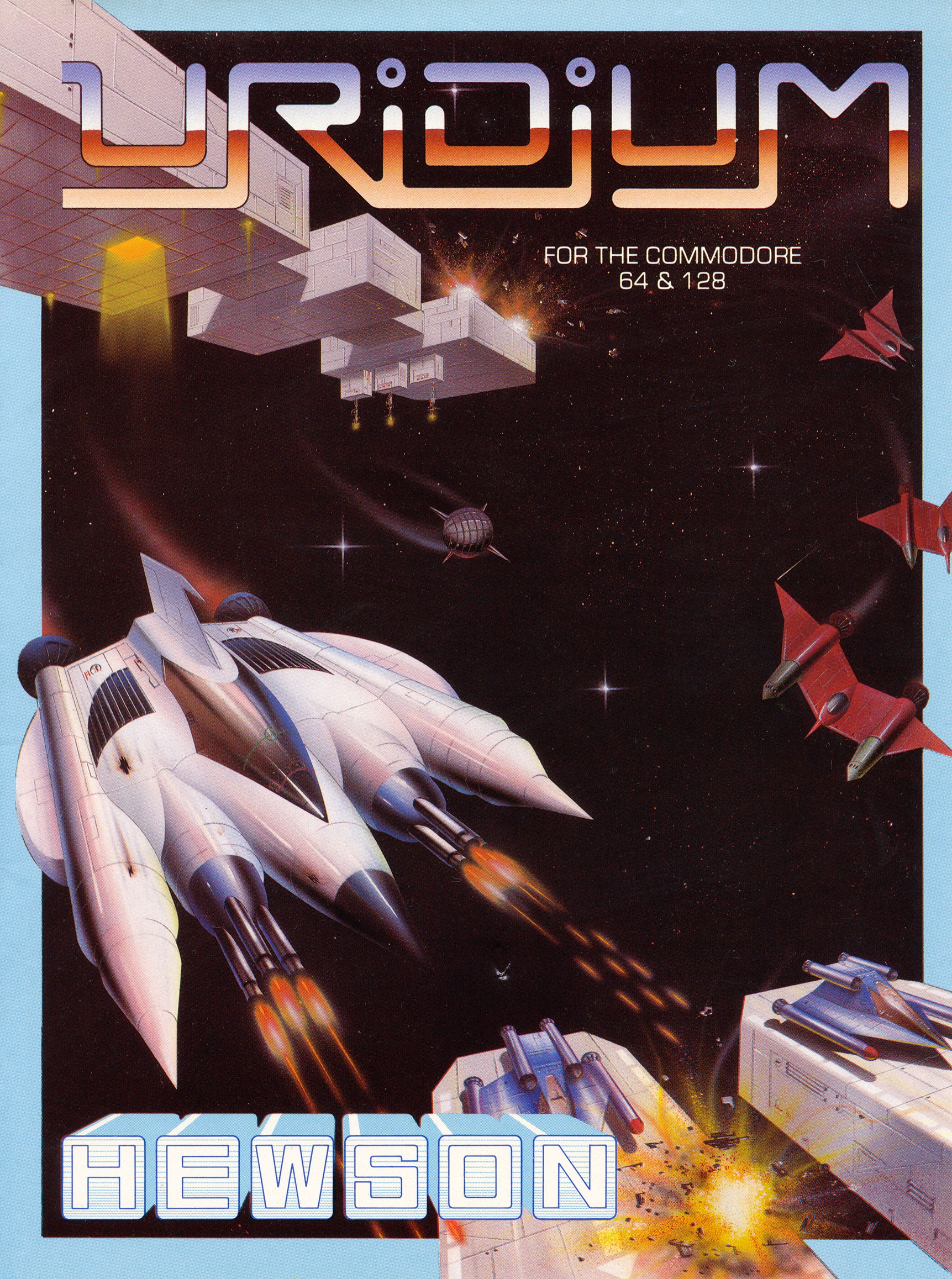
Paradroid - original Hewson Consultants cassette box art, 1985
Paradroid, Hewson Consultants, 1985

Paradroid is the game that secured Andrew Braybrook's reputation, and forty years on it holds up as one of the most elegant designs in the C64 library. The premise is compact: a fleet of spacecraft has been overrun by its own robot crew. You control the Influence Device - the lowliest droid aboard - and must work up the robot hierarchy by taking over progressively more powerful units through the game's circuit-combat mini-game. There is nothing quite like it on any platform from 1985.

The premise is a 2000 AD comic strip compressed into 64 kilobytes. The robots are numbered 101 through 999, with the number indicating combat class. Every droid you encounter is tagged with its rank before the fight begins. You know going in whether you are the underdog or the favourite. That single design decision - making the power hierarchy legible at a glance - shapes every second of play.

Fourteen Months in a Stroud Bedroom

Braybrook documented the development of Paradroid in a diary published across multiple issues of Zzap!64 beginning in late 1984. The diary is extraordinary reading: pages of pseudocode, design diagrams, honest accounts of dead ends, and the gradual emergence of the circuit-combat concept from what he described as a need to make each takeover encounter feel genuinely risky. He was sole programmer, designer, and composer on the project.

The studio he co-founded with Steve Turner in 1983, Graftgold, was at this point two people working from Stroud, Gloucestershire. No publisher's art department. No dedicated audio team. Braybrook composed the SID score himself alongside the code. The diary - available in archived form at zzap64.co.uk and archive.org - they are among the most detailed primary documents of the C64 golden age.

The transfer game needed to feel like a real struggle. If it was too easy there was no reason to fear the higher-class droids. If it was too random, skill became irrelevant. The circuit layout changes every time, so you have to read it fast and work with what you're given.

- Andrew Braybrook, Zzap!64 development diary (archived at zzap64.co.uk)

The Smallest Droid in the Biggest Fight
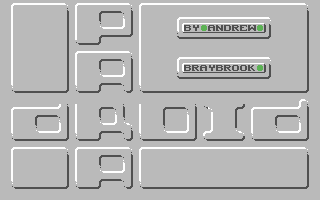
Paradroid gameplay - the Influence Device navigating a spacecraft corridor, with droids patrolling
Paradroid (C64) - the Influence Device navigating a corridor on board one of the eight spacecraft

Paradroid's gameplay has two distinct modes that snap between each other without ceremony. In exploration mode, you navigate the ship's corridors - the Influence Device is fragile, far weaker than most of the droids it will face. You can shoot, but a direct confrontation with a high-class unit is usually fatal. The game rewards scouting and avoidance over aggression.

Initiate contact with a droid and the screen switches to the transfer game: a shared circuit board where both players are represented as competing currents. The goal is to control more nodes than your opponent before the timer expires. It is a puzzle, a test of rapid pattern recognition, and a timed decision problem - all in a sub-game that lasts perhaps fifteen seconds.

Win the transfer and you inhabit the droid - seeing the game from its higher power level, able to take on units that would have destroyed the Influence Device. Each ship has sixteen floors. Clear the droids from all eight ships and the game is won. But each controlled droid has an energy supply that drains with use, and the only way to sustain it is to keep fighting. The game does not let you rest.

A Puzzle Hidden Inside a Shoot-Em-Up
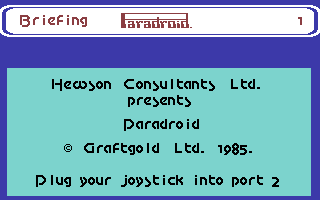
Paradroid transfer game - the circuit board mini-game during a droid takeover attempt
The transfer game - Paradroid's circuit-board mini-game, which generates a new layout for every encounter

What Braybrook achieved technically was to embed a fully realised puzzle game inside an action game without either disrupting the pace. The C64's 6510 processor had to manage the spaceship environment, the patrolling AI, the SID music, and the entire transfer mini-game within the same loop. The diary documents the optimisation process in detail: areas where initial approaches were too slow, solutions found through careful restructuring of the code rather than raw efficiency gains.

The robot AI - limited by the hardware - nonetheless creates a convincing impression of autonomous behaviour. Different droid classes move differently, respond differently to threat, and patrol different areas of the ship. The overall effect is a sense that the spacecraft is a functioning environment rather than a shooting gallery.

Ninety-Seven Percent and the Golden Joystick

Zzap!64 Issue 7 (November 1985) awarded Paradroid a Sizzler rating of 97%. The review, which ran to several columns across the magazine's multi-reviewer format, called the circuit combat system "one of the cleverest and most original ideas we have seen in a game of this type" and praised the consistency of the design - every element serving the core loop without extraneous features.

In 1986, Paradroid won the Golden Joystick Award - at the time the most prestigious mainstream games industry recognition in the UK. That the award covered 1985 releases meant it competed against every title of a remarkable year. It won on merit. Braybrook was named Best Programmer of the Year at the same ceremony.

Still Played, Still Studied, Still Unmatched

Paradroid has been ported and remade many times - official conversions for the Amiga, Atari ST, ZX Spectrum, Amstrad CPC, and BBC Micro followed the original, along with Paradroid 90 (1990), an Amiga-native remake that rebuilt the visuals entirely while preserving the core mechanics. The original C64 version remains the definitive one.

The game continues to be discussed in the context of emergent gameplay and systemic design. The relationship between exploration, combat, and resource management - power draining constantly, droids always patrolling, the transfer game always a gamble - creates a loop that holds up against modern analysis as well as it does against memory. See the People page for Braybrook's biography, and the full studio history for context on how Paradroid fits within Graftgold's arc.
View in catalogue → Music: SID → Reviews → Studio history → Play today →

02 / 04

Uridium

Uridium - original Hewson Consultants cassette box art, 1986
Uridium, Hewson Consultants, 1986

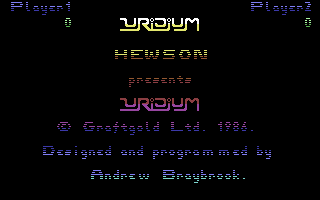
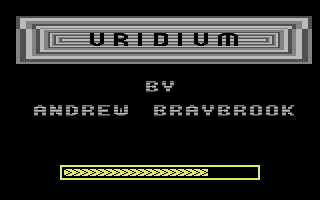
Uridium is, by any measure, a remarkable piece of work. A horizontal shoot-em-up in which the player strafes the surface of fifteen alien dreadnoughts - each with its own surface geography, turret placement, and obstacle pattern to learn and exploit - it ran at a speed that was, in 1986, genuinely shocking on the C64. Braybrook completed it in approximately six weeks.

Six Weeks from Concept to Cassette

The rapid development of Uridium is well-documented in Braybrook's own retrospective interviews and in the Zzap!64 development diary he wrote during the period. He had a clear picture of the mechanic he wanted - a game about navigating a hostile surface at high speed and landing cleanly after clearing the enemy craft - and moved toward it directly.

I wrote Uridium in about six weeks. I had a clear picture of what I wanted, and the C64 just about managed to keep up with it.

- Andrew Braybrook, Retro Gamer, "Making Of Uridium"

Rob Hubbard composed the title music after the game was otherwise complete. It is one of the most celebrated SID compositions ever written: driving, atmospheric, technically demanding on the chip. The SID chip's three oscillators are pushed hard, and Hubbard's exploitation of the hardware gives the title screen a density of sound that prepares the player for the speed of what follows.

Strafe, Destroy, Land

Uridium gameplay - the Manta fighter strafing the surface of an alien dreadnought
Uridium (C64) - the Manta fighter navigating the surface of one of the fifteen dreadnoughts

Each level in Uridium follows the same structure: the Manta fighter flies over the surface of a dreadnought, destroying the craft's complement of enemy fighters while avoiding the ship's own defensive gun emplacements and the surface obstacles - gaps, pylons, and raised sections that require precise altitude control at high speed.

Once all enemy fighters are destroyed, the dreadnought begins to glow and a landing strip becomes active. The player must bring the Manta down onto the moving strip in a controlled landing. Get it wrong and the Manta crashes. The landing sequence is brief but demanding - a moment of fine precision after the chaos of the strafing run.

The fifteen dreadnoughts are individually named (Midas, Orchid, and others) and each has a distinct surface layout. As the player progresses, the gap patterns become more demanding and the enemy fighter formations more aggressive. The game escalates without ever changing its fundamental mechanics - the same problem, progressively harder.

Speed the Hardware Wasn't Designed to Give

What Braybrook achieved technically in Uridium was speed. The C64's 6510 CPU runs at approximately 1 MHz - a constraint that makes the scrolling speed of Uridium's surface look, to any contemporary player, physically impossible. He achieved it through careful optimisation: minimising what was drawn, what was updated, and what was checked on each cycle. The diary documents the approach in accessible technical terms.

The scrolling is smooth at a rate that places it well above comparable titles of the period. Contemporary players and reviewers noted it immediately. The surface detail - obstacles, gaps, gun emplacements, the dreadnought's own hull texture - is preserved at full speed. Nothing is simplified or removed to achieve the framerate.

A Sizzler That Didn't Need Six Weeks to Earn

Uridium landing sequence - the Manta approaching the dreadnought landing strip
Uridium (C64) - the landing sequence at the end of each dreadnought level requires precision after the strafing run

Zzap!64 awarded Uridium a Sizzler - the magazine's highest commendation, reserved for games scoring above 90%. The review praised the game's technical achievement directly and pointed to the landing mechanic as the element that distinguished it from contemporary shoot-em-ups. Retro Gamer's retrospective "Making Of" feature, published years later, gave Braybrook space to describe the development process at length.

Ports followed for the Amiga, Atari ST, DOS, ZX Spectrum, Amstrad CPC, and BBC Micro. The C64 original retains a particular authority: the optimisation required to achieve that speed on that hardware was a specific achievement, and later ports on more capable machines did not need to work as hard to approximate the experience.

The Sequel Arrived Seven Years Later

Uridium 2 (1993, Amiga) expanded the original's structure with multi-stage missions, detailed Amiga-era graphics, and a Jason Page score. It is an accomplished follow-up and was well received. But the original remains the primary object: the game that demonstrated in 1986 what a single programmer working alone could achieve on a home microcomputer with six weeks and a clear idea. See the annotated Uridium source for a technical deep-dive into the C64 code.

View in catalogue → Music: Rob Hubbard SID → Reviews → Studio history → Modern: annotated source → Play today →

03 / 04

Gribbly's Day Out

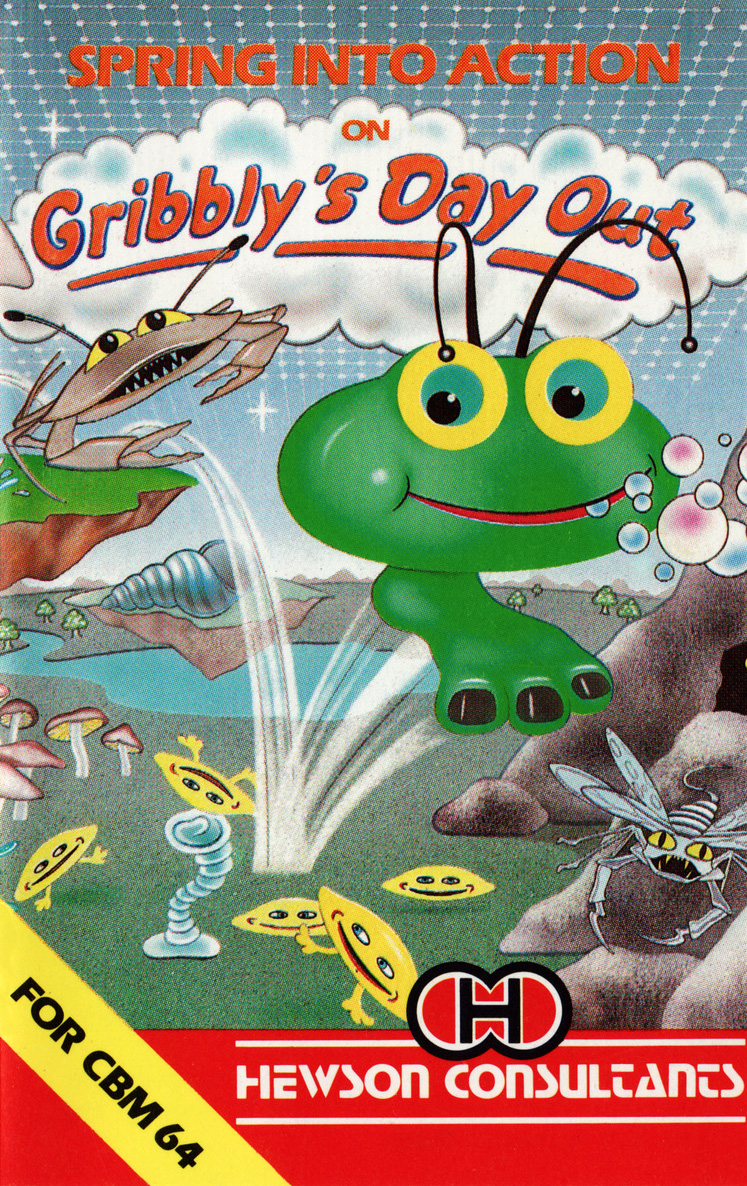
Gribbly's Day Out - Hewson Consultants cassette box art, 1985
Gribbly's Day Out, Hewson Consultants, 1985

Gribbly's Day Out appeared in 1985 - the same year as Paradroid - and shows a side of Braybrook's design instincts that his shoot-em-up work tended to obscure. Where Paradroid is systematic and clinical, Gribbly is warm and strange. The protagonist is Gribbly Grobbly, a Blabgorian from planet Blabgor, described as the most advanced species in the known universe. His task is to rescue Gribblets - infant Blabgorians who have wandered into a dangerous world - without harming them in the process of defending them.

The Second Major Game of a Single Year

That Braybrook produced both Paradroid and Gribbly's Day Out in 1985 is a remarkable output. They are not similar games - different genre, different tone, different mechanical concerns - which means the dual achievement cannot be attributed to a single creative impulse applied twice. Braybrook was working on both levels simultaneously, as a solo developer, and delivering finished work in both directions.

Gribbly's Day Out was published by Hewson Consultants alongside Paradroid. The two games appeared in the same issue of Zzap!64 (Issue 7, November 1985), reviewed side by side as the work of the same programmer. That pairing was, in retrospect, the best possible summary of what Graftgold could do: the studio's range was apparent from the first review.

Protect the Gribblets - Without Shooting Them

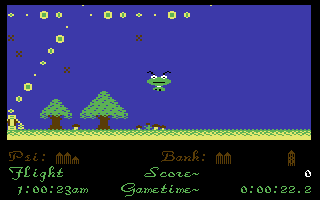
Gribbly's Day Out gameplay - Gribbly Grobbly rescuing Gribblets from the alien world
Gribbly's Day Out (C64) - Gribbly navigating the alien world, where Gribblets must be guided to safety

The mechanic is built around parental protection rather than combat. Gribbly can generate a protective force that repels enemies, but must position himself carefully - too aggressive and he risks harming the Gribblets he is trying to save. The game rewards patient, thoughtful play rather than reflexes alone. Different Gribblets have different behaviours: some will follow, some will wander, some will be pulled toward hazards.

The sixteen levels are played in a random order (with the exception of the first and last), so experienced players encounter genuine variation on repeat playthroughs. This was unusual for 1985 - most platformers of the period used fixed level sequences.

Random Levels Before Random Was Normal

Technically, the game manages the Gribblets as individual entities with their own states - each one tracking its position, behaviour mode, and proximity to threats. This was non-trivial on the C64's limited resources. The result is a game where each level feels populated and alive rather than static: the Gribblets move, react, and create unexpected situations that the player must respond to in real time.

The Year's Most Original Platformer, Made by the Same Person Who Made Its Best Shooter

Gribbly's Day Out - later level with more complex terrain and Gribblet placement
Gribbly's Day Out (C64) - a more complex level arrangement, with Gribblets scattered across challenging terrain

Gribbly was a complete change of pace from Paradroid. I wanted something that had warmth to it - a character you cared about, a problem that wasn't just about shooting things. The Gribblets had to feel like they needed protecting, not just collecting.

- Andrew Braybrook, The Graftgold Story (Fusion Retro Books, 2022)

Zzap!64's review praised the game's originality and noted the contrast with Paradroid in terms of both theme and tone - that both came from the same programmer in the same year was held up as evidence of exceptional range. The game was a commercial success and remained in Hewson Consultants' catalogue for several years.

The Odd Game Out That Proves the Whole Point

Gribbly's Day Out is the entry in the Graftgold canon that tends to be overlooked - overshadowed by Paradroid and Uridium's stronger critical reputations. That is its own argument: that a game capable of being overshadowed by your other work from the same year required exceptional output as a baseline. The game's alien-parenting mechanic anticipated design directions that would not become mainstream for another decade. See the studio history for the full Graftgold context.

View in catalogue → Music: SID → Studio history → Play today →

04 / 04

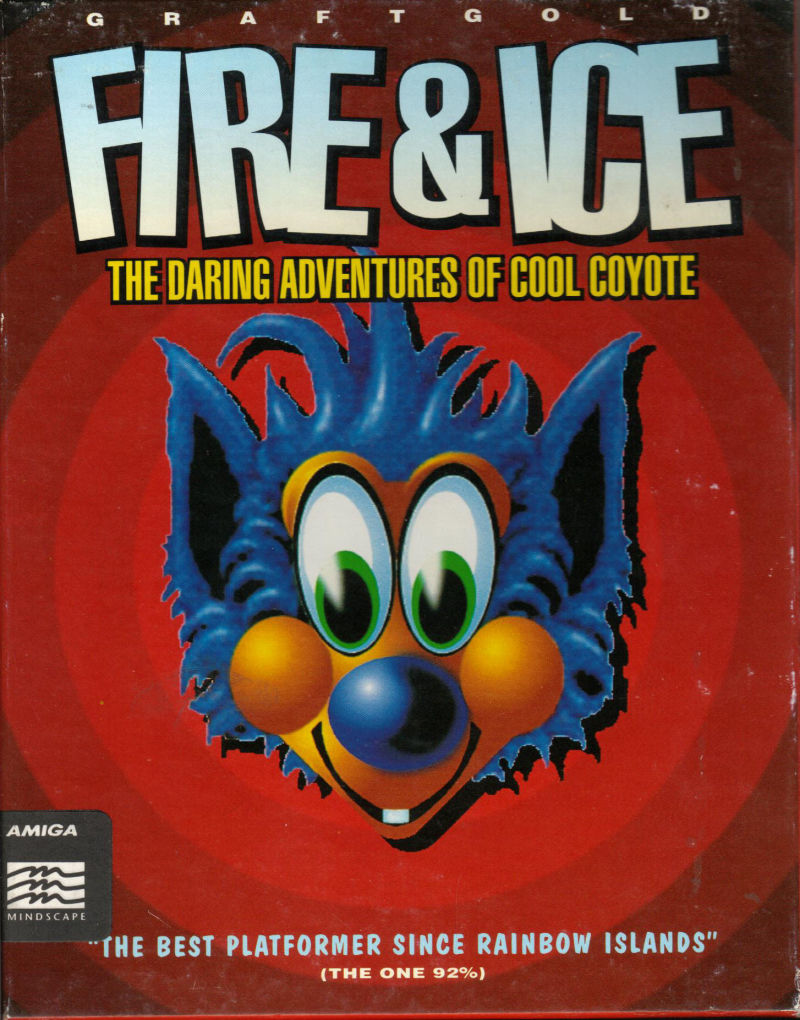
Fire & Ice

Fire and Ice: The Daring Adventures of Cool Coyote - box art, 1992
Fire & Ice, Renegade Software, 1992

Fire & Ice: The Daring Adventures of Cool Coyote arrived in 1992 after seven years of shoot-em-ups - the most striking departure in the Graftgold catalogue. Where the C64 titles were defined by precision and restraint, Fire & Ice is generous and colourful: lush Amiga scrolling landscapes, a fully animated protagonist who throws snowballs at fire-themed enemies, and a musical score from Jason Page that had more in common with contemporary animated features than with anything Graftgold had released before.

After Seven Years of Shoot-Em-Ups, a Change of Direction

The decision to move from shoot-em-ups to a platformer was deliberate. By 1990, Graftgold had established a strong reputation through Paradroid, Uridium, and Morpheus, and had successfully transitioned to the Amiga with Paradroid 90 and Rainbow Islands. But the shoot-em-up genre was becoming crowded, and Braybrook was interested in the design problems that platformers presented - character animation, multi-layered scroll, level design that rewarded exploration over reflex.

I wanted to try something different - a game with a character at its centre rather than a ship or a droid. The platformer genre gave me problems I hadn't solved before. That was the appeal of it.

- Andrew Braybrook, The Graftgold Story (Fusion Retro Books, 2022)

Jason Page was brought in as composer for the project - his first collaboration with Graftgold. Page had built a strong reputation for his Amiga and C64 music, and his score for Fire & Ice is one of the most accomplished platformer soundtracks of the era: playful, melodic, and exactly matched to the game's visual character. His involvement defined the Amiga-era sound of the studio.

Snowballs and Precise Jumps

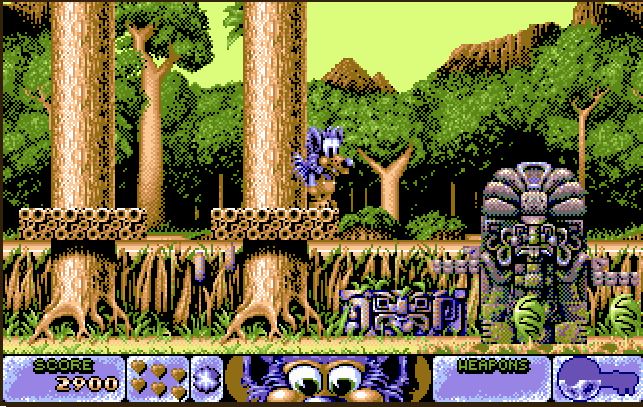
Fire and Ice gameplay - Cool Coyote on an ice world, surrounded by fire enemies
Fire & Ice (Amiga) - Cool Coyote navigating one of the game's themed worlds

Cool Coyote's primary weapon is snowballs - thrown in a low arc that requires the player to anticipate rather than aim directly. Fire-themed enemies are vulnerable to cold. The game's levels are built around fire/ice contrast: hot environments populated by fire creatures, cold environments that provide momentary safety. The visual language is consistent throughout - the game's colour palette and enemy design are tightly integrated with the core mechanic.

The level design rewards exploration. Hidden routes, bonus items, and alternate exits give players reason to move through the levels carefully rather than rushing. The platforming demands precision - Cool Coyote's jump arc is responsive and readable, with a weight that distinguishes it from the floatier movement of contemporary competitors.

Parallax Scrolling When the Amiga Was Running Out of Time

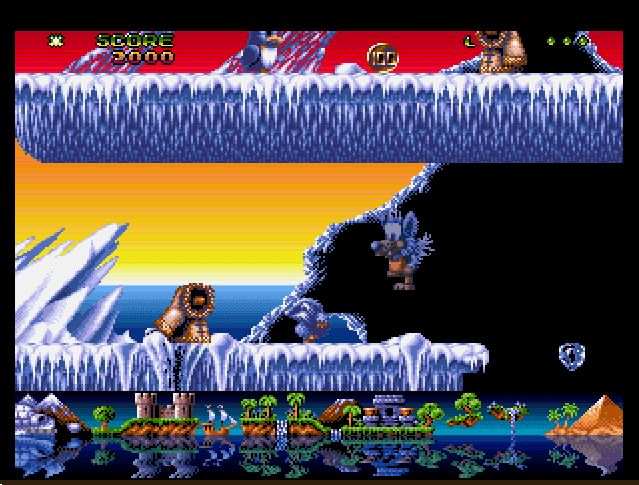
Fire and Ice - detailed Amiga parallax scrolling landscape with layered backgrounds
Fire & Ice (Amiga) - the multi-layer parallax scrolling that was a technical highlight of the title

Fire & Ice appeared in 1992, towards the end of the Amiga's commercial peak. The technical presentation was strong: multi-layer parallax scrolling backgrounds, detailed sprite animation for Cool Coyote and the enemy types, and smooth screen movement at a pace that placed it comfortably within the genre's standards of the time. The Amiga version is the primary one, with Atari ST, DOS, and C64 conversions following.

Critics Who Came Expecting a Shoot-Em-Up

The Amiga press of 1992 received Fire & Ice warmly. Reviewers noted the quality of the animation and the tightness of the control, and several pointed to the departure from Graftgold's shoot-em-up heritage as evidence of genuine creative range. The game held its own against the genre leaders of the time and demonstrated, conclusively, that the studio's reputation rested on craft rather than genre familiarity.

The Last Great Graftgold Title

Fire & Ice was followed by Uridium 2 (1993) and then a period of licensed console work before the studio closed in 1998. It stands as Graftgold's farewell to original character-led design - the point at which the studio demonstrated it could turn its technical discipline toward warmth and personality without losing the craft that defined the C64 period.

Jason Page's contribution gives the game a distinct identity that separates it from everything else in the Graftgold catalogue. See the People page for profiles of both Braybrook and Page, and the Amiga era section of the studio history for the broader context of Graftgold's final years.

View in catalogue → People: Jason Page → Studio history → Play today →